
30 Most Interesting Animal Facts
The animal world is full of extraordinary abilities, unusual behaviors, and surprising adaptations. Some animals can survive extreme environments, others have remarkable senses, and many have abilities that seem almost impossible.
From tiny insects to enormous whales, animals have evolved in fascinating ways to find food, communicate, protect themselves, reproduce, and survive in their environments. Here are some of the most interesting animal facts that reveal just how diverse the natural world really is.
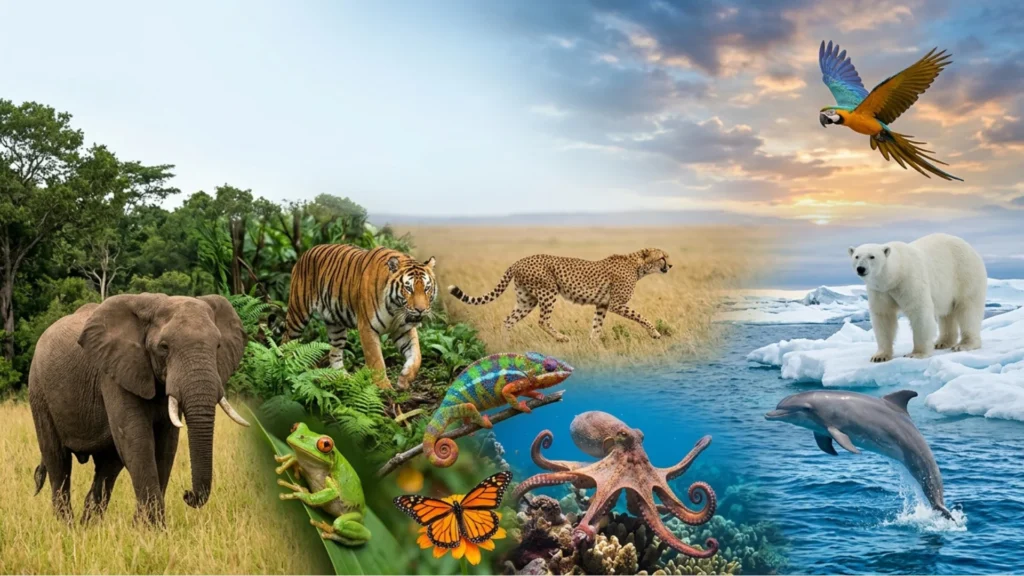
1. Octopuses Have Three Hearts
An octopus has three hearts. Two hearts pump blood toward the gills, where oxygen is absorbed, while the third pumps oxygen-rich blood to the rest of the body.
Interestingly, the main heart stops beating while an octopus swims, which is one reason octopuses often prefer crawling along the seafloor rather than swimming continuously.
2. Cheetahs Are the Fastest Land Animals
The cheetah is widely recognized as the fastest land animal, capable of reaching speeds of around 60 to 70 miles per hour during short bursts.
Its lightweight body, long legs, flexible spine, and specialized feet help it accelerate rapidly when chasing prey. However, cheetahs cannot maintain their top speed for long periods.
3. Elephants Can Communicate Using Very Low-Frequency Sounds
Elephants communicate using a variety of sounds, including very low-frequency calls known as infrasound.
These sounds can travel considerable distances, allowing elephants to communicate with members of their group even when they are far apart. Elephants also use body movements, touch, and other vocalizations to communicate.
4. Some Turtles Can Breathe Through Their Skin
Certain turtle species have unusual adaptations that allow them to absorb oxygen through specialized areas of their body while underwater.
This ability is particularly useful for species that spend long periods submerged, especially during cold weather or while resting underwater.
5. Dolphins Have Individual Names
Bottlenose dolphins can develop distinctive vocalizations called signature whistles. These whistles function somewhat like individual identifiers, allowing dolphins to recognize and communicate with one another.
Research has shown that dolphins can respond to the signature whistles of particular individuals, demonstrating sophisticated social communication.
6. Axolotls Can Regrow Body Parts
Axolotls are famous for their remarkable regenerative abilities. They can regenerate structures such as limbs and can also repair certain tissues and organs.
Their unusual ability to regenerate body parts has made them an important subject of scientific research.
7. Giraffes Have Extremely Long Necks but the Same Number of Neck Vertebrae as Humans
A giraffe’s neck can reach impressive lengths, yet giraffes generally have seven cervical vertebrae, the same basic number found in humans.
The difference is that each vertebra is greatly elongated. This gives the giraffe its characteristic height and helps it reach vegetation high above the ground.
8. Some Birds Can Navigate Using Earth’s Magnetic Field
Certain birds can use Earth’s magnetic field as part of their navigation system.
This ability, known as magnetoreception, can help migratory birds travel over long distances and find their way between breeding and wintering areas.
Scientists are still studying exactly how different species detect and use magnetic information.
9. Bees Can Communicate the Location of Food
Honeybees have a remarkable form of communication known as the waggle dance.
A worker bee can perform movements that provide other bees with information about the direction and approximate distance of a food source. This allows the colony to efficiently communicate about resources.
10. Sloths Move Slowly to Conserve Energy
Sloths are known for their slow movements, which are closely connected to their low-energy lifestyle.
Their diet consists largely of leaves, which provide relatively little energy. Moving slowly helps sloths conserve energy, while their adaptations also help them spend much of their time in trees.
11. Crows Can Use Tools
Some crow species demonstrate impressive problem-solving abilities and can use tools to obtain food.
They have been observed manipulating objects and solving multi-step problems. Their intelligence is one reason corvids, including crows and ravens, are frequently studied by animal behavior researchers.
12. Chameleons Can Change Their Color
Chameleons are well known for their ability to change color. However, this ability is not simply a way to disappear into any background.
Color changes can be associated with communication, social interactions, temperature regulation, and changes in emotional or physiological state. The exact mechanisms and purposes vary among species.
13. Whales Are Among the Largest Animals Ever Known
The blue whale is the largest known animal to have lived on Earth.
Blue whales can grow to extraordinary sizes and are much larger than even the biggest land animals. Despite their enormous bodies, they primarily feed on tiny organisms such as krill.
14. Ants Can Work Together as Superorganisms
A single ant has limited abilities, but colonies can accomplish remarkably complex tasks through cooperation.
Ants communicate using chemical signals and other cues. Large colonies can organize activities such as finding food, defending the nest, caring for young, and maintaining their living environment.
This coordinated behavior is sometimes described as a superorganism, where the colony functions in many ways like a larger biological system.
15. Polar Bears Have Black Skin
Although polar bears appear white, their skin is actually black.
Their fur is made up of mostly transparent, hollow-looking hairs that scatter light, giving the coat its characteristic pale appearance. Underneath the fur, dark skin helps absorb solar radiation.
16. Owls Cannot Move Their Eyes Like Humans
Owls have relatively fixed eyes compared with humans. Instead of moving their eyeballs freely from side to side, they rely heavily on their flexible necks to change their field of view.
Their necks contain adaptations that allow them to rotate their heads dramatically without cutting off normal blood flow to the brain.
17. Kangaroos Use Their Tails for Balance
A kangaroo’s tail is more than a simple appendage. It plays an important role in balance and movement.
When moving slowly, kangaroos can use their tails as an additional support point, while during faster movement the tail contributes to balance and body control.
18. Some Frogs Can Survive Being Partially Frozen
Certain frog species have evolved extraordinary adaptations for surviving freezing temperatures.
The wood frog, for example, can tolerate substantial freezing of its body during winter. Its body produces substances that help protect cells and tissues during freezing and thawing.
19. Sharks Have Existed for Hundreds of Millions of Years
Sharks belong to an ancient lineage that predates dinosaurs.
Their evolutionary history stretches back hundreds of millions of years, making sharks one of the most enduring groups of vertebrates on Earth. Modern sharks include many different species with very different sizes, diets, and lifestyles.
20. Bats Are the Only Mammals Capable of True Sustained Flight
Bats are the only mammals capable of true powered flight.
While some other mammals, such as flying squirrels, can glide through the air, bats actively generate lift and propulsion using their wings. Their wings are formed from elongated fingers covered by a flexible membrane.
21. Penguins Cannot Fly, but They Are Excellent Swimmers
Penguins are birds, but their bodies are highly adapted for life in water rather than flight through the air.
Their wings have evolved into flipper-like structures that help them propel themselves underwater. Their streamlined bodies and dense feathers also help them survive in aquatic environments.
22. Camels Can Survive Long Periods Without Drinking Water
Camels are highly adapted to life in arid environments.
Their bodies have several adaptations that help them conserve water and tolerate dehydration. Contrary to a common misconception, a camel’s hump does not store water. It primarily stores fat, which can be used as an energy source.
23. Spiders Are Not Insects
Spiders and insects are both arthropods, but they belong to different groups.
Spiders are arachnids and typically have eight legs, while insects generally have six legs and three main body sections.
This is a simple example of why animal classification is useful when learning about the diversity of life.
24. Butterflies Taste With Their Feet
Butterflies have sensory receptors on their feet that help them detect chemical information from surfaces.
When a butterfly lands on a plant, these receptors can help it determine whether the plant is suitable for feeding or, in some species, for laying eggs.
25. Some Animals Can See Light Humans Cannot
Humans can see only a limited portion of the electromagnetic spectrum. Some animals can detect wavelengths outside the range of normal human vision.
For example, many insects can see ultraviolet light, which can help them locate flowers and interpret visual signals that humans cannot see.
26. Dogs Have a Powerful Sense of Smell
Dogs possess a highly developed sense of smell and rely heavily on scent to explore and interpret their environment.
Their noses contain vastly more odor-sensitive receptors than humans, and their brains devote substantial processing capacity to analyzing smells.
This ability is why specially trained dogs can assist with tasks such as detecting certain substances, tracking scents, and locating people.
27. Cats Use Many Forms of Communication
Cats communicate through much more than meowing.
They use body posture, facial expressions, tail movements, ear positions, scent marking, touch, and vocalizations to communicate with other cats and with people.
Understanding these different signals can provide useful clues about a cat’s behavior and surroundings.
28. Some Animals Can Survive Without Oxygen for Long Periods
Different animals have evolved different ways to tolerate low-oxygen environments.
Some aquatic animals can survive periods of reduced oxygen by slowing their metabolism or using specialized physiological adaptations. These strategies allow them to survive conditions that would be dangerous for many other animals.
29. Many Animals Use Camouflage to Avoid Detection
Camouflage helps animals blend into their surroundings.
It can be used by prey to avoid predators, by predators to approach prey, or by animals simply to remain unnoticed. Camouflage can involve colors, patterns, body shapes, textures, and even changes in appearance.
30. Animal Intelligence Comes in Many Different Forms
Intelligence in animals cannot always be measured in the same way as human intelligence.
Different species have evolved different cognitive abilities suited to their environments. Some animals demonstrate problem-solving, memory, tool use, navigation, social learning, communication, or complex cooperation.
From elephants and dolphins to crows, parrots, primates, and many other species, animal cognition is far more diverse than it may initially appear.
Why Are Animals So Different From One Another?
The enormous variety of animals exists because species have evolved different adaptations over long periods of time.
An animal’s body, behavior, senses, diet, reproduction, and communication are influenced by the environment in which it lives and the challenges it faces.
A desert animal may have adaptations for conserving water, while an ocean animal may have adaptations for swimming, diving, or surviving pressure. A predator may develop specialized senses for finding prey, while a prey animal may evolve camouflage or other defensive adaptations.
These differences are what make the animal world so fascinating to explore.
Frequently Asked Questions
Explore More Animal Facts
The animal world contains far more remarkable discoveries than can fit into a single article. Every species has its own adaptations, behaviors, characteristics, and survival strategies.
From household pets to insects, marine animals, birds, reptiles, and wildlife, there is always something new to discover.
Explore more Animal Guides on AnimalFactsPro to learn about the fascinating animals that share our planet.