Hooded Seal
Hooded Seal: The Seal With a Balloon on Its Head and a Four-Day Childhood
The hooded seal is the North Atlantic’s most flamboyant seal, a big silver animal whose males inflate a hood over their noses and can blow a bright red balloon out of a single nostril. Its pups, the famous bluebacks, are weaned in about four days, the shortest childhood of any mammal on Earth.
By Emily Carter · Reviewed by our vet team · Updated 10 November 2026 · 9 min read
Males inflate a hood and red balloonPups wean in about 4 daysDives to 1,000 m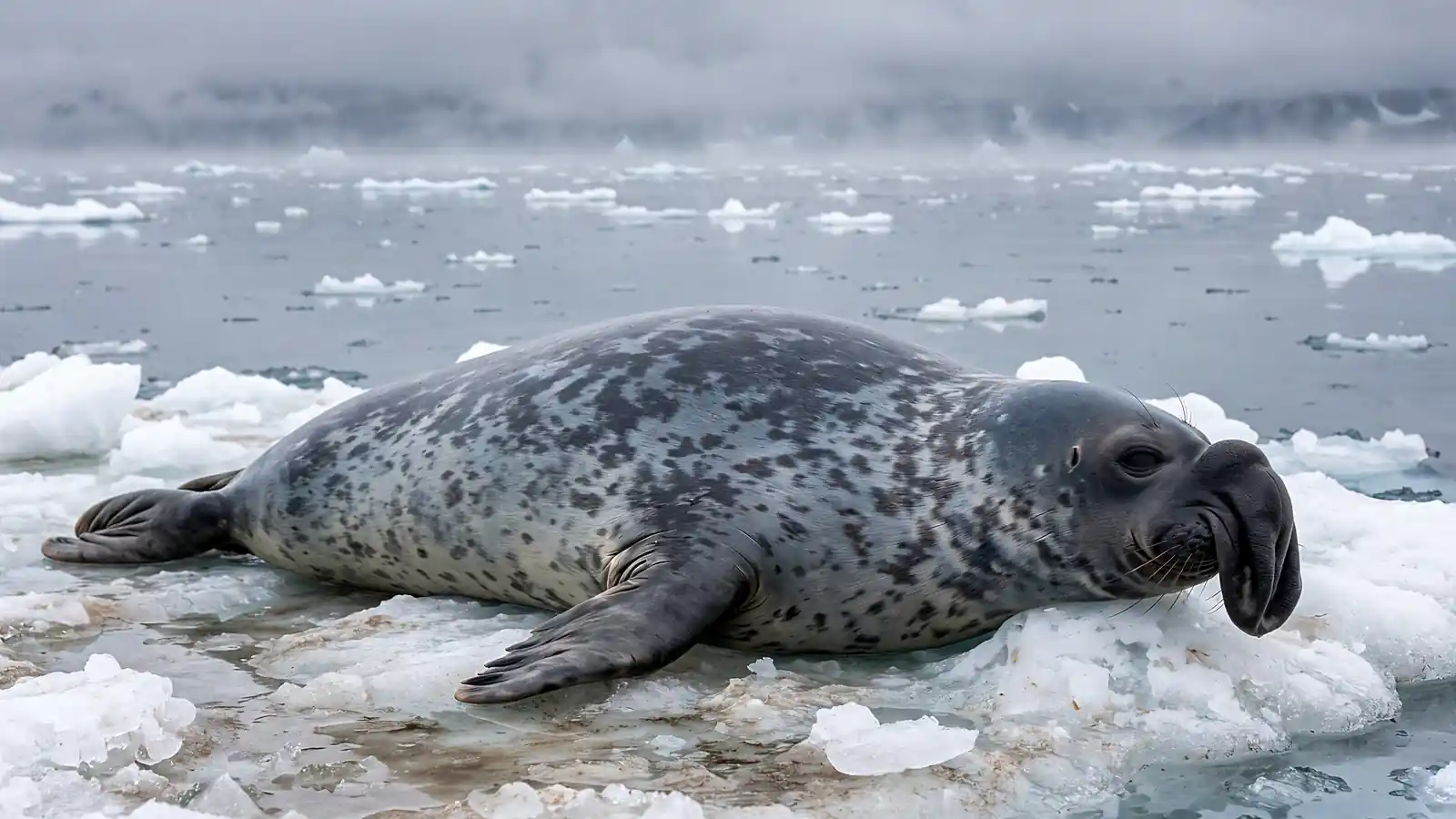
At a Glance
Fast facts first: the hooded seal is the showman of the northern ice, a deep-diving, fast-living animal that packs mating, birth and weaning into a few frantic weeks on the spring pack ice. Here is the species at a glance.
Hooded Seal Size and Weight
A male hooded seal is a serious animal: up to about 2.5 metres (8.2 feet) long and as heavy as 300 kilograms, built thick through the chest and shoulders. Females are noticeably slimmer, at roughly 2.2 metres and 160 kilograms, so a big male outweighs his mate by nearly two to one — one of the stronger size gaps among the northern seals.
Much of the difference is display equipment. Only the male carries the famous inflatable hood and the extra neck and throat bulk that goes with it, and males keep growing long after females have levelled off. Pups, meanwhile, start life at an already sturdy 90 to 105 centimetres and 20 to 24 kilograms.
Appearance and Anatomy
The coat is blue-grey to silver, splashed with irregular dark blotches, and the face is black out to behind the eyes, like a mask. At rest, an adult male looks like a big, handsome, ordinary seal — the party trick hides in plain sight, folded into a wrinkled sac of skin draped over the top of the nose.
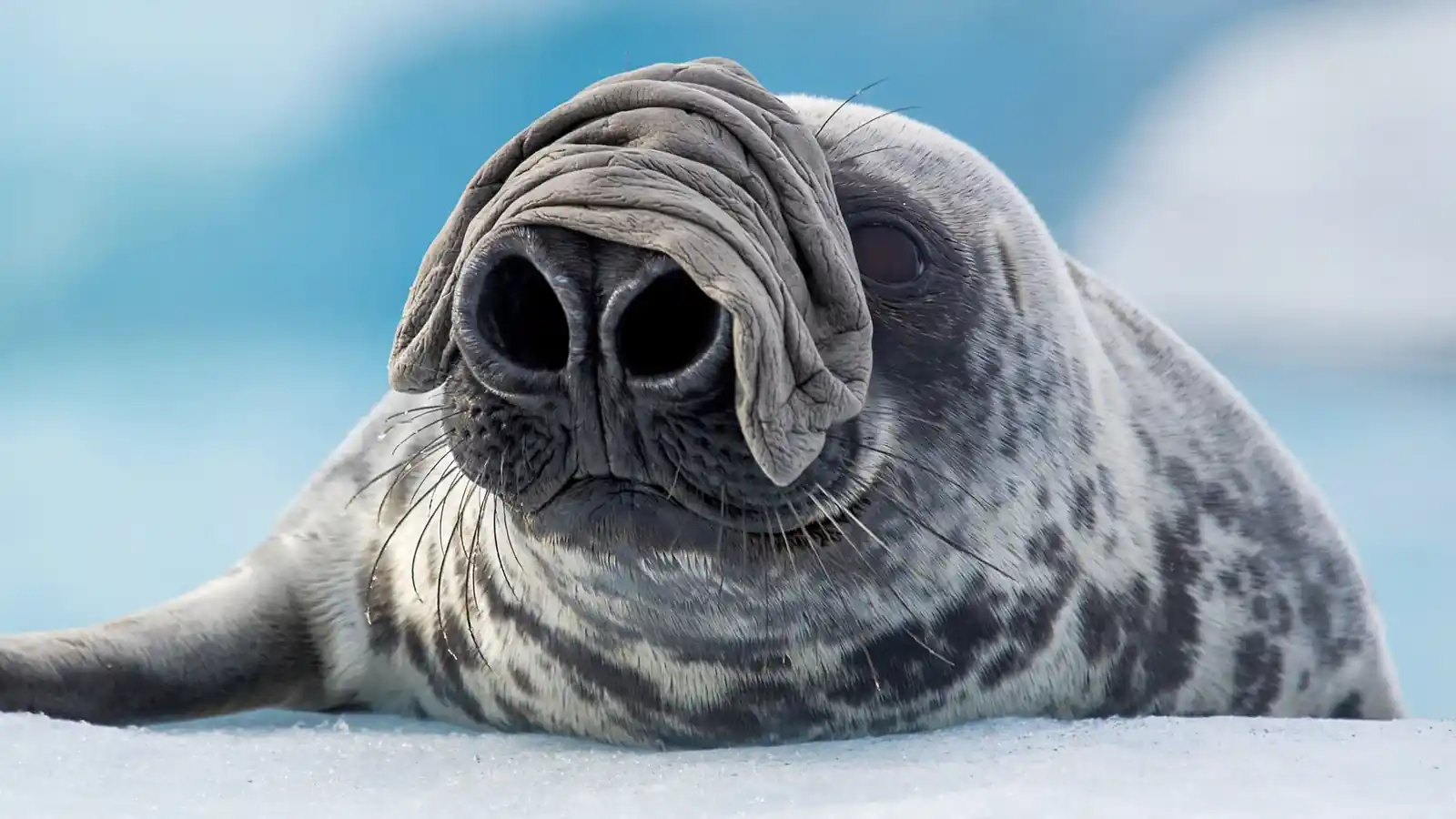
That sac is the hood. From about four years old, a male can inflate it until it bulges over his forehead, then force the lining of one nostril out into a bright red balloon the size of a grapefruit, shaking it at rivals and females alike. The species also holds a quieter record: the largest nostrils of any seal, exactly the plumbing such a display demands. Females and young males carry only a hint of the hood and cannot inflate the balloon.
Habitat and Range
The species belongs to the cold North Atlantic and the fringes of the Arctic Ocean, following the drifting pack ice as it forms and melts. Breeding happens in just four known areas: the Gulf of St. Lawrence, the Front off Newfoundland and Labrador, Davis Strait between Canada and Greenland, and the West Ice near Jan Mayen — sharing the first two with the much more numerous harp seal.
Summer is spent feeding in deep northern water, and each year most adults gather again on the ice in the Denmark Strait area to moult, replacing their coats before dispersing to feed. Young animals wander surprisingly far — hooded seals have turned up as rare vagrants far down the coasts of Europe and North America.
The year is a triangle of journeys. From the spring breeding ice the adults travel to the moulting grounds off Greenland, shed their coats through early summer, then scatter into the deep North Atlantic to feed for the rest of the year before converging on the ice again. Young animals are the great wanderers of the family: juveniles have strayed as far south as the Caribbean and the coasts of Europe, turning up exhausted on beaches thousands of kilometres from the nearest pack ice, among the most far-flung vagrants of any seal.
Diet and Feeding
This is a deep-water hunter. The diet leans on redfish, Greenland halibut and other bottom fish, herring and polar cod from the mid-water, and a steady supply of squid, octopus and shrimp. Prey is caught over the continental slopes and in the deep channels between the ice and the shore, rather than in the shallows where many seals feed.
The dives match the menu: most feeding dives reach around 600 metres, exceptional dives pass 1,000 metres, and a single dive can last well over half an hour, with the longest recorded stretching beyond fifty minutes. Few air-breathing hunters work so deep for so long on a single breath.
Foraging is measured in weeks, not hours. Between the breeding and moulting seasons the adults make long feeding trips into the deep Atlantic, diving almost continuously, day and night, in the pattern of a true oceanic hunter rather than a coastal one. The menu shifts with the grounds — redfish and halibut over the slopes, squid in the open water, herring and cod where the schools run — and the oil-rich livers and blubber built on those trips are what carry an animal through the fasting weeks on the breeding ice.
Behavior and Social Life
Alone is the default setting. Adults spread themselves widely over the ocean and the ice, and even in the breeding season the pattern is one family at a time: a female with her pup, attended by a single male who has fought off the others and now guards the spot beside her, while rival males wait at the edges of the floe.
The contests are mostly theatre — hoods inflated, red balloons shaking, deep roars rumbling under the ice — because a real fight on sea ice helps nobody. Males also sing in their way, producing underwater sounds during the breeding season that carry through the dark water between floes.
Away from the breeding ice, this is one of the least social seals in the North Atlantic. Feeding animals travel and dive alone, and the noise and theatre of March dissolve completely by April into a solitary, silent life in deep water. Even the youngsters, once they have survived their fasting weeks and taken to the sea, feed alone — there is no school, no apprenticeship, just instinct and a stomach full of blubber to learn on. For an animal so briefly and intensely social, the other eleven months are spent almost entirely out of the company of its own kind.
Reproduction and Babies
In March, the whole species runs on fast-forward. A female hauls out on the spring pack ice and gives birth to a single blueback pup, named for the steel-blue fur on its back. The pup is born unusually ready for the world: it has already shed its baby fur in the womb and arrives wearing a layer of blubber instead.
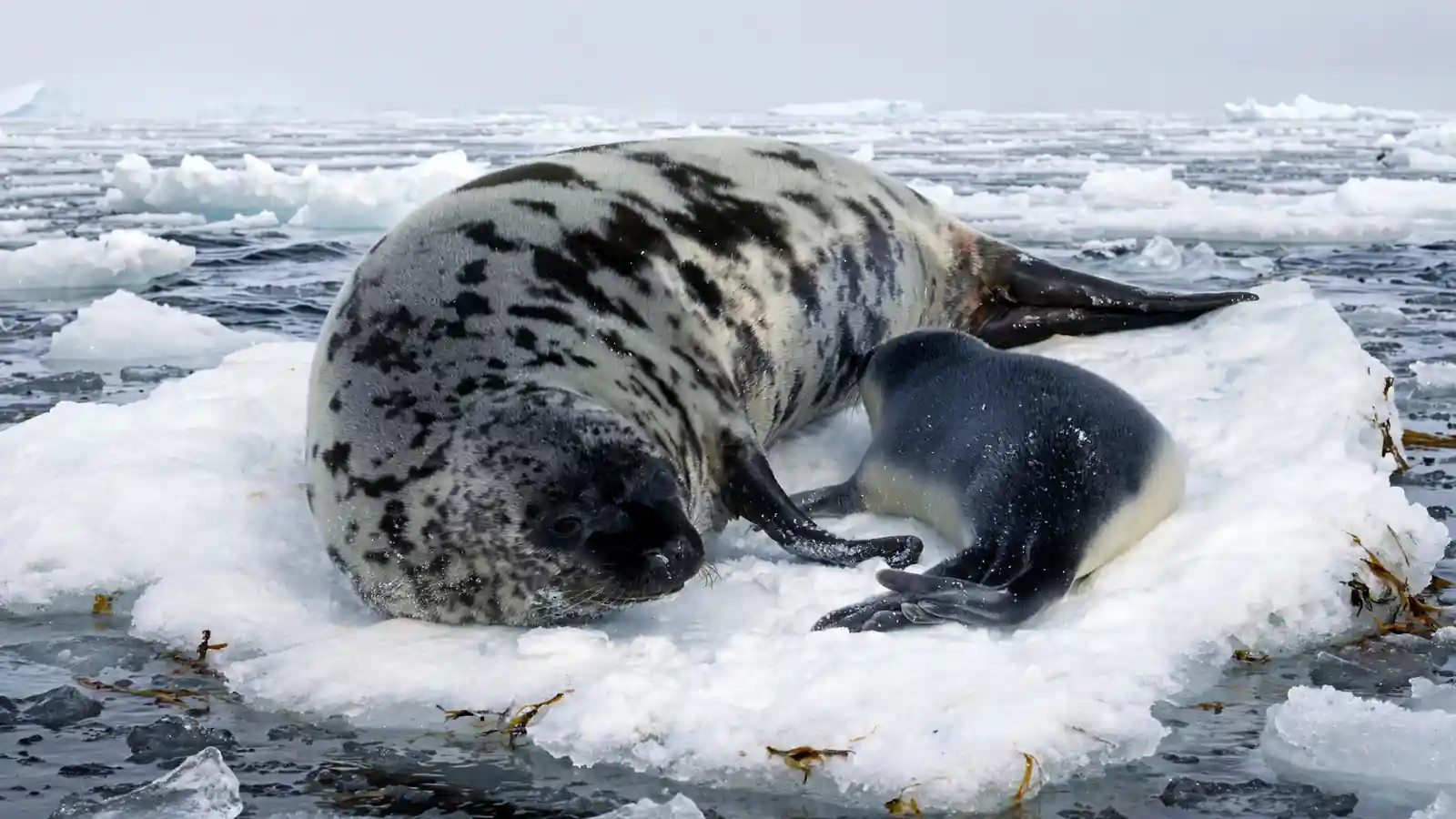
Then comes the record. Nursing lasts about four days — on average, the shortest lactation of any mammal alive. The milk is 60 to 70 percent fat, and the pup roughly doubles its weight before its mother leaves to mate again; the abandoned youngster then fasts on the ice for several weeks, living off that blubber while it learns to feed itself. Counting a long pause of delayed implantation, the full pregnancy runs close to eleven and a half months.
Threats and Conservation
On the ice, pups and adults face polar bears; in the water, killer whales and the big Greenland shark. Historically, though, the greatest pressure came from people: blueback pelts were once prized, and the hunt went on for generations before quotas began in 1971. Hunting continues at a smaller scale in parts of the range, alongside deaths in fishing gear.
The species is now listed as Vulnerable and declining, and its future is tied to the pack ice it breeds on: earlier break-up of the spring ice can strand or drown newborn pups before their four days of milk are done. The university species account for the hooded seal gathers the research on its numbers, range and biology in one place.
Fun Facts
- Its pups are weaned in about four days on average — the shortest nursing period of any mammal on Earth.
- A male can blow a bright red balloon out of a single nostril while the hood on his head is fully inflated.
- Blueback pups shed their baby fur before they are even born, arriving on the ice already wrapped in blubber.
- Its milk can be 60 to 70 percent fat, among the richest produced by any mammal.
- It has the largest nostrils of any seal — exactly what inflating that famous hood requires.
- Some individuals dive past 1,000 metres and stay underwater for close to an hour.
Frequently Asked Questions
How Big Is a Hooded Seal?
Males reach about 2.5 metres (8.2 feet) and up to 300 kilograms. Females are smaller, around 2.2 metres and 160 kilograms, so a big male can weigh nearly twice as much as his mate.
Why Is It Called a Hooded Seal?
For the inflatable sac of skin on the adult male’s head. From about four years old he can blow the hood up over his forehead as a display — and push the lining of one nostril out into a bright red balloon.
What Is the Red Balloon on a Hooded Seal?
It is the male’s nasal septum, the lining between the nostrils, forced out through one nostril and inflated. Males display it, often shaking it, to impress females and warn off rival males during the breeding season.
How Long Does a Hooded Seal Pup Nurse?
About four days — the shortest nursing period of any mammal. The milk is 60 to 70 percent fat, the blueback pup roughly doubles its weight, and then it fasts on the ice for weeks, living off the blubber it gained.
What Does a Hooded Seal Eat?
Redfish, halibut and other bottom fish, herring and polar cod, plus squid, octopus and shrimp. It hunts in deep water, with most feeding dives reaching around 600 metres and the deepest past 1,000 metres.
Where Do Hooded Seals Live?
In the cold North Atlantic and Arctic fringe, breeding on pack ice in four areas: the Gulf of St. Lawrence, the Front off Newfoundland, Davis Strait, and the West Ice near Jan Mayen. They moult near the Denmark Strait.
Are Hooded Seals Endangered?
They are listed as Vulnerable and declining. Seal hunting has been limited by quotas since 1971, but the loss and early break-up of the spring pack ice they breed on is now the central concern.
Similar Species Worth Exploring
Keep Exploring
More northern ice seals await: meet the harp seal that shares its breeding ice, the whiskered bearded seal, or the whole family in our guide to the types of seals and sea lions. No seal packs more drama into spring than the hooded seal.