Whale Shark
Whale Shark: The Gentle Giant That Outsizes Every Other Fish
The whale shark is the largest fish in the world, a slow, spotted giant that can outgrow a bus yet feeds on some of the smallest life in the sea. It is a true shark, not a whale, and despite its enormous mouth it has never been known to hunt people. This guide covers its record size, its thousands of useless teeth, what it eats, where it travels and why this gentle giant is now endangered worldwide.
By Emily Carter · Reviewed by our vet team · Updated 10 November 2026 · 10 min read
Largest fish in the worldMouth up to 1.5 m wideListed as Endangered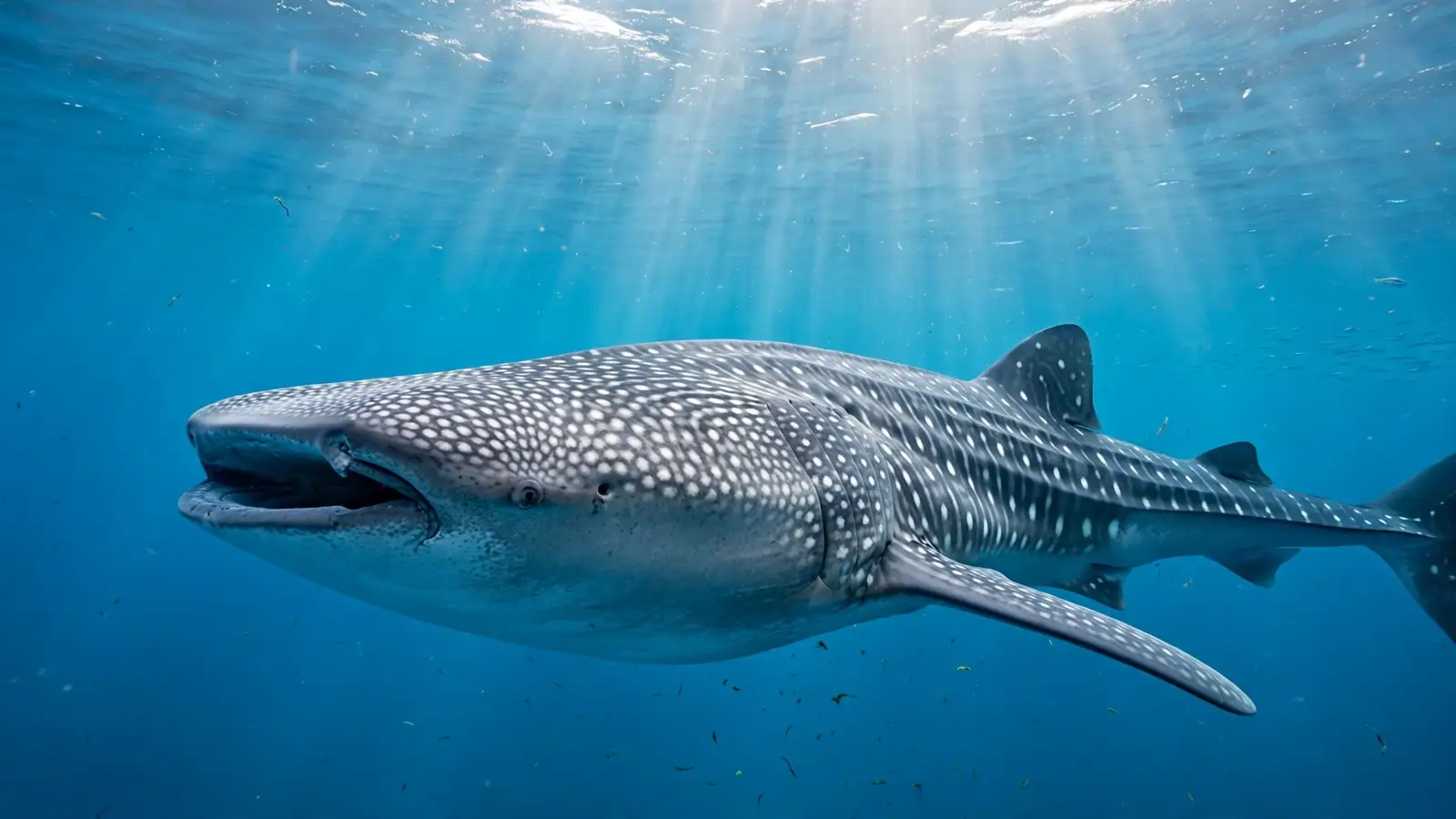
At a Glance
Whale Shark Size and Weight
Whale shark size sets the record for any fish alive today. Most adults seen at feeding sites measure between about 5.5 and 10 metres (18 to 33 feet) long, but the species grows far beyond that. The largest reliably recorded individual measured 18.8 metres (61.7 feet), and average adults are estimated at around 9.7 metres and roughly 9 tonnes, with the biggest animals weighing around 20 tonnes or more. Females grow larger than males, as in many sharks. The only other fish in its size league is the basking shark, a fellow filter feeder that strains plankton through an enormous mouth of its own.
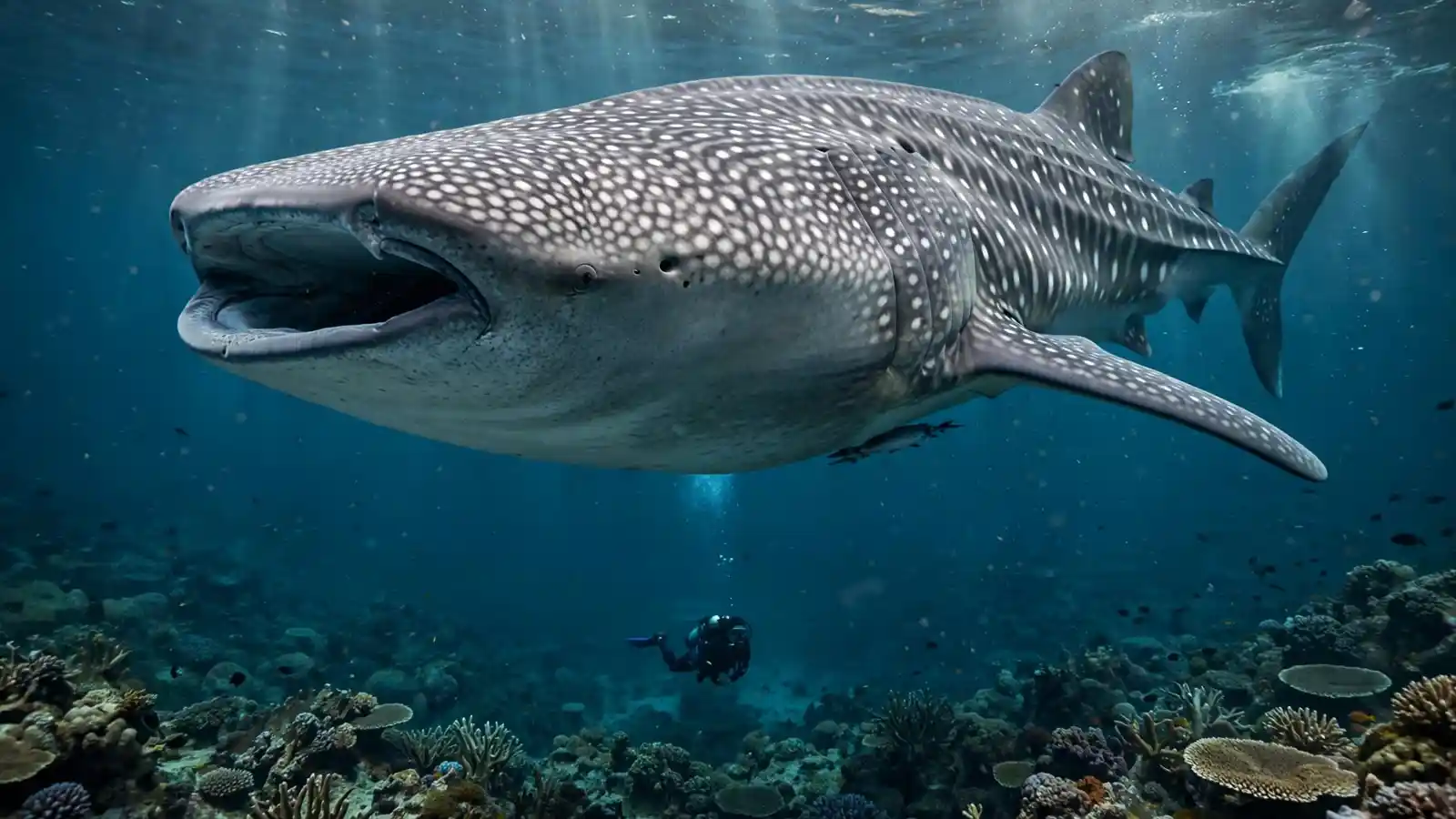
That bulk is carried on a fusiform, torpedo-shaped body that is broad and flattened at the head and tapers towards a powerful tail with a large upper lobe. Growth is slow and maturity comes late: males are thought to mature at around 8 to 9 metres, at roughly 25 to 30 years of age, which is one reason the species recovers so slowly when numbers fall. It keeps growing through a very long life, so the true giants are also likely to be the oldest animals in the population.
Its proportions place it firmly among its relatives, and you can browse the full species record for Rhincodon typus to see how scientists classify it and what the research record holds. Among its kin it is unmistakable — which is exactly why it rewards a closer look.
Whale Shark Teeth and a Mouth Built for Filtering
Open that record-breaking body at the front and you find the widest mouth of any fish: up to about 1.5 metres (nearly 5 feet) across on a large adult, set at the very front of the broad, flattened head rather than underneath it. The eyes are tiny by comparison, sitting just behind the corners of the mouth, and the whole head is covered in the checkerboard pattern of pale spots and stripes that makes this species unmistakable. No two patterns are identical, and researchers identify individuals from the spot arrangement behind the gills, much like a fingerprint.

Whale shark teeth are the great surprise inside that mouth. There are around 300 rows of them, holding roughly 3,000 teeth in total, yet each tooth is only a few millimetres long and none of them is used for biting or chewing. Feeding is done instead by 20 or so filter pads inside the mouth, which sieve food from the water as it passes over the gills. The teeth appear to be leftovers from more predatory ancestors, kept on while the animal evolved into a full-time filter feeder.
The skin completes the picture. It is among the thickest of any animal, grey to blue-grey above and pale below, armoured with tiny tooth-like denticles — researchers have even found denticles protecting the eyeballs, a feature not known in any other fish. Prominent ridges run along the body and tail, stiffening a frame that swims with slow, steady sweeps of the whole rear half of the body.
Habitat and Range
Whale sharks live in all the world’s tropical and warm-temperate seas, mostly between about 30°N and 35°S latitude, favouring surface water of roughly 21 to 30°C. Well-known feeding areas include Ningaloo Reef in Western Australia, the waters of the Philippines, the Yucatán coast of Mexico, Belize, Ecuador and South Africa, but nearly every coastal country within those latitudes has recorded the species. Individuals are highly migratory and may cross whole ocean basins, following plankton blooms as they shift with the seasons.
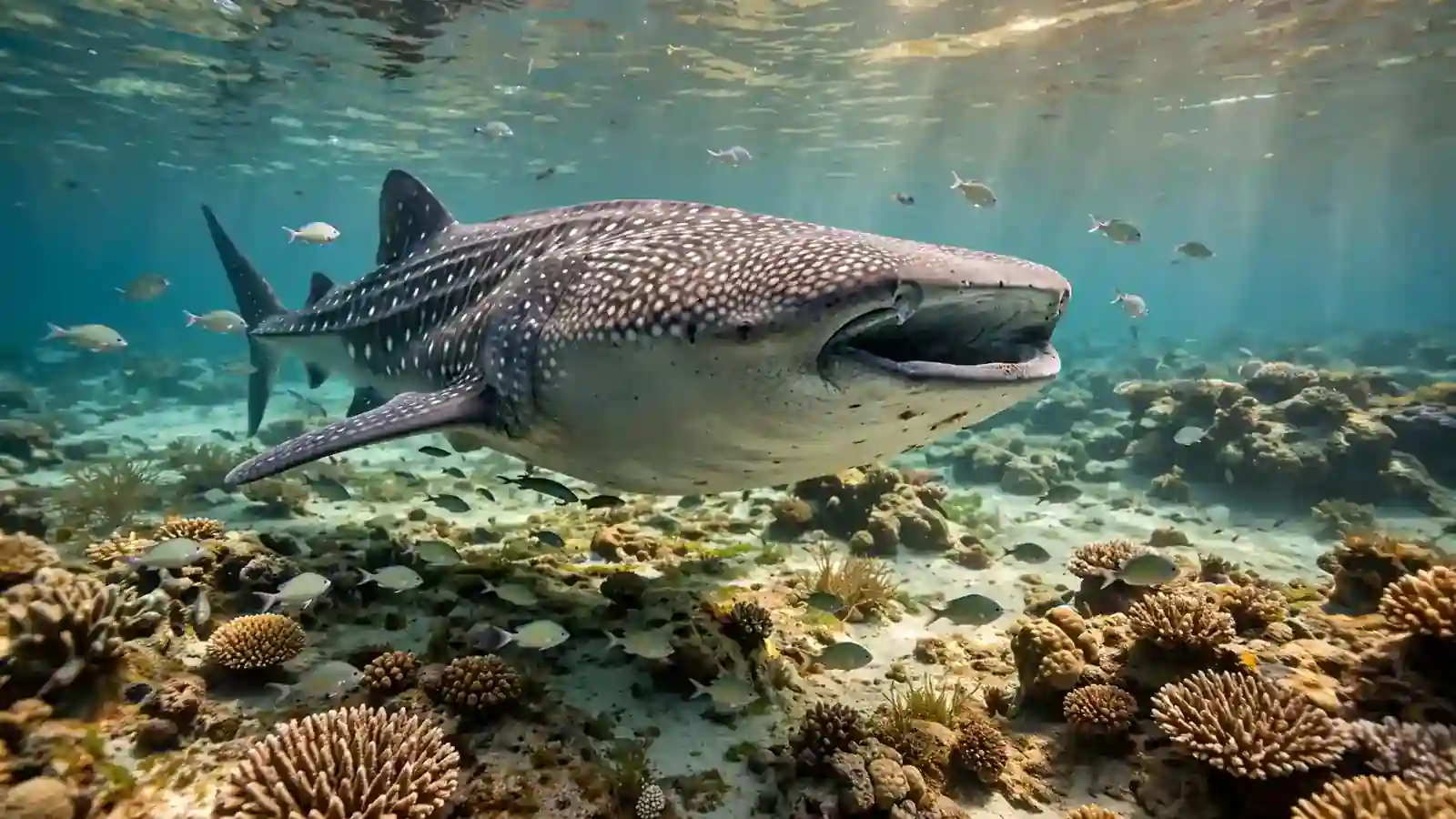
Although they are best known at the surface, tagged whale sharks have dived beyond 1,700 metres and tolerated water as cold as about 8°C on those dives, far deeper and colder than their feeding habitat. Most of the time, though, they stay where the food is: coastal zones, reef lagoons and offshore upwellings with high productivity. At a handful of sites they gather in remarkable numbers — one aggregation off Isla Contoy in the Mexican Caribbean was surveyed at up to 420 individuals, the largest ever recorded for the species.
Diet and Feeding
What do whale sharks eat turns out to be almost everything small that drifts or swims weakly in sunlit water: plankton, krill, crab larvae, jellyfish, fish eggs and small schooling fish such as sardines and anchovies, plus mackerels, small tunas and squid. A feeding whale shark can process thousands of litres of water an hour through its filter pads, so even tiny prey adds up to a giant’s meal when it is concentrated in a dense patch.

Three feeding styles cover most situations. In ram filter feeding the shark simply swims forward with its mouth open, letting its own motion push water across the filters — the method used when prey is thinly spread. When food is dense at the surface it feeds more actively, opening and closing its mouth to suck water in, sometimes hanging almost vertically in the water column. Either way, the teeth play no part at all: everything is strained, swallowed and digested without a single bite.
Reproduction and Pups
For all its size, this shark reproduces in the live-bearing way of its carpet shark relatives. Females carry developing embryos nourished by yolk, with no placental connection, and give birth to live pups roughly 55 to 65 centimetres long. One famous female, harpooned off Taiwan in 1995 at 10.6 metres long, was carrying about 304 embryos at different stages — the largest litter recorded for any shark, and evidence that females can store sperm and fertilise eggs in successive batches.

Where mating and pupping actually happen is still one of the species’ great unknowns, because newborn whale sharks are almost never seen and no clear breeding grounds have been found. What is certain is the timing of a life: slow growth, maturity at around 25 to 30 years, and a lifespan that researchers now estimate at roughly 80 to 130 years, with an age of 50 years confirmed directly by radiocarbon dating of a vertebra. An animal that breeds this late cannot replace itself quickly.
Threats and Conservation
Its endangered listing reflects a global decline driven mainly by people. The species has been targeted in some fisheries for its meat, fins and liver oil, taken accidentally in nets set for other fish, and struck by ships and propeller blades as it feeds at the surface. Because adults are docile and predictable at feeding sites, they are easy to approach — a gift for tourism, but a risk wherever protection is weak or unenforced.
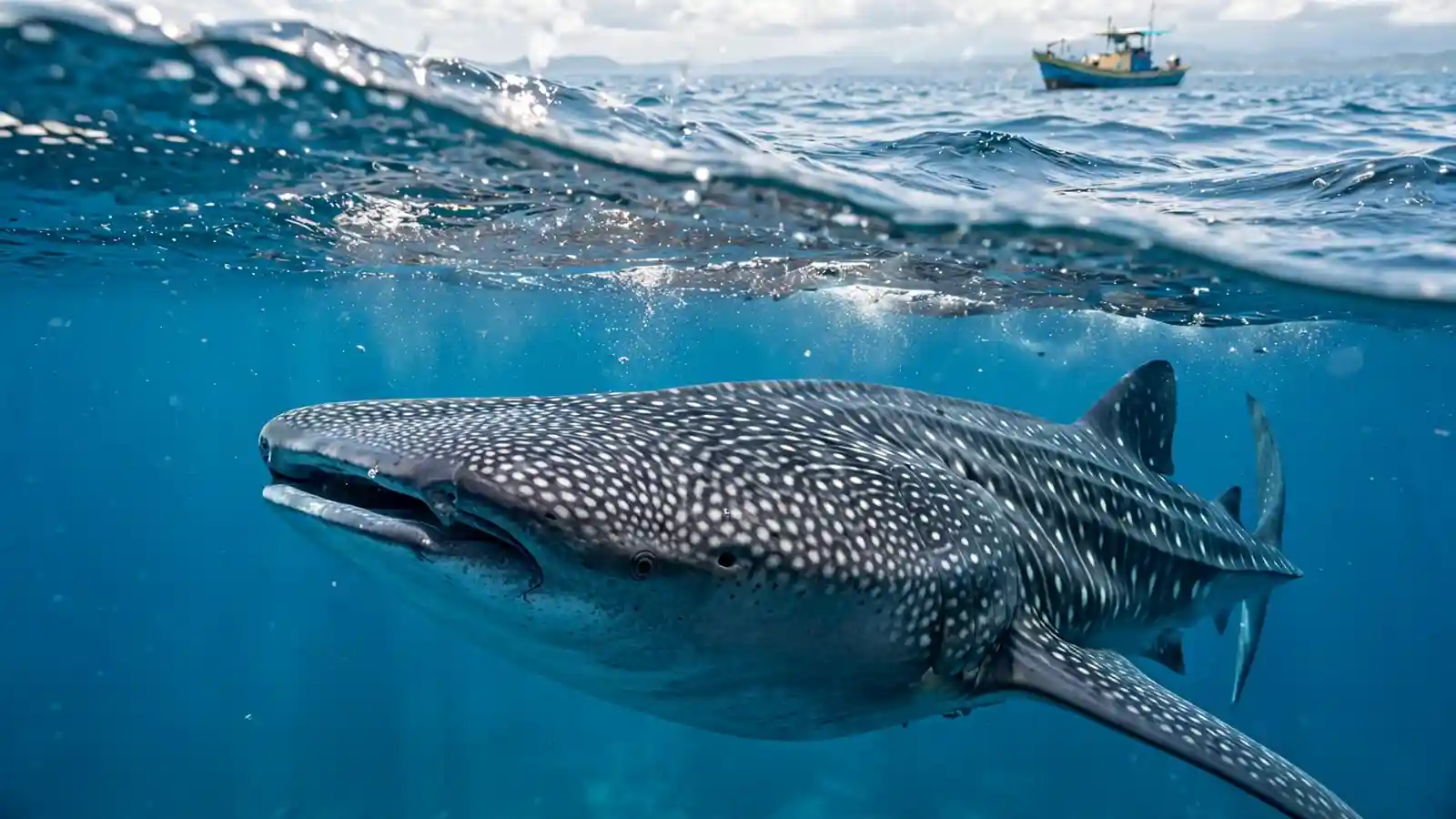
The species is now legally protected across much of its range, including Australia, the Philippines, India, Mexico and the Maldives, and well-run ecotourism at places like Ningaloo has shown that a living one can be worth far more than a caught one. Even so, a fish that matures at 25 to 30 years and may live past a century rebuilds its numbers over decades, not seasons, which is why every protected adult matters and why the endangered status is unlikely to lift soon.
Fun Facts
- Each whale shark carries a unique checkerboard of spots and stripes, and scientists identify individuals from photographs of the pattern behind the gills.
- Its mouth holds around 300 rows of teeth and roughly 3,000 teeth in total, yet not one of them is used to catch or chew food.
- One female was found carrying about 304 embryos at once, the largest litter ever recorded in a shark.
- Tagged whale sharks have dived deeper than 1,700 metres, far below the warm surface water where they feed.
- The spot pattern is so reliable that a global photo library tracks thousands of named individuals across every tropical ocean.
- Despite outweighing most dinosaurs of the sea in fame, it is a true shark with a skeleton of cartilage, not a whale at all.
Frequently Asked Questions
How Many Teeth Does a Whale Shark Have?
A whale shark has around 300 rows of tiny teeth holding roughly 3,000 teeth in total. Each tooth is only a few millimetres long, and none of them is used for feeding. The shark eats by sieving plankton and small fish through filter pads inside its mouth, so the teeth are thought to be leftovers from predatory ancestors.
How Big Do Whale Sharks Get?
Whale sharks commonly measure 5.5 to 10 metres (18 to 33 feet) long, and the largest reliably recorded individual reached 18.8 metres (61.7 feet). Big adults weigh around 20 tonnes or more. Females grow larger than males, and the very biggest animals are probably also the oldest, because growth continues through a very long life.
What Do Whale Sharks Eat?
Whale sharks eat plankton, krill, crab larvae, jellyfish, fish eggs and small schooling fish such as sardines and anchovies, along with small tunas and squid. They are filter feeders, straining food from thousands of litres of water an hour through sieve-like pads in the mouth rather than biting or chewing anything.
Is a Whale Shark a Whale or a Shark?
A whale shark is a shark, not a whale. It is a fish with gills and a skeleton of cartilage, named only for its whale-like size and filter-feeding habits. Whales are mammals that breathe air and nurse their young, while this species gives birth to pups that fend for themselves from the start.
Are Whale Sharks Dangerous to Humans?
No. Whale sharks are docile and are not considered dangerous to people. They feed only on plankton and small fish, their tiny teeth cannot bite, and they routinely allow divers and snorkellers to swim nearby. The real risk in an encounter runs the other way, from boat strikes and disturbance to the shark.
How Long Do Whale Sharks Live?
Whale sharks are thought to live about 80 to 130 years. An age of 50 years has been confirmed directly by radiocarbon dating of a vertebra, and growth studies built on that result point to a maximum lifespan well past a century. They mature late, at around 25 to 30 years old.
Where Do Whale Sharks Live?
Whale sharks live in tropical and warm-temperate seas worldwide, mostly between about 30 degrees north and 35 degrees south. Famous feeding areas include Ningaloo Reef in Australia, the Philippines, Mexico, Belize, Ecuador and South Africa. They favour warm surface water rich in plankton but can dive beyond 1,700 metres.
Similar Species Worth Exploring
Keep Exploring
Still curious about sharks? Compare this gentle filter feeder with the great white shark, meet the river-roaming bull shark, or browse every species in our guide to the types of sharks. However you explore, every other fish is still measured against the whale shark.