Spinner Dolphin
Spinner Dolphin: The Acrobat That Spins Through Tropical Seas
The spinner dolphin is the greatest acrobat in the dolphin family, able to corkscrew through as many as seven spins in a single leap. Slim, long-beaked and painted in three clean tones of grey, it hunts the deep ocean by night and rests in sunny tropical bays by day.
By Emily Carter · Reviewed by our vet team · Updated 10 November 2026 · 9 min read
Up to 7 spins in one leapA three-tone colour patternHunts by night, rests by day
At a Glance
Fast facts first: the spinner dolphin is the high-flyer of the tropics, a slim, three-toned dolphin that works the night shift in the open ocean and clocks off in a sheltered bay at dawn. Here is the species at a glance.
Spinner Dolphin Size and Weight
A spinner dolphin is a small, slim dolphin built for speed: between 1.3 and 2.1 metres long depending on its form and sex, and roughly 60 to 77 kilograms. Four forms are recognised around the world, from the little dwarf spinner of Southeast Asian waters to the larger Gray’s spinner of Hawaii and the open Pacific, and size tracks those forms closely.
Males of the eastern form carry two odd extras: a dorsal fin that leans forward as if fitted backwards, and a thickened hump on the underside of the tail stock. Why males advertise themselves this way is still debated, but it makes the big eastern males recognisable at a glance.
Appearance and Anatomy
Three tones, cleanly stacked: a dark grey cape across the back, light grey flanks, and a white belly — a pattern shared with few other dolphins and visible every time one arcs out of the water. The beak is the other signature: extremely long and thin even by dolphin standards, dark-tipped, and matched by a slim, athletic body and a small, upright dorsal fin.

Set it beside the bulkier bottlenose dolphin and the differences are obvious — this is the racing build of the family, all length and lightness, made for a life of leaping. The very name is Latin for it: longirostris simply means long-beaked.
The colours are not painted on at birth. Calves start out a plainer, darker grey, and the crisp three-tone stacking of cape, flank and belly sharpens as the animal grows, until by adulthood the pattern is strong enough to pick out individuals in a feeding school at a distance. The beak carries a dark tip and a dark line back to the eye, the flippers are thin and slightly recurved, and the small dorsal fin ranges from gently curved to almost triangular and upright depending on the form — one more reason the four forms were long argued over by scientists. Teeth are numerous and small, built for seizing little fish and squid rather than tearing, and the throat and belly stay pale and unmarked. In the eastern form, old males go further still: the tail stock thickens into a keel above and below, and the dorsal fin cants forward so strongly that early naturalists wondered if the fin had been fitted on backwards. Look at a mixed school closely and you can read it like a crowd — plain dark youngsters, crisply patterned adults, and the odd, heavy-keeled old male bringing up the rear.
Habitat and Range
Warm water is the rule: the species lives throughout the tropical and subtropical Atlantic, Pacific and Indian oceans, far offshore for feeding and close inshore for rest. Its most famous address is Hawaii, where schools spend their days in shallow, sandy bays along the islands’ coasts, a habit shared by populations around tropical islands worldwide.
The day splits in two. By day, sheltered bays over pale sand, in water often less than 50 metres deep, where the school can rest and socialise in safety. By night, the open ocean beyond the reef, where the deep food rises. Few dolphins commute so faithfully between two such different worlds.
The map of the species is drawn in warm water: a near-continuous tropical belt around the planet, bounded by the temperature of the sea. Island coasts with sheltered, sandy bays are the anchors of the whole system — Hawaii most famously, but also bays in places such as Guadeloupe, Sri Lanka and the Red Sea — while the eastern Pacific form roams a far more oceanic life, resting in loose company on the open water itself. Wherever they live, the pattern holds: shallow and sheltered by day, deep and dark by night. Other small dolphins hold stranger addresses in the same warm belt: the beakless irrawaddy dolphin works rivers and estuaries, while Hector’s dolphin keeps to the cool coasts of New Zealand.
Diet and Feeding
The night shift is the feeding shift. As darkness falls, a great deep layer of lanternfish, squid and small shrimp rises from the depths toward the surface — and the dolphins rise with it, hunting cooperatively in the dark. Lanternfish from that deep scattering layer make up much of the diet, topped up with squid and deep-water crustaceans.
Hunting dives can reach around 400 metres, serious depth for so small a dolphin, and the school works together, echolocation stitching the group through black water. By dawn the pantry sinks away again, and the dolphins head back to their resting bays with the day’s work done.
The commute is timed to the prey. At dusk the deep scattering layer — that vast, slow tide of lanternfish, squid and shrimp that hides in the depths by day — begins its nightly climb toward the surface, and the schools pour out of their bays to meet it on the way up. It is cooperative work: the dolphins spread out over the hunting ground, calling and listening, bunching the prey for each other as the feeding runs through the night in waves, with rest breaks at the surface between bouts of deep diving.
Behavior and Social Life
And then there is the spinning. A spinner dolphin launches clear of the water and rotates along its own length — up to seven full spins in one leap — before crashing back in a burst of spray. Researchers believe the leaps work mainly as acoustic signals, a splashy punctuation visible and audible across the school, and may also help shake off remoras and other hangers-on.

The schools themselves are liquid: dozens to hundreds of animals, sometimes more than a thousand, splitting and merging through the day as families, juveniles and travelling parties mix. Resting schools cruise slowly in formation over their bays, half-asleep and watchful at once, ready to scatter at the first sign of a shark.
Spinning is only the headline act. The full repertoire includes chin slaps, tail slaps, head slaps and long, low porpoising arcs strung together in trains of leaps when the school is moving fast — a running commentary of splashes that lets hundreds of animals stay coordinated without a single sound in the air. A travelling spinner dolphin school is rarely quiet for long, and the displays peak at the day’s turning points: the excited departure from the bay at dusk, and the long, social, splashy return at dawn.
Reproduction and Babies
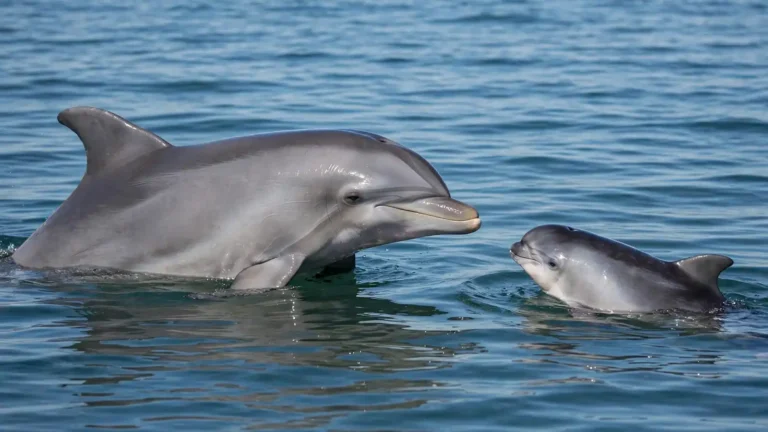
Calves arrive after a pregnancy of about ten and a half months, born at roughly 77 centimetres — a third of their mother’s length — and they nurse for a long, unhurried ten to seventeen months while learning the school’s two-world routine of bay and open sea.
Motherhood is spaced out: most females calve only about once every three years, and a calf may stay loosely associated with its mother well beyond weaning. In a species where the school is everything, those slow, well-tended childhoods are how the knowledge of bays, routes and hunting grounds passes down.
Threats and Conservation
The species’ darkest chapter came from tuna. In the eastern Pacific, these dolphins swim above yellowfin tuna, and purse-seine fleets learned to catch the tuna by netting the dolphins — killing hundreds of thousands a year in the 1960s. Dolphin-safe methods cut the toll to a few thousand a year by the 1990s, but the eastern populations, hammered for decades, have still not fully recovered.
Worldwide the species is listed as Least Concern, and most populations are faring far better than the eastern Pacific schools. Disturbance at resting bays — boats and swimmers pressing close while the animals try to sleep — is the modern pressure to manage. The full federal species profile follows each population in detail.
Fun Facts
- A single leap can include up to seven complete spins — no other dolphin performs like it.
- It rests by cruising slowly in formation over sandy bays, one half of its brain asleep while the other stays on watch.
- By night it dives as deep as 400 metres to raid the rising layer of lanternfish and squid.
- Four forms are recognised, from the dwarf spinner of Southeast Asian seas to the big Gray’s spinner of Hawaii.
- Schools can pass a thousand animals, splitting and merging like liquid through the day.
- Its scientific name, longirostris, is simply Latin for long beak.
Frequently Asked Questions
How Big Is a Spinner Dolphin?
Between 1.3 and 2.1 metres long and roughly 60 to 77 kilograms, depending on the form. The dwarf form is smallest; Gray’s spinner of Hawaii and the Pacific is among the largest.
Why Do Spinner Dolphins Spin?
Mainly, researchers believe, to communicate: a spinning leap makes a distinctive splash that carries across the school. Spinning may also help dislodge remoras and parasites, and it often erupts when the school is excited or changing activity.
How Many Times Can a Spinner Dolphin Spin?
Up to seven complete rotations in a single leap — the highest count of any dolphin. Most leaps involve fewer spins, combined with flips, tail slaps and bow-riding in one long display.
What Does a Spinner Dolphin Eat?
Lanternfish, squid and deep-water shrimp, hunted at night. The dolphins feed on the deep scattering layer as it rises toward the surface after dark, diving as deep as about 400 metres.
Where Do Spinner Dolphins Live?
Throughout the tropical and subtropical oceans. They rest by day in shallow sandy bays — famously in Hawaii — and move offshore at night to feed over deep water.
How Long Do Spinner Dolphins Live?
About 20 years on average, with the oldest known individuals reaching around 26. Females calve roughly once every three years after a pregnancy of about ten and a half months.
Are Spinner Dolphins Endangered?
The species is listed as Least Concern overall. The eastern Pacific populations were devastated by tuna purse-seine nets in the last century and remain depleted, though deaths have fallen sharply since the 1990s.
Similar Species Worth Exploring
Keep Exploring
More dolphins to meet: the scarred and mysterious Risso’s dolphin, the shy harbor porpoise of northern harbours, or the whole family in our guide to the types of dolphins. No dolphin puts on a show like the spinner dolphin.