Harbor Porpoise
Harbor Porpoise: The Shy, Beakless Whisper of Northern Coasts
The harbor porpoise is one of the smallest cetaceans in northern coastal waters, and one of the shyest animals you will never quite see. Beakless, round-headed and gone in a single roll of its little triangular fin, it spends its whole life within sight of shore, yet most people never notice it at all.
By Emily Carter · Reviewed by our vet team · Updated 10 November 2026 · 9 min read
No beak at allA small triangular dorsal finSurfaces every 25 seconds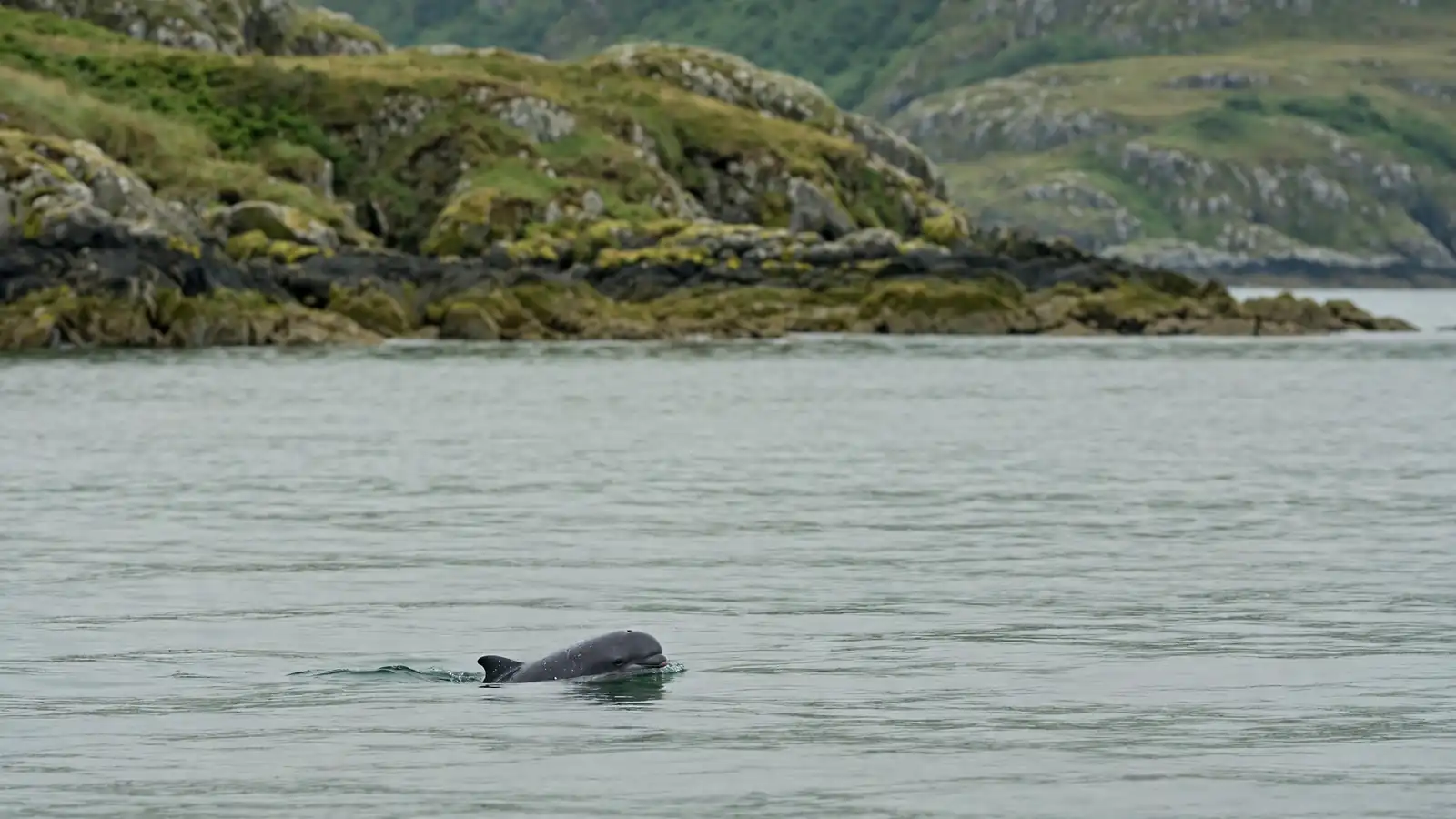
At a Glance
Fast facts first: the harbor porpoise is the little round-headed porpoise of bays and harbour mouths, a quiet neighbour that asks only to be left alone with its fish. Here is the species at a glance.
Harbor Porpoise Size and Weight
A harbor porpoise is genuinely tiny by whale standards: about 1.5 to 1.9 metres (5 to 6 feet) long and roughly 50 to 75 kilograms, with females growing slightly larger than males. It is one of the smallest cetaceans in the world, closer in size to a big sheepdog than to any dolphin it might be confused with.
The body is stocky and torpedo-round, built to hold heat in cold northern water, and that small size comes at a cost: it loses warmth fast and burns energy quickly, so it must feed frequently, day and night, for much of its life. There is no off-season of fasting for an animal this small.
Appearance and Anatomy
Forget the dolphin smile — there is no beak here at all. The head is blunt and rounded, almost dome-shaped, with a barely-there mouth line, and the back carries the surest field mark of all: a small, neat, triangular dorsal fin, 15 to 20 centimetres tall, where a dolphin’s fin would curve like a sickle. The back is dark grey, the belly pale, with a dark stripe running from the mouth back to the flipper. That blunt, beakless outline has one much bigger echo in the family: Risso’s dolphin, the scarred squid hunter of the deep slopes. And if the beak test still leaves you unsure, our dolphin vs porpoise comparison works through every difference that matters.
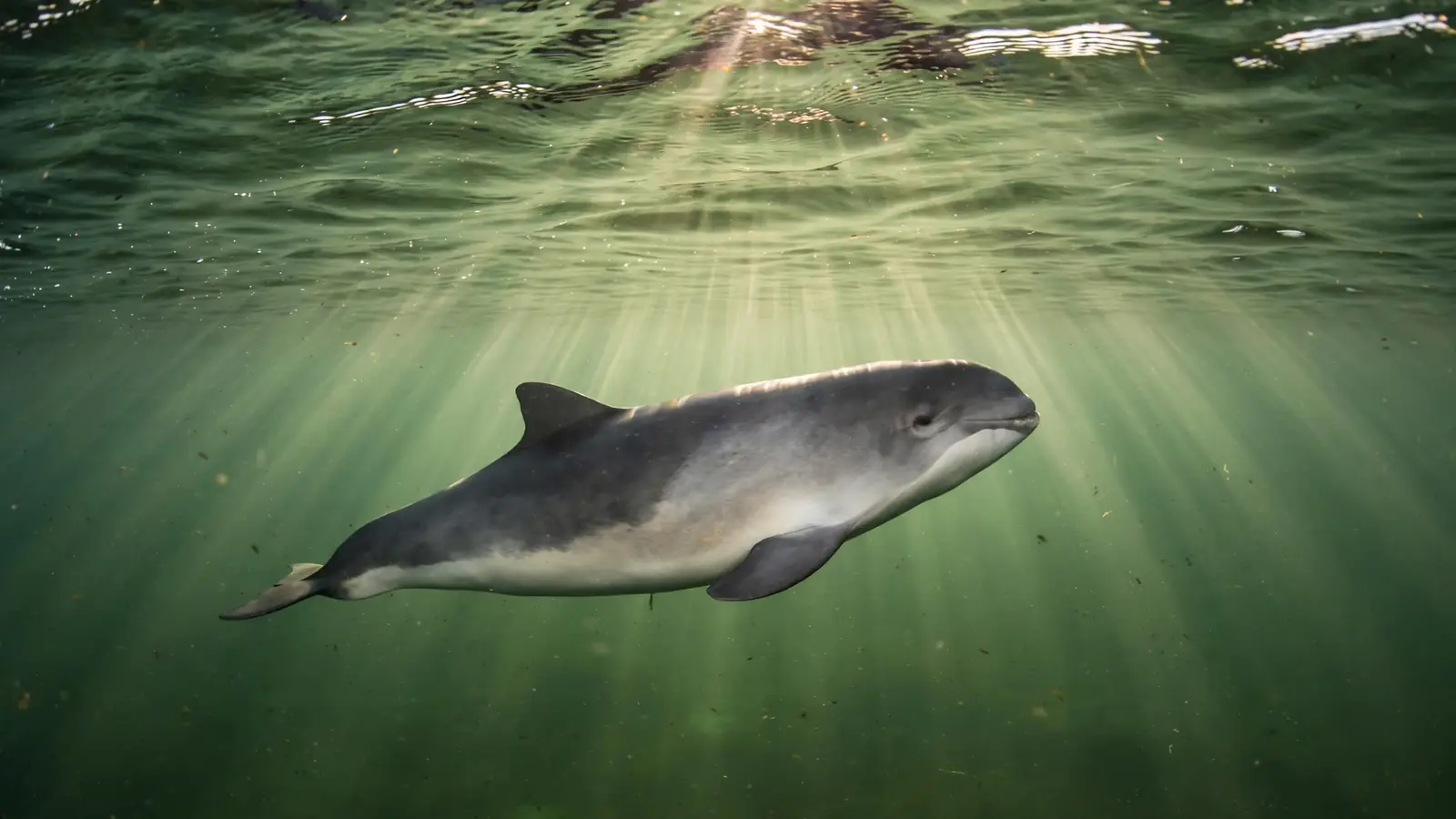
Open the mouth and there is a second giveaway: the teeth are tiny spades, flattened front to back, where a dolphin’s teeth are simple cones. It is also the name that causes mix-ups — this is no relation of the harbor seal, which is a true seal that merely shares the same harbours, hauled out on the same shores the porpoise patrols. Its fellow North Pacific porpoise is Dall’s porpoise, a bigger, faster black-and-white sprinter built for the open ocean.
Age writes itself on the body in small ways. Calves are born darker than adults, almost black, and lighten through their first years into the adult pattern of charcoal back and pale belly, while the white of the underside creeps higher up the flanks in older animals. The triangular fin carries its own signature: its front edge is roughened by a row of tiny hard bumps, called tubercles, whose purpose is still argued over — grip in turbulent water and a role in sensing have both been suggested. The flippers are small and paddle-rounded, the tail flukes notched in the middle, and the whole animal, seen from a boat, reads as a study in miniature: everything a dolphin has, drawn at half scale and in a plainer hand. Females average a little longer and heavier than males, and by their teeth and build the two sexes can be told apart in the hand, though at sea, in a two-second surfacing, even experts usually cannot. None of it is showy — which is rather the point of an animal whose whole survival strategy is not being noticed.
Habitat and Range
True to its name, this is an animal of the water’s edge: shallow bays, estuaries, harbours and tidal channels around the cold-temperate coasts of the northern hemisphere, in both the North Atlantic and the North Pacific, with a separate population in the Black Sea. It rarely ventures into water deeper than a couple of hundred metres and seldom far from land.
That shoreline loyalty makes it the cetacean people live closest to — it feeds off piers, ferry routes and fishing harbours from New England to Scotland to Japan — yet its shyness keeps it almost invisible. A two-second glimpse of a rolling back and triangular fin is a good sighting.
Certain places draw them again and again: tidal races where currents squeeze between headlands, the edges of sandbanks, and the mouths of estuaries where small fish concentrate. Animals show real loyalty to good home bays, turning up in the same waters season after season, and they will occasionally wander far up large rivers on the tide — one of the few whales comfortable in water you could almost wade across. In winter many shift slightly further offshore or southward, tracking their fish, but always within the shallow shelf seas.
Diet and Feeding
Small schooling fish make up most of the diet: herring above all, plus cod, pollack, hake and sardines, with squid, shrimp and other small creatures taken when fish are scarce. A harbor porpoise hunts close to the bottom and through the water column of its shallow home, snapping up single fish rather than herding schools.
It finds them by sound. Its echolocation clicks are narrow-band and extremely high-pitched, peaking around 130 kilohertz — the highest-frequency sonar of any cetacean, far above anything human ears can hear, and probably tuned to pick small fish out of cluttered, shallow water while staying hard for killer whales to overhear.
Behavior and Social Life
Shy is the defining word. This porpoise avoids boats rather than riding their bows, almost never leaps, and when travelling it surfaces roughly every 25 seconds for a quick breath, showing nothing but a dark back and that little triangular fin. Dives usually last around four minutes and can reach about 200 metres, and in a burst it can swim at over 20 kilometres an hour.
Society is small-scale: mothers with calves, pairs, and loose groups of five to ten are the norm, though rich feeding grounds can briefly draw far larger gatherings. It is a quiet animal altogether, and its brief surfacing puff of breath — old sailors called it the puffing pig — is often the only sign it was ever there.
Feeding can be acrobatic for so shy an animal. Fishermen and whale-watchers sometimes see one burst through a shoal in a tight, fast roll, or chase a single fish with sudden changes of direction that belie its usual slow, rolling travel. Much feeding happens at night or in murky water where eyes are useless, which is where the click trains take over: short, rapid-fire bursts of sonar that let the animal pick out individual fish against a cluttered bottom of weed, rock and sand. Calves learn the technique shadowing their mothers, echo-locating at her side from their first months.
Reproduction and Babies
Life runs fast. Pregnancy lasts about eleven months, and a single calf is born in summer at 70 to 100 centimetres long and 6 to 8 kilograms — already a fifth of its mother’s length. The calf nurses for around seven to eight months, riding in its mother’s slipstream and surfacing in perfect step beside her.
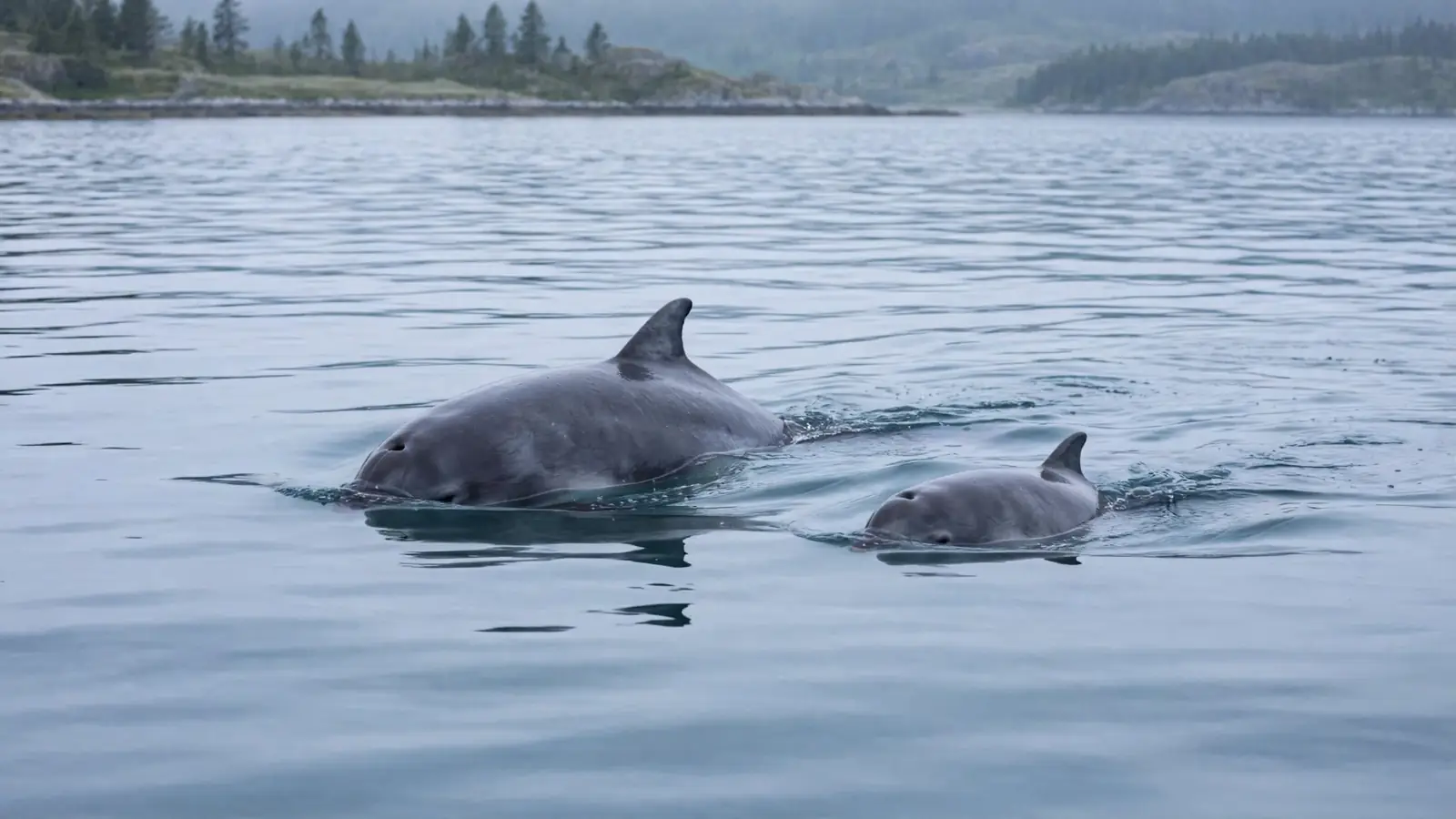
Because the species is short-lived, it breeds at a pace few whales match: many females produce a calf almost every year once mature. That fast turnover is the population’s insurance policy, letting numbers rebuild quickly wherever the threats ease off.
Threats and Conservation
The gravest danger is invisible: gillnets. Set for fish along the very coasts this porpoise hunts, the near-transparent nets are hard for its sonar to detect, and drowning in fishing gear has long been the leading human-caused killer. Add busy shipping noise, chemical pollution that builds up in its blubber, and — strangely — attacks by bottlenose dolphins, which kill porpoises in some shared waters without eating them, and the little porpoise has plenty to contend with.
Overall the species is listed as Least Concern, but the average hides the extremes: the Baltic Sea population is critically endangered, reduced to a few hundred animals. Where nets are fitted with acoustic pingers and quiet refuges exist, numbers respond well. The full federal species profile tracks each population and the protections in place.
The remedies are known, and where they are applied they work. Pingers — small acoustic alarms clipped to nets — warn the animals away from gillnets, quiet zones and marine reserves give calves safer nurseries, and bycatch monitoring has cut deaths sharply in several well-managed fisheries. The Baltic population, down to a few hundred animals, is the test case: small, isolated and surrounded by busy shipping, it shows both how fragile a local population can be and how much protection a determined programme can still achieve. The species’ worldwide numbers are healthy; its future is decided bay by bay.
Fun Facts
- It has no beak at all — the blunt, rounded head is the fastest way to tell it from any dolphin.
- Its echolocation clicks, at around 130 kilohertz, are the highest-pitched sonar of any whale or dolphin.
- Travelling, it surfaces to breathe roughly every 25 seconds, showing only a flash of back and fin.
- A female can produce a calf almost every year — a fast life for such a small cetacean.
- It almost never leaps or bow-rides; boats are things to slip away from, not toys to play with.
- Its teeth are shaped like tiny spades, while a dolphin’s teeth are cone-shaped pegs.
Frequently Asked Questions
How Big Is a Harbor Porpoise?
About 1.5 to 1.9 metres (5 to 6 feet) long and roughly 50 to 75 kilograms, with females slightly larger than males. It is one of the smallest cetaceans in the world.
What Is the Difference Between a Porpoise and a Dolphin?
A porpoise has a blunt, beakless head, a small triangular dorsal fin, a stockier body and spade-shaped teeth. A dolphin usually has a clear beak, a curved sickle-shaped fin and cone-shaped teeth.
Where Do Harbor Porpoises Live?
In shallow northern coastal waters — bays, estuaries, harbours and channels of the North Atlantic, North Pacific and Black Sea. They stay close to shore and rarely enter water deeper than about 200 metres.
What Does a Harbor Porpoise Eat?
Mostly small schooling fish such as herring, cod, pollack, hake and sardines, plus squid and shrimp. It hunts with very high-pitched echolocation clicks, around 130 kilohertz.
Is a Harbor Porpoise a Seal?
No — and the confusion is understandable. The harbor porpoise is a small toothed whale; the harbor seal is a true seal. They simply share the same harbours, bays and fish-rich shores.
How Long Do Harbor Porpoises Live?
Up to about 24 years at most, though many live far shorter lives. Females breed quickly, often producing a calf nearly every year, which helps populations hold their ground.
Are Harbor Porpoises Endangered?
The species as a whole is listed as Least Concern, but some populations are in serious trouble — the Baltic Sea population is critically endangered. Drowning in gillnets is the biggest single threat.
Similar Species Worth Exploring
Keep Exploring
Keep exploring the small whales of the coast: compare it with the famous bottlenose dolphin, meet the acrobatic spinner dolphin, or browse the whole family in our guide to the types of dolphins. Quiet as it is, the harbor porpoise may be the wild whale living closest to you.