Hector’s Dolphin
Hector’s Dolphin: the tiny New Zealander with the Mickey Mouse fin
The Hector’s dolphin is one of the smallest dolphins on Earth — and one of the rarest: a grey-and-white homebody found only around New Zealand, recognised at a glance by its rounded, mouse-ear fin. Here is its size, habits and hard fight to survive.
Home: Shallow New Zealand coasts only
Cousin: The Māui dolphin, down to about 54
At a Glance
Imagine a dolphin shrunk to the size of a large dog, painted in grey, white and black, and given a dorsal fin borrowed from a cartoon mouse — then place it in one country only. That is this species, and its small range is both its charm and its curse.
Hector’s Dolphin Size and Weight
A Hector’s dolphin is genuinely tiny: even the largest females, the bigger sex, reach only about 1.6 metres (5.3 feet) — many South Island males average just 1.25 metres — and adults weigh around 50 to 60 kilograms (110 to 130 pounds). On a beach, one would barely reach your waist.
Females outsize males clearly, which is unusual among dolphins. A newborn calf is only about 70 centimetres long, small enough that its first weeks are spent tucked against its mother in the shallows where it was born.
Small size shapes everything about this animal’s life: it hunts small prey, lives in small groups, travels small distances — most never roam more than a few dozen kilometres from their home bay in an entire lifetime. Everything is in proportion to that scale: a heart the size of a grapefruit, a brain quick enough for a complicated social life, and a lifespan packed into two short decades.
Appearance and Anatomy
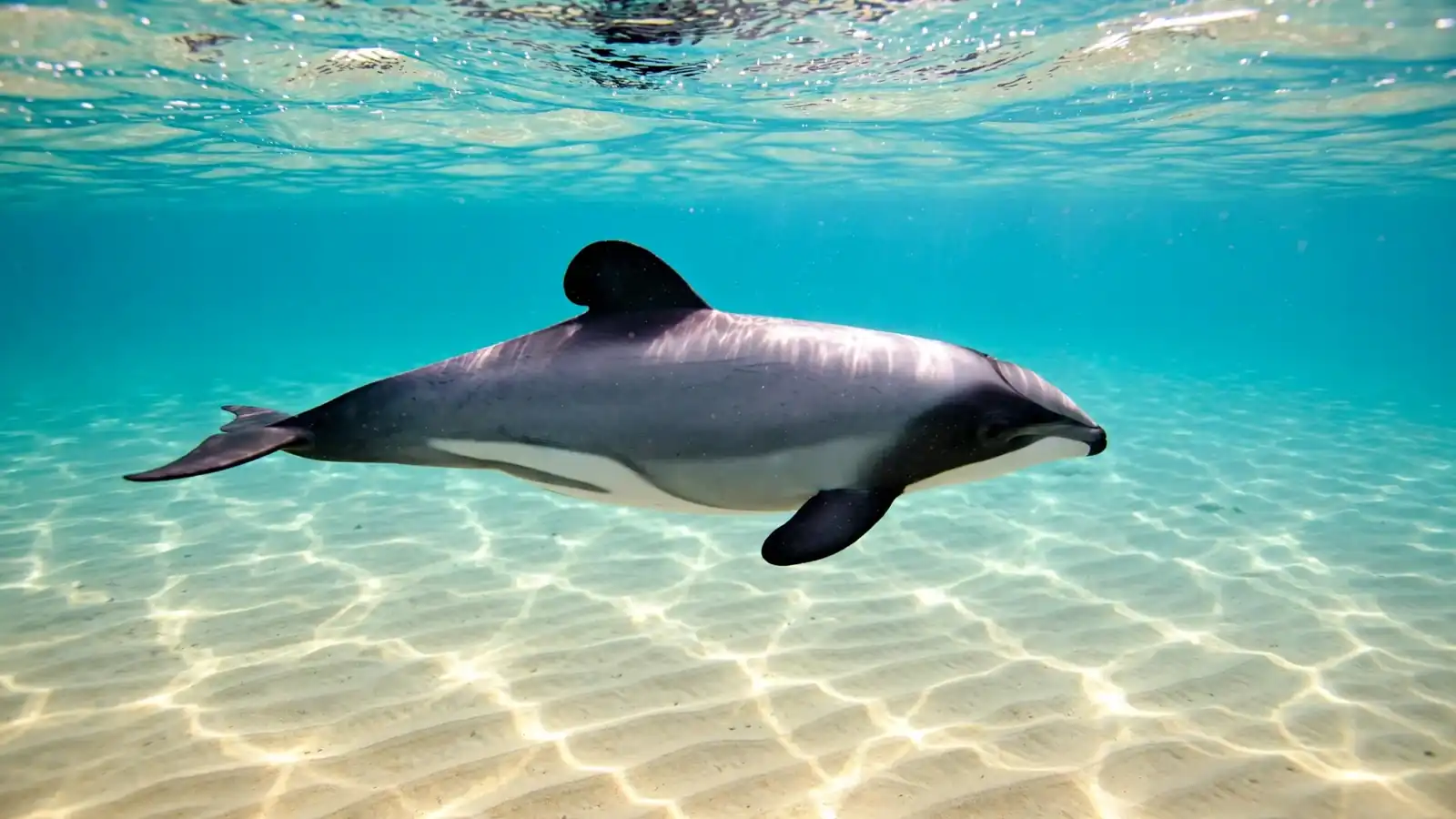
One feature identifies a Hector’s dolphin instantly: the dorsal fin is rounded. Not triangular, not hooked like other dolphins’, but a smooth black lobe — the famous ‘Mickey Mouse ear’ — that no other dolphin wears. The full identification guide in the full species account starts with exactly that fin.
The body is a painter’s mix: light grey over the back and sides, a white band across the belly, and black on the dorsal fin, flippers, tail flukes and the tip of the short beak, with dark patches around the face. The beak itself is barely separate from the head — short, blunt, and dark-tipped.
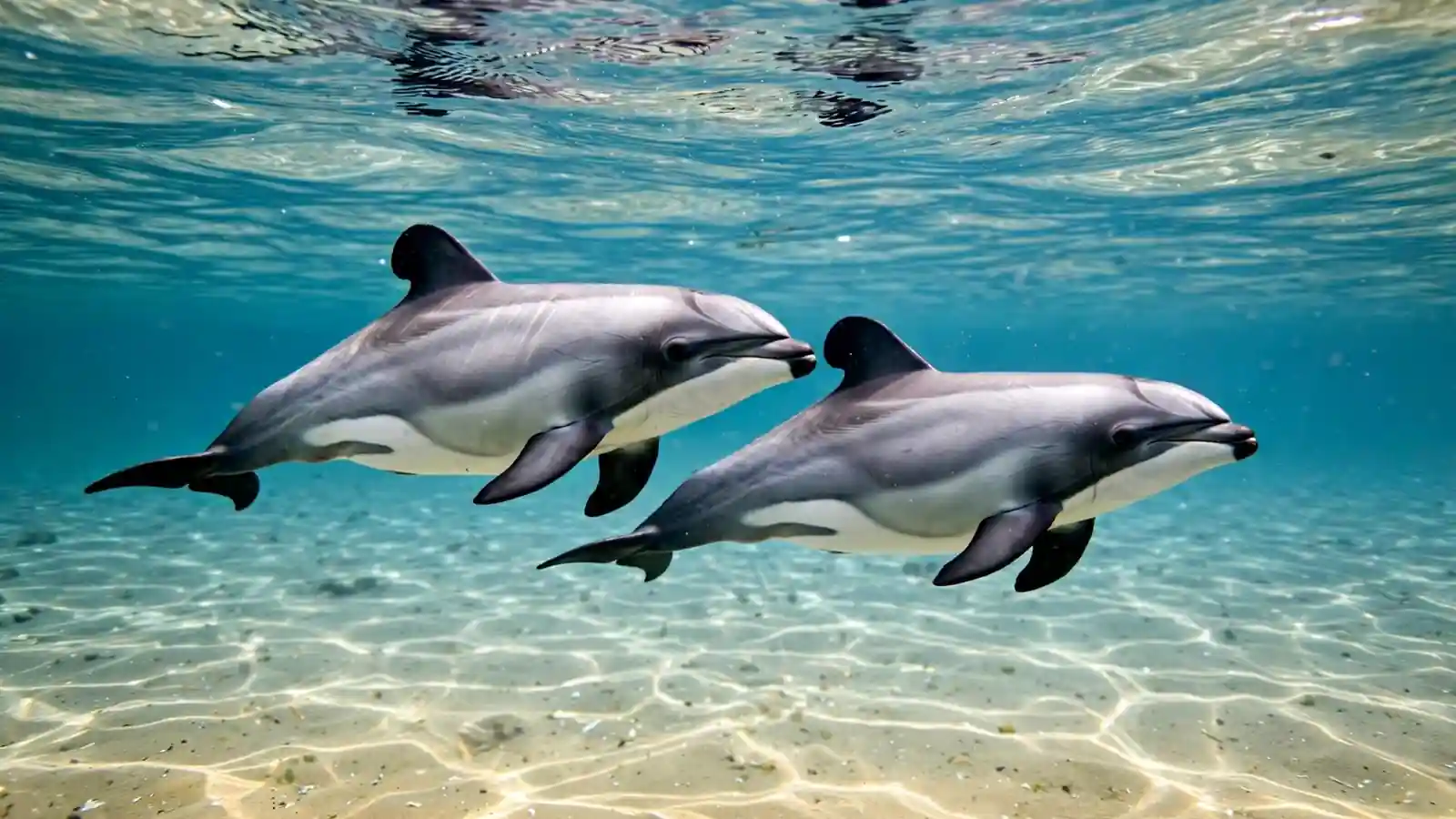
Males and females look alike, and calves are born with faint foetal folds and a browner tint that fades. The tail flukes are broad with pointed tips and a clear centre notch — proportions that fit a slow, coastal life rather than ocean crossings.
Habitat and Range
The Hector’s dolphin lives in one place on Earth: the shallow coastal waters of New Zealand. The main population hugs the South Island’s coasts — Banks Peninsula is the stronghold — while its North Island subspecies, the Māui dolphin, survives only off the west coast between Taranaki and Kaipara.
It is a creature of the surf zone and the harbour mouth: almost always in water less than 100 metres deep and usually within a kilometre of shore, moving slightly further out in winter and pressing inshore in summer, when calves are born in the warm shallows.
Site loyalty is extreme. Photo-identification studies show individuals holding core areas just kilometres wide, with neighbours’ home bays spaced some 30 kilometres apart and the longest recorded journey barely over 100 kilometres. Each bay effectively has its own dolphins — lose them, and no others will move in. Seasonal movements are small and tidal as much as geographic: animals follow the murky, food-rich edges of channels and surf lines, and tour-boat crews learn quickly which headlands belong to which dolphins.
Diet and Feeding
Small prey for a small dolphin: a Hector’s dolphin hunts little schooling and bottom fish — red cod, sprats, yellow-eyed mullet, stargazers and juvenile fish of many kinds — plus squid, taking whatever its home patch of coast provides.
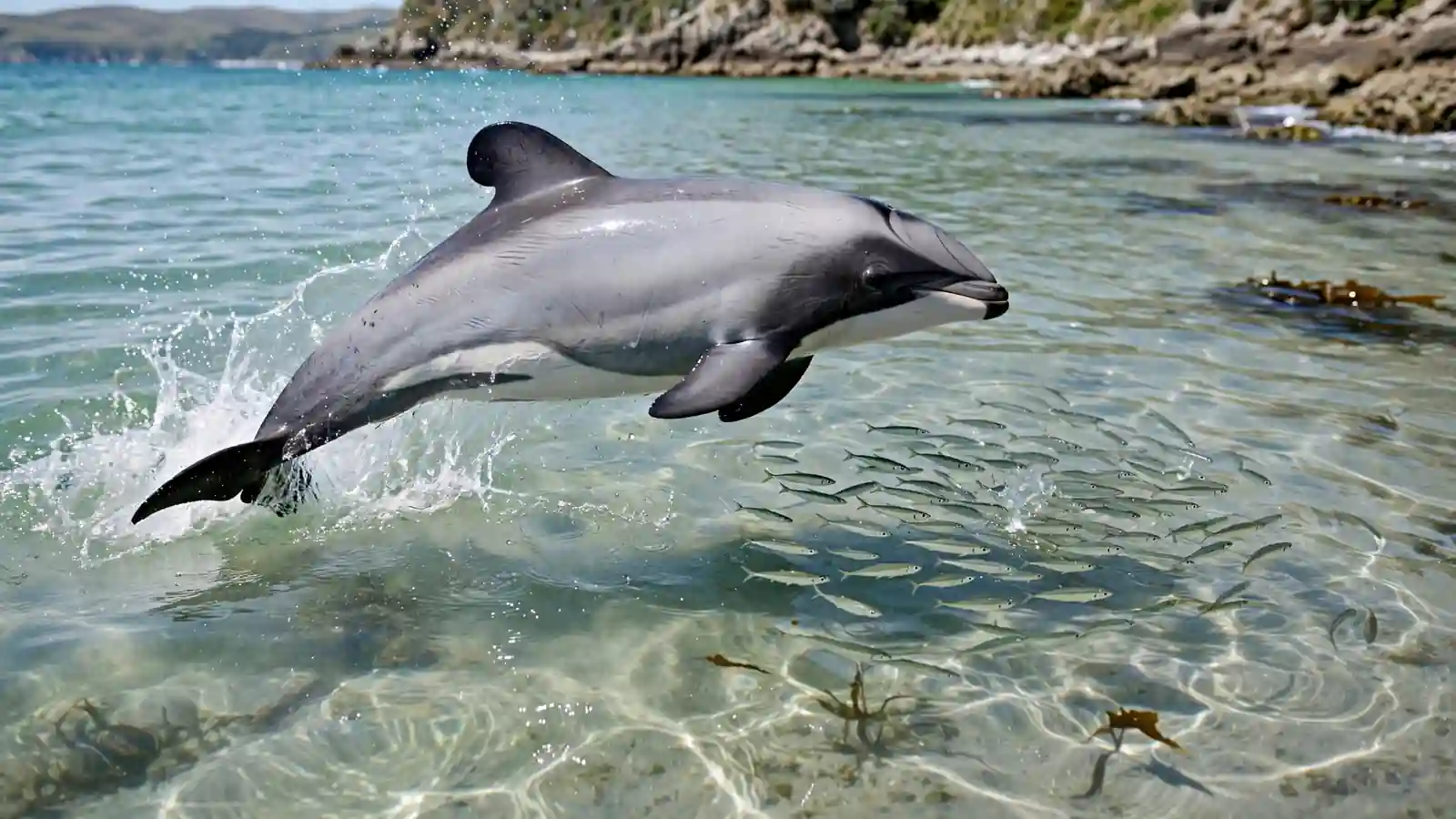
Feeding happens in the murk as much as in clear water, and the tool is sound. This species produces some of the highest-frequency clicks of any dolphin — narrow-band pulses peaking around 82 to 135 kilohertz, tuned like a precision instrument for finding small fish close to the seabed.
Dives are short, usually under three minutes, and the dolphin works the full water column: snapping at fish near the surface, then nosing along the bottom. Groups often feed spread out over a reef or channel, each animal hunting its own few square metres of home water.
Behavior and Social Life
Groups are small and fluid — two to eight animals is typical, gathering into loose parties of twenty or so around food or in the breeding season, then splitting again. It is a fission-fusion social life: friendships flexible, family ties loose, except for the one bond that matters, mother and calf.
For a small dolphin it is surprisingly playful around boats, riding bow waves and investigating swimmers, though it rarely leaps as high or as often as a bottlenose. Most activity happens near the surface, where its rounded fin and grey back roll through the harbour chop. Youngsters are the most exuberant, porpoising in tight arcs around their mothers and chasing one another through the kelp beds, while the adults keep a calmer rhythm of surfacing rolls.
What it does not do is travel. One may live twenty years within sight of the same headland, which is why conservation works bay by bay: a marine mammal sanctuary around Banks Peninsula has protected one core population since 1988.
Communication and Sound
Almost everything this dolphin says is a click — it has one of the simplest vocal repertoires of any dolphin, built from those same high-frequency pulses used for hunting, sped up into bursts during social excitement. With no far-carrying whistle, its acoustic world is intimate and close-range, matching a life lived in small groups in small bays. Click trains speed into a buzz as the dolphin closes on a fish — the acoustic signature of a strike — then fall silent again as it surfaces to breathe.
Reproduction and Calves
Females mature at seven to nine years and males at six to nine, and the breeding season is the southern summer. After a pregnancy of ten to twelve months, a single calf is born between early November and mid-February, in the warm, shallow water close to shore.
The calf stays with its mother for one to two years, but she can only afford this every two to four years — a female produces at most about seven calves in a twenty-year life. That slow maths is the whole conservation problem: even with perfect protection, numbers can only climb a few percent a year.
Predators and Threats
Sharks are the natural danger — broadnose sevengills and blue sharks patrol the same coasts, and scarred survivors show the encounters happen. But natural predation is not what emptied these bays: set nets and trawl nets are, by a very wide margin, the greatest threat this species has ever faced. Scarred survivors are not rare, and mothers with calves keep to the shallowest, safest water in summer — one more reason the inshore nursery zone matters so much.
Conservation and Human Interaction
The Hector’s dolphin is listed as endangered, and its northern subspecies — the Māui dolphin — is critically endangered, with recent surveys estimating only around 54 animals older than a year, making it one of the rarest marine dolphins on the planet.
Around 15,000 Hector’s dolphins remain around the South Island, most counted in aerial surveys along the east coast — and the threats are known precisely, because the official fact sheet at the national species profile lays them out: set-net and trawl bycatch above all, then toxoplasmosis washing from land, boat strikes and coastal pollution.
The response has been sanctuaries, net restrictions and an ever-tighter web of rules around the remaining bays. It is working, slowly, in protected water — proof that for a dolphin that never leaves home, protecting home is the entire battle.
Fun Facts
- It is one of the smallest dolphins in the world — a big female is shorter than most adults are tall.
- Its rounded dorsal fin is shaped like a Mickey Mouse ear, and no other dolphin has one.
- Most individuals spend their whole lives within about 30 kilometres of where they were born.
- Its clicks are among the highest-pitched of any dolphin — far above human hearing.
- The Māui dolphin, its northern subspecies, numbers only around 54 animals: rarer than the giant panda is numerous.
- Females are larger than males, and a mother raises at most about seven calves in her lifetime.
Frequently Asked Questions
How Big Is a Hector’s Dolphin?
Tiny — up to about 1.6 metres (5.3 feet) long and 50 to 60 kilograms (110 to 130 pounds) in weight, with females larger than males. It is one of the smallest dolphins in the world, and newborn calves are only about 70 centimetres long.
What Do Hector’s Dolphins Eat?
Small fish and squid: red cod, sprats, mullet, stargazers and other little coastal species. They find prey with high-frequency echolocation clicks, diving for under three minutes at a time and hunting from the surface to the seabed.
Where Do Hector’s Dolphins Live?
Only around New Zealand, in shallow water usually within a kilometre of shore. The main population lives around the South Island; the Māui dolphin subspecies survives off the North Island’s west coast.
Why Is a Hector’s Dolphin’s Fin Rounded?
The smooth, lobed dorsal fin — nicknamed the Mickey Mouse ear — is unique to this species and its closest relatives. It is the fastest way to identify one: no other dolphin in New Zealand waters has a rounded fin.
Are Hector’s Dolphins Endangered?
Yes. The species is endangered with about 15,000 animals left, and the Māui dolphin subspecies is critically endangered at around 54 individuals. Drowning in set nets and trawl nets is the main threat, along with disease from land-based pollution.
What Is the Difference Between Hector’s and Māui Dolphins?
They are subspecies of the same species. Māui dolphins live off the North Island’s west coast, grow slightly larger, and are genetically distinct — and far rarer, numbering around 54 animals compared with about 15,000 Hector’s around the South Island.
What Is a Baby Hector’s Dolphin Called?
A calf. Calves are born in summer, between November and mid-February, after a pregnancy of ten to twelve months. They stay with their mothers for one to two years, and females calve only every two to four years.
Similar Species
Keep Exploring
Still curious about the small whales? Meet the Irrawaddy dolphin, Asia’s equally rare river specialist, compare the classic bottlenose dolphin, or browse them all in our guide to the types of dolphins. Small, grey and found nowhere else on Earth — the hector’s dolphin is New Zealand in dolphin form.