Conger Eel
Conger Eel: the heaviest true eel in the sea
The conger eel is a thick-bodied, grey-brown hunter that spends its days wedged into reefs, wrecks and harbour walls, and its nights out hunting crabs and fish. The European species is the heaviest eel on Earth — big females outweigh most adult humans — yet almost everything about its life, from its age to its breeding grounds, remains half-hidden.
By Emily Carter · Reviewed by our vet team · Updated 10 November 2026 · 8 min read
Up to 3 m and 110 kgHunts crabs and fish at nightBreeds once, then dies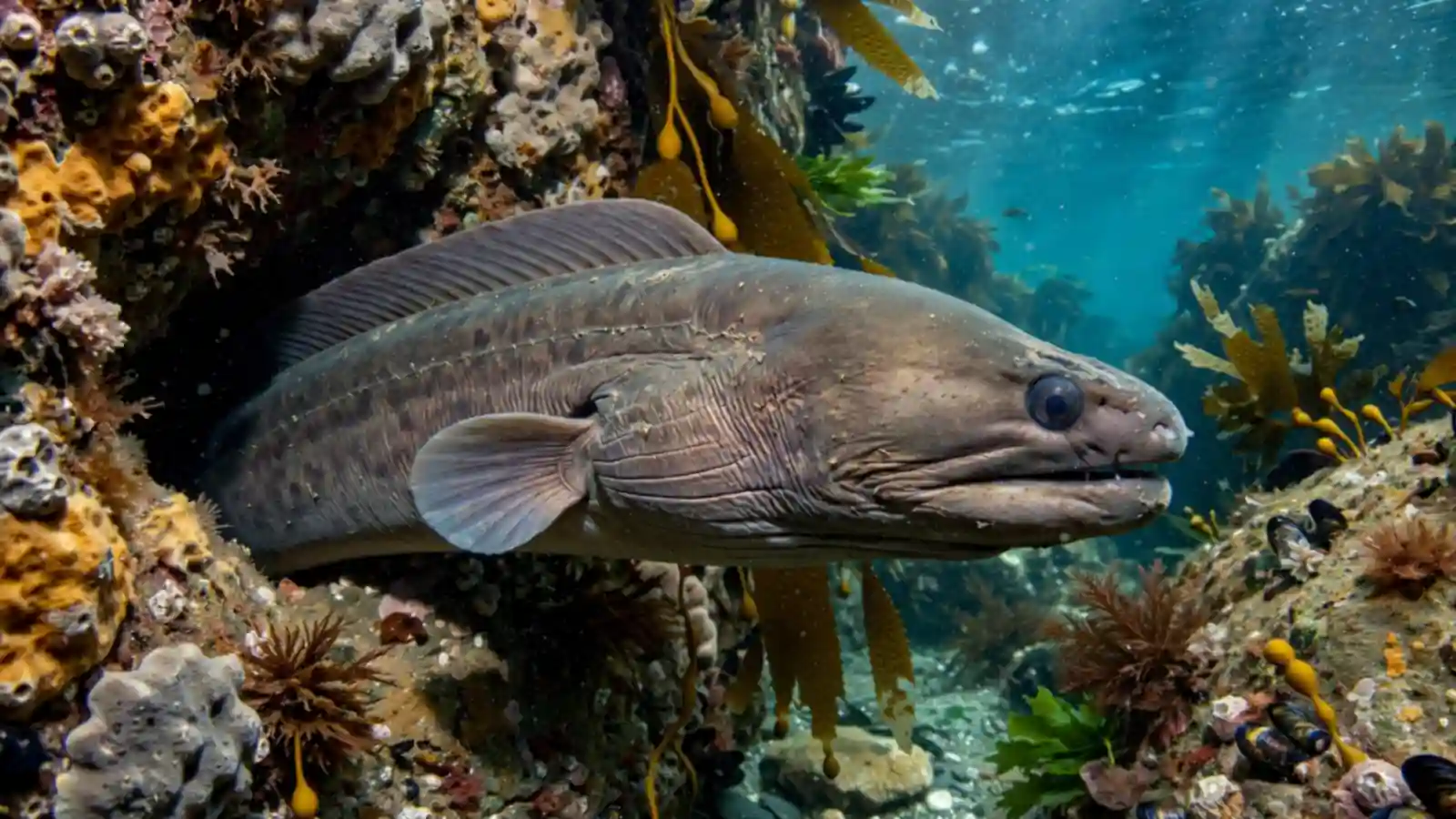
At a Glance
A conger eel is what you get when an eel is built like a heavyweight. Instead of the slim, snake-thin body of its freshwater cousins, it carries a thick column of muscle wrapped in smooth, scaleless grey-brown skin, with one long fin running unbroken around its back and tail. That body is a tool: it lets the conger wedge itself immovably into rock holes by day, and wrestle crabs and fish out of the dark by night.
Conger Eel Size and Weight
Most conger eels a diver or angler meets are between 1 and 1.5 metres (3.3 to 5 feet) long — already a lot of eel. Females grow far bigger than males, and the largest reliably reported European congers reach 3 metres (9.8 feet), about the length of a small family car, with weights around 110 kilograms (240 lb). No other true eel comes close on weight, which earns the species its title as the heaviest eel in the world.
Size depends on sex and patience. Males mature at only about half a metre and rarely grow much beyond a metre, while a female in a safe wreck hole, undisturbed for years, simply keeps growing. You can browse the full species record for Conger conger for the formal maximum sizes gathered from catches across its range.

The conger’s build explains its habits. That deep, muscular trunk cannot chase fish in open water, but it can anchor the eel in a crevice so firmly that predators — and fishermen — struggle to pull it out, and it gives the jaws something solid to bite against. Everything about this fish is designed for ambush, not pursuit.
Conger conger Up Close: Jaws, Skin and Senses
The conger eel’s head is broad and blunt, with a mouth that reaches back level with the eye and an upper jaw that projects slightly beyond the lower. Inside are rows of small, sharp, close-set conical teeth; the front teeth are flattened and packed together so tightly they almost form a single cutting edge. Add jaw muscles built for crushing, and a crab’s shell is no defence at all.
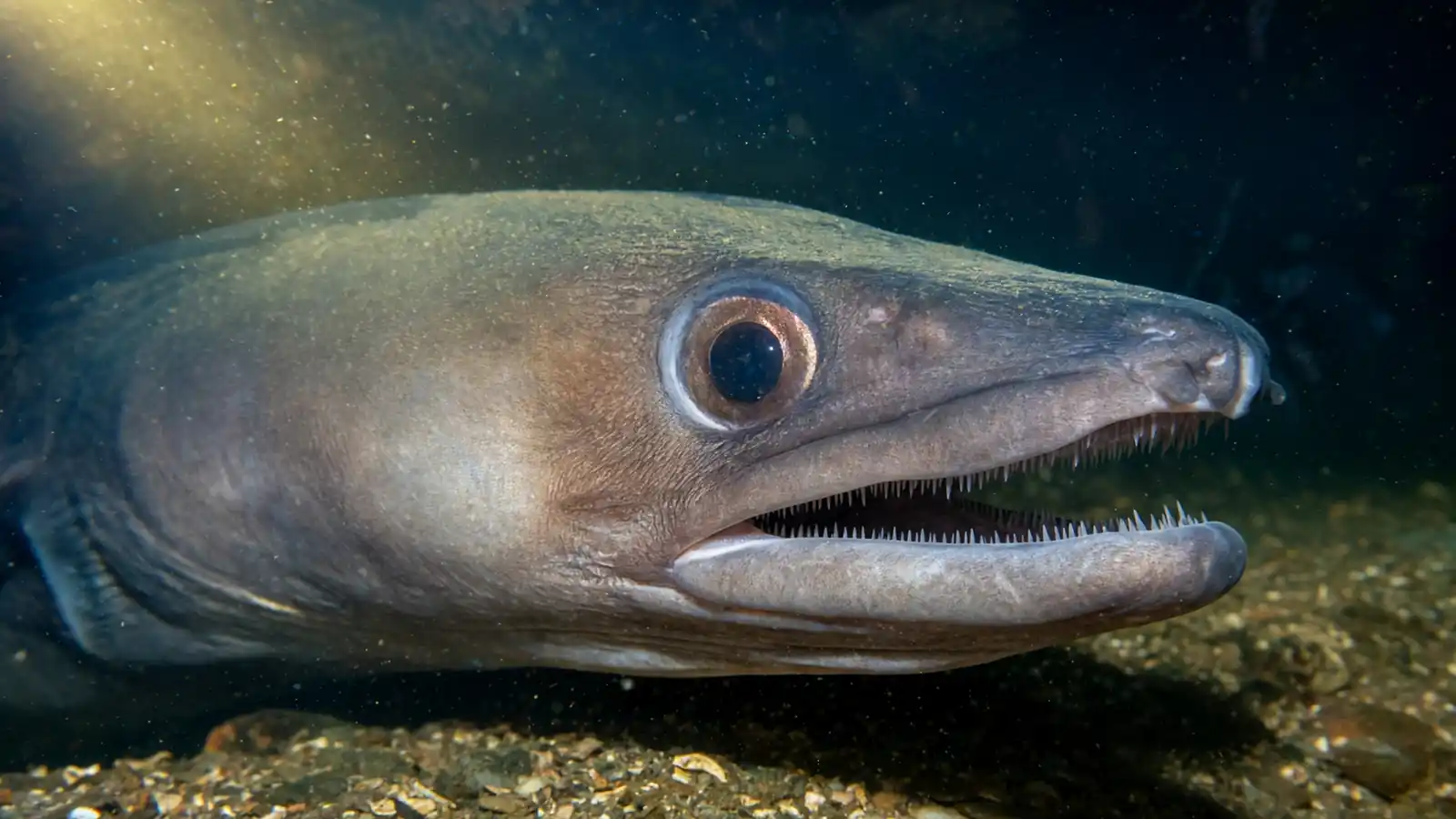
A conger finds most of its food by smell. Its large nostrils sample the current constantly, and a hunting conger follows scent trails across the seabed the way a dog follows a trail through grass. The eyes are large but play second fiddle after dark; the sensitive lateral line down each flank picks up the vibrations of fish and crabs moving nearby. The skin itself is thick, tough and slick with mucus — protection for a life spent squeezing through rock and wreckage.
People often ask about the conger eel vs moray eel comparison. The two are easy to separate once you know the signs: a conger is plain grey-brown, stout, and has rounded pectoral fins and a blunt snout, while morays are usually slimmer, often boldly patterned, and lack pectoral fins entirely.
Habitat: Rocks, Wrecks and Harbour Walls
The European conger lives along the rocky coasts of the northeast Atlantic, from Norway and Iceland in the north to Senegal in the south, and throughout the Mediterranean Sea. Its one requirement is somewhere to hide: a crevice in a reef, a hole in a boulder field, the pipework of a harbour wall, or the shadowed interior of a shipwreck, which big females may occupy for years.

Most congers live in water shallower than 500 metres, on the continental shelf, but the species has been recorded far deeper — one was taken at 1,171 metres in the eastern Ionian Sea. Young congers sometimes turn up in deep rock pools at very low tide, while the largest adults tend to hold the deepest, most permanent holes on the reef.
Diet and Hunting by Night
By day, all you usually see of a conger eel is a head at a hole, watching. The real animal appears after dark, when it leaves shelter and hunts across the reef and sand: bottom fish of many kinds, crabs and lobsters, octopus and squid. Prey is seized in a sudden lunge and swallowed whole; crabs are crushed in the jaws, and a fish too big to swallow may be bitten and spun until a piece tears free.

Night is also when anglers meet them. Congers take fish and squid baits presented on the bottom near reefs and wrecks, and a hooked fish uses all that muscle — backing into its hole and bracing — which is why wreck fishermen regard a big conger as one of the hardest-fighting fish on the coast.
Conger Eel Spawning: The One-Way Breeding Migration
The conger eel’s life cycle is the strangest thing about it. After years inshore — somewhere between five and fifteen — a ripening conger stops feeding altogether. Its teeth loosen and fall out, its gut withers, its bones soften, and all its remaining resources pour into eggs or sperm. Then it leaves the coast for deep offshore water, in a migration from which no conger ever returns.

Spawning is thought to happen in deep areas of the Atlantic and Mediterranean, where a female releases between 3 and 8 million eggs — and then, spent, she dies. The eggs hatch into leptocephali: transparent, leaf-shaped larvae that drift in the currents for up to two years before reaching a coast, reshaping into tiny eels, and taking up the hole-dwelling life.
How long a conger lives in total, nobody can say with confidence. Ageing an eel that sheds its own teeth is guesswork; the honest answer combines the growth years and the migration, and lands somewhere around fifteen to twenty years, perhaps more.
Congers and People: Catches, Divers and Lookalikes
Congers have been eaten on European coasts for centuries, and they are still prized by sea anglers — less for the fight on the line than for the fight at the boat, where a landed conger, all muscle and temper, is handled with genuine respect. Modern wreck divers take the opposite approach: resident congers are celebrities, watched and photographed rather than disturbed, and individuals in famous wreck holes can become local characters.

Two other eels get mixed up with it. The moray eel is a reef fish of warmer seas — slimmer, pattern-skinned and finless behind the head. The garden eel is at the opposite extreme: finger-thin, living in sandy colonies, and no relation in habit at all. And the familiar European eel of rivers is a far slimmer, yellow-brown fish; the conger is purely marine and built on another scale entirely.
Fun Facts
- Before breeding, a conger eel’s teeth fall out and its stomach degenerates. The migration to the spawning grounds is powered entirely by stored fat.
- At about 110 kg, the biggest European conger outweighs most adult humans — in an eel with no scales, no pelvis and no hind fins.
- A conger larva can drift for up to two years before it ever sees a coast, travelling on currents as a transparent leaf.
- Big females are homebodies: the same wreck hole can hold the same conger for years, and divers often know their local fish individually.
- The conger family is huge — more than 230 species — and includes the tiny garden eels as well as the heavyweight European conger.
- A conger braced in its hole can be nearly impossible to pull out. Anglers who hook one close to a wreck often simply lose.
Frequently Asked Questions
How Big Do Conger Eels Get?
European congers commonly reach 1 to 1.5 metres (3.3 to 5 feet), with females growing much larger than males. The biggest reliably reported fish approach 3 metres (9.8 feet) and about 110 kilograms (240 lb) — which makes the European conger the heaviest eel in the world.
Are Conger Eels Dangerous?
Not usually. A conger eel is shy by day and curious by night, and divers regularly watch big females in wrecks without any trouble. A cornered, hooked or grabbed conger is a different matter: its jaws are strong and its bite can tear. Leave one alone and it will leave you alone.
What Do Conger Eels Eat?
Conger eels hunt at night for bottom fish, crabs, squid and octopus, seizing prey with a sudden lunge from their holes. The meal is swallowed whole — crabs are crushed in the powerful jaws, and large fish are sometimes spun until a manageable piece tears free.
Where Do Conger Eels Live?
European congers live along rocky coasts in the northeast Atlantic, from Norway and Iceland down to Senegal, and throughout the Mediterranean. They shelter in reef crevices, shipwrecks and harbour walls, mostly shallower than 500 metres, though they have been recorded far deeper.
How Long Do Conger Eels Live?
Nobody knows exactly. Conger eels are so hard to age that estimates rest on captive fish and growth studies, which suggest something like 15 to 20 years or more before the final breeding migration — after which, like all congers, the adult dies.
Do Conger Eels Bite?
Yes — if they are grabbed, hooked or cornered. A conger’s bite is not venomous, but the jaws are strong, the teeth grip hard, and the fish twists as it bites, which can tear the wound. Anglers are advised to handle big congers with great care, and divers simply give them room.
Can You Eat Conger Eel?
Yes. Conger has firm, white, meaty flesh and has been eaten around European coasts for centuries — grilled, smoked, or cooked in the fish stews and soups of the Mediterranean. Only large fish are usually kept, because small congers are considered poor eating and best released.
Do Conger Eels Really Die After Spawning?
Yes. A ripening conger stops feeding altogether — its teeth loosen and fall out, its gut withers and its bones soften — then it leaves the coast for deep offshore water, in a migration from which no conger ever returns. Spawning happens in deep areas of the Atlantic and Mediterranean, where a female releases between 3 and 8 million eggs and then, spent, she dies.
What Is the Difference Between a Conger Eel and a Moray Eel?
The two are easy to separate once you know the signs: a conger is plain grey-brown, stout, and has rounded pectoral fins and a blunt snout, while morays are usually slimmer, often boldly patterned, and lack pectoral fins entirely. Congers haunt the rocky coasts, wrecks and harbour walls of the northeast Atlantic and Mediterranean, while morays are reef fish of warmer seas.
Similar Species Worth Exploring
Keep Exploring
Still curious about eels? Compare the conger with the moray eel, meet the colony-dwelling garden eel, or browse the whole collection through the types of fish. Heavyweight, hole-dweller, one-way traveller — the coast hides nothing quite like the conger eel.