Minke Whale
Minke Whale: the smallest great whale with a white-banded flipper
The minke whale is the smallest of the great whales and, quietly, one of the most successful: a sharp-nosed little rorqual found from the edge of the ice to the tropics. Here is its size, its signature white flipper band, its diet, its curious habits and its long history with whalers.
By Emily Carter · Reviewed by our vet team · Updated 10 November 2026 · 9 min read
Length up to 10 mWeight up to 9 tonnesLifespan up to 50 years
At a Glance
The minke whale is the whale most people have never noticed: small for a giant, quick, and often alone. Its common name is a fisherman’s joke that stuck: a Norwegian spotter named Meincke reportedly mistook one for a blue whale, and ‘Meincke’s whale’ shrank over the years into minke. Its scientific name is more respectful: acutorostrata means ‘sharp snout’, and the snout is where any minke story should start.
Minke Whale Size and Weight
A minke whale is the smallest member of the rorqual family, the group that also holds the blue, fin and humpback whales. Adults reach up to about 10 metres (33 feet) long and weigh up to around 9,000 kilograms (20,000 pounds). Females grow slightly larger than males, as in most of its giant cousins.
Next to a blue whale it looks like a scale model, and that smallness shapes its whole life. It can hunt in shallow bays and rocky fjords where its bigger relatives cannot turn, slip along the ice edge, and thrive on smaller, patchier food than a giant could live on.
A newborn calf measures about 2.4 to 3.5 metres and weighs 320 to 450 kilograms. It grows fast on rich milk and is weaned at only four to six months old, young by whale standards.
Appearance and Anatomy
The minke whale is built like a dart. The body is sleek and compact, dark grey to black or brownish above and clean white below, with a paler grey chevron sweeping behind the head. The head itself is the sharpest of any rorqual: a flat triangle ending in a pointed tip, made for slicing through the surface snout-first.
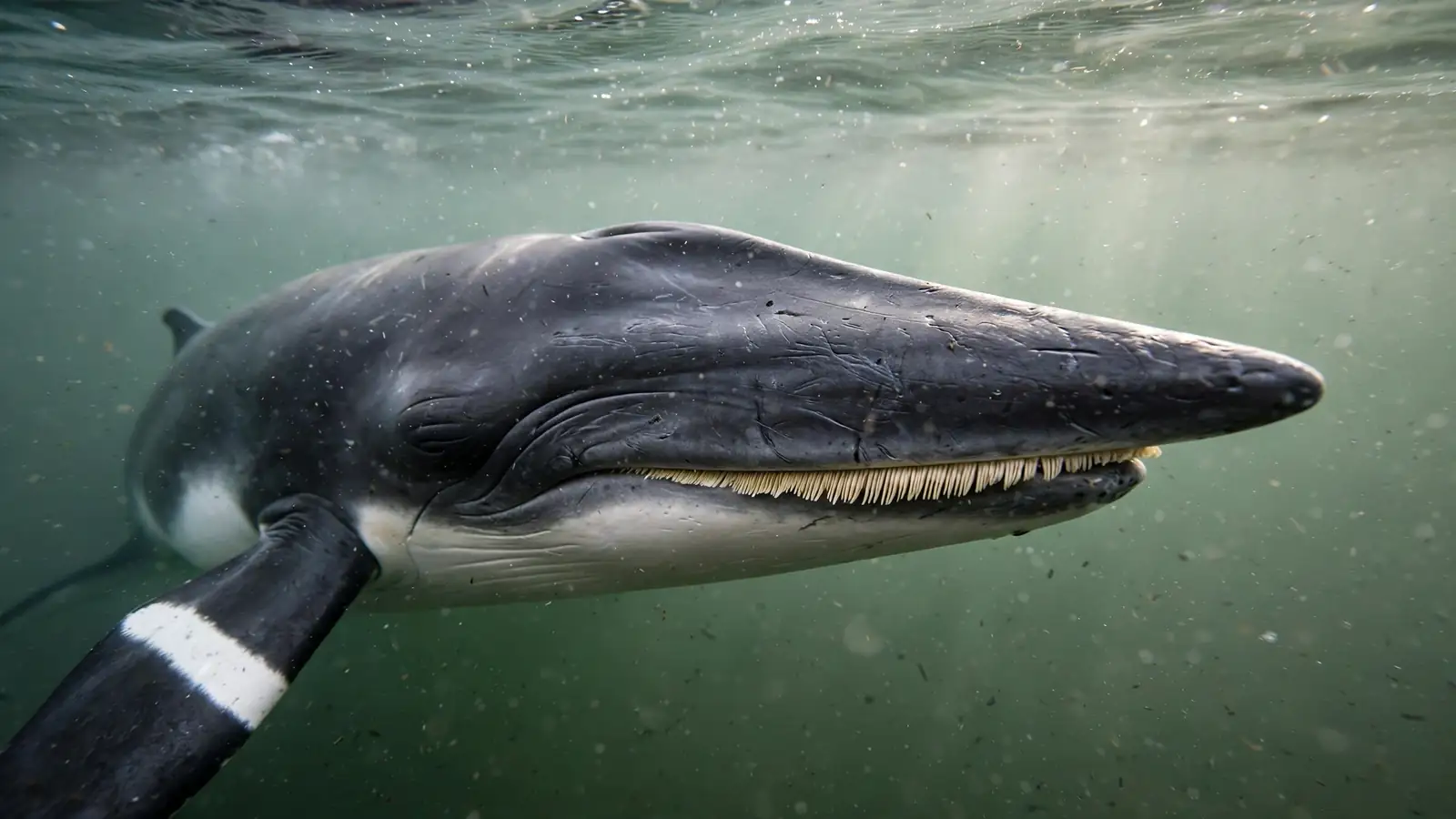
Halfway along the back stands a tall, strongly curved dorsal fin, and behind the mouth hang 230 to 360 short baleen plates on each side, white to cream in northern animals. Fifty to seventy pleats run down the throat, letting it balloon outward when the whale lunges into a shoal.
One mark settles every argument about its identity: a bold white band across the middle of each dark flipper. No other rorqual wears it, and it flashes like a signal flag whenever the whale rolls at the surface. A smaller dwarf form lives in southern waters, while the separate Antarctic species lacks the band entirely.
Habitat and Range
Minkes are everywhere there is cold, food-rich water. The species ranges through all the world’s oceans, from the polar ice edge through temperate seas into the tropics, though it clearly prefers cooler water and is commonest at high latitudes.
Its year runs on migration. Summer is spent feeding in cold northern or southern waters, often right against the ice; winter is for travelling toward the equator to breed in warmer seas. It is as much a coastal whale as an ocean one, entering bays, estuaries and fjords, and seldom straying more than about 170 kilometres from land.
Diet and Feeding
Krill and little fish are the whole menu. Depending on the ocean, it takes herring, capelin, cod, mackerel, sand lance and anchovies, sieving them from the water with its short baleen; in southern waters, krill does most of the work.
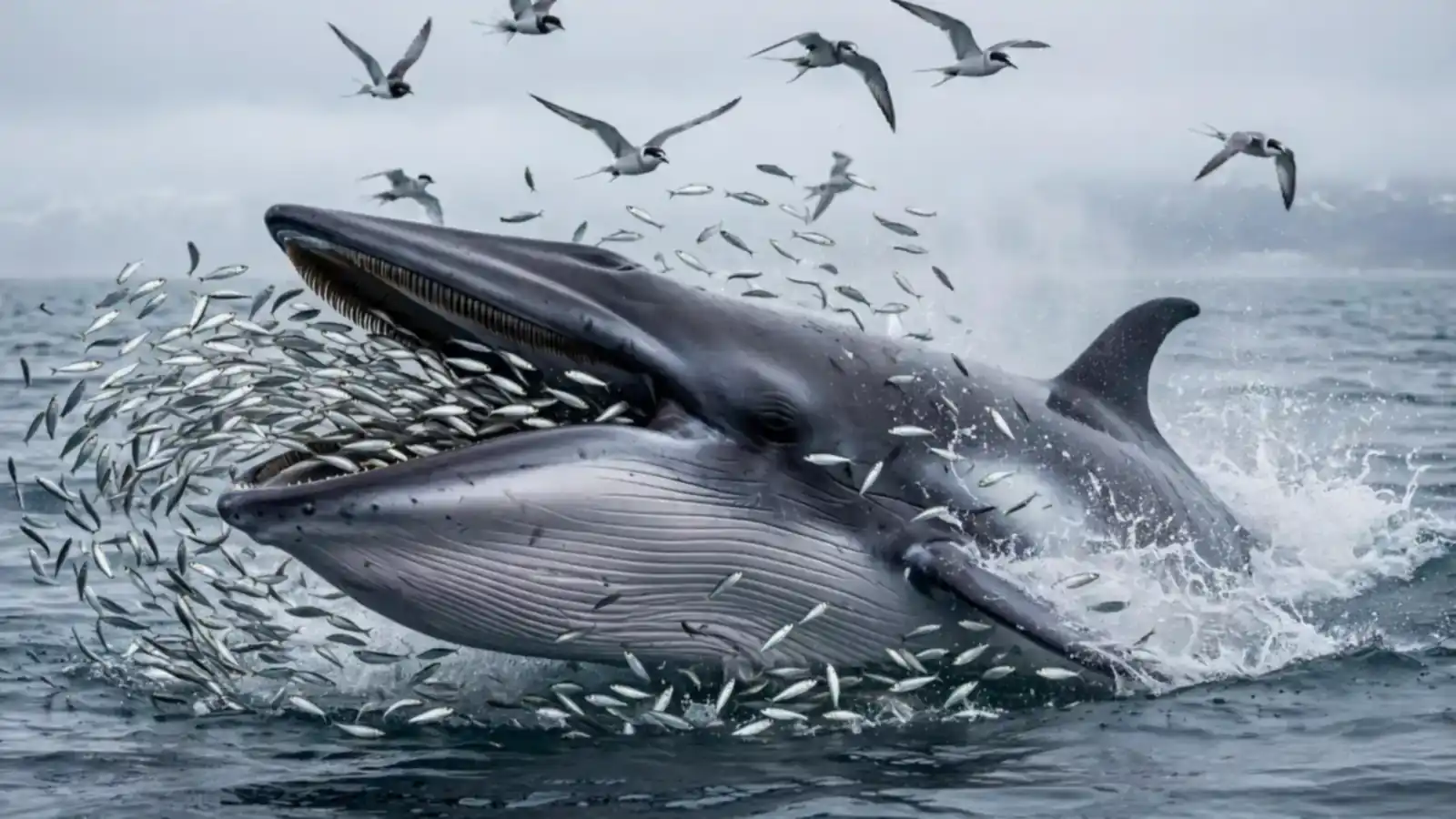
The hunt is a sideways ambush. The whale accelerates into a school, rolls, and opens its mouth so the pleated throat balloons with water and fish; then it closes its jaws and squeezes the water out through the baleen, swallowing what is left. Patient seabirds know the pattern well, gathering over feeding minkes to snatch whatever escapes, as described in this full account of the species’ feeding and senses.
Behavior and Social Life
Expect solitude. A minke is usually alone or in a pair or trio, though where food concentrates, loose gatherings of dozens, even hundreds, may feed in the same rich water near the poles. Between surfacings it shows little: a pointed snout, a small bushy blow two or three metres high, a smooth roll of the back, and no tail flukes at all before it dives.
Underwater it is faster than it looks. Dives usually last six to twelve minutes, and before a long one the whale throws its back into a high, steep arc. Chased minkes can pour on speed in a burst that throws up a distinctive ‘roostertail’ of spray, a trick they need when the hunters in a later section come calling.
For all its shyness at a distance, it is famously curious up close. Minkes approach stationary boats, circle them, spyhop among ice floes to look around, and sometimes breach clear of the water, landing with a heavy splash. Whale watchers in cold-water bays count a close encounter among the best experiences on the water.
Communication and Sound
For a whale, it keeps its voice down, but the repertoire is strange and varied: clicks, grunts, ratchets, thumps and trains of pulses have all been recorded. Different oceans have different dialects, and some sounds are tied to feeding or to the breeding season.
The most famous is the ‘boing’: a long, metallic, spring-like note recorded for years in the North Pacific before anyone traced it to this species. In Antarctic waters, an equally odd descending call, nicknamed the bio-duck, was a mystery for decades until it too was matched to the Antarctic minke whale.
Reproduction and Babies
It breeds fast for a giant. This species matures young, at roughly three to eight years, mates in the winter season, and carries its calf for ten to eleven months before giving birth in warm water. Remarkably, a female can be pregnant again within a year or two, so minkes can rebuild their numbers far faster than the slow-breeding great whales.
The calf stays close through its first seasons, learning the migration routes between the feeding grounds and the warm breeding seas. With mothers able to calve so often, and calves weaned within six months, this species bounces back from losses in a way its giant relatives simply cannot.
Predators and Threats
One hunter can catch a minke: the killer whale. Packs of mammal-eating orcas run minkes down in chases that can last an hour at speeds of 15 to 30 kilometres an hour, testing the smaller whale’s stamina to its limit. Many minkes still win the race, outlasting their pursuers, which is one reason speed matters so much to this species.
Everything else that kills minkes wears a human face: nets and lines that entangle, ships that strike, and the hunting fleets covered in the next section. Sharks may take calves, but for an adult in open water, the black-and-white hunter and the human one are the dangers that count.
Conservation and Human Interaction
For centuries whalers ignored the minke as too small to bother with. That changed in the 1930s, when the giant whales had been hunted down and fleets turned to the little rorqual that was left. Its saving grace is abundance: global numbers are estimated at well over 300,000 animals, making it one of the commonest great whales left.
Even so, it is still hunted today. Norway, Japan and Greenland together take a limited number each year, a practice that keeps the species in the headlines; the full picture of its populations and pressures is set out in the official stock assessments for this species. Entanglement in fishing gear, ship strikes, ocean noise and shifting prey add quieter pressures of their own.
The fair summary is a hopeful one with an asterisk: a widespread, adaptable whale, numerous enough to be secure for now, but still the only great whale that people deliberately hunt. Watching that number, and where its food goes as oceans warm, is the real conservation task.
Fun Facts
- It is named after a hapless Norwegian spotter who reportedly mistook one for a blue whale.
- Its scientific name, acutorostrata, means ‘sharp snout’ — the first thing you see when one surfaces.
- It never shows its tail flukes before a dive, unlike most of its giant relatives.
- A feeding minke is a birdwatcher’s clue: gulls and terns gather above it to steal escaping fish.
- Its ‘boing’ call puzzled navy listeners for decades before anyone realised a whale was making it.
- Despite being the smallest great whale, it is probably the most numerous of them all.
Frequently Asked Questions
How Big Is a Minke Whale?
It reaches up to about 10 metres (33 feet) long and weighs up to around 9,000 kilograms (20,000 pounds). That makes it the smallest of the rorquals, the family that includes the blue whale, and females grow slightly larger than males.
What Does a Minke Whale Eat?
It eats krill and small schooling fish such as herring, capelin, cod and sand lance. It lunges sideways into a shoal with its throat pouch ballooning, then strains the water out through its short cream baleen plates.
Where Does a Minke Whale Live?
It lives in every ocean on Earth, from the edge of the polar ice to the tropics, though it prefers cold water. It feeds at high latitudes in summer, migrates toward the equator in winter, and often hunts close to coasts, in bays and fjords.
How Long Does a Minke Whale Live?
It can live for up to about 50 years. Scientists read its age in the growth layers of its ear bones and earplugs, and in the scars and marks that build up across a long life in cold water.
Is a Minke Whale Endangered?
No: it is widespread and numerous, with global numbers estimated at more than 300,000. It is still hunted in a few countries, however, and faces entanglement, ship strikes and warming oceans, so its status is watched rather than taken for granted.
What Is a Baby Minke Whale Called?
A baby is called a calf. It is born after about ten to eleven months, measures 2.4 to 3.5 metres, and is weaned at just four to six months old, fast work that lets its mother breed again unusually soon.
Similar Species Worth Exploring

Keep Exploring
Keep exploring the rorqual family: meet the fin whale, the sleek second-largest animal on Earth, follow the barnacle-covered gray whale on its epic migration, or compare them all in our guide to the types of whales. The next minke whale may surface beside your boat before you have finished reading.