Crown Of Thorns Starfish
Crown of Thorns Starfish: The Reef Eater With Venomous Spines
The crown of thorns starfish is a native reef animal that eats living coral — and when its numbers explode, it can strip a reef bare. It is not an invader. It belongs on the reef. The problem is what happens when there are too many of them.
By Emily Carter · Reviewed by our vet team · Updated 10 November 2026 · 10 min read
Eats living coralVenomous spinesNative, not invasive
At a Glance
The crown of thorns starfish is the most feared animal on a coral reef — and also one of the most misunderstood. It is a big, spiny starfish with up to twenty-three arms, and it eats coral: not dead coral, but living coral, polyp by polyp, leaving white skeletons behind it. A single animal can eat up to about ten square metres of coral a year. When there are thousands of them, the reef disappears.
What Is a Crown of Thorns Starfish?
It is a large, spiny starfish of the Indo-Pacific, named for the crown of long, sharp spines that covers its upper surface. It is much bigger than the starfish of a rock pool — 25 to 35 centimetres across, and up to 80 centimetres in the largest specimens — and it has many more arms: seven to twenty-three, usually twelve to nineteen, where an ordinary starfish has five.
The species is long known as Acanthaster planci, and that is still the name used for the Indian Ocean populations. The Pacific populations are now often separated as a second species, Acanthaster solaris, on the basis of genetic and physical differences. The split is recent and not yet universal, and this guide notes it rather than choosing a side: the animal on the Great Barrier Reef is the one now often called A. solaris, and the animal in the Indian Ocean is A. planci.
One fact belongs at the front, because it is the most common mistake about this animal: this starfish is native to the Indo-Pacific. It is not an invasive species. It has lived on these reefs for millions of years, and the reefs evolved with it. The problem is not that it is here — it is that, in some places and some years, there are far too many of them.
The Venomous Spines
The crown of thorns is covered in long, sharp spines, each one venomous. The spines are the animal’s defence: a fish that bites a crown of thorns gets a mouthful of spines and venom, and learns not to do it again. The venom is a mix of chemicals that causes intense pain, swelling and nausea in people, and a spine can break off in the skin and keep working its way in.

A sting is painful but not fatal. There are no recorded human fatalities from one, and the treatment is straightforward: remove the spines, soak the wound in hot water, and seek medical care if the pain spreads. Divers learn to give the animal room, and to never touch it with bare hands — the spines can pierce a wetsuit glove, and a startled starfish can raise its spines in defence.
The spines are also the reason the animal has so few predators. The giant triton snail, a large predatory sea snail, is one of the few animals that can eat a crown of thorns, prising it off the reef and consuming it whole. The triton’s shell was once collected as a souvenir, and the collecting helped the starfish — one more way that people, without meaning to, tipped the balance toward the outbreaks.
What Do Crown of Thorns Starfish Eat?
They eat living coral. The animal climbs onto a coral colony, pushes its stomach out through its mouth, and drapes the stomach over the coral, digesting the living polyps and leaving the white skeleton behind. The feeding is slow and thorough: a starfish can spend hours on a single colony, and it moves on only when the coral is stripped.

The favourite food is Acropora, the fast-growing staghorn and table corals that build the reef’s structure. A crown of thorns prefers Acropora above all, and it will eat other corals when the Acropora is gone — but the preference matters, because Acropora is the coral that builds the reef fastest, and the coral the reef can least afford to lose.
A single starfish eats up to about ten square metres of coral a year — the range in the literature is roughly six to ten square metres, and the top of the range is the figure to remember. Ten square metres is a patch of reef the size of a small room, eaten by one animal in one year. Multiply that by thousands of animals, and the arithmetic of an outbreak becomes clear.
Outbreaks: When the Numbers Explode
A crown of thorns outbreak is defined by density: fifteen or more animals per hectare is the threshold at which the reef is in trouble. At normal densities — a few animals per hectare — the starfish are part of the reef, eating a little coral here and there, and the reef grows back. At outbreak densities, the eating outpaces the growth, and the reef declines.
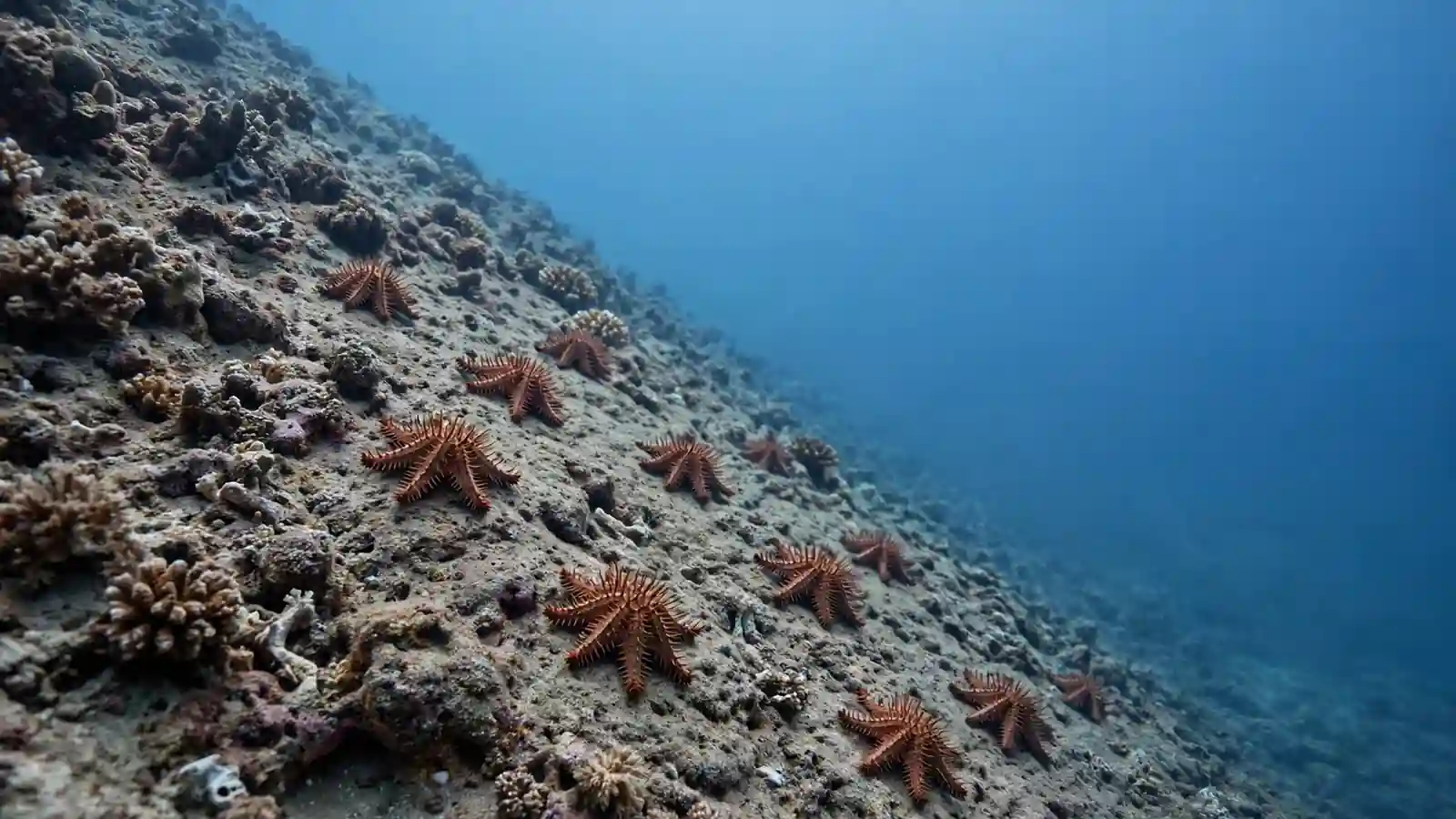
The outbreaks are driven by reproduction. A female crown of thorns can release millions of eggs in a single spawning, and the larvae drift in the plankton for weeks before settling on the reef. In a good year, with warm water and plenty of plankton food, a huge proportion of the larvae survive — and two years later, the reef is covered in young starfish.
The outbreaks are not new. They have happened for as long as people have watched the reefs, and the Great Barrier Reef has had four major outbreaks since the 1960s. What has changed is the frequency and the context: the reefs are now stressed by warming water and by runoff from the land, and the outbreaks hit harder because the coral is already weakened. The starfish is not the only threat to the reef — but it is the one that eats it.
The Damage to the Reef
The damage an outbreak does is visible from the air. A reef hit by crown of thorns turns white: the living coral is stripped to skeleton, and the white skeletons stand out against the blue water like bones. The fish leave, because the coral they shelter in is gone, and the reef’s structure — the three-dimensional habitat that supports hundreds of species — collapses into rubble.

On the Great Barrier Reef, the outbreaks have destroyed large areas of coral. The starfish are responsible for a significant share of the coral loss on the reef over the past decades, alongside bleaching and cyclones, and the losses are concentrated: an outbreak moves across a reef like a fire, eating everything in its path, and the reef behind it takes a decade or more to recover.
The recovery is possible — the reef does grow back, and the coral does return — but it is slow, and it depends on the outbreak ending. A reef that is hit by bleaching and then by crown of thorns, in the same decade, may not recover at all. The damage is not just the coral that is eaten; it is the years of growth that are lost, and the species that depend on the coral and do not come back.
Controlling the Outbreaks
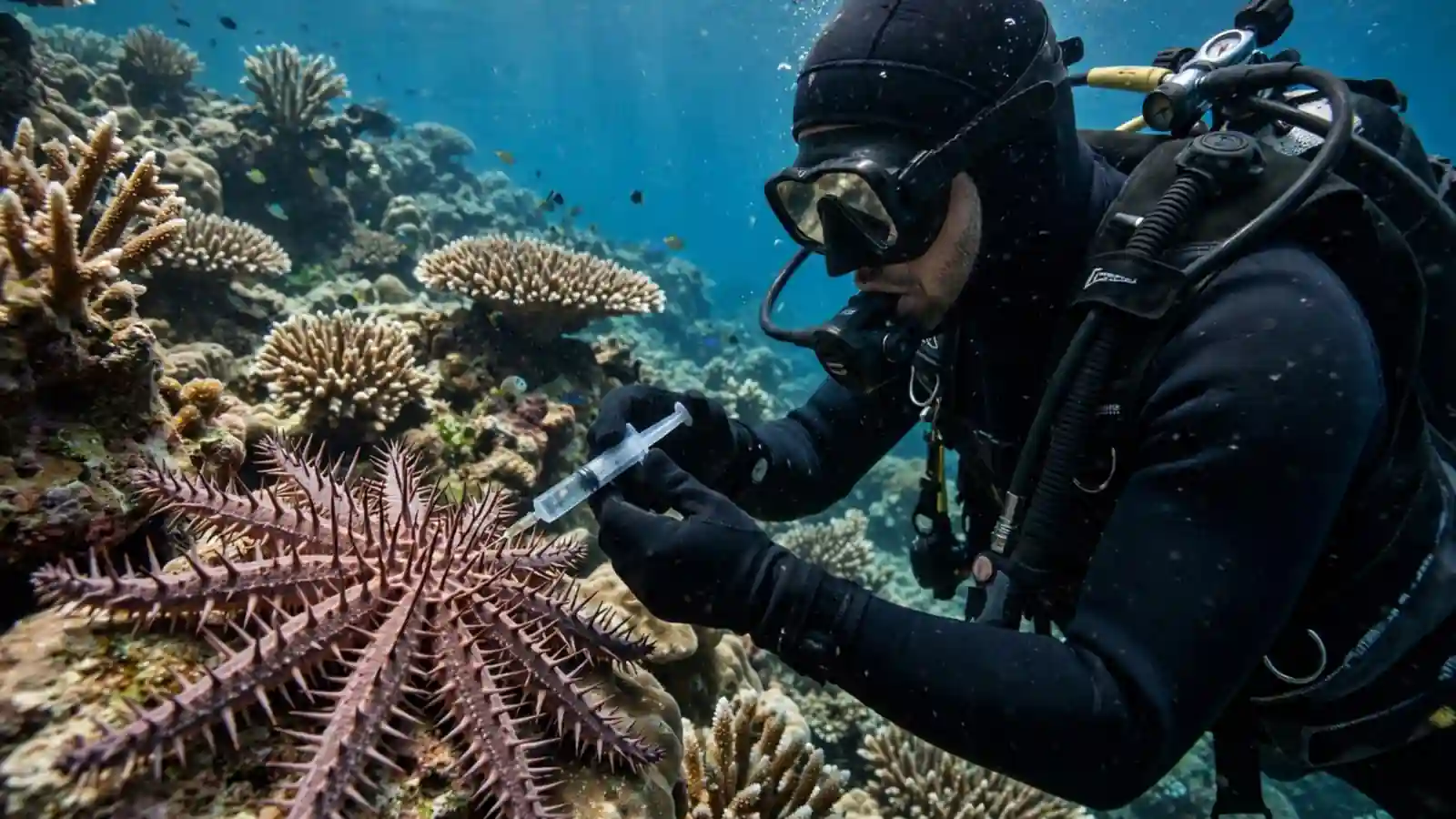
Controlling a crown of thorns outbreak is done by hand, one starfish at a time. Divers swim the reef, find the animals, and inject them with bile salts or vinegar — a dose that kills the starfish without harming the reef around it. The work is slow and expensive: a team of divers can clear a reef in days, but the reef must be revisited, because the starfish keep coming.
The other control is the giant triton snail, the starfish’s natural predator. The triton is a large, beautiful sea snail that hunts crown of thorns, prising them off the reef and eating them whole — and it is one of the few animals that can. The triton’s shell was once collected as a souvenir, and the collecting reduced the triton population, which helped the starfish. Protecting the triton is now part of protecting the reef.

The control effort is the largest of its kind in the world. On the Great Barrier Reef, a dedicated control programme employs divers year-round, targeting the outbreaks before they spread, and the programme has kept some reefs alive that would otherwise have been stripped. The work is never finished — the starfish are native, and they will always be there — but the control keeps their numbers at a level the reef can live with. The threat and the response are set out in detail in the threat guide.
Fun Facts
- A single animal can eat up to about ten square metres of coral a year.
- An outbreak is defined as fifteen or more animals per hectare.
- A female can release millions of eggs in a single spawning.
- The spines are venomous, but there are no recorded human fatalities.
- The giant triton snail is one of the few animals that can eat a crown of thorns.
- The species is native to the Indo-Pacific — it is not an invader, and the reefs evolved with it.
Frequently Asked Questions
Are Crown of Thorns Starfish Invasive?
No. The crown of thorns starfish is native to the Indo-Pacific, and it has lived on these reefs for millions of years. The problem is not that it is here — it is that, in some places and some years, its numbers explode into outbreaks, and the eating outpaces the coral’s growth. An invasive species is one that arrives from elsewhere; the crown of thorns is at home.
Are Crown of Thorns Starfish Venomous?
Yes. The long spines are venomous, and a sting causes intense pain, swelling and nausea. There are no recorded human fatalities, and the treatment is to remove the spines, soak the wound in hot water and seek medical care if the pain spreads. Divers give the animal room and never touch it with bare hands.
What Do Crown of Thorns Starfish Eat?
Living coral — above all Acropora, the fast-growing staghorn and table corals that build the reef’s structure. The starfish pushes its stomach out through its mouth and drapes it over the coral, digesting the living polyps and leaving the white skeleton behind. A single animal eats up to about ten square metres of coral a year, with the range in the literature roughly six to ten.
What Causes a Crown of Thorns Outbreak?
Reproduction. A female can release millions of eggs in a single spawning, and in a good year — warm water, plenty of plankton food for the larvae — a huge proportion survive. Two years later the reef is covered in young starfish. Outbreaks have happened for as long as people have watched the reefs, but they hit harder now because the coral is already stressed by warming water and runoff.
How Are Crown of Thorns Starfish Controlled?
By hand, one starfish at a time. Divers inject the animals with bile salts or vinegar, which kills the starfish without harming the reef, and the work is repeated because the starfish keep coming. The giant triton snail, the starfish’s natural predator, is also protected. On the Great Barrier Reef a dedicated control programme employs divers year-round.
How Many Arms Does a Crown of Thorns Starfish Have?
Seven to twenty-three, usually twelve to nineteen — far more than the five arms of an ordinary starfish. The animal is also much bigger than a rock-pool starfish, at 25 to 35 centimetres across and up to 80 centimetres in the largest specimens.
What Is the Difference Between Acanthaster Planci and Acanthaster Solaris?
They are the two names now used for the crown of thorns starfish. The species was long known as Acanthaster planci, and that name is still used for the Indian Ocean populations. The Pacific populations are now often separated as Acanthaster solaris, on the basis of genetic and physical differences. The split is recent and not yet universal — this guide notes it rather than choosing a side.
How Much Coral Does a Crown of Thorns Starfish Eat?
A single animal can eat up to about ten square metres of coral a year, eating living coral polyp by polyp and leaving white skeletons behind it. When there are thousands of them, the reef disappears.
Similar Species Worth Exploring
Keep Exploring
Meet the brittle star, the crown of thorns’ fast, arm-shedding cousin, then the sea cucumber, the reef’s cleaner, and browse the whole family in our types of echinoderms hub — then come back to the reef eater with the venomous spines, the crown of thorns starfish.