Spotted Eagle Ray Facts: Size, Leaps and Reef Habitat
Spotted Eagle Ray: The Leaping Ray of the Atlantic
The spotted eagle ray leaps clear of the water on a 3-metre wingspan, an Endangered Atlantic ray that carries a venomous tail barb.
By Emily Carter · Reviewed by our vet team · Updated 10 November 2026 · 7 min read
Leaps clear of waterWingspan about 3 mEndangered (2020)
At a Glance
The spotted eagle ray is the ray that flies twice. It flies underwater on a 3-metre wingspan, and it flies above it too — leaping clear of the surface in a full breach that ends in a splash heard across the bay. It is also a ray with a taxonomic split: the name that once covered the world’s spotted eagle rays now belongs to the Atlantic alone. This guide covers the leaps, the split, and the reef life of a ray that is now Endangered.
Spotted Eagle Ray Size: A 3-Metre Wingspan
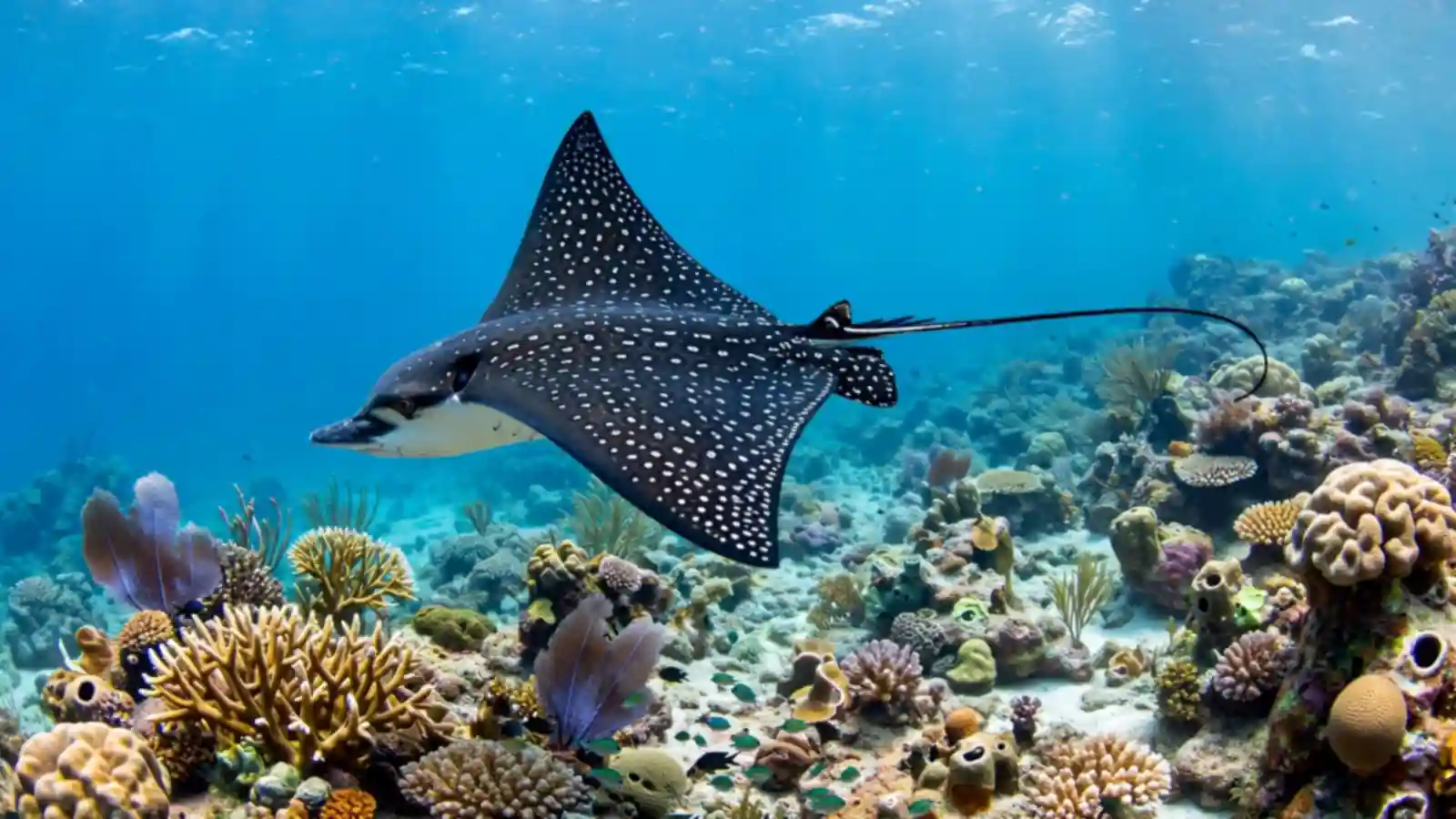
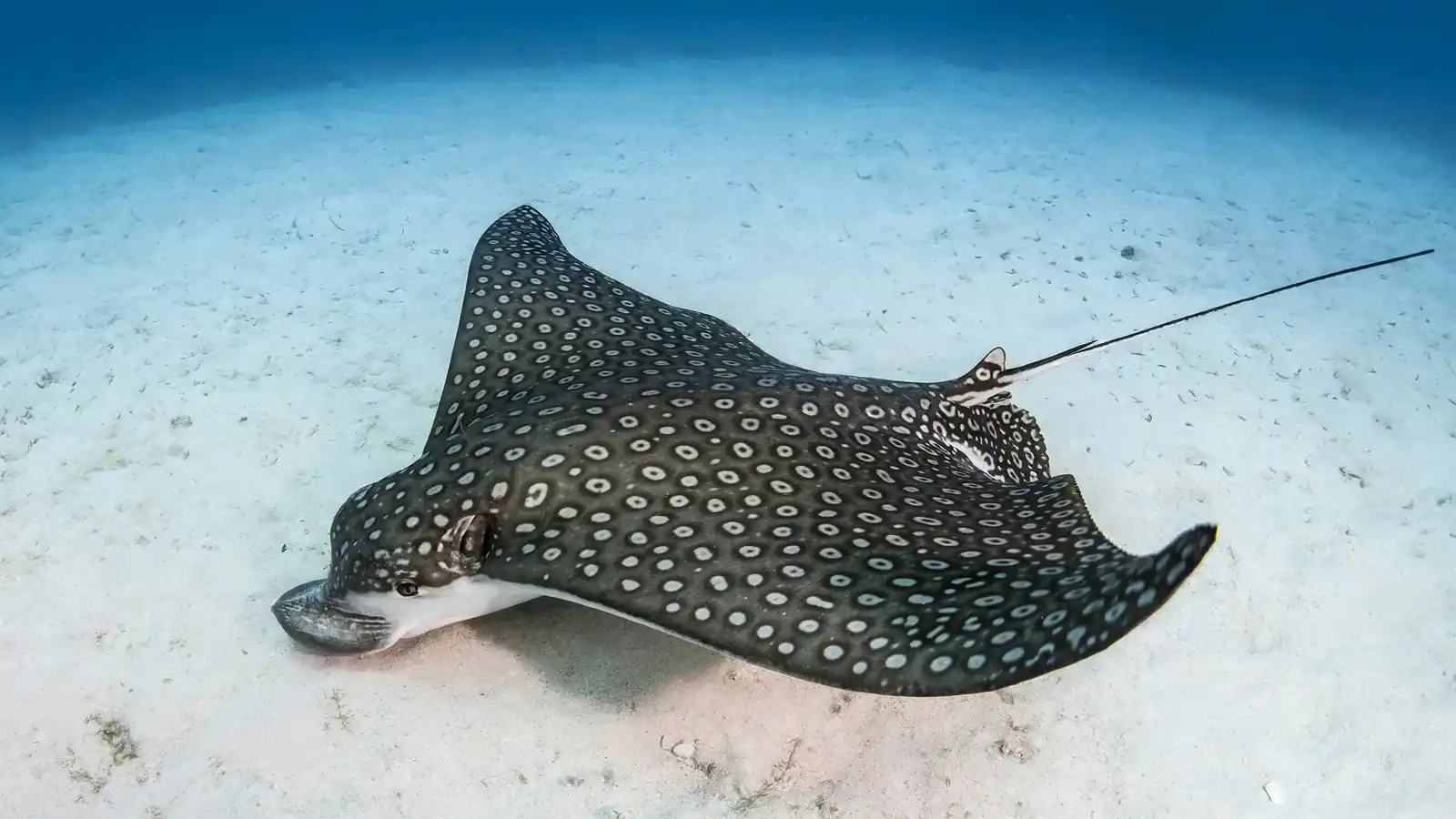
It has a wingspan of about 3 metres and weighs up to 230 kg, with a total length of about 5 metres including its long, whip-like tail. Its back is dark with a pattern of white spots — the marking that gives the species its name — and its head is pointed, with a duck-like snout.
The spots are the identification mark, and they are unique to each animal: no two spotted eagle rays have the same pattern, and researchers use the spots to recognise individuals, the way whale researchers use fluke patterns. For the full species record, see the Florida spotted eagle ray species profile.
Why Spotted Eagle Rays Leap Clear of the Water
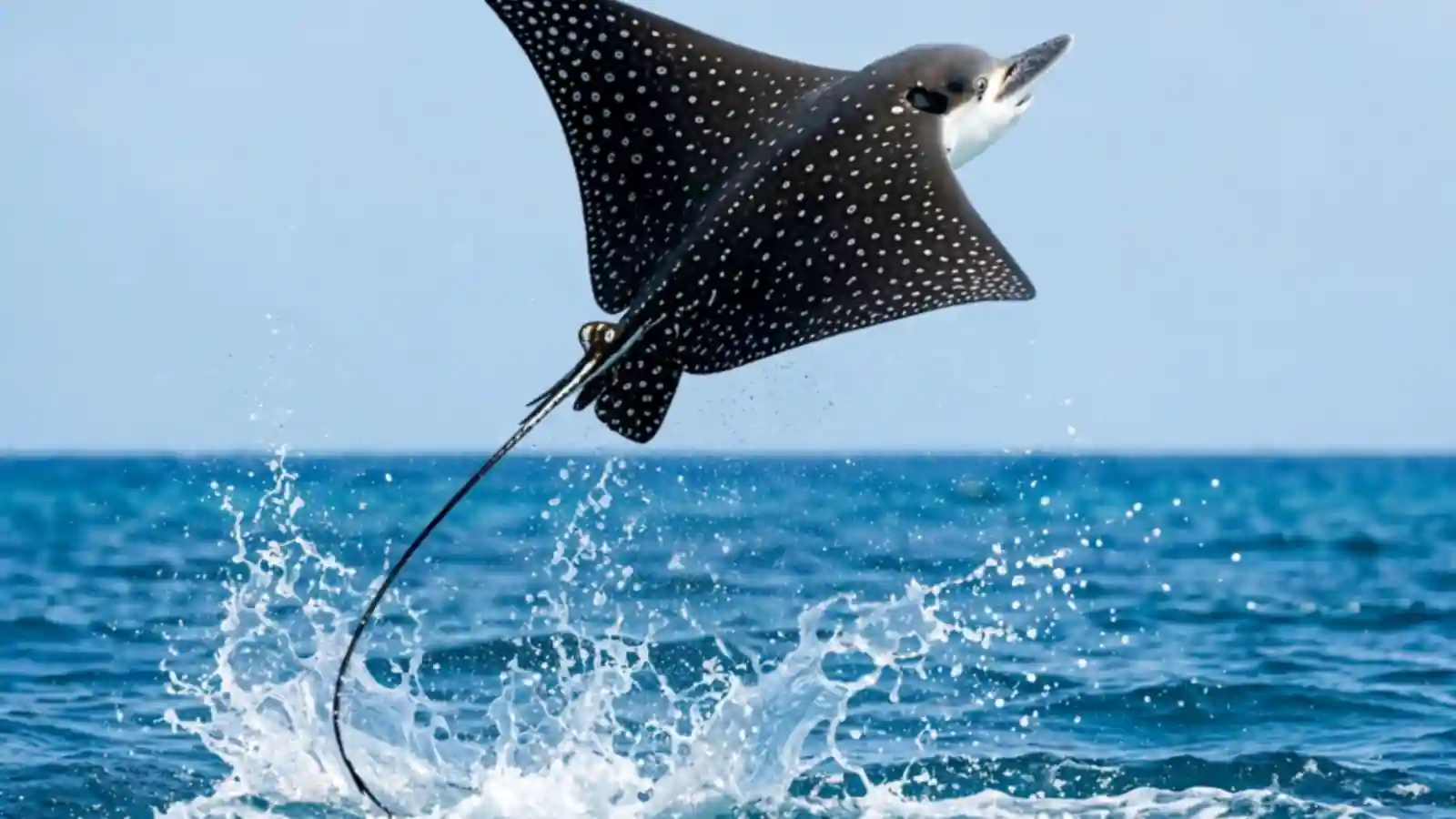
Spotted eagle rays leap clear of the water, sometimes several times in a row, landing with a splash that can be heard across a bay. Why they leap is still debated — the leading ideas are that they are shaking off parasites, communicating, or simply playing — but the behaviour is one of the most famous sights in the ray world.
The leap is a full breach: the ray leaves the water completely, wings spread, and comes down flat. It is not a jump for food — the ray’s food is on the bottom — which makes the behaviour all the more remarkable.
Where Spotted Eagle Rays Live: The Atlantic Only
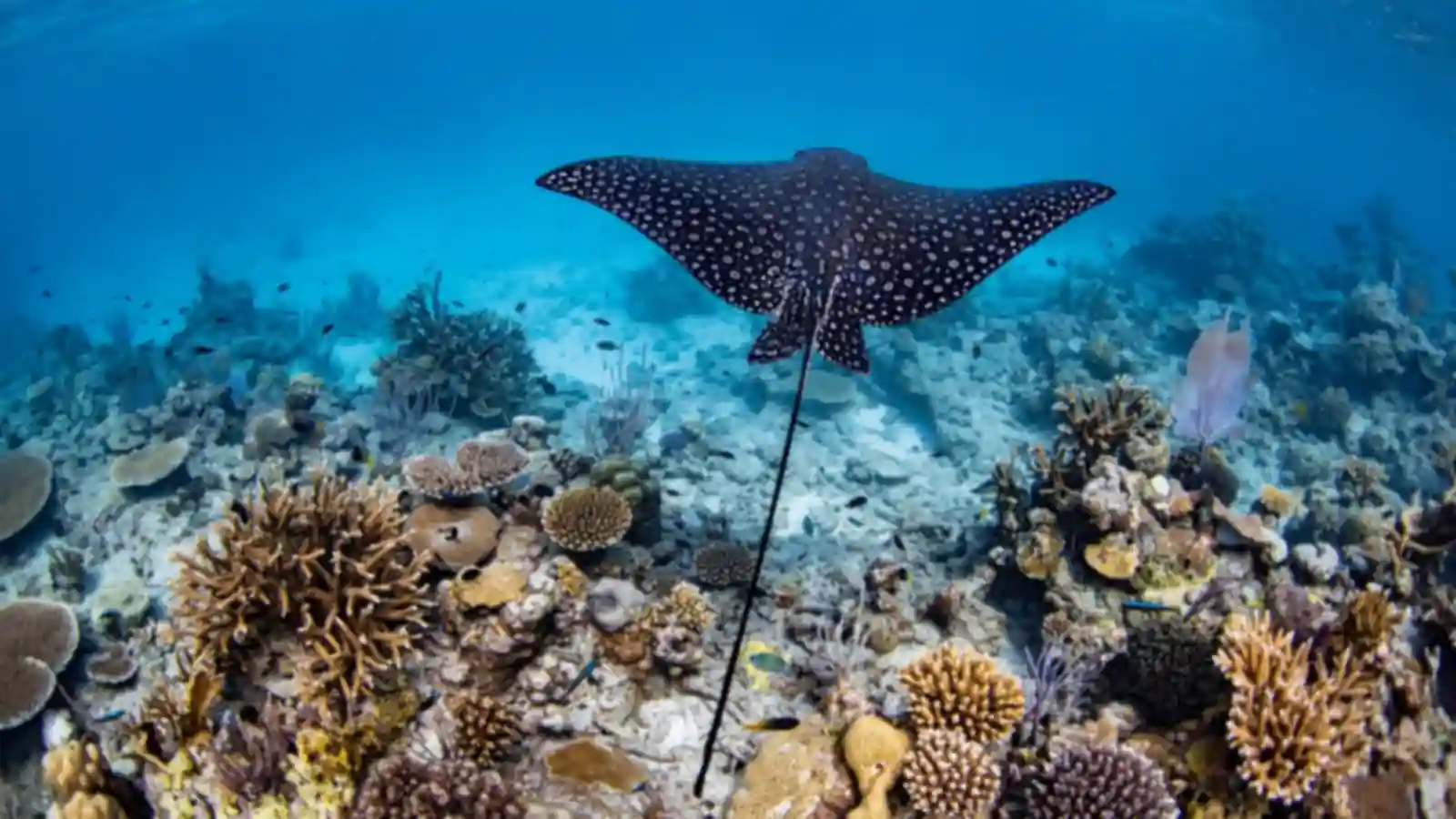
It lives in the Atlantic Ocean — and that “only” matters. For decades, the name Aetobatus narinari was used for spotted eagle rays worldwide, but a taxonomic split has divided them: the Atlantic species keeps the name narinari, the Indo-Pacific species is now Aetobatus ocellatus, and the eastern Pacific species is Aetobatus laticeps.
The Atlantic ray lives on reefs, in bays and estuaries, and in shallow coastal water, usually over sand or seagrass where its food is buried. It is a warm-water ray, and it moves with the seasons, following the warm water north in summer and south in winter.
What Do Spotted Eagle Rays Eat? Crushing Shells on the Bottom

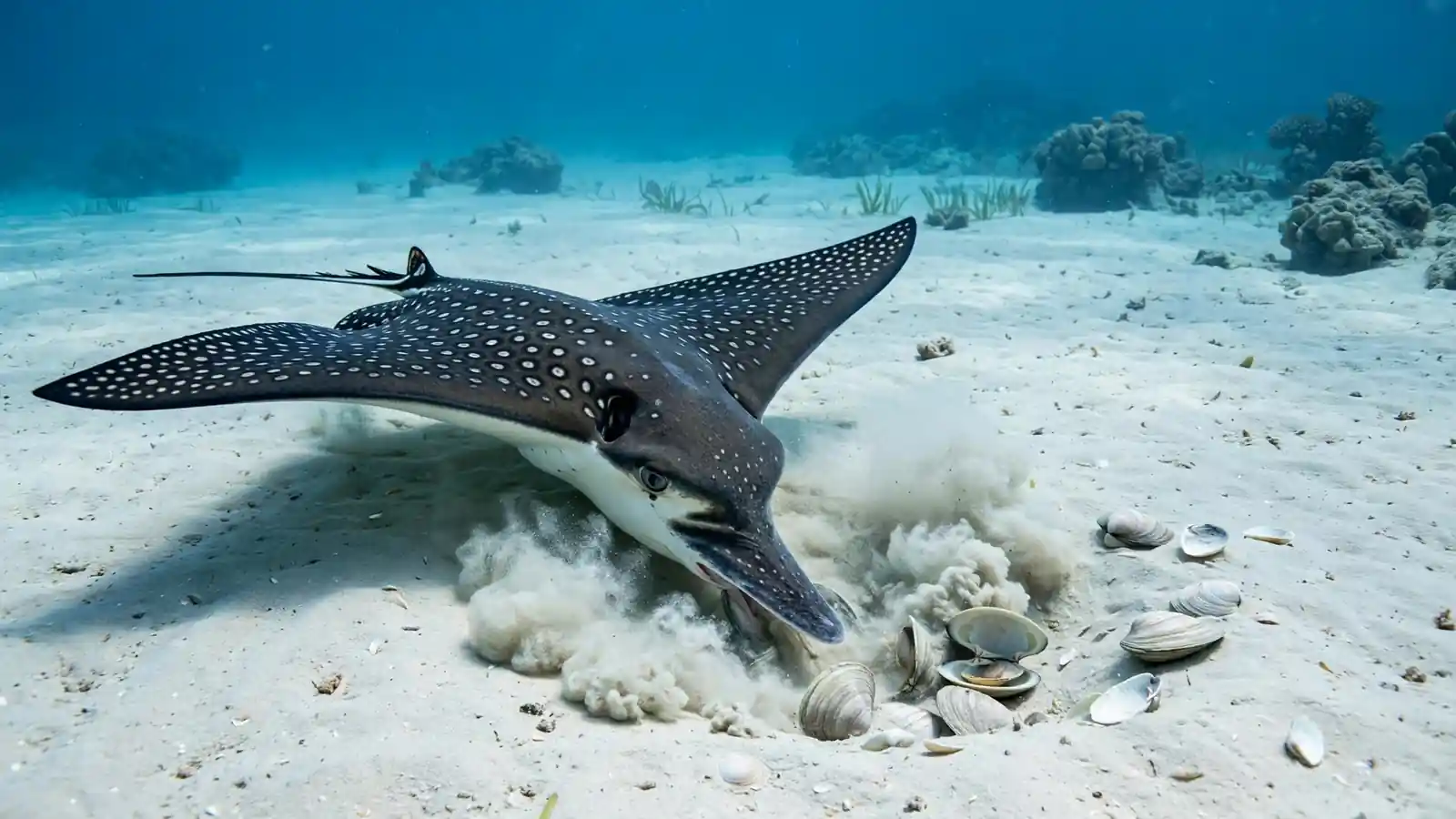
It eats molluscs, crustaceans and small fish, dug from the sand with its snout and crushed with the flat, plate-like teeth in its jaws. It roots in the bottom like a pig, leaving pits in the sand that mark where it has fed. The butterfly ray works the same sandy bottom, a wide flat disc gliding low over the sand in search of buried prey.
Its feeding is a reef service of sorts: by digging, the ray turns over the sediment and exposes food for other animals, and by eating molluscs it keeps shellfish numbers in check. A ray’s feeding pit is a small ecosystem in itself.
The Venomous Tail Barb: A Sting to Respect
It carries a venomous barb on its long tail, and the sting is serious. In 2008, a man in the Florida Keys was killed when a leaping ray struck his boat and its barb pierced his chest — a freak accident, but a reminder that the barb is a real weapon.
The barb is defensive, not offensive: the ray uses it only when threatened, and it does not hunt with it. Swimmers and divers should give the ray space, especially when it is leaping — the danger is the tail, not the teeth.
Conservation: An Endangered Atlantic Ray
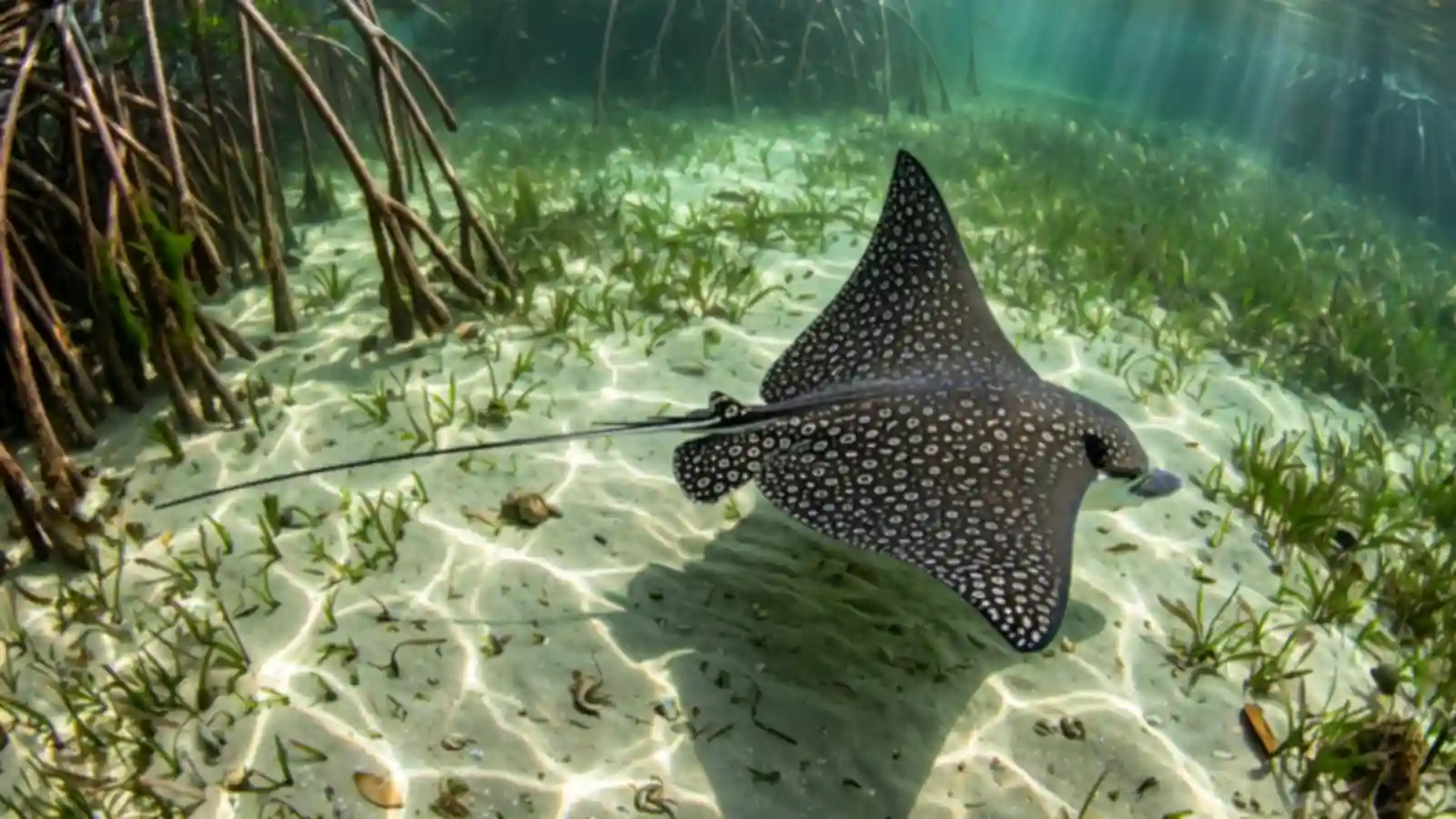
It is listed as Endangered, a status set in 2020. Older pages still show the old Near Threatened assessment, but that is outdated — the Atlantic population has fallen sharply under fishing pressure and habitat loss.
The species is protected in Florida, where it is illegal to harvest, and its future depends on protecting the shallow bays and seagrass beds where it feeds and breeds. A ray that leaps for joy — or for parasites — needs its home waters intact.
Fun Facts
- Spotted eagle rays leap completely clear of the water, sometimes several times in a row.
- No two spotted eagle rays have the same spot pattern.
- The Atlantic species keeps the name narinari; the Indo-Pacific one is now ocellatus.
- A leaping ray killed a man in the Florida Keys in 2008 — a freak accident.
- The ray’s total length, including its tail, is about 5 metres.
- Spotted eagle rays are protected in Florida, where harvest is illegal.
Frequently Asked Questions
How Big Do Spotted Eagle Rays Get?
The wingspan is about 3 metres, the weight up to 230 kg, and the total length about 5 metres including the long whip-like tail.
Why Do Spotted Eagle Rays Jump Out of the Water?
The reason is still debated — the leading ideas are shaking off parasites, communicating, or play. The leap is a full breach, wings spread, landing flat.
Where Do Spotted Eagle Rays Live?
In the Atlantic Ocean only — on reefs, in bays and estuaries, and in shallow coastal water over sand or seagrass. The Indo-Pacific and eastern Pacific spotted eagle rays are now separate species.
What Do Spotted Eagle Rays Eat?
Molluscs, crustaceans and small fish, dug from the sand with the snout and crushed with flat, plate-like teeth.
Are Spotted Eagle Rays Dangerous?
They carry a venomous barb on the tail, and the sting is serious — a man was killed in the Florida Keys in 2008 when a leaping ray struck his boat. The barb is defensive, and the ray does not hunt with it.
What Is the Difference Between a Spotted Eagle Ray and a Manta Ray?
The manta ray is much larger — up to 7 metres across — with a wide terminal mouth for filter-feeding and no stinger. The spotted eagle ray is smaller, about 3 metres across, with a pointed duck-like snout, a spotted back and a venomous tail barb.
Are Spotted Eagle Rays Endangered?
Yes — the spotted eagle ray is listed as Endangered (2020). Older pages still show Near Threatened, but that assessment is outdated.
Similar Species Worth Exploring
Keep Exploring
Still exploring the rays? Meet the schooling Cownose Ray, watch the leaping Devil Ray, and then size up the largest ray of all, the Giant Manta Ray, and then come back to the bay to meet the spotted eagle ray.