Haddock
Haddock: the cod with the devil’s thumbprint
The haddock is the cod family’s marked member, a North Atlantic fish carrying a black thumbprint behind its gill that folklore blames on the devil himself. This guide explains the mark and its legends, covers where the fish lives and what it eats, and settles the comparison everyone asks about, haddock versus cod, from the animal’s side of the story.
By Emily Carter · Reviewed by our vet team · Updated 10 November 2026 · 8 min read
Marked with a black thumbprintNorth Atlantic bottom-dwellerThe cod comparison, settled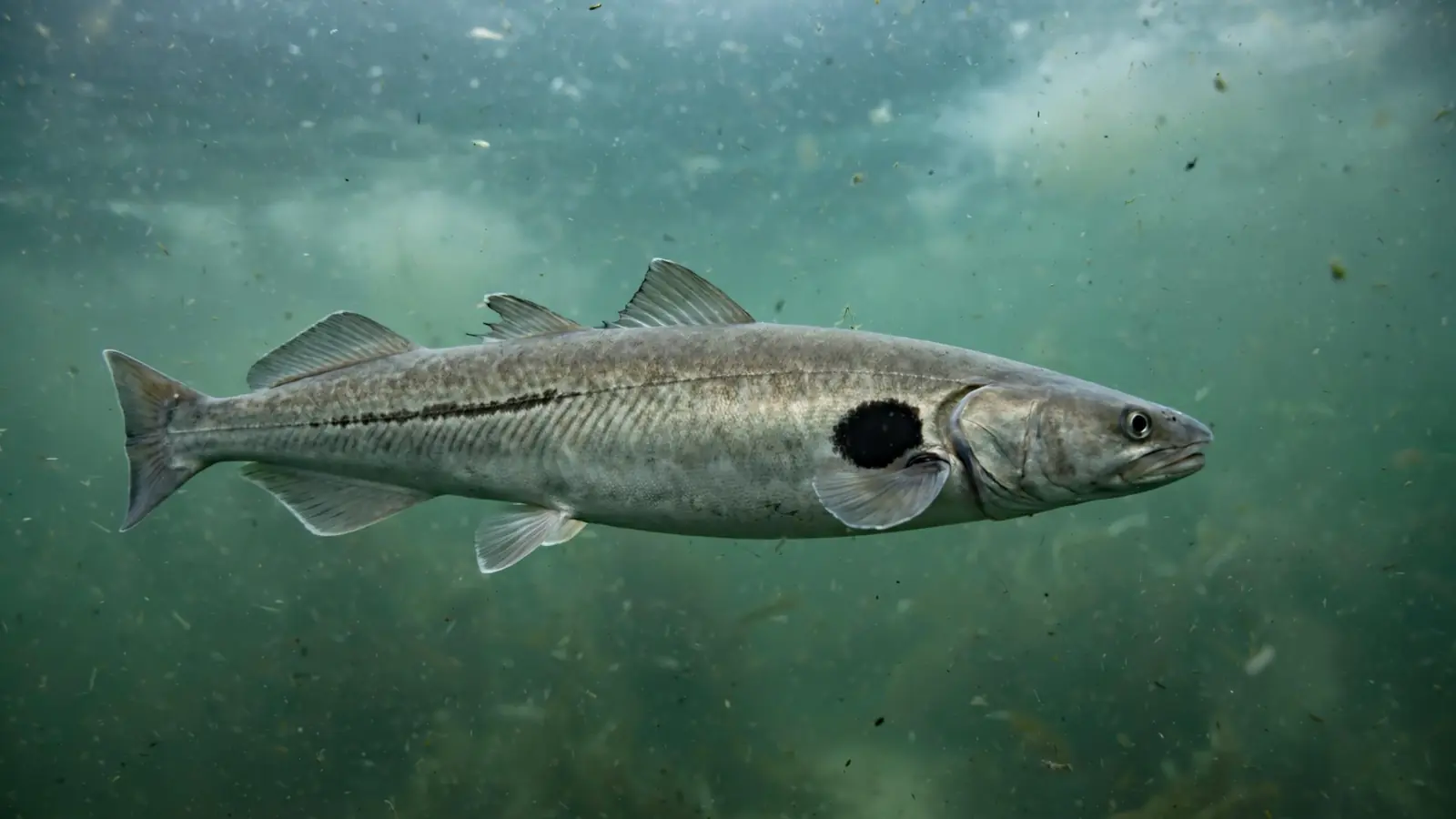
At a Glance
A haddock wears its identity on its shoulder: one black thumbprint, pressed in behind the gill as if the fish had been grabbed by a sooty hand. It is the quickest identity check in the North Atlantic, and around that small dark mark has gathered a fish of folklore, of winter spawning shoals, and of the longest-running argument in the fish shop, it or cod.
The Thumbprint: St Peter’s Mark
Every fish carries the same signature: a bold black blotch on each side, set above the pectoral fin like a thumb pressed in ink, and running back from it a lateral line of jet black that gives the fish its scientific name, Melanogrammus, the black-lined one. Two old stories compete to explain the blotch. In one, it is the thumbprint of St Peter, left when the apostle handled the fish; in the grimmer Scottish version, the devil grabbed a one and the scorch of his fingers never faded. Biologists, less romantically, read it as camouflage and signalling, a disruptive mark that also tells one from another at a distance.

Whatever its origin, the mark works as a field guide all by itself. No other North Atlantic member of the cod family carries a blotch like it, and together with the black line it separates a one from cod, whiting and pollock at a glance, in the water, on the deck or through the fishmonger’s glass. The devil, St Peter or plain pigment, it is the most useful thumbprint in the Atlantic.
Bottom Life in the Cold Atlantic
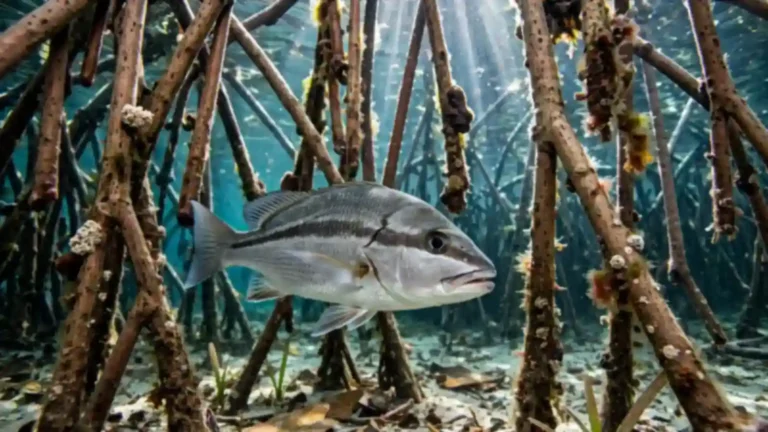
They live their whole adult lives in touching distance of the floor of the North Atlantic. The range runs on both sides of the ocean, from New England and Georges Bank to Iceland, the North Sea, the Norwegian coast and the Barents Sea. The fish hold over sand, gravel and broken ground, most often between about 40 and 150 metres down, 130 to 500 feet, in water that stays properly cold in every season. They are not wanderers of the open column like their pollock cousins; the seabed is home, pantry and shelter in one.

The year turns on spawning. In late winter and early spring the fish gather in great shoals over chosen grounds, the North Sea and Georges Bank among the famous ones, and the females shed their buoyant eggs into the current by the million. For the rest of the year the shoals loosen and the fish spread across the feeding bottoms, growing on the rich northern grounds through the short summer. The animal’s species account maps the range, depths and grounds in full.
What Do Haddock Eat? Sifting the Seabed
A fish eats the bottom itself, or near enough. Working head-down over the ground, it picks marine worms, brittle stars and small sea urchins, crushes little crustaceans and molluscs, and sieves the sediment for buried prey, guided by a chin barbel fringed with taste buds that samples the seabed like a tongue. When small fish come within reach, sand eels, capelin, sprats and young herring, the browsing turns to snapping, and adult fish rise off the bottom to take them.
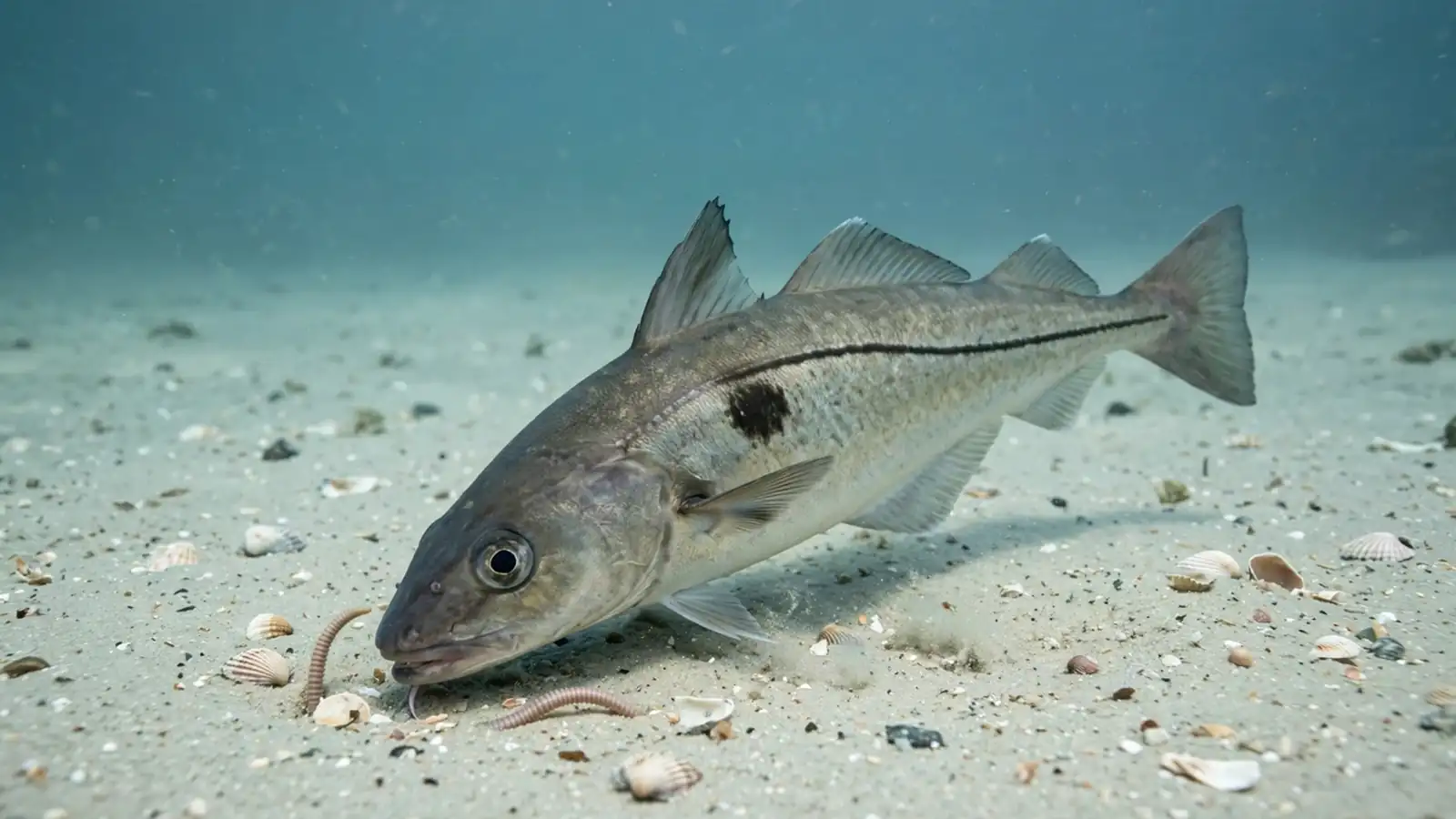
The traffic runs both ways. They are eaten by cod, by seals and by every large predator of the northern shelf, and the young fish in particular feed the ecosystem that feeds on them. Its own hunting is the quiet, deliberate kind, a lifetime spent combing the same cold gravel for whatever the tide of seasons delivers.
The Fish vs Cod: The Family Argument
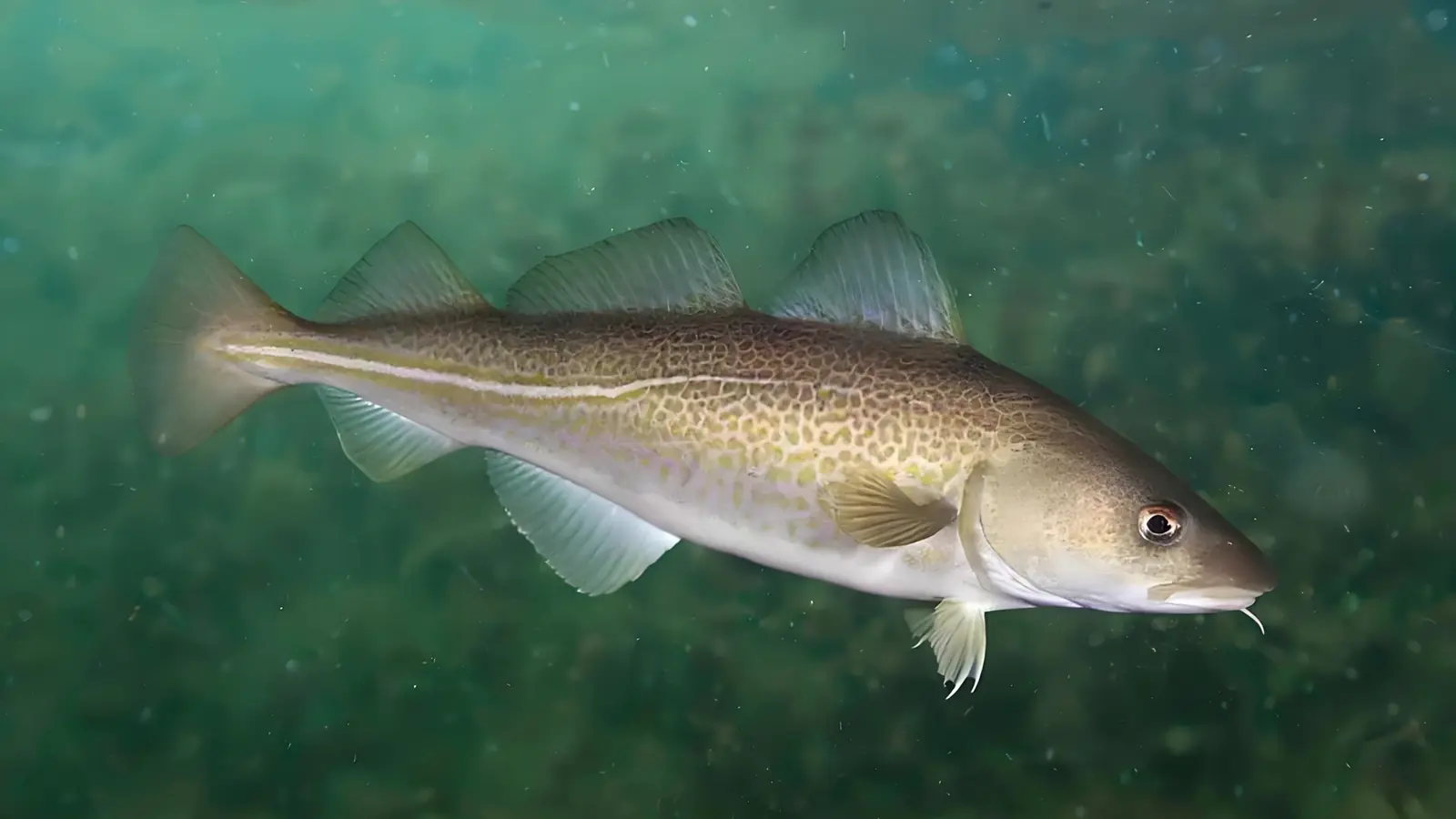
The comparison never dies because the fish genuinely are close: same family, same seas, same three-dorsal silhouette. The separation, though, is total once the marks are read. Cod: no thumbprint, a pale lateral line, heavy speckling, a bold barbel, a body that can pass a metre and 20 kilograms without strain. This fish: the black thumbprint, a black lateral line, a smaller mouth, a slimmer build, and a first dorsal fin that rises tall and pointed where the cod’s is merely respectable. Colour helps too: the fish’s back runs purplish-grey where the cod’s is green-brown and mottled.
One cultural postscript, kept to a sentence because this is the fish’s guide and not the smokehouse’s: the fish’s golden smoked form, the Finnan haddie of Scottish fame, is part of why the name carries so much affection in Britain. But the living distinction is the one that matters here, and it is written on the fish in black.
Size and Growth
This is a modest-sized fish by the standards of its family. The everyday adult measures 30 to 60 centimetres and weighs between 1 and 3 kilograms, the 2-to-7-pound fish of a thousand fish counters. Beyond that, the tail of the distribution stretches a long way: exceptional fish approach a metre in length, and the greatest recorded fish pass it. Nothing in the species’ design suggests the cod’s bulk; the fish is the slighter, finer-boned cousin throughout its life.
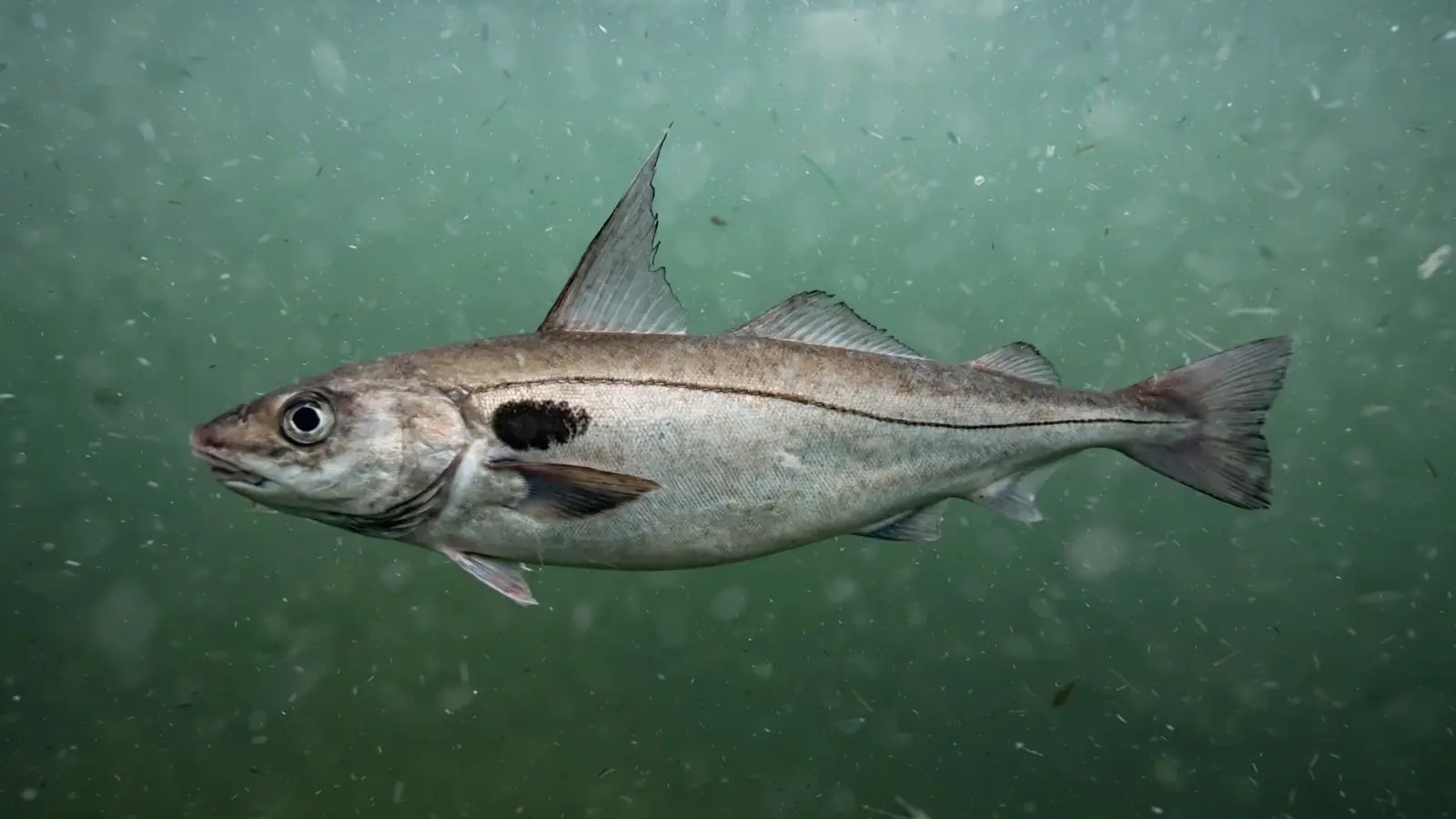
Growth is quickest in the first years and in the richest grounds; a fish of the famous strong year classes can seem to be everywhere at once, all the same size, a single generation moving through the sea like a cohort through a school. The giants, meanwhile, are simply the ones that kept not dying, in an ocean that gives a bottom fish a hundred ways to do so.
Life Cycle: Ten Years on the Bottom
They live past ten years as a matter of course, and the elders approach twenty, a respectable span for a fish of the trawled shelf. They mature at two to four years old, and the spawning system runs on abundance: a large female releases eggs not in the thousands but in the millions across a season, scattering them to drift with the plankton. What the system cannot control is the sea itself, and Their recruitment is famously fickle, most year classes modest, and now and then one enormous class that carries the population for a decade.
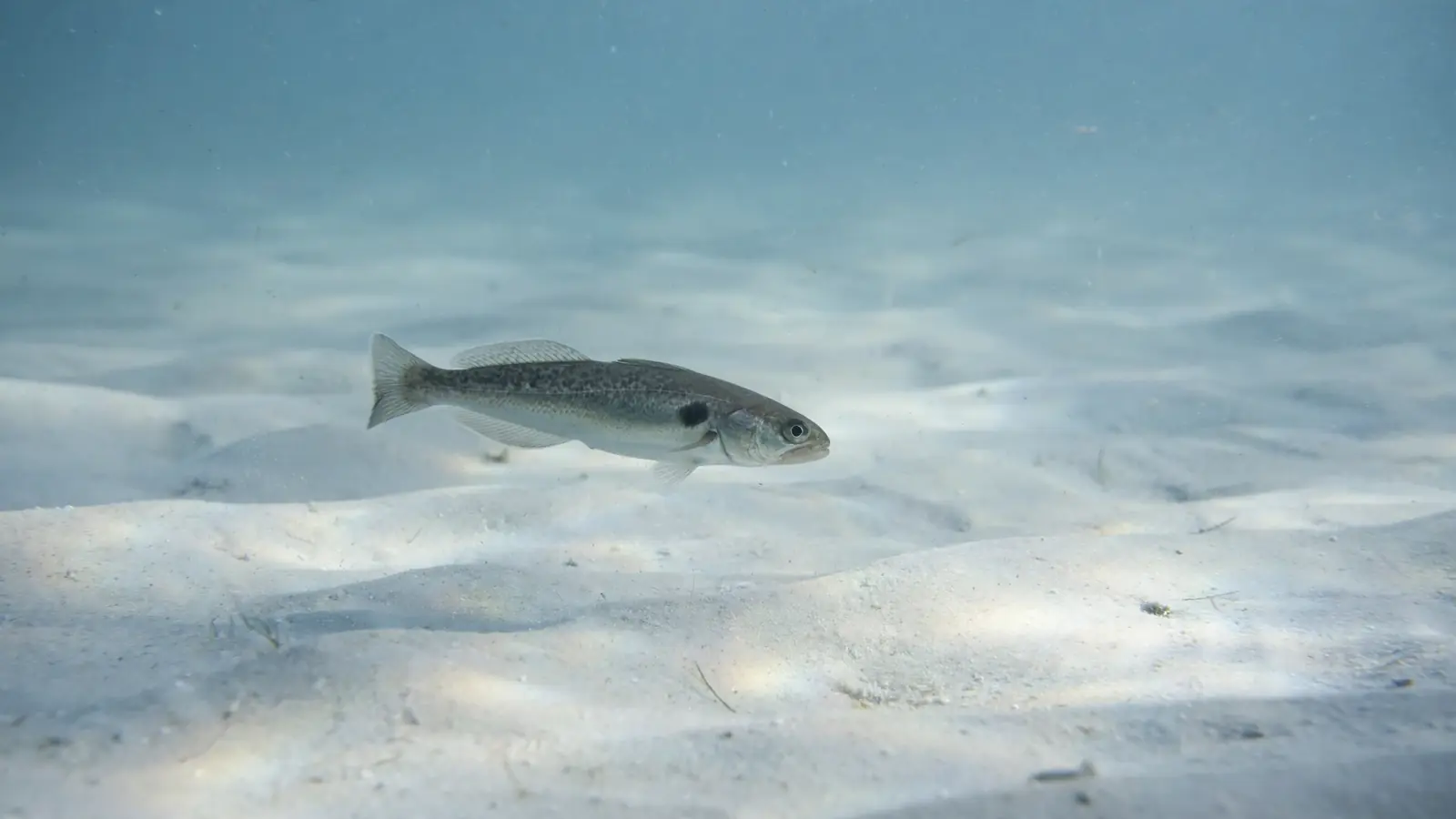
The global assessment lists the species as Vulnerable, a warning earned in decades of heavy trawling, yet the species has also become a management success in places: several stocks, the North Sea’s prominently, have rebuilt under firm quotas as the strong year classes were protected rather than cropped. A fish that can flood the sea with eggs needs only to be left enough adults, and the thumbprinted fish has shown it can do the rest.
Fun Facts
- Its scientific name, Melanogrammus, means “black line”, after the jet-black lateral line along its flank.
- Folklore gives the thumbprint two authors: St Peter, said to have gripped the fish, and the devil, whose burnt fingers are blamed in Scotland.
- A big female fish can release well over a million eggs across a single spawning season.
- They taste the seabed before they bite into it: the small chin barbel is lined with taste buds.
- Some fish year classes are so strong that one good spawning can dominate the population for years afterwards.
- The first dorsal fin of a one is tall and pointed, a little sail that no cod in its family can match.
Frequently Asked Questions
What Is the Black Mark on a Haddock?
It is a natural pigment blotch, mirrored on both sides of the body just above the pectoral fin, and it is the fish’s surest identification mark. Folklore prefers a better story: in one tradition the mark is St Peter’s thumbprint, left when the apostle gripped the fish; in Scottish telling, it is the devil’s burnt fingerprint. Its jet-black lateral line runs from the same shoulder, completing the signature.
Haddock vs Cod: What Is the Difference?
Marks and proportions separate the cousins. A fish carries the black thumbprint and a black lateral line; a cod has neither, wearing speckles and a pale line instead. Cod grow far larger, with a bolder chin barbel and a squarer tail, while the fish is slimmer, smaller-mouthed and taller in its first dorsal fin, which rises pointed like a little sail. Put together, a marked, dark-lined fish is a one every time.
Where Do Haddock Live?
They live on and just above the seabed of the North Atlantic, on both the American and European sides, from New England and Georges Bank across to Iceland, the North Sea, Norway and the Barents Sea. They favour depths of roughly 40 to 150 metres over sand, gravel and broken rock, in water that stays cold the year round.
What Do Haddock Eat?
The seabed provides. They browse the bottom for marine worms, brittle stars, sea urchins, small crustaceans and molluscs, probing with a chin barbel lined with taste buds, and they rise to take small fish such as sand eels, capelin and young herring when the chance offers. It is a bottom-feeder’s diet, found by taste and touch as much as by sight.
How Big Do Haddock Get?
The typical adult is 30 to 60 centimetres long and somewhere between 1 and 3 kilograms (roughly 2 to 7 pounds). Exceptional fish run much larger, approaching a metre; the greatest lengths on record pass it slightly. As with most of the cod family, the giants are the survivors, fish that have run the gauntlet of predators and nets for a decade or more.
How Long Do Haddock Live?
They commonly live beyond ten years, and the oldest individuals approach twenty. They mature at two to four years old and spawn in late winter and early spring, the females releasing buoyant eggs that can number in the millions for a large fish. Survival of the young varies wildly between years, which is why single strong year classes echo through the population for a decade.
Similar Species Worth Exploring
Keep Exploring
Keep exploring the cod family: meet the two-fish puzzle in our pollock guide, or browse the whole shoal in the types of fish. Then come back to the fish carrying the oldest fingerprint in the Atlantic: the haddock.