Christmas Tree Worm: Coral Crowns, Size and Reef Life
Christmas Tree Worm: Coral Crowns, Size and Reef Life
The Christmas tree worm is a tiny worm that lives in a tube inside a coral head, with two bright spiral crowns that look like miniature Christmas trees. It is one of the most photographed animals on the reef — a flash of colour no bigger than a thumbnail, waving its crowns in the current and vanishing into its tube at the first sign of danger.
By Emily Carter · Reviewed by our vet team · Updated 10 November 2026 · 8 min read
Spiral tree crownsLives in coralTo 4 cm
At a Glance
The Christmas tree worm is a small, colourful worm that lives in a tube buried in a coral head, with only its two spiral crowns showing. The crowns look like tiny Christmas trees — bright, feathery spirals in red, orange, yellow, blue or white — and they are the worm’s gills and its dinner table in one: they take in oxygen and catch plankton from the water. The worm itself is rarely seen, because at the first sign of danger it pulls the crowns into its tube and disappears.
What Is a Christmas Tree Worm?
It is a tube-dwelling marine worm in the family Serpulidae, the feather-duster worms, and its scientific name is Spirobranchus giganteus. It lives in the tropical reefs of the Caribbean and the Indo-Pacific, buried in a tube inside a living coral head, with only its two spiral crowns showing above the coral’s surface.

The worm is small — the crowns are only about 4 centimetres across — but it is one of the most recognisable animals on the reef, because the crowns are so brightly coloured and so distinctive. The name comes from the shape: two spirals, like miniature Christmas trees, waving in the current. The worm’s cousin, the tube worm of the deep sea, lives the same tube-dwelling life at vents — but this worm does it in the sunlit shallows, in a coral head, in full colour.
Christmas Tree Worm Crowns: The Spiral Trees
The crowns are its signature: two spirals of feathery tentacles, called radioles, that unroll from the tube like tiny Christmas trees. The radioles are covered in fine hairs, and they do two jobs at once — they take in oxygen from the water, like gills, and they catch plankton and detritus, like a net, passing the food down to the mouth at the centre of the crown.
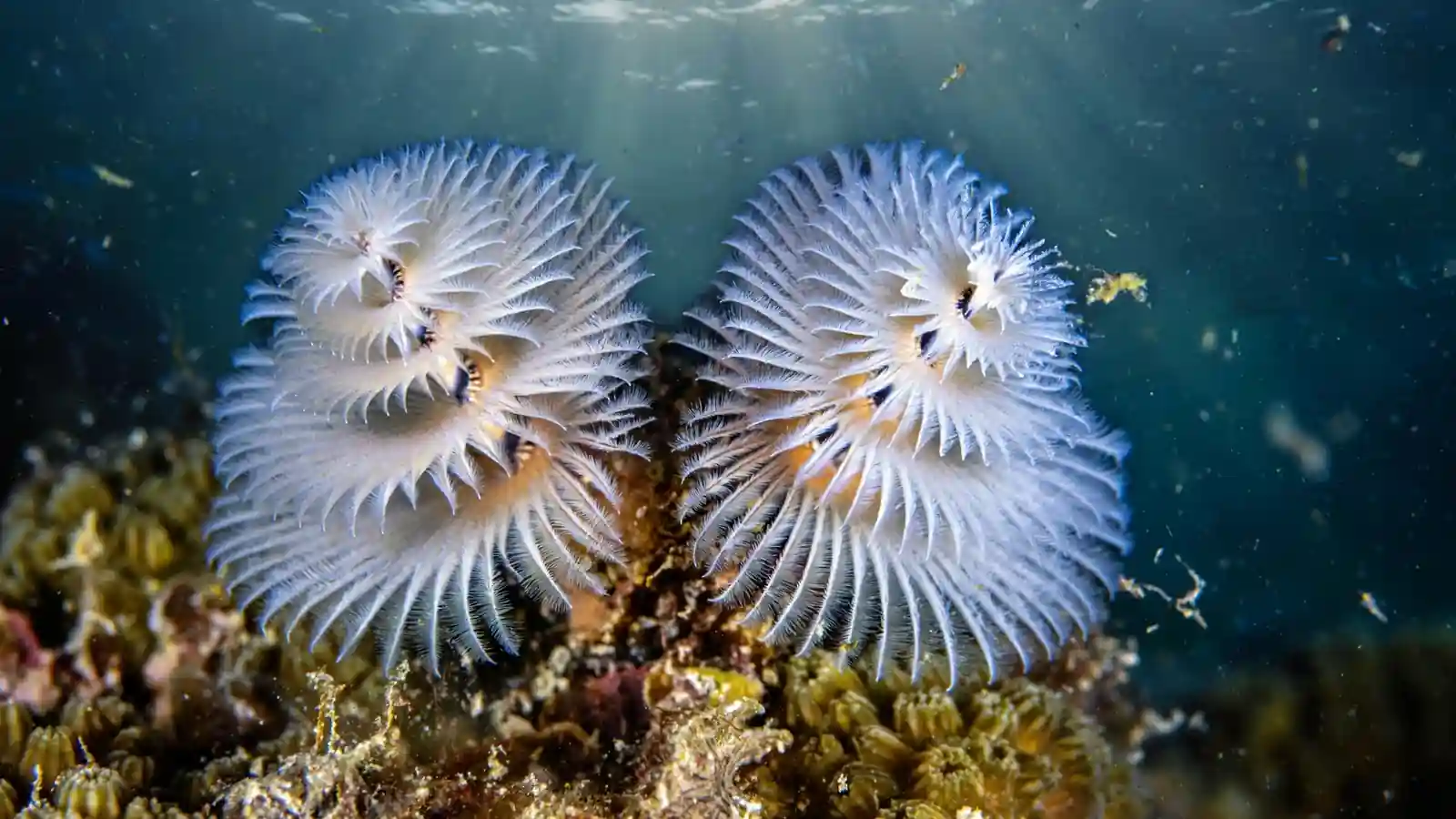
The crowns are also the worm’s alarm system. At the first sign of a shadow or a vibration, the worm pulls the crowns into its tube in a fraction of a second, and the tube’s opening is sealed by a plug called an operculum. Divers learn to approach slowly: one that has pulled in will not come out again for minutes, and a reef full of withdrawn worms is a reef of empty holes.
Colors: Red, Orange, Blue and White
Christmas tree worms come in almost every colour of the reef: bright red, orange, yellow, blue, purple, white, and banded combinations of two or three. The colour is in the radioles themselves, and no two worms on a reef are quite the same — a single coral head can hold a dozen worms in a dozen different colours, like a tiny garden.

Why the colours are so varied is still debated. One idea is that the colour warns predators that the worm is not worth eating. Another is that the colour is simply a side effect of the pigments in the worm’s body, with no purpose at all. Whatever the reason, the colours are what make the worm a favourite of underwater photographers, and the reason it is one of the most photographed animals on the reef.
The Coral Home: Living in the Reef
It lives inside a living coral head — most often a brain coral or a star coral — in a tube it builds for itself. The worm settles on the coral as a larva, builds its tube, and the coral grows around it, burying the tube in the coral skeleton until only the opening shows. The worm and the coral live together for years, sometimes decades, and the worm’s tube becomes part of the reef itself.

The partnership is mostly one-sided: the worm gets a home and protection, and the coral gets little in return — though some studies suggest the worm’s feeding may help the coral by clearing sediment from its surface. The worm cannot leave its tube, and if the coral dies, the worm dies with it. The worm’s fate is tied to the reef’s fate, which is why it is a quiet indicator of reef health: where the reefs are healthy, the worms are everywhere.
Feeding: Plankton From the Current
It feeds by filtering the water. Its crowns are covered in fine hairs that catch plankton and detritus drifting past in the current, and tiny cilia pass the food down the radioles to the mouth at the centre of the crown. The worm feeds whenever the current is running and the crowns are out, and it stops the moment it pulls in.

The feeding is gentle and constant, and the worm’s needs are small — a few plankton a minute, all day, every day. The crowns’ other job is breathing: the same feathery surface that catches food also takes in oxygen from the water, so the worm breathes and eats with the same organ. It is a simple, elegant design, and it works in the clear, current-swept water of a healthy reef.
Life Cycle and Lifespan
Its life begins as a tiny larva, drifting in the plankton for 9 to 12 days before settling on a coral head. The larva builds a small tube, grows its crowns, and begins the long, quiet life of a reef worm — feeding, growing, and pulling in at every shadow. The worm grows slowly, and the tube grows with it, buried deeper in the coral as the coral grows around it.

Christmas tree worms live a long time for such a small animal: more than 30 years, with the longest-lived worms outlasting the coral heads they live in. They breed by releasing eggs and sperm into the water, and the larvae drift on to the next reef. The species has not been assessed by the IUCN, so it carries no Red List category.
Reef Health: Why These Worms Matter
It is a quiet indicator of reef health. Where the reefs are healthy, the worms are everywhere — a dozen colours on a single coral head, crowns waving in the current. Where the reefs are damaged by bleaching, pollution or storms, the worms are among the first animals to disappear, because they cannot leave their coral home and they cannot survive without clear, current-swept water.

The worm’s fate is tied to the coral’s fate, and the coral’s fate is tied to the ocean’s temperature and chemistry. Protecting the reef protects the worm, and the worm’s bright crowns are a reminder of what a healthy reef looks like. The guide from the Angari Foundation describes the worm and its coral home in detail.
Fun Facts
- Its crowns are only about 4 centimetres across — no bigger than a thumbnail.
- It can live for more than 30 years, outlasting the coral head it lives in.
- The worm pulls its crowns into its tube in a fraction of a second at the first sign of danger.
- A single coral head can hold a dozen worms in a dozen different colours.
- The crowns do two jobs at once: they breathe and they catch food.
- The worm cannot leave its tube — if the coral dies, the worm dies with it.
Frequently Asked Questions
What Is a Christmas Tree Worm?
The Christmas tree worm is a small tube-dwelling worm, Spirobranchus giganteus, that lives in a tube inside a living coral head on tropical reefs. Only its two spiral crowns show — bright, feathery spirals that look like miniature Christmas trees. The crowns are the worm’s gills and its dinner table in one.
How Big Is a Christmas Tree Worm?
Small. The crowns are only about 4 centimetres across, and the worm’s body inside the tube is a few centimetres long. The name “giganteus” is misleading — it refers to the species being large for its family, not large in absolute terms. The worm is one of the smallest animals on the reef, and one of the most photographed.
What Coral Do Christmas Tree Worms Live On?
Most often brain corals and star corals. The worm settles on the coral as a larva, builds its tube, and the coral grows around it until only the opening shows. The worm and the coral live together for years, sometimes decades, and the worm’s tube becomes part of the reef itself.
What Do Christmas Tree Worms Eat?
Plankton and detritus. The crowns are covered in fine hairs that catch plankton drifting past in the current, and tiny cilia pass the food down to the mouth at the centre of the crown. The same feathery surface also takes in oxygen, so the worm breathes and eats with the same organ.
Why Is It Called a Christmas Tree Worm?
For its crowns. The worm’s two spiral crowns of feathery tentacles look like miniature Christmas trees — bright, feathery spirals in red, orange, yellow, blue or white, waving in the current above the coral. The name comes from the shape, not from any connection to Christmas itself.
How Long Do Christmas Tree Worms Live?
A long time for such a small animal — more than 30 years, with the longest-lived worms outlasting the coral heads they live in. The worm grows slowly, and its tube grows with it, buried deeper in the coral as the coral grows around it.
Do Christmas Tree Worms Move?
Not as adults. A Christmas tree worm lives its whole adult life in one tube inside one coral head, and it cannot move to a new coral. It can only pull its crowns into the tube when threatened. The only moving stage is the larva, which drifts in the plankton for 9 to 12 days before settling on a coral head.
Similar Species Worth Exploring
Keep Exploring
Start with the tube worm family guide, then meet the giant tube worm, the three-metre giant of the vents, and browse the whole family in our types of marine worms hub — then come back to the tiny tree-crowned jewel of the reef, the Christmas tree worm.