Blue Crab
Blue Crab: the beautiful swimmer of the estuaries
The blue crab is the jewel of North America’s estuaries: sapphire-blue legs, an olive shell edged with spikes, and a temper famous among anyone who has tried to pick one up. It is also one of the few crabs that truly swims, rowing through the water on paddle-shaped back legs. Short-lived, fast-growing and endlessly eaten, by predators and people alike, it lives its three years at full speed.
By Emily Carter · Reviewed by our vet team · Updated 10 November 2026 · 9 min read
Sapphire-blue legs and clawsSwims with paddle legsMolts about 25 times in its life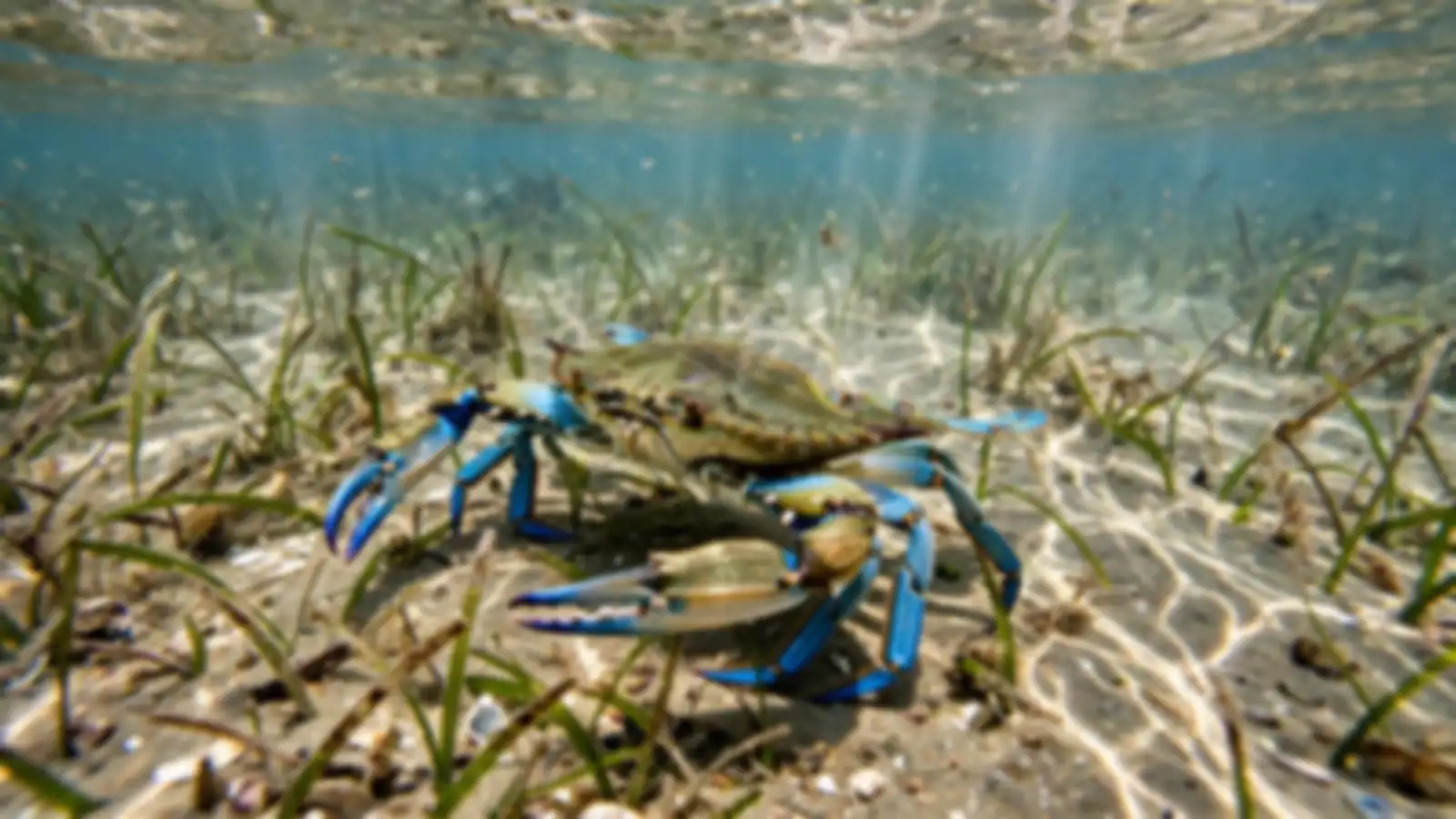
At a Glance
The blue crab, Callinectes sapidus, is the crab that built Chesapeake Bay’s reputation: Maryland’s state crustacean, the star of a thousand crab shacks, and above all a superb wild animal. It grows from a speck of plankton to a quarter-metre of spikes and attitude in about a year, mates once in a blaze of molting, and carries up to two million eggs at a time. Here is the animal behind the feast.
Blue Crab Size and Shape
A big specimen measures up to about 23 centimetres (9 inches) across the shell, from one long lateral spike to the other, and the width is the point: this is a broad, flattened crab built like a shield. The carapace is olive-green above and white below, armed with spines along the front edge and a long spike at each side. Underneath, the folded abdomen, the apron, tells the sexes apart: narrow and T-shaped on males, broad and rounded on mature females.

The colours do the same job at a glance. Males wear the famous sapphire blue on their legs and claw arms, brightest on the big “jimmy” males. Females are duller above but carry scarlet tips on their claws, long compared to painted fingernails, and a brighter orange flush when carrying eggs. Blue crabs sit in the swimming-crab family, a branch of the wider clan mapped in our guide to the types of crustaceans.
The Beautiful Swimmer: Paddle Legs and Speed
Most crabs walk; the species rows. Its last pair of legs ends in broad, flat paddles, and by sculling with them the crab swims properly: sideways, upwards, even backwards, fast enough to snatch small fish and to escape nets. The scientific name celebrates exactly this: the animal’s species record unpacks Callinectes sapidus, from Greek and Latin roots meaning “beautiful, savoury swimmer”.

Swimming lets the it live a double life, grazing the bottom, then lifting off to cross channels and ride tides up and down the estuary. It is not the only paddle-legged crab, a whole set of swimming crabs shares the design, but it is the most famous. On land it is all defence: rearing up, claws spread, ready to pinch hard and let go of a leg if a predator grabs one (the leg regrows at the next molt).
Where Do Blue Crabs Live? Habitat and Range
Blue crabs live along the western Atlantic from Nova Scotia to Argentina, with the great strongholds in the Chesapeake Bay, the Gulf of Mexico and Florida’s bays and lagoons. They are estuary animals above all: brackish bays, tidal marshes, river mouths and seagrass meadows, wherever fresh and salt water mix. Few crabs tolerate such a range of salinity, and blue crabs exploit it fully, from nearly fresh rivers to the open coast.

The sexes split the estuary between them. Males push upriver into fresher, sheltered water and stay there, while mature females head the other way, migrating to the salty bay mouths to spawn, since their larvae need ocean water to survive. Seagrass beds are the nursery of the whole system, sheltering young crabs from predators, which is why the health of the grass and the health of the crab rise and fall together.
Blue Crab Life Cycle: Sponges, Larvae and 25 Molts
A female specimen mates only once, in a single dramatic window: the moment she completes her final molt and is still soft. A male cradles and guards her through it, then she stores his sperm, sometimes for more than a year, and uses it to fertilise several batches of eggs. Each batch, the sponge, holds between 750,000 and 2 million eggs, carried under her apron for about two weeks, ripening from orange to brown-black as the embryos develop.
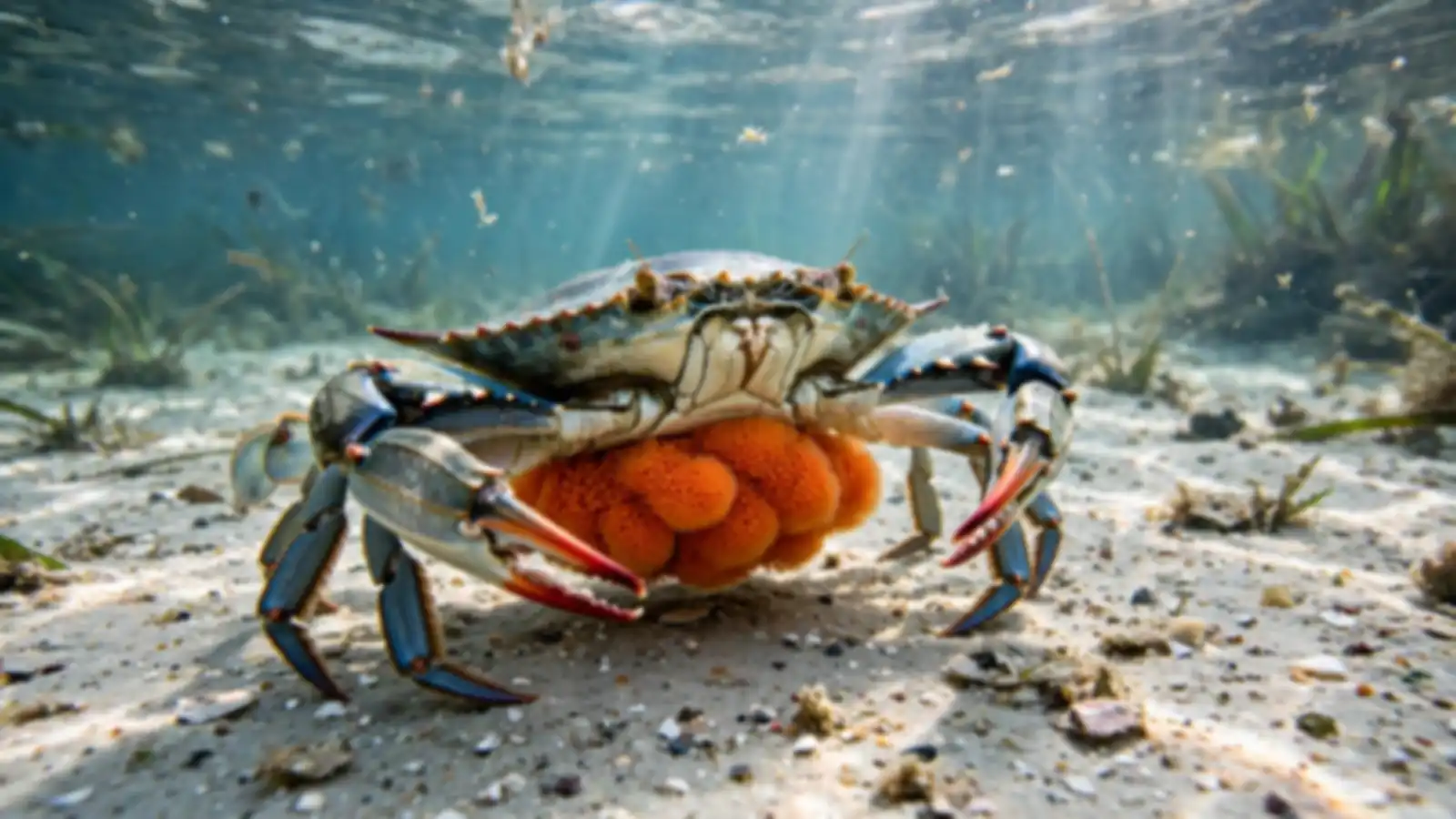
The larvae, zoeae, are swept out to sea and drift in the plankton through several stages before the young megalopa rides the currents back into the estuary and settles in the seagrass. From there it is growth by installments: a crab molts around 25 times in its life, finishing the climb in roughly a year in warm water. Few survive the gauntlet; the whole strategy is numbers.
Molting and the Soft-Shell Crab
Molting is its defining drama. The old shell splits along the back edge and the crab backs out of it entire, claws, legs, even the coverings of its eyes, then swells with water to stretch the new, soft shell to a size roughly a third bigger. For a day or two it is a paper crab, defenceless and hiding, before the new armour hardens. Watermen read the signs on a crab’s swim-fin, from white-line to red-line, to predict the molt almost to the day.
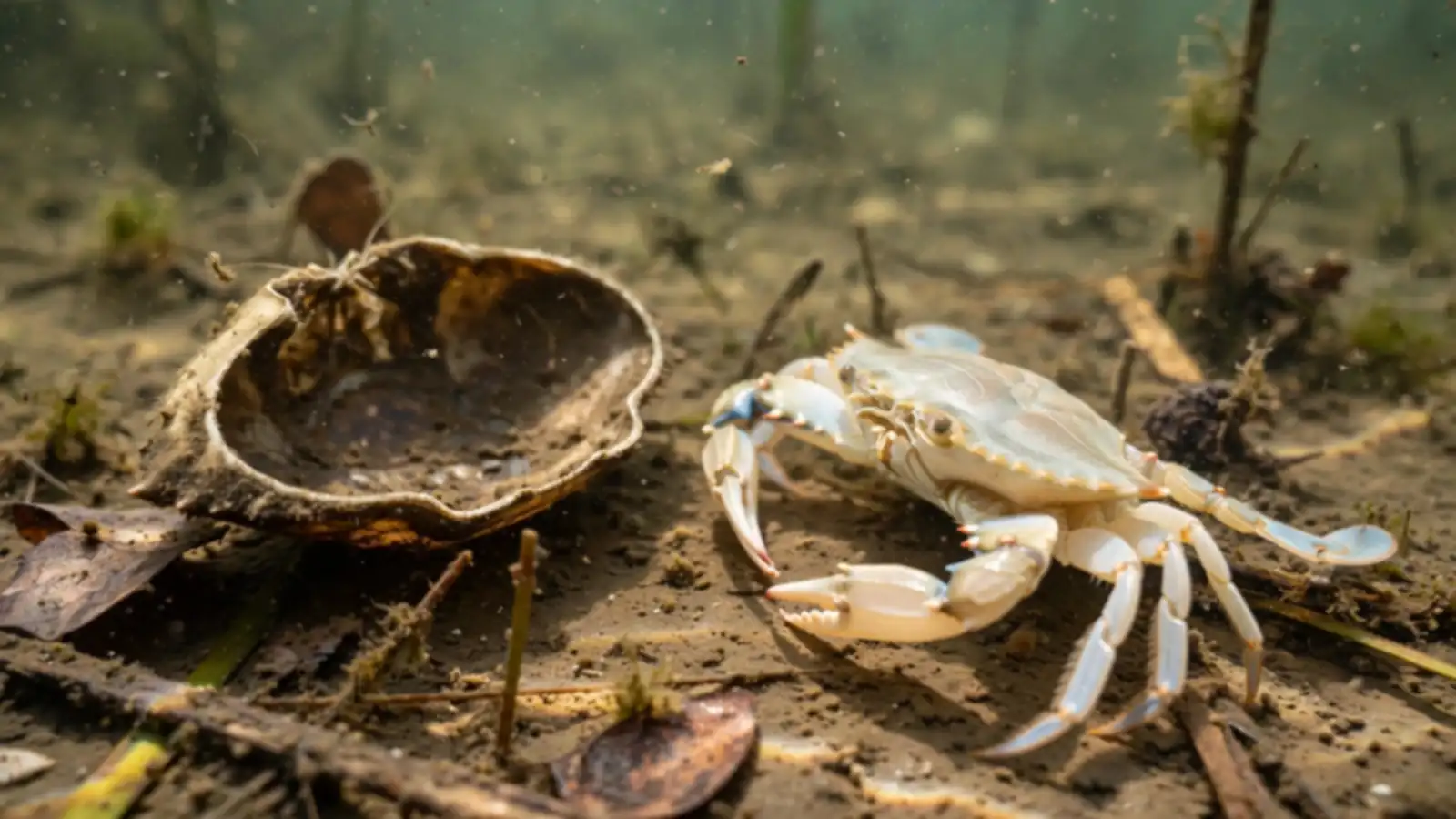
That soft window is the soft-shell crab of restaurant fame: the whole animal, shell and all, eaten in the brief hours when the new shell is still tender. It is also the crab’s most dangerous hour, when fish, birds, bigger crabs and the fishery all take their share. A crab that survives every molt for about three years, the species’ typical lifespan, has beaten long odds.
Blue Crabs as Food: The Fishery in Brief
This guide is about the animal, but the animal’s story cannot be told without the table, so here it is, in one place. Steamed whole with seasoning in the Chesapeake style, picked into crab cakes, or fried whole as a soft-shell, the species supports one of the most valuable crab fisheries in the United States, worked with pots, trotlines and dredges and managed with size limits, seasons and female protections that have tightened as stocks have swung.

Those swings are the honest part of the story: Its numbers ride on seagrass health, winter cold and predator pressure as much as on fishing, and the population has been rebuilt before through exactly the sort of management now applied year by year. If you want its relatives at the table, the stone crab of Florida is the other great American food crab, but the it got there first, and its feast culture, brown paper, mallets, patience, remains the original.
Fun Facts
- Its scientific name, Callinectes sapidus, translates roughly as “beautiful, savoury swimmer”, a rare case of a Latin name doubling as a restaurant review.
- Males are called jimmies, mature females sooks, and egg-carrying females sponges, in the working language of Chesapeake watermen.
- A female mates only once in her life, during her final molt, but can produce several sponges of up to two million eggs from that single mating.
- The species is Maryland’s official state crustacean, a title it holds on the strength of the Chesapeake Bay fishery.
- Its paddle-shaped back legs make it one of the strongest swimming crabs; it can swim sideways, up, and even backwards.
- A crab can shed a trapped leg on purpose and regrow a serviceable replacement at its next molt.
Frequently Asked Questions
What Is a Blue Crab?
A It is a swimming crab, Callinectes sapidus, native to the western Atlantic and Gulf coasts of the Americas. It is recognised by its sapphire-blue legs, olive spiked shell and paddle-shaped rear legs. Males have bright blue claws; females have red-tipped claws and a broad apron. It lives in estuaries and is famous both as wildlife and as seafood.
How Big Do Blue Crabs Get?
Blue crabs grow to about 23 centimetres (9 inches) across the shell, measured from spike to spike, and weigh up to around 450 grams (1 pound) for an exceptional male. Most adults are smaller, around 13 to 18 centimetres across. Females are typically a little smaller than males but carry a much broader abdomen.
How Can You Tell a Male Blue Crab From a Female?
Check the apron, the folded flap under the body: a male’s is narrow and T-shaped, a mature female’s is broad and rounded, built to hold her egg sponge. Females also have red-tipped claws, while males are a brighter, more even blue. Watermen call males jimmies and females sooks.
What Do Blue Crabs Eat?
Blue crabs are aggressive omnivores. They eat clams, oysters and mussels, which they crush with their claws, plus shrimp, small fish, worms, carrion and plant material. They are important predators of the estuary floor and equally important scavengers, and in turn they feed fish, birds, turtles and people.
How Long Do Blue Crabs Live?
Blue crabs live about 3 years, occasionally up to 4. They grow fast, molting around 25 times and reaching maturity in about a year in warm water. Females mate once, at their final molt, and may spend over a year producing egg sponges from that single mating before they die.
What Is a Soft-Shell Blue Crab?
A soft-shell blue crab is a specimen in the brief window just after molting, when the new shell is still soft and papery. The crab has backed out of its old shell and swelled to a larger size but not yet hardened. Soft-shells are prized as food because the whole crab can be eaten, and in the wild it is the crab’s most vulnerable stage.
Can Blue Crabs Swim?
Yes, blue crabs are strong swimmers. Their rear pair of legs ends in flat paddles that row the crab through the water sideways, upward and even backward. Swimming lets them cross channels, ride tidal currents between feeding grounds and escape predators, a rare ability among crabs and the source of their scientific name’s “swimmer”.
Why Is It Called the ‘Beautiful Swimmer’?
Its scientific name, Callinectes sapidus, means beautiful, savoury swimmer — and it earns the first word. The species is one of the few crabs that truly swims, rowing through the water on paddle-shaped back legs, and its sapphire-blue legs give it the beauty to match.
How Many Eggs Can a Female Blue Crab Carry?
A female blue crab carries up to two million eggs at a time, held in a bright orange mass — the sponge — under her abdomen. She mates once, after her final molt, and the eggs hatch into planktonic larvae that drift in the currents.
Similar Species Worth Exploring
Keep Exploring
Keep exploring the crab clan through the types of crabs, its Pacific rival the Dungeness crab, and the wider world of the types of crustaceans. Few animals pack more life, colour and attitude into three short years than the blue crab.