Garden Eel
Garden Eel: the reef fish that grows like a plant
The garden eel is a fish that behaves like a plant — a colony of slender, swaying stalks rising from the sand, each one an eel anchored in its own burrow. Touch one, and the whole colony vanishes into the sand in a ripple. It is one of the reef’s strangest sights, and it is a fish, not a plant.
By Emily Carter · Reviewed by our vet team · Updated 10 November 2026 · 8 min read
Lives in colonies of swaying stalksEach eel has its own burrowVanishes into the sand at a touch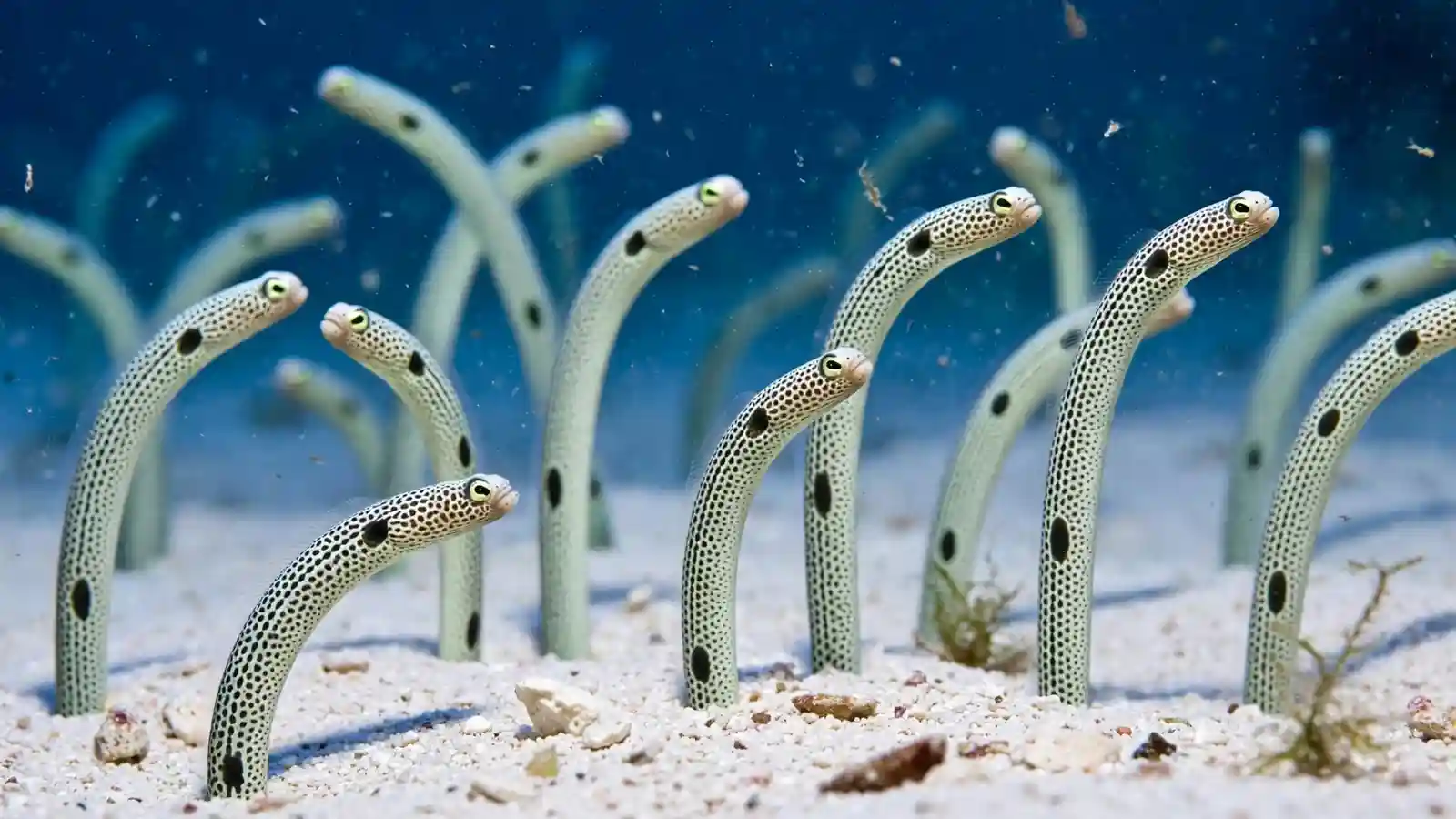
At a Glance
The garden eel is a slender eel of the family Congridae, and it lives a life unlike any other eel: instead of swimming free, it anchors itself in a burrow in the sand and spends its life swaying in the current, feeding on the plankton that drifts past. Hundreds of garden eels can live together in a colony, their heads and upper bodies rising from the sand like a field of stalks — a “garden” of eels, each one in its own burrow, each one watching the current for food.
What Is a Garden Eel?
It is a small, slender eel that lives in a burrow in the sand, with only its head and upper body sticking out. It belongs to the conger eel family, but it has given up the free-swimming life: its body is built for the burrow, with a pointed tail that digs and a slimy mucus that lines the burrow walls. The spotted species, Heteroconger hassi, is the best-known species, with a pale body covered in black spots.
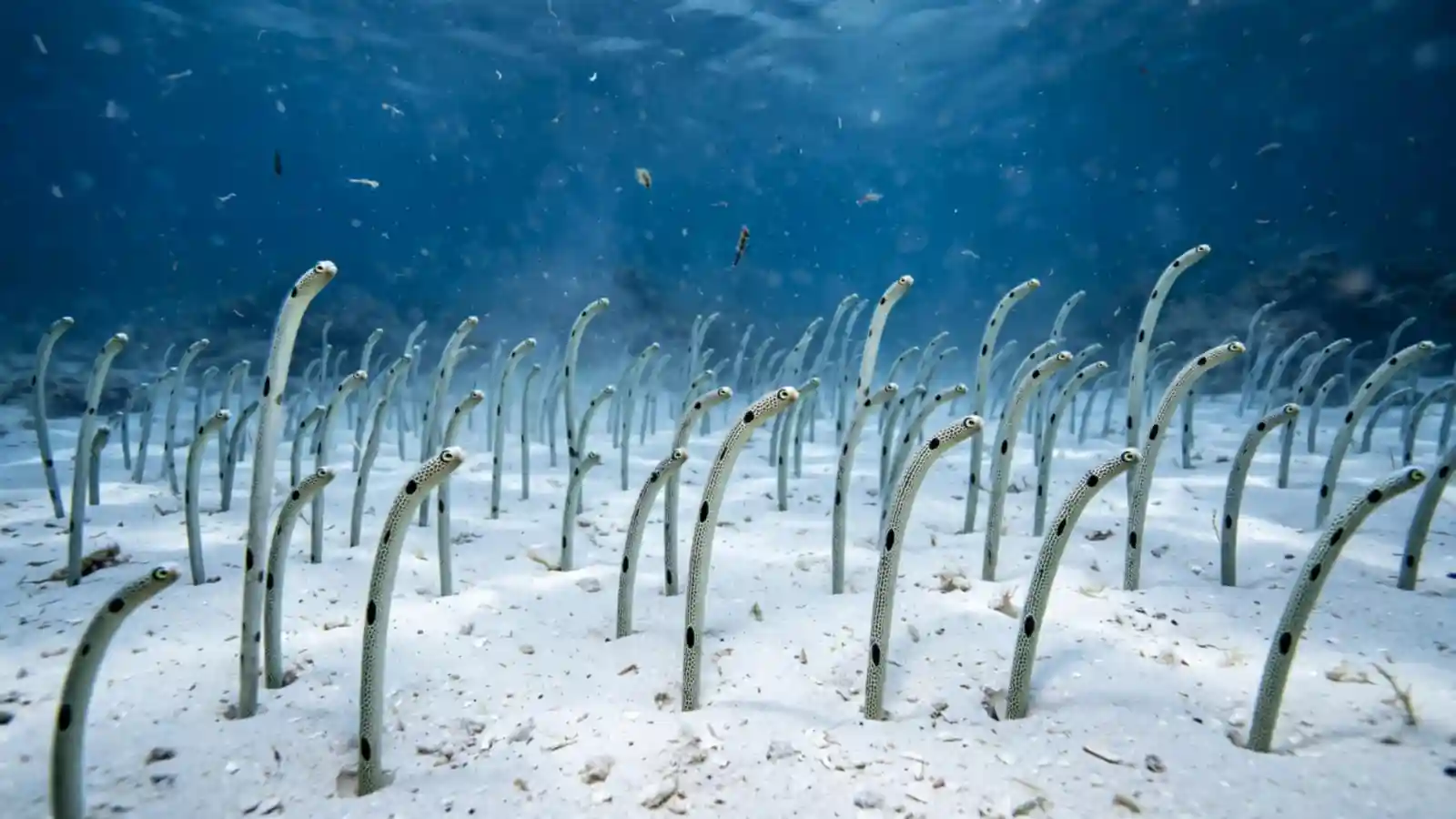
There are about 36 species in two genera, Heteroconger and Gorgasia, and they live on sandy slopes and sand flats near coral reefs in tropical seas around the world. They are not plants, though they look like them — each “stalk” is a fish, and each fish is watching the water for food and for danger. The spotted garden eel profile records the size, burrow and feeding figures behind this guide.
Garden Eel Size and Appearance
The spotted species grows to about 40 to 45 centimetres long, about the length of a forearm, and it is only about a centimetre thick — a long, thin stalk of a fish. Its body is pale, almost white, covered in black spots that give it its name, and its head is small, with large eyes and a mouth set for snatching plankton from the current. A rare claim of 61 centimetres is treated as uncertain and is not used here.
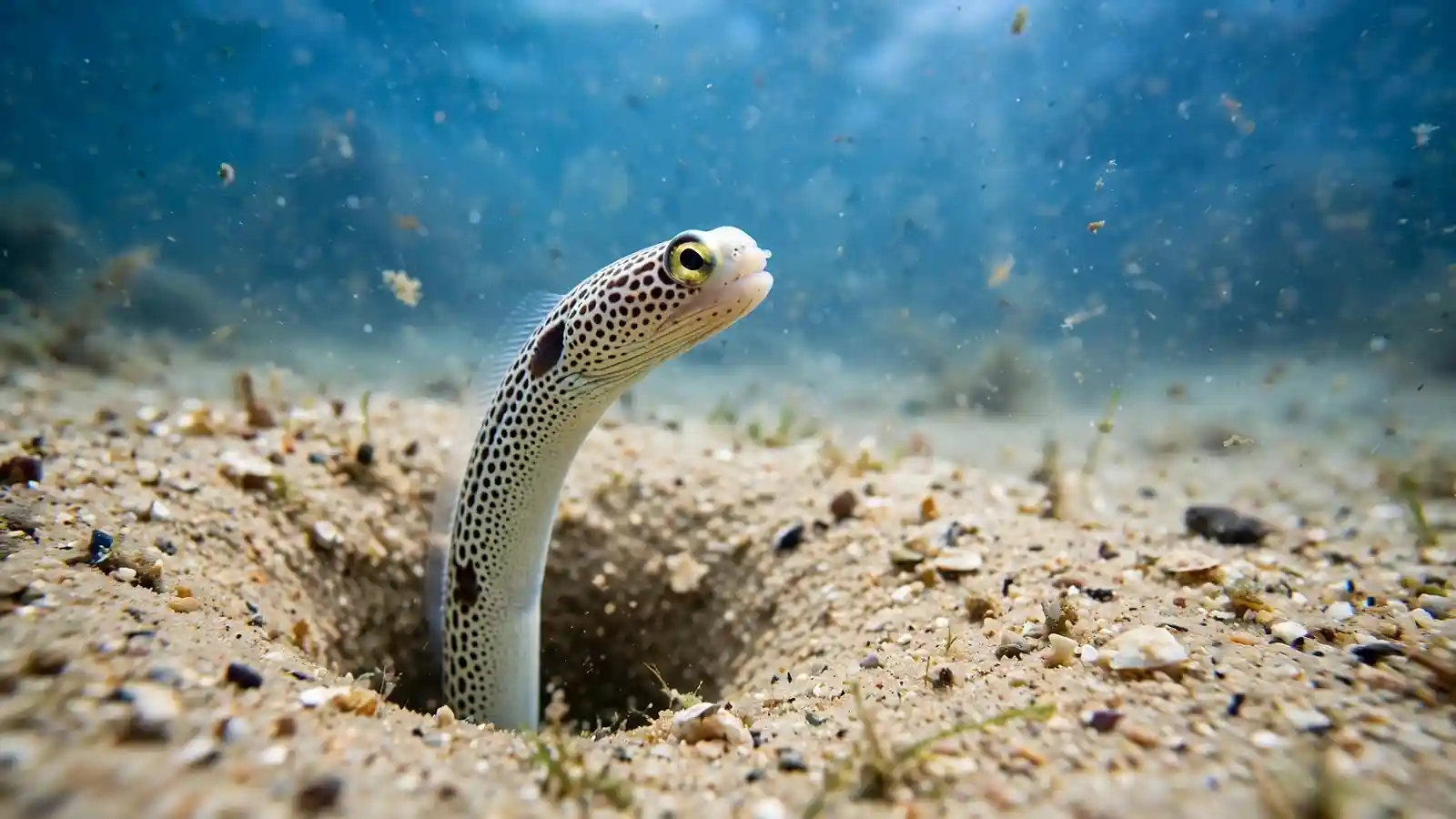
The body is built for the burrow. The tail is pointed and hard, for digging, and the skin produces a mucus that coats the burrow walls and keeps the sand from collapsing. The eel never leaves the burrow as an adult — it lives, feeds and breeds in it, and it can retreat into it in a fraction of a second. Young garden eels are dark, almost black, and they lighten as they grow.
The Spotted Species
The spotted species, Heteroconger hassi, is the species most divers meet, and it is the one this guide anchors on. It lives in the Indo-Pacific, from the Red Sea and East Africa to Japan and Australia, in colonies on sandy slopes near reefs, usually between 7 and 45 metres deep. The spots are the field mark: a pale body with black spots, in a pattern that is different for every eel, like a fingerprint.
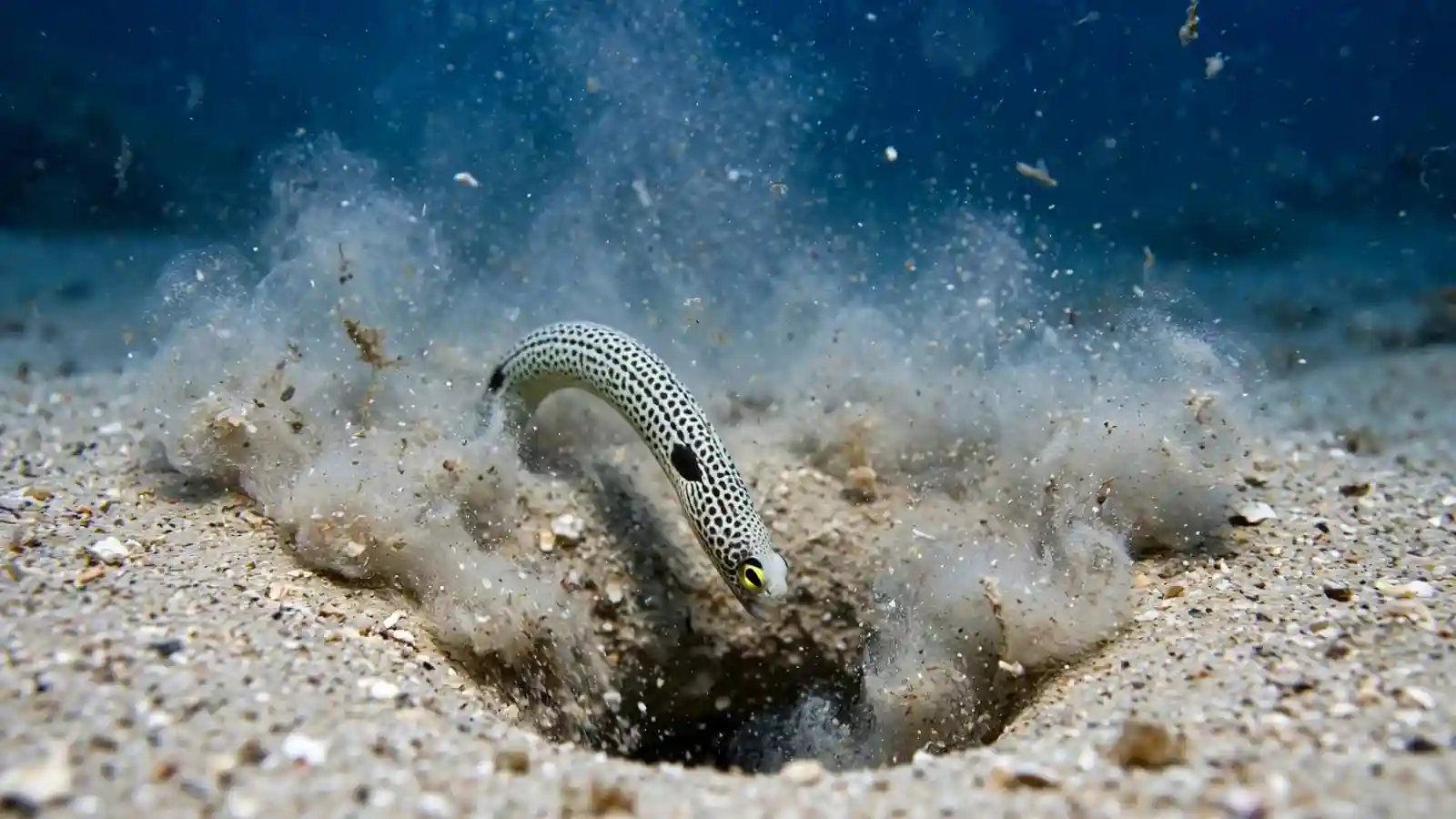
Spotted garden eels are shy fish, and they are famous for their shyness. At the Sumida Aquarium in Tokyo in 2020, the garden eels became so shy — hiding in their burrows when visitors disappeared during the pandemic — that the aquarium asked people to video-call the eels, to remind them that humans were not a threat. The story made the eels famous, and it is a reminder of how sensitive they are: one that is startled will not come out for a long time.
The Colonies: A Field of Stalks
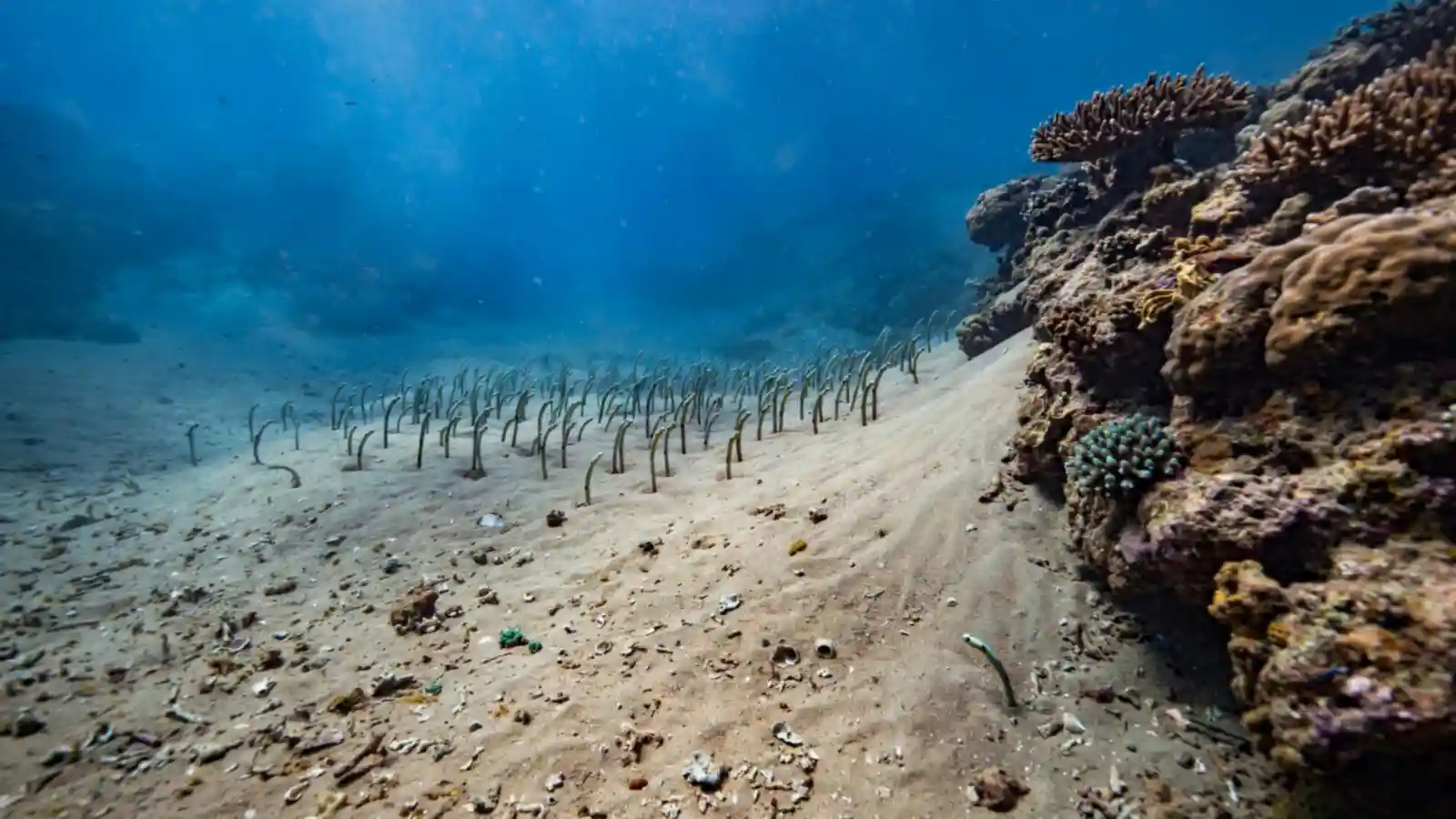
Garden eels live in colonies of dozens to hundreds, sometimes more, with each eel in its own burrow about 30 centimetres from its neighbours — close enough to see each other, far enough that each has its own patch of current to feed from. The colony looks like a field of stalks swaying in the wind, and the effect is hypnotic: hundreds of pale, spotted eels, all facing into the current, all swaying together.

The colony is a defence as much as a home. A single eel is easy prey, but a colony has hundreds of eyes, and when one eel retreats, the alarm ripples through the colony in a wave — the eels vanish into the sand one after another, like a field of grass flattening in the wind. The colony also helps with feeding: the eels’ combined feeding does not deplete the plankton, because the current brings a constant supply. The goby, its sand-flat neighbour, lives the same bottom-dwelling life in a burrow of its own.
The Burrows: Built Tail-First
It builds its burrow tail-first. It backs into the sand, wriggling its pointed tail down and around, and it coats the walls with mucus, which hardens into a lining that keeps the burrow from collapsing. The burrow is about as deep as the eel is long, and the eel never leaves it — it feeds, rests and breeds in the burrow, and it retreats into it at the first sign of danger.
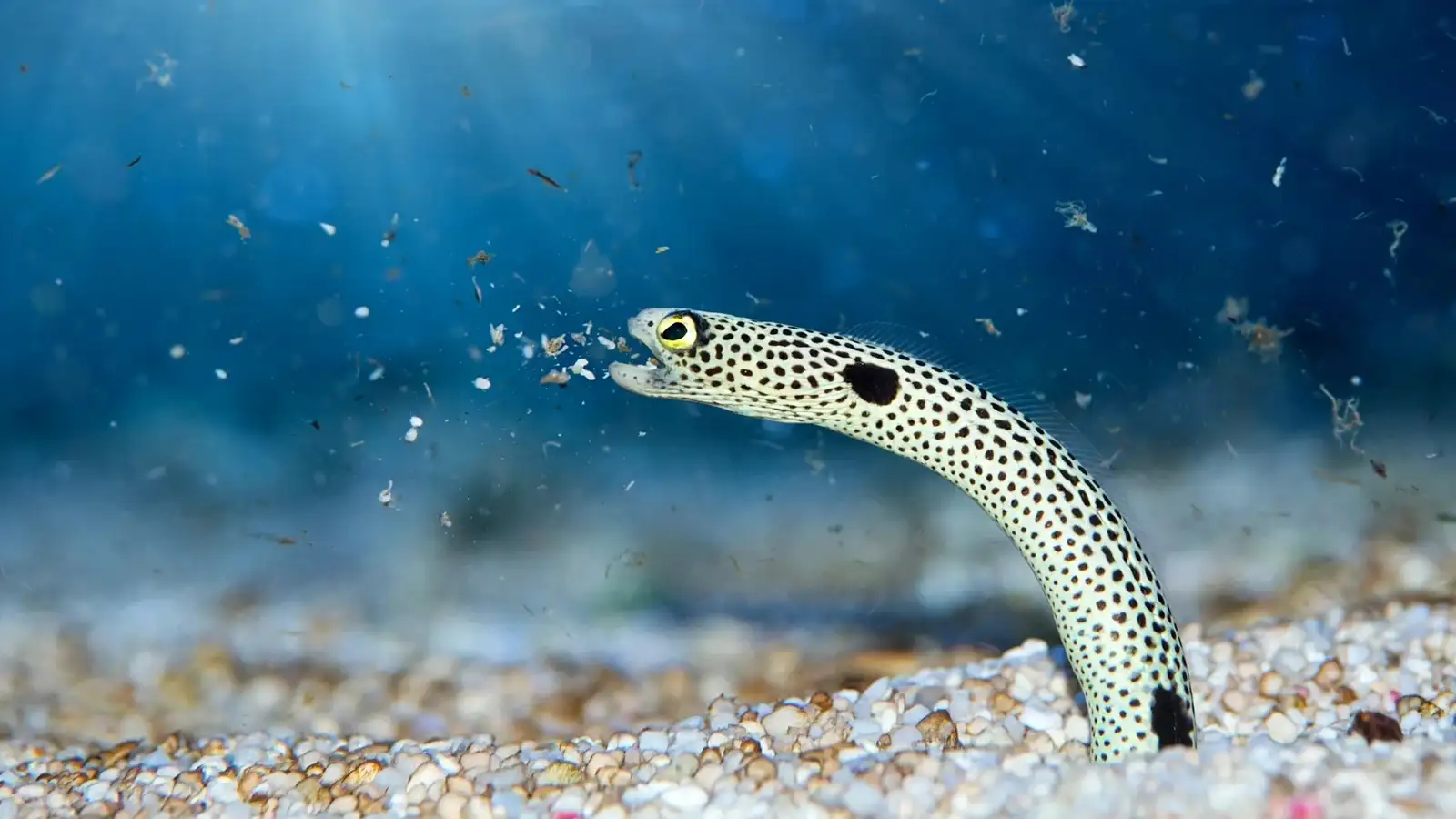
The burrow is also the eel’s home for life. Once one has dug its burrow, it stays in it, and it defends the burrow mouth against other eels. If the burrow is destroyed, the eel must dig a new one, which takes time and leaves it exposed. The burrow is so important that garden eels will not settle on sand that is too coarse or too loose — they need fine, stable sand that holds a burrow.
Diet: Plankton on the Current
Garden eels eat plankton — the tiny animals and larvae that drift past in the current. They face into the current, mouths open, and snatch the plankton as it comes to them, without ever leaving the burrow. It is a life of waiting: the eel sways, watches, and snaps at whatever drifts within reach, and it may eat hundreds of tiny animals in a day.
The diet is the reason the colony works. The current brings a constant supply of plankton, and each eel feeds from its own patch of water, so the colony does not starve itself. The eels are most active when the current is running, and they retreat into their burrows when it slackens or when a predator approaches. Mating happens in the burrow too: the male and female stretch out of their burrows towards each other, and the eggs are laid in the sand.
Fun Facts
- A colony can hold hundreds of eels, each in its own burrow, swaying like a field of stalks.
- It builds its burrow tail-first, lining the walls with mucus so the sand does not collapse.
- When one eel retreats, the alarm ripples through the colony in a wave.
- In 2020 the Sumida Aquarium asked people to video-call its shy garden eels, who were hiding from the lack of visitors.
- Young garden eels are dark, almost black, and they lighten as they grow.
- It never leaves its burrow as an adult — it feeds, rests and breeds in it.
Frequently Asked Questions
What Is a Garden Eel?
A garden eel is a slender eel that lives in a burrow in the sand, with only its head and upper body sticking out. Hundreds live together in colonies that look like a field of swaying stalks, and each eel feeds on the plankton that drifts past in the current.
How Big Do Garden Eels Get?
A spotted garden eel grows to about 40 to 45 centimetres long and only about a centimetre thick. A rare claim of 61 centimetres is treated as uncertain. Young garden eels are dark, almost black, and lighten as they grow.
Why Do Garden Eels Live in Colonies?
Garden eels live in colonies of dozens to hundreds because the colony is a defence and a feeding strategy: hundreds of eyes watch for predators, and the alarm ripples through the colony when one eel retreats. Each eel feeds from its own patch of current, so the colony does not starve itself.
Do Garden Eels Ever Leave Their Burrows?
No — as adults, garden eels never leave their burrows. They feed, rest and breed in the burrow, and they retreat into it at the first sign of danger. They build the burrow tail-first and line the walls with mucus.
What Do Garden Eels Eat?
Garden eels eat plankton — tiny animals and larvae that drift past in the current. They face into the current, mouths open, and snatch the plankton as it comes to them, without ever leaving the burrow.
How Deep Do Garden Eels Live?
Spotted garden eels live on sandy slopes near reefs, usually between 7 and 45 metres deep. They need fine, stable sand that holds a burrow, and they are found in tropical seas around the world.
How Long Do Garden Eels Live?
Garden eels are reported to live 35 to 40 years, though the figure is weakly sourced and should be treated as reported rather than certain. They grow slowly and stay in the same burrow for life.
Similar Species Worth Exploring
Keep Exploring
Keep exploring the reef fish through the goby, its sand-flat neighbour, the seahorse, the upright cousin that curls its tail and waits, and the wider world of the types of fish. No reef fish grows quite like a garden than the garden eel.