Arctic Tern
Arctic Tern: The Longest Migration of Any Animal
The arctic tern flies around 70,000 kilometres a year — further than any other animal on Earth. It breeds in the Arctic summer, flies to the Antarctic for the southern summer, and then flies back again, living in daylight almost all year long.
By Emily Carter · Reviewed by our vet team · Updated 10 November 2026 · 9 min read
Longest migration on Earth~70,000 km a yearTwo summers, no winter
At a Glance
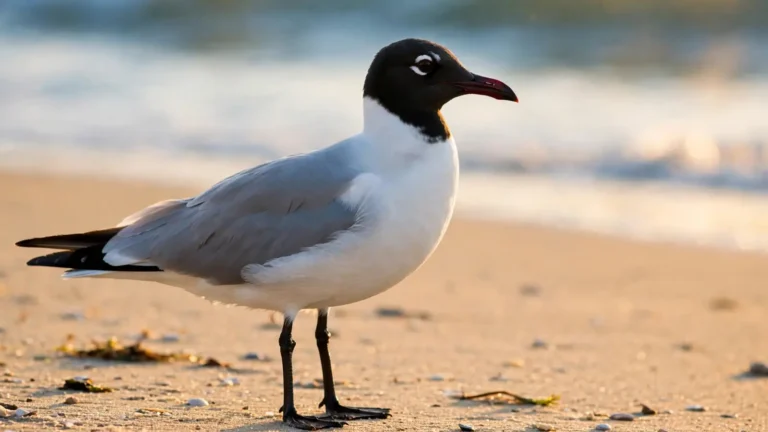
The arctic tern is a small seabird with a red bill and a black cap, and it holds one of the great records of the animal kingdom: the longest migration of any animal. It is a bird that never sees winter. It breeds in the Arctic in the northern summer, flies south to the Antarctic for the southern summer, and then flies north again — and it does it every year of a life that can last thirty years.
The Longest Migration on Earth
No animal migrates further than this bird. The headline figure is around 70,000 kilometres a year — the distance from the Arctic to the Antarctic and back, flown every year of the bird’s life. Over a thirty-year lifetime, a single tern may fly more than two million kilometres, the equivalent of three round trips to the Moon.

The numbers come from tracking, not guessing. A 2010 study that fitted geolocators to birds breeding in Greenland and Iceland found they flew an average of about 70,900 kilometres a year, following the winds in great S-shaped loops across the Atlantic. And one bird from the Farne Islands, off the north-east coast of England, flew 96,000 kilometres in ten months — the longest single migration ever recorded for an animal.
The figures vary because the route varies. Birds from different colonies take different paths, and the wind decides the rest. But the range is consistent: every study finds the same thing, that this species flies further than any other animal, and that the distance is measured in tens of thousands of kilometres a year.
The Route: Arctic to Antarctic and Back
The route is not a straight line. A tern leaving the Arctic in the late summer flies south down the Atlantic, often in a great S-shape: down the west coast of Africa, across to South America, and then on to the Antarctic. The return journey, in the spring, takes a different path, often further west, following the winds that carry the bird north. The route is set by the wind, not by the map.

The birds do not hurry. The southward journey takes two or three months, with long stops at sea to feed and rest, and the northward journey takes a similar time. The tern is a seabird that lives on the wing: it feeds at sea, sleeps on the wing, and only comes to land to breed. The ocean is its home, and the journey is its life.
The tracking has changed what we know. Before the geolocators, the route was guessed from ringing recoveries — a bird ringed in the Arctic and found dead in the Antarctic, and little in between. Now the whole journey is mapped, and the map shows a bird that uses the whole Atlantic, from the Arctic to the Antarctic, and that treats the ocean as a single, continuous home.
Two Summers, No Winter
It lives in daylight almost all year. It breeds in the Arctic in the northern summer, when the sun never sets, and then it flies to the Antarctic for the southern summer, when the sun never sets there either. The bird that leaves the Arctic in August arrives in the Antarctic in November, in time for the southern summer — and it leaves the Antarctic in March, in time for the northern summer.

The result is a bird that sees more daylight than any other animal. A tern that lives thirty years will have seen the equivalent of many more summers than a bird that stays in one place, and the long days are the point: the summer is when the food is richest, the fish are closest to the surface, and the breeding is possible. The tern follows the summer around the world.
The cost is the journey itself. The bird must fly 70,000 kilometres a year to keep the summer, and it must do it on a body that weighs a hundred grams. It is a small bird doing the biggest journey on Earth — and it does it every year, without exception.
Breeding in the Arctic
Arctic terns breed in the Arctic and sub-Arctic, on the coasts of northern Europe, North America and Asia, and on the islands of the North Atlantic. The colonies are on flat, open ground near the sea — a beach, a tundra flat, or a rocky island — and the nests are simple scrapes in the ground, sometimes lined with a few pebbles or bits of vegetation.
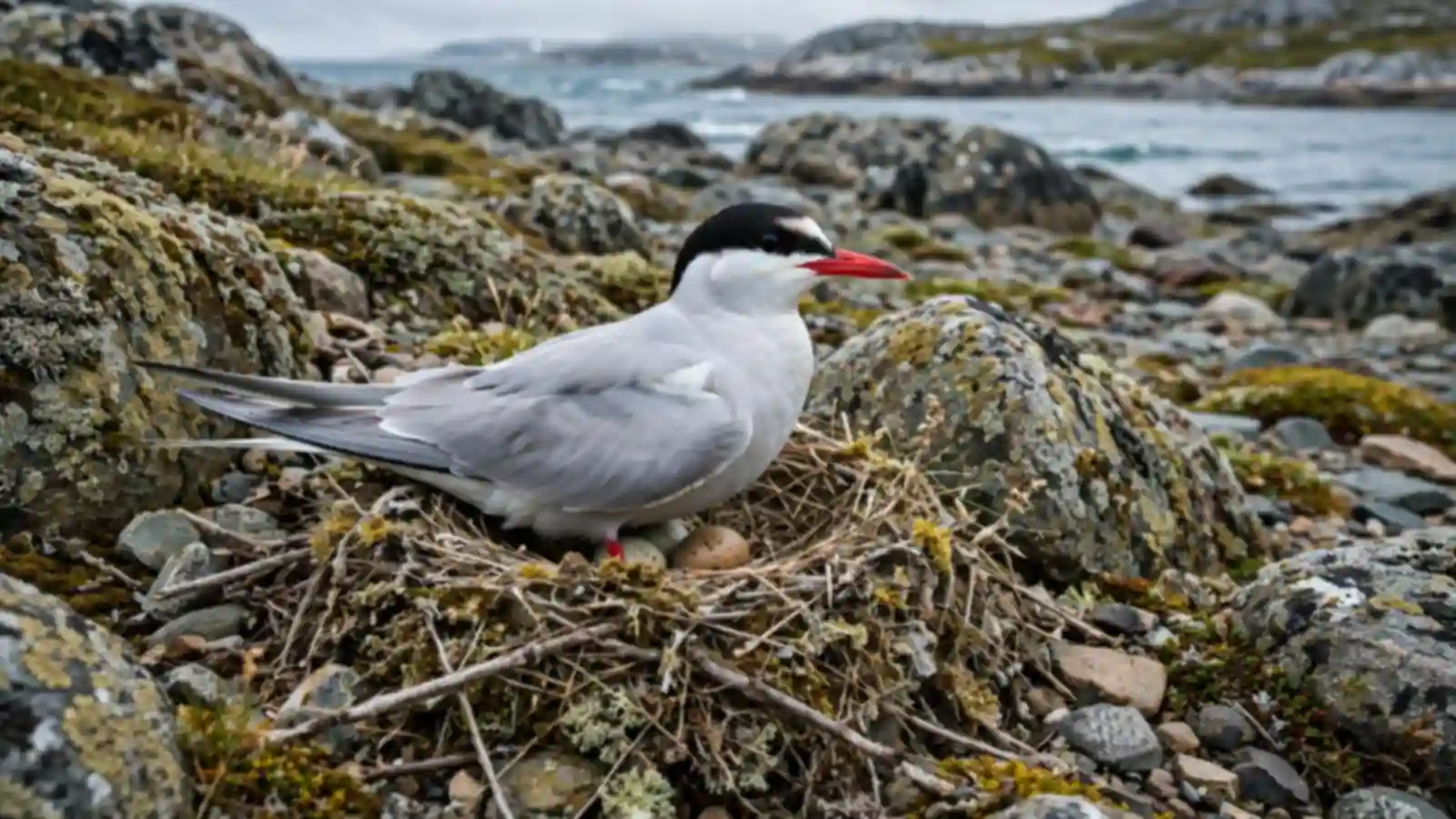
The clutch is usually two eggs, laid a few days apart and incubated for about three weeks by both parents in turn. The chicks hatch covered in down and are fed by both parents, who bring small fish from the sea, and they fledge at about three or four weeks. The parents defend the colony fiercely, dive-bombing anything that comes near — including people, who learn to wear a hat or carry a stick.
The breeding season is short, because the Arctic summer is short. The birds arrive in May, lay in June, and the chicks fledge in July — and by August the colony is empty, the birds already on their way south. A tern that loses its eggs will lay again, but the window is narrow, and a late start means a chick that is not ready for the journey.
What Do Arctic Terns Eat?
Arctic terns eat small fish and krill, with crustaceans and small squid as the second course. They hunt by plunge-diving: the bird hovers over the water, head down, and then drops, hitting the surface bill-first and snatching the fish just below. The dive is shallow — a metre or two — and the bird is back in the air in seconds.

The hunting is done at sea, on the wing, all year round. The tern does not land to eat; it catches the fish, swallows it in flight, and goes on. In the breeding season the parents carry fish back to the chicks, one at a time, held crosswise in the bill — and a chick may be fed a dozen times a day, each fish a small silver sliver.
The diet is the reason the route is what it is. The tern follows the fish, and the fish follow the summer — the plankton blooms, the krill swarms, and the small fish that feed on them. The bird’s whole life is a search for the richest water, and the richest water is always in the summer, always somewhere else. The full species guide, including the migration figures, is in the arctic tern species guide.
The Southern Cousin: Antarctic Tern
It has a southern cousin: the Antarctic tern, Sterna vittata, which breeds on the Antarctic Peninsula and the sub-Antarctic islands. The two look alike — both are small, grey and white, with a black cap and a red bill — but the Antarctic tern is the homebody of the pair. It does not migrate to the Arctic; it stays in the south all year, moving only as far as the pack ice allows.

The Antarctic tern is the bird the arctic tern meets at the end of its journey. When the arctic tern arrives in the Antarctic in November, the Antarctic terns are already there, breeding on the same shores — and the two species share the same waters, the same fish, and the same long southern summer. They are easy to confuse in the field, and the telling difference is the season: in the Antarctic summer, the tern that has just flown 70,000 kilometres is the arctic one.
The Antarctic tern’s range is small and its numbers are modest, and it is listed as Least Concern. It is the bird that stayed home while its cousin flew to the other end of the Earth — and the comparison is the point. Its migration is not a necessity of being a tern; it is a choice the species made, and its cousin shows what the other choice looks like.
Fun Facts
- The arctic tern flies around 70,000 kilometres a year — further than any other animal.
- One bird from the Farne Islands flew 96,000 kilometres in ten months.
- Over a thirty-year life, a single tern may fly more than two million kilometres.
- The arctic tern lives in daylight almost all year, following the summer from pole to pole.
- Arctic terns dive-bomb intruders at the colony — including people, who learn to wear a hat.
- The Antarctic tern is the arctic tern’s southern cousin, and it never leaves the south.
Frequently Asked Questions
How Far Do Arctic Terns Migrate?
Around 70,000 kilometres a year — the longest migration of any animal. A 2010 study of birds breeding in Greenland and Iceland found an average of about 70,900 kilometres a year, and one bird from the Farne Islands flew 96,000 kilometres in ten months, the longest single migration ever recorded for an animal.
What Is the Longest Migration of Any Animal?
The arctic tern’s. It breeds in the Arctic in the northern summer, flies to the Antarctic for the southern summer, and then flies back again — around 70,000 kilometres a year, every year, for a life that can last thirty years. No other animal migrates further.
Do Arctic Terns See Two Summers a Year?
Yes. They breed in the Arctic in the northern summer, when the sun never sets, and then fly to the Antarctic for the southern summer, when the sun never sets there either. The result is a bird that lives in daylight almost all year, following the summer around the world.
What Do Arctic Terns Eat?
Small fish and krill, with crustaceans and small squid as the second course. They hunt by plunge-diving — hovering over the water and dropping bill-first to snatch the fish just below the surface — and they swallow the fish in flight, without landing.
How Long Do Arctic Terns Live?
About 30 years, with the oldest recorded birds reaching 34. A tern that lives thirty years may fly more than two million kilometres in its lifetime, the equivalent of three round trips to the Moon.
Where Do Arctic Terns Breed?
In the Arctic and sub-Arctic, on the coasts of northern Europe, North America and Asia, and on the islands of the North Atlantic. The colonies are on flat, open ground near the sea, and the nests are simple scrapes in the ground. The parents defend the colony fiercely, dive-bombing anything that comes near.
What Is the Difference Between an Arctic Tern and an Antarctic Tern?
The Antarctic tern, Sterna vittata, is the arctic tern’s southern cousin. The two look alike, but the Antarctic tern does not migrate to the Arctic — it stays in the south all year, breeding on the Antarctic Peninsula and the sub-Antarctic islands. In the Antarctic summer, the tern that has just flown 70,000 kilometres is the arctic one.
Similar Species Worth Exploring
Keep Exploring
Meet the wandering albatross, the other great flyer of the Southern Ocean, then the osprey, a fish hunter of a different kind, and browse the whole family in our types of seabirds hub — then come back to the small bird with the longest journey on Earth, the arctic tern.