Osprey
Osprey: the fish hawk that hunts feet-first
The osprey is a fish-eating bird of prey built for a single job: snatching live fish from the water with spiny feet and a reversible toe. Found on every continent except Antarctica, this remarkable raptor nearly vanished in the twentieth century, then staged one of the great conservation comebacks. Here is how it hunts, where it nests, and why its migration splits families across whole continents.
By Emily Carter · Reviewed by our vet team · Updated 10 November 2026 · 8 min read
Wingspan up to 170 cmEats almost only live fishFound on six continents
At a Glance
The osprey is not a true seabird at all, and that is the first surprise. It is a hawk — a bird of prey in the same broad group as eagles and kites — that has specialised so completely in fishing that it now owns a family all to itself, Pandionidae, with a single living species. Every part of it, from its oily feathers to its closable nostrils, is fishing equipment.
That specialisation nearly became a trap. In the mid-twentieth century the pesticide DDT thinned the shells of its eggs across North America and Europe, and breeding numbers crashed. The bans that followed let the species recover so strongly that it is now one of the most widespread raptors on Earth, nesting beside busy harbours and city rivers as happily as on wild northern lakes.
Osprey Wingspan, Size and Appearance
It is a medium-large raptor, 55 to 58 centimetres long with a wingspan of 145 to 170 centimetres. Females are the bigger sex, weighing up to a fifth more than males at 1,600 to 2,000 grams against their 1,200 to 1,600. In flight the long wings are held in a shallow, crooked M shape, and dark patches at the wrist joints show clearly from below.
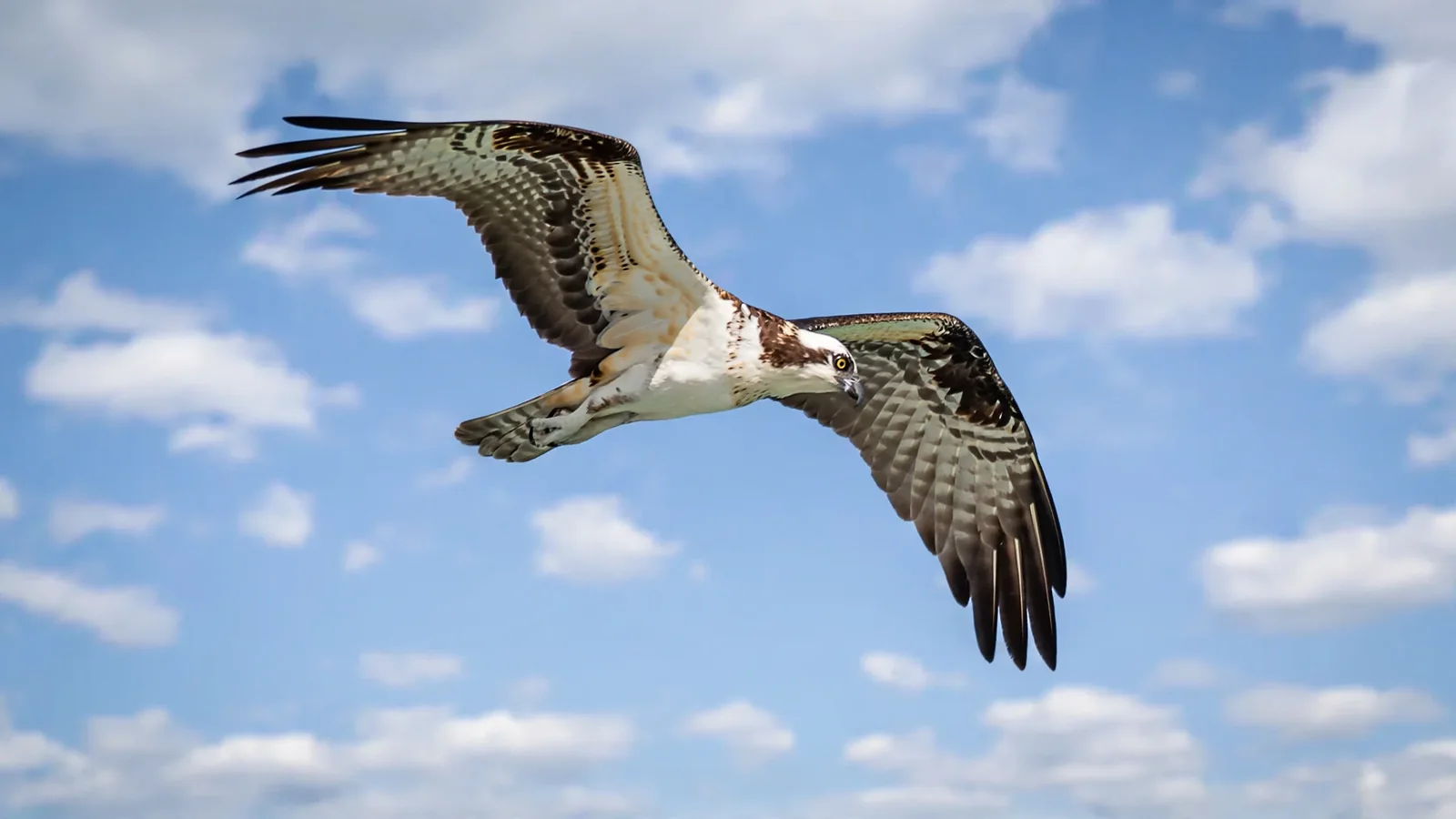
Up close it is unmistakable: snow-white head and underside, a chocolate-brown back, and a bold dark stripe through the eye like a bandit’s mask. The feet are the real giveaway. The outer toe can swivel to point backwards, so two toes grip each side of a fish, and the soles carry sharp spines called spicules that work like the tread on a climbing boot.
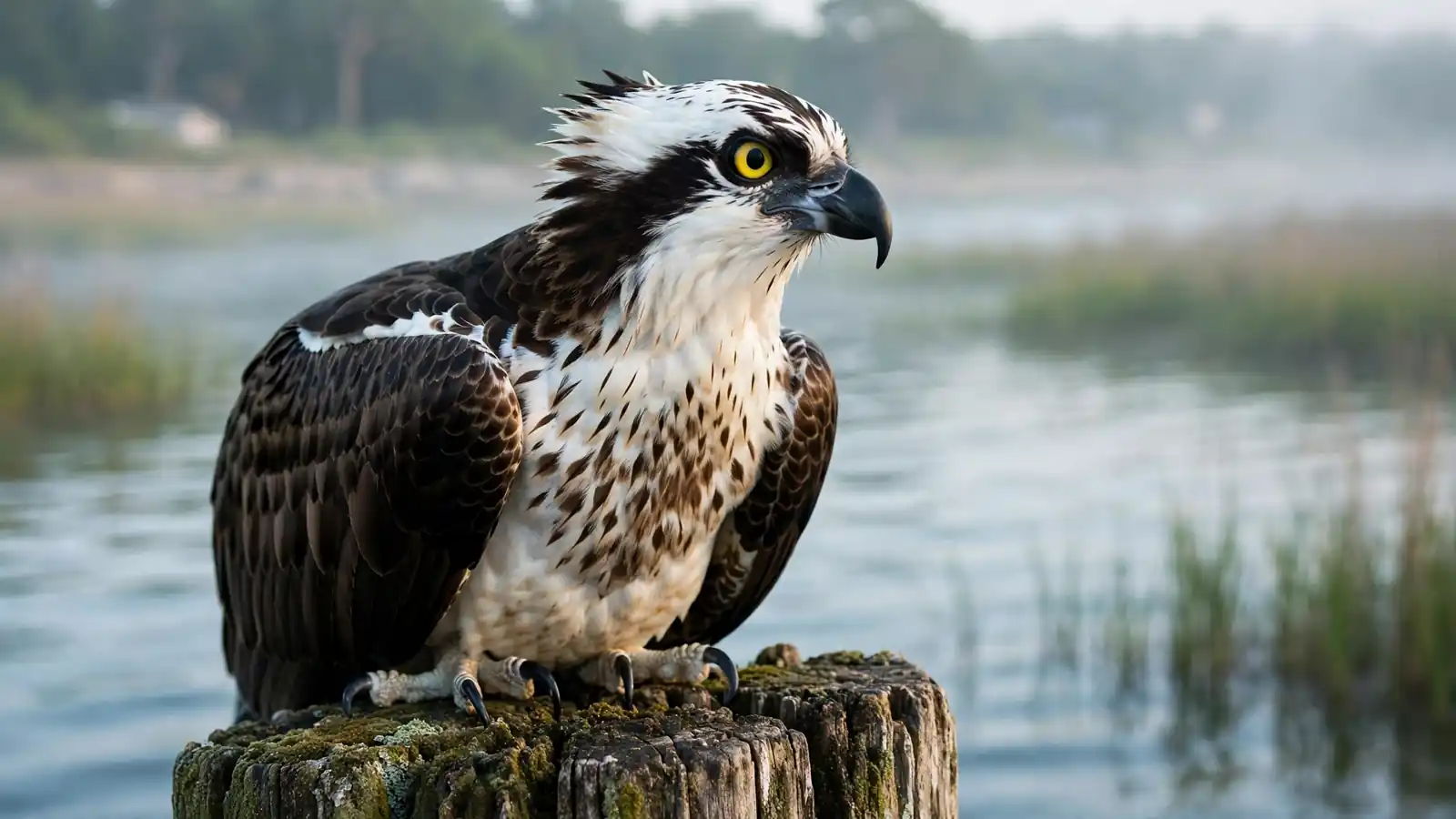
Four subspecies are recognised across the species’ enormous range, differing slightly in size and in how dark the head markings are. All of them share the same essential design, because all of them do the same job. Wherever there is shallow, fish-filled water, this bird’s shape is close to a perfect answer.
What Do Ospreys Eat? Hunting and Diet
Ask what the osprey diet consists of and the answer is refreshingly short: fish, almost nothing else, and almost always caught alive. Cruising or hovering 10 to 30 metres above the water, the bird spots a fish near the surface, folds its wings and drops feet-first, swinging its talons forward at the last instant. It can plunge a metre deep, and its oily plumage and sealable nostrils keep the water out.

Success rates are the envy of other predators — studies commonly record one catch in every three or four dives, and sometimes far better. Once airborne, the bird twists the fish head-first in its grip to cut wind resistance, a small aerodynamic courtesy no other raptor bothers with. You can read a full natural-history account of its hunting and habits for more detail on this fishing technique.
The fish taken are typically modest — most weigh between 150 and 300 grams — and include whatever shoals near the surface locally: mullet, trout, perch, herring and many more. Only when fish are truly unavailable will it stoop to frogs, snakes, rodents or other birds, and such meals are rare footnotes in an overwhelmingly fishy menu.
Where Do Ospreys Live?
Few birds live almost everywhere. Ospreys breed or winter on every continent except Antarctica, always tied to water: seacoasts, estuaries, large lakes, slow rivers and reservoirs. The one firm requirement is shallow fishing water within a few kilometres of a safe nest site, which is why this bird is as at home over a Scottish loch as over a Florida bay.
That flexibility explains its recovery. As fish stocks improved and nesting platforms multiplied, ospreys recolonised waters they had been missing from for a century, and they tolerate people remarkably well once they learn the neighbourhood means them no harm.
Not every population travels, either. Birds in Florida, the Caribbean, parts of Australia and other warm regions are resident all year, holding the same territories through the seasons their northern cousins spend on other continents. Between the residents and the migrants, there is scarcely a month when one is not fishing somewhere on Earth — one reason this single species can stand for raptor recovery worldwide.
Osprey Nests and Breeding
The nest is a architecture project that never finishes. Pairs build a bulky platform of sticks on dead trees, cliffs, channel markers, electricity poles and purpose-built platforms, usually within three to five kilometres of the water, and they add to it year after year until it can be two metres across. The female lays two to four eggs, incubates them for about 40 days, and the chicks fledge at 48 to 76 days old.
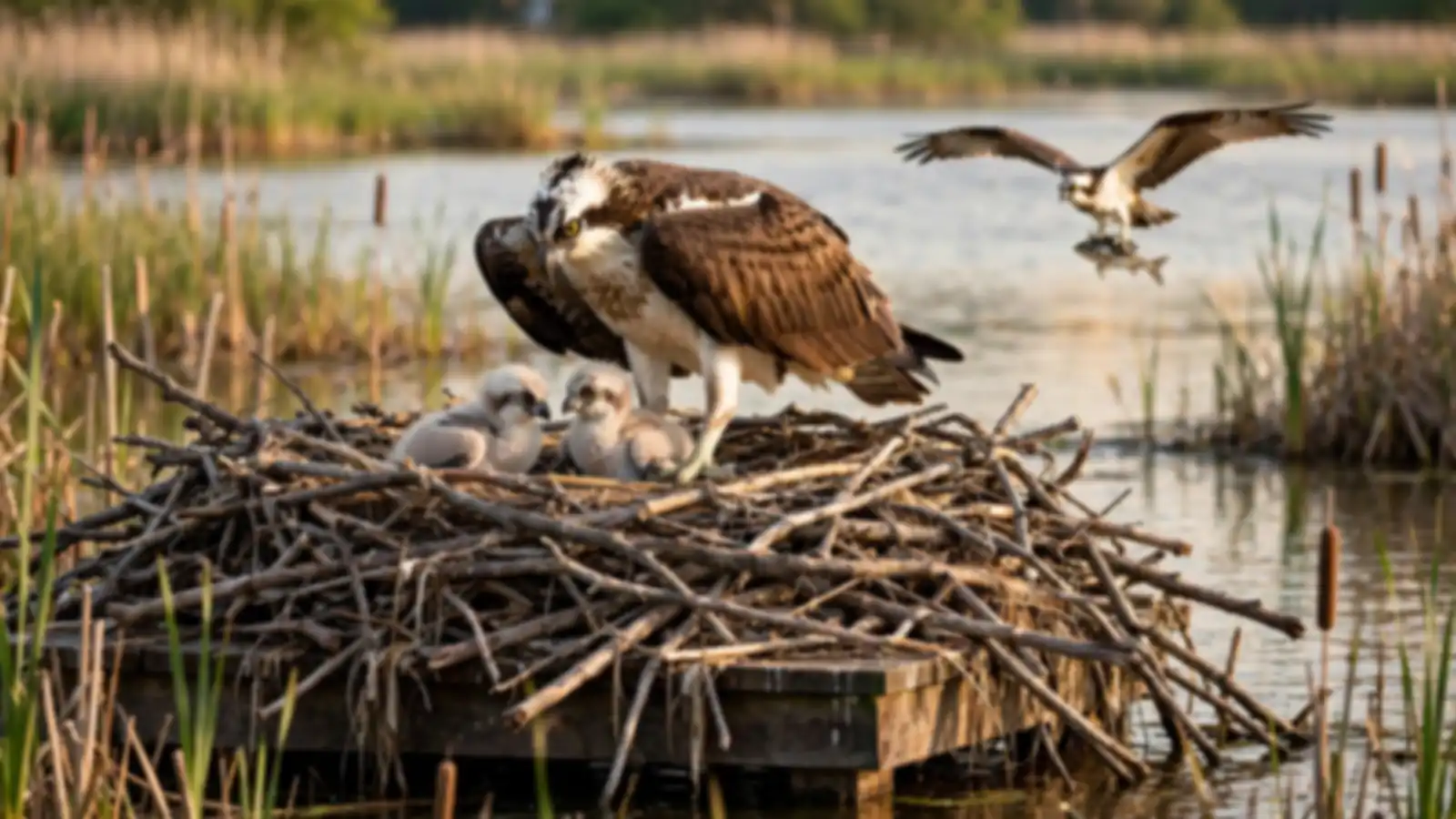
Nest cameras have turned this private life into a public soap opera, and watching has become part of the species’ modern story. In 2026 one New England county counted a record 103 breeding pairs around its marshes, while a long-running San Francisco Bay nest cam aired its final season — proof both of how loved these nests are and of how closely the public now follows each season’s chicks.
Young ospreys are slow to grow up. They do not breed until about three years old, but those that survive their first migration can live a long time: the oldest known wild bird reached 25 years, wearing a ring placed on it as a chick decades earlier.
Migration: Where Do Ospreys Go in Winter?
Northern ospreys are travellers on a grand scale. Birds that breed in North America winter from Florida down to South America; European breeders cross the Mediterranean and the Sahara to winter in West Africa, flying thousands of kilometres over land and open sea where there is nothing to eat. They migrate by day, riding thermals and coastlines, and each bird travels alone.
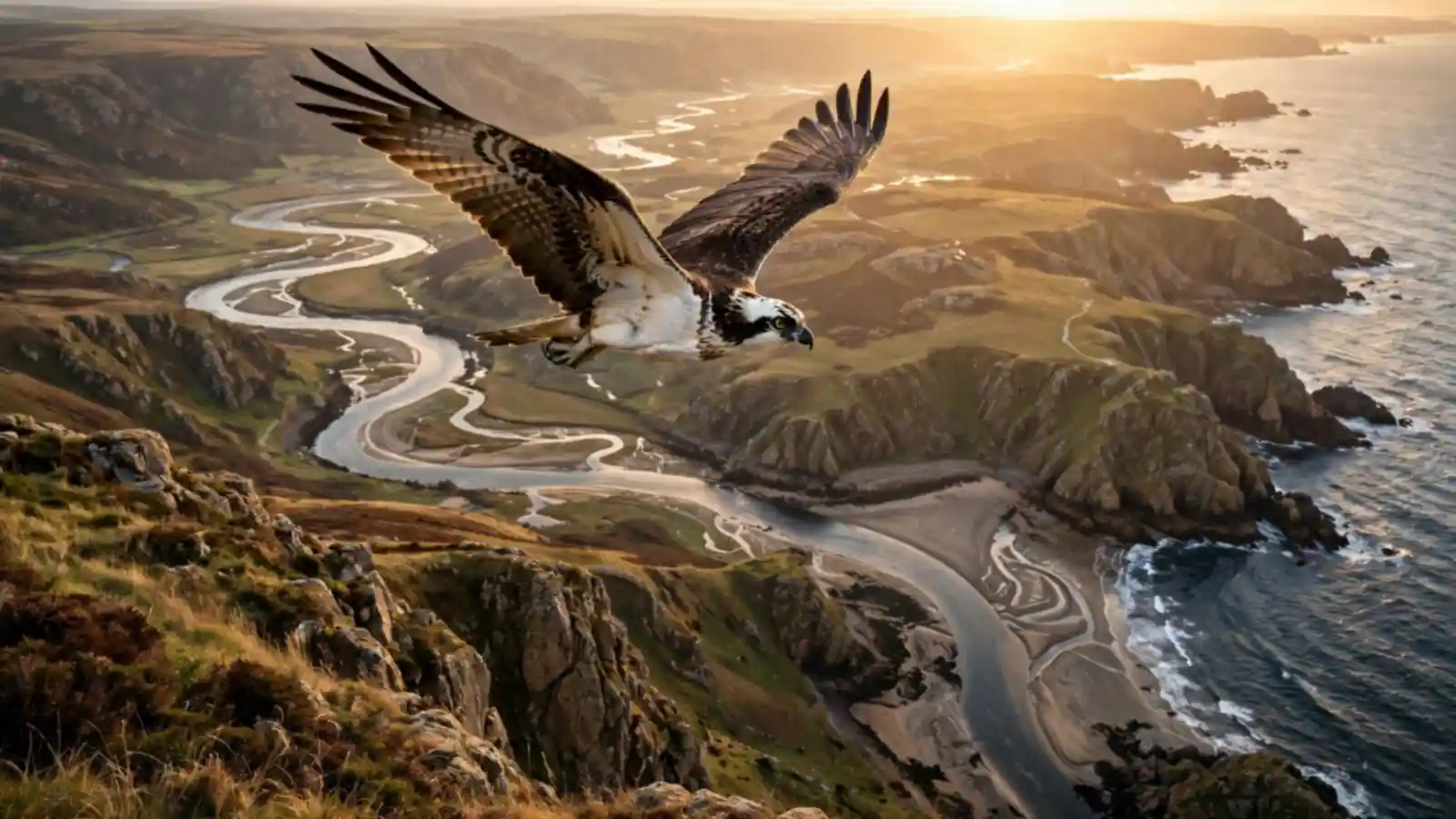
That solo habit surprises people: the family does not travel together when it migrates. The female usually leaves first, the male stays to feed the fledged young a little longer, and the juveniles set off last, navigating by instinct to wintering grounds they have never seen. Pairs reunite the following spring — usually at the same nest, fidelity to the address mattering more than fidelity on the road.
A Comeback Story: From DDT to Recovery
Its darkest years came from an invisible poison. DDT, sprayed widely after the Second World War, washed into waterways, concentrated up the food chain, and left breeding birds laying eggs with shells too thin to survive incubation. Some regional populations fell by 80 or 90 per cent before bans in the early 1970s stopped the damage.
What followed is one of conservation’s cleanest victories. With the poison gone, nesting platforms provided, and wetlands protected, ospreys returned decade by decade until the species was secure again across most of its range. Its recovery is now the standard proof that a widespread bird, given clean water and a safe place to nest, can come back from the edge on its own wings.
People now help deliberately. Conservation groups raise nesting platforms wherever dead trees are scarce, power companies pad the poles ospreys insist on using, and wardens guard famous nests through the season. The bird that once symbolised what pesticides could destroy has become the bird that shows what protection can rebuild — nesting, fittingly, in full public view.
Fun Facts
- Its outer toe is reversible: it can point two toes forward and two backward, turning each foot into a pair of tongs for gripping slippery fish.
- Its nostrils can close completely, and its plumage is unusually oily — both adaptations for a bird that regularly plunges underwater.
- After catching a fish, the bird always repositions it head-first in flight, like a pilot streamlining cargo.
- The species is the only member of its family, Pandionidae, making it taxonomically one of a kind among raptors.
- Ospreys were once shot as competitors by fishermen; today the same birds are protected and their nests are watched by millions online.
- The oldest known wild bird lived to 25 years — a remarkable age for a bird that migrates across continents twice a year.
Frequently Asked Questions
What Do Ospreys Eat?
Ospreys eat almost exclusively live fish, which make up around 99 per cent of the diet. They hunt by hovering over shallow water and plunging feet-first onto fish near the surface, typically catching fish of 150 to 300 grams. Only rarely, when fish are scarce, will an osprey take frogs, rodents, snakes or other birds.
Do Ospreys Migrate?
Yes, most northern ospreys migrate long distances. Birds breeding in North America winter as far south as South America, while European breeders cross the Sahara to winter in West Africa. Southern populations, such as those in Florida and Australia, are largely resident and stay near their breeding waters all year.
Where Do Ospreys Migrate to in Winter?
It depends where they breed. North American ospreys winter from Florida and the Caribbean down through Central America to South America. European and Asian breeders head for West Africa, the Mediterranean fringes and South Asia. Each osprey tends to return to the same wintering area every year.
Does the Osprey Family Travel Together When They Migrate?
No. The osprey family separates before migrating: the female typically leaves first, the male stays longer to feed the fledged youngsters, and the juveniles migrate last, entirely on their own. Young birds navigate by instinct to wintering grounds they have never visited, which makes the family’s spring reunion at the nest all the more remarkable.
Where Do Ospreys Live?
Ospreys live beside fish-rich water on every continent except Antarctica — coasts, estuaries, lakes, rivers and reservoirs. They need shallow water for hunting and a safe platform nearby for nesting. Few birds have a wider natural distribution, and the species has reclaimed much of the range it lost in the twentieth century.
Where Do Ospreys Nest?
Ospreys nest on high, open platforms: dead trees, cliff tops, buoys, electricity poles and artificial nesting platforms, almost always within a few kilometres of water. The stick nest grows year by year as the pair returns and adds material, and established nests can become huge, bulky structures used for decades.
Similar Species Worth Exploring
Keep Exploring
Still by the water? Meet the wandering albatross, a bird that crosses oceans without landing, or browse the full guide to the types of seabirds for the osprey’s cliff-and-coast neighbours. Wherever fish run near the surface, sooner or later you will see the osprey.