Hatchetfish
Hatchetfish: the tiny deep-sea fish that glows to disappear
The hatchetfish is a tiny deep-sea fish shaped like a hatchet — a silver blade of a body with a deep belly, huge upward-looking eyes and a row of lights along its belly. It glows from below to match the light from above, vanishing against the surface. It is one of the deep sea’s cleverest disappearing acts.
By Emily Carter · Reviewed by our vet team · Updated 10 November 2026 · 8 min read
Glows from its belly to vanishEyes built to look straight upShaped like a hatchet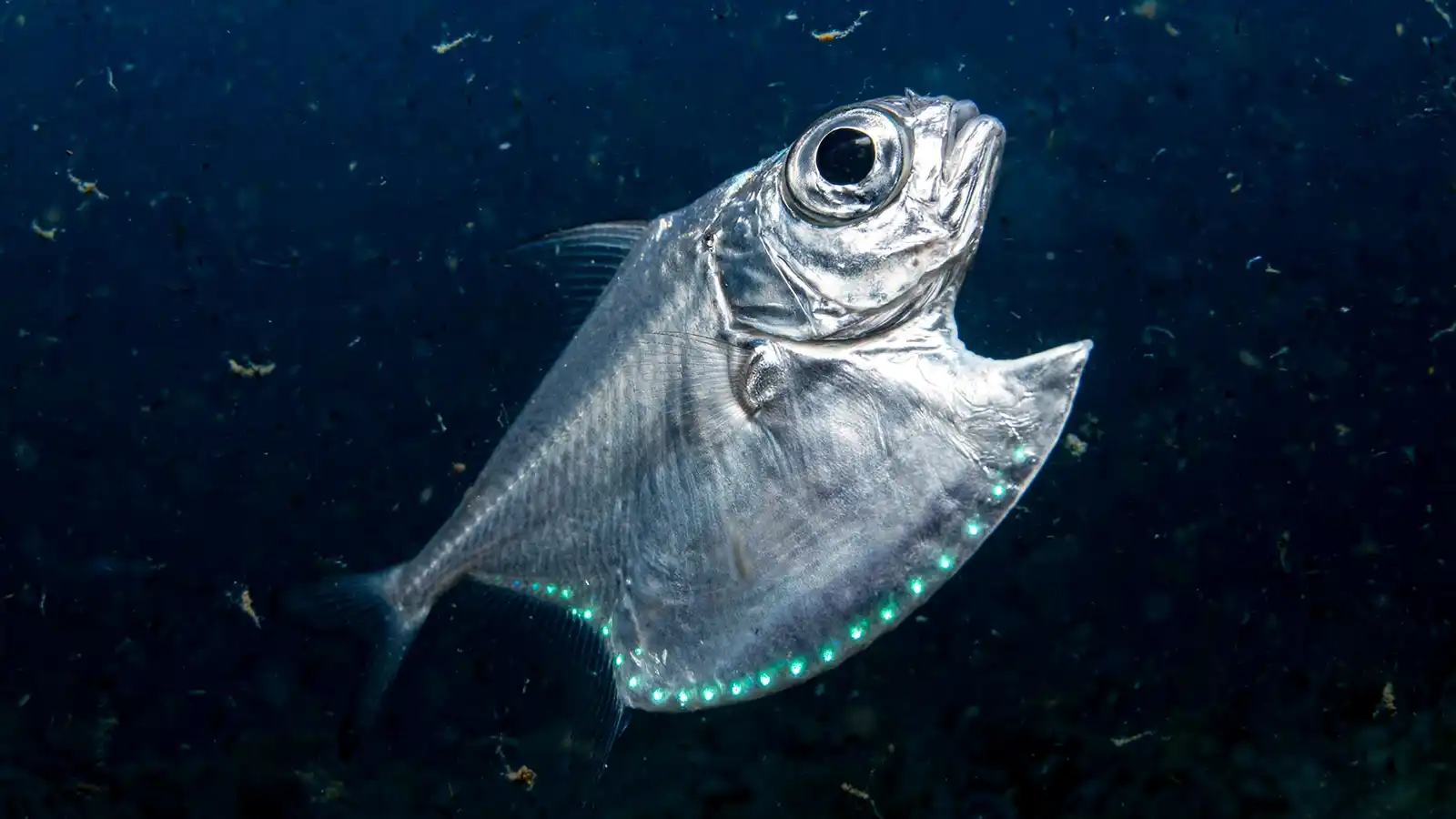
At a Glance
The hatchetfish is a small marine fish of the family Sternoptychidae, named for its shape: a deep, flattened body like the blade of a hatchet, with a tiny tail and a belly full of light-producing organs. It lives in the mesopelagic twilight zone, hundreds of metres down, where the only light comes from above, and it survives by glowing from its belly at exactly the brightness of the light above — a trick called counterillumination that makes it invisible from below. It is a fish that hides by shining.
What Is a Hatchetfish?
It is a tiny deep-sea fish, 2.8 to 12 centimetres long, with a body shaped like a hatchet blade: deep and flattened from side to side, with a sharp belly edge and a small tail. Its back is dark, its sides are silver, and its belly carries a row of photophores — light-producing organs — that glow blue-green. The eyes are enormous and tubular, pointing straight up, to watch for the silhouettes of prey and predators against the faint light above.

There are around 45 species of these marine fish — counts vary, with some lists giving about 73, which would include related genera — and they live in tropical and temperate oceans around the world. They are not the freshwater species kept in home aquariums, which are a different family entirely. This marine fish is a creature of the deep, and it is almost never seen alive except by submersible. The species facts record the size, depth and glowing figures behind this guide.
Size and Shape
They are tiny: most are 2.8 to 12 centimetres long, about the length of a finger, and they weigh only a few grams. Their bodies are deep and laterally flattened, like a blade, with a sharp ventral edge that may help them slice through the water or make them harder to swallow. The dorsal fin is small and set far back, and the tail is forked and delicate.

The shape is a compromise. A deep body makes the fish harder for a predator to swallow, and the silver sides reflect the faint light of the twilight zone. But a deep body is also slow, and it is not a fast swimmer — it drifts, hovers and makes short darts, saving its energy for the daily migration. It is a fish built for hiding, not for speed.
The blade shape squeezes a deep body into very little length: at 2.8 to 12 centimetres, the fish is far taller than it is long, and the sharp belly edge is the bottom of that blade. From the side it looks broad and silver; from below, the edge all but disappears into the glow of its own belly lights.
Hatchetfish Eyes: Built to Look Up
Its eyes are its most striking feature after its shape: they are enormous, tubular and pointed straight up, like a pair of telescopes. The eyes are built to collect the faint light from above and to spot the silhouettes of prey and predators against it. The retinas are packed with light-sensitive cells, and the lenses are large, gathering every photon in the dim twilight zone.
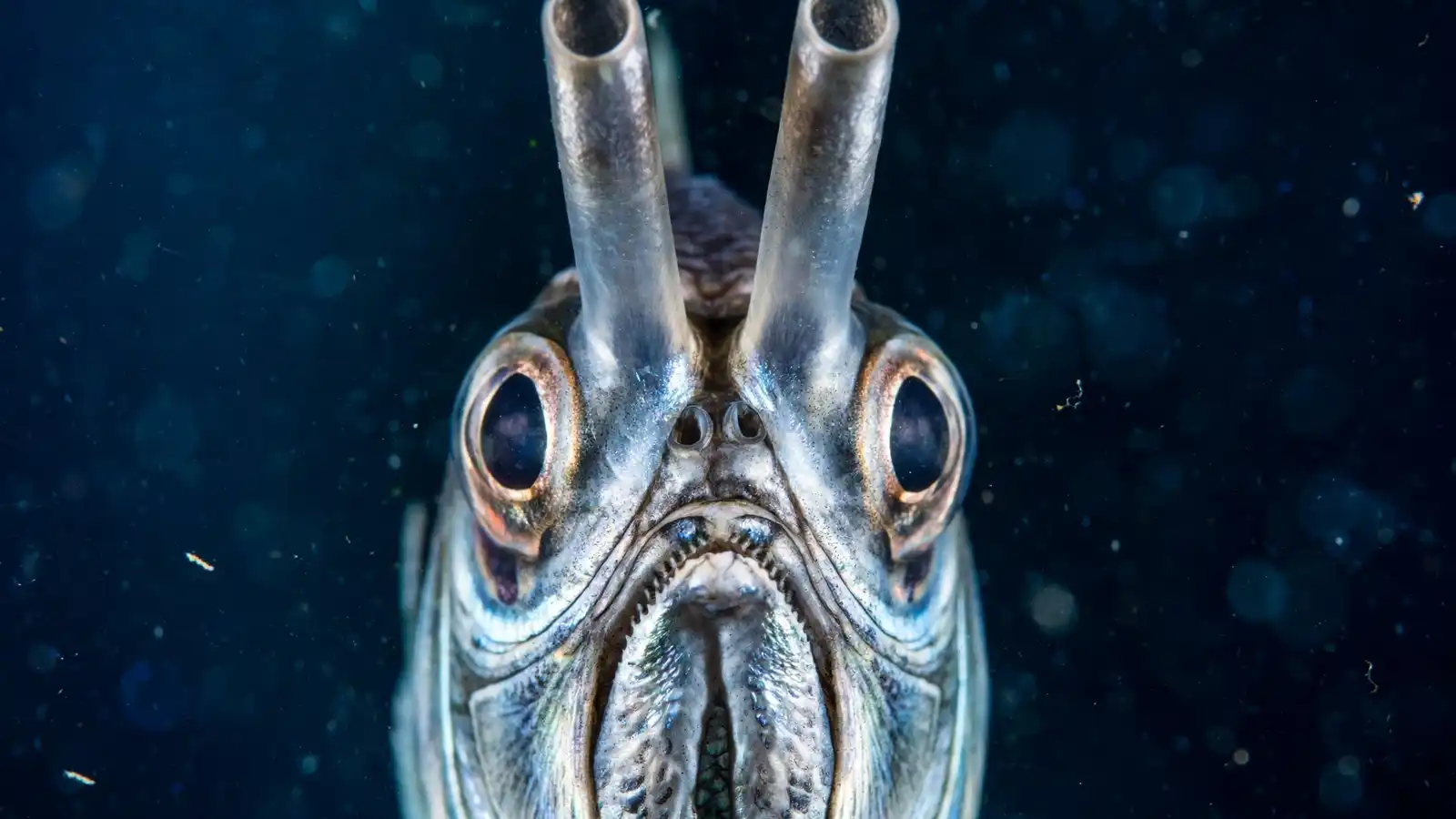
The upward gaze is a way of life. In the twilight zone, food comes from above — copepods, krill and small fish silhouetted against the light — and predators come from above too. A fish that looks up sees both, and it can strike at prey or vanish before a predator strikes it. The eyes are so large that they dominate the head, and they give the fish a startled, watchful expression.
That upward stare never really switches off. The food it watches for — copepods, krill and small fish — drifts and swims in the lit water overhead, and so do the hunters that eat this fish. Big tubular eyes, packed with light-sensitive cells, are how a few grams of fish keep track of both at once.
Bioluminescence and Counterillumination
Counterillumination is this fish’s great trick, and it works like this: the fish’s belly carries a row of photophores that produce blue-green light at exactly the brightness of the light filtering down from the surface. Seen from below, the fish’s glowing belly matches the background light, and the fish vanishes — a predator looking up sees nothing but the glow of the surface. It is camouflage by light, and it is one of the most elegant tricks in the deep sea.
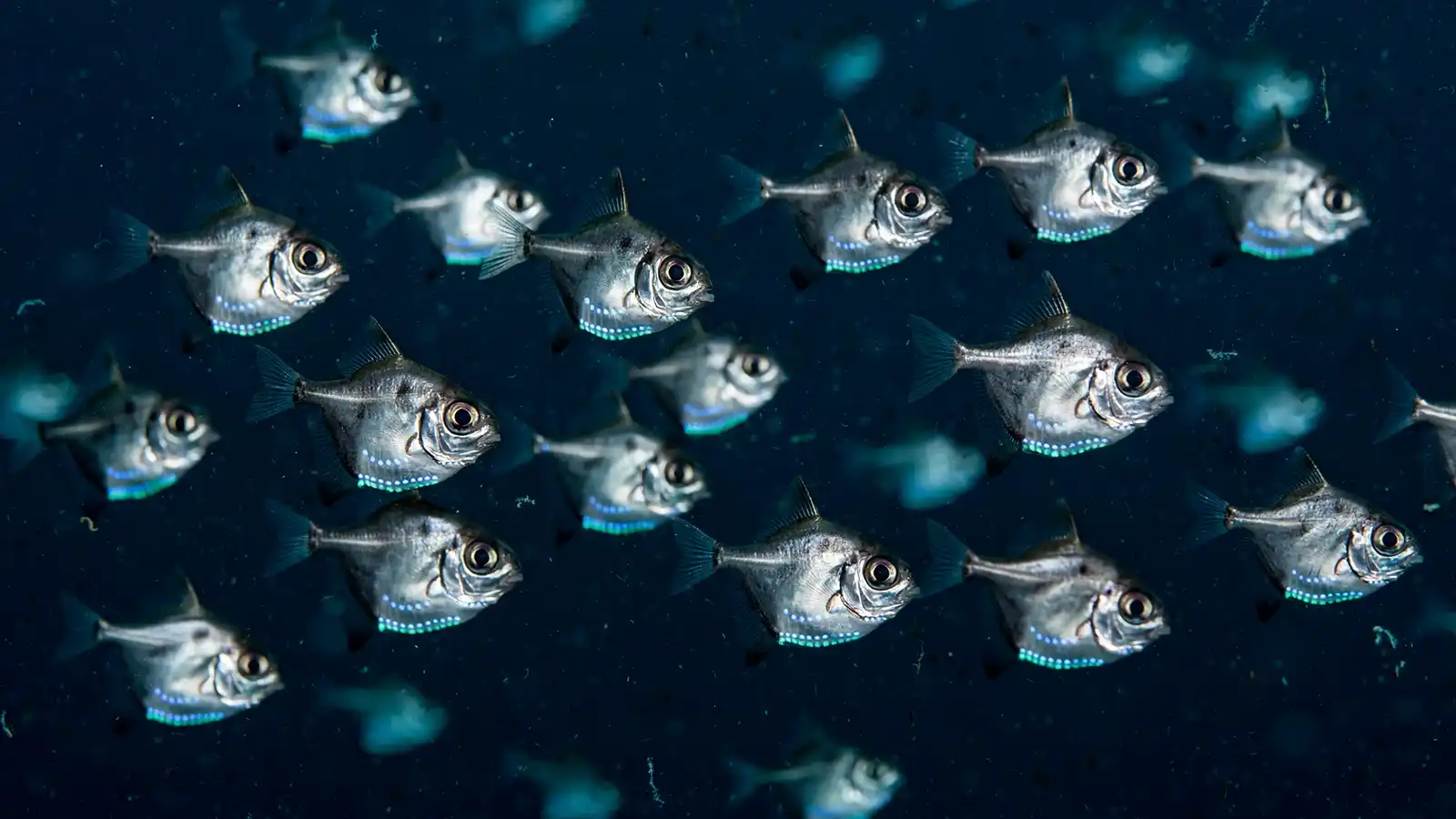
The fish can control the light. It adjusts the brightness of its photophores to match the changing light above — brighter at noon, dimmer at dusk — and it can switch them off when it needs to. The light is made by bacteria or by the fish’s own chemistry, depending on the species, and it is the same blue-green as the light that filters down through the water. The trick is not perfect — a sharp-eyed predator can still spot the fish — but it is good enough that these fish survive in waters full of predators.
Habitat: The Twilight Zone
They live in the mesopelagic twilight zone, mostly between 200 and 600 metres deep, with a range from about 50 to 1,500 metres. They are found in tropical and temperate oceans around the world, and they are most abundant where the water is clear and the light penetrates deep. During the day they stay deep, where the light is dim and the counterillumination works best; at night they rise towards the surface to feed, following the plankton that migrates up after dark.
The pattern repeats every day of its short life: down in the dim water by day, where the glowing belly works best, then up towards the food-rich surface at night, when darkness hides the climb. Clear tropical and temperate waters, where the light reaches deepest, hold the greatest numbers.

The daily migration is the largest migration on Earth, and this fish is part of it: every night, trillions of small animals rise from the deep to feed near the surface, and every morning they sink back down. It rides the migration, feeding at night and hiding by day, and it is food for almost everything bigger than it — tuna, squid, whales and seabirds. The black swallower, a predator of the same deep waters, hunts these fish among its prey.
Diet and Night Migration
They eat copepods, krill and small fish, caught with a quick upward strike. They hunt by looking up, spotting the silhouette of prey against the light, and darting up to snatch it. Their mouths are small and upturned, built for snatching prey from above, and they feed mostly at night, when they rise towards the surface and the plankton is thick.

The night migration is a feast and a risk. At night the surface waters are full of food, but they are also full of predators, and its counterillumination does not work as well in the dark. So the fish feed quickly, then sink back down at dawn, to the safety of the twilight zone. Their lifespan is short — under a year, by one report, though the figure is weakly sourced — and they breed and die fast, in the rhythm of the deep.
A small, upturned mouth suits that way of feeding: everything worth eating is above, silhouetted against the light, and one quick dart upward is all it takes. The strike has to be fast — the same lit water that shows the prey also shows the hunter to anything bigger.
Fun Facts
- It glows from its belly at exactly the brightness of the light above, vanishing from below.
- Its eyes are tubular telescopes pointed straight up, to spot prey and predators against the light.
- These marine fish are not the freshwater fish of home aquariums — they are a different family.
- They rise towards the surface every night to feed, in the largest migration on Earth.
- There are around 45 species of these marine fish, though counts vary.
- It is only 2.8 to 12 centimetres long — about the length of a finger.
Frequently Asked Questions
What Is a Hatchetfish?
It is a tiny deep-sea fish of the family Sternoptychidae, shaped like a hatchet blade, with a deep silver body, huge upward-looking eyes and a row of glowing photophores along its belly. It lives in the mesopelagic twilight zone and hides by glowing.
How Do Hatchetfish Glow?
They carry photophores — light-producing organs — along their bellies, which glow blue-green. The fish adjusts the brightness to match the light filtering down from the surface, so that seen from below it vanishes against the background light.
What Is Counterillumination?
Counterillumination is camouflage by light: an animal produces light on its underside at the same brightness as the light from above, so a predator looking up sees nothing but the background glow. This fish is one of the best examples of the trick.
How Big Are Hatchetfish?
They are 2.8 to 12 centimetres long, about the length of a finger, and weigh only a few grams. Their bodies are deep and flattened, like a hatchet blade, with a sharp belly edge.
How Deep Do Hatchetfish Live?
They live mostly between 200 and 600 metres deep, in the mesopelagic twilight zone, with a range from about 50 to 1,500 metres. At night they rise towards the surface to feed, following the plankton migration. The opah shares this twilight zone, hunting the same mesopelagic waters — and it does so as the first fully warm-blooded fish, keeping its body about 5 degrees warmer than the water around it.
What Do Hatchetfish Eat?
They eat copepods, krill and small fish, caught with a quick upward strike. They hunt by looking up and spotting the silhouette of prey against the light, and they feed mostly at night near the surface.
Are Hatchetfish the Same as Freshwater Hatchetfish?
No — the marine fish belong to the family Sternoptychidae and live in the deep sea, while the freshwater fish belong to a different family and live in South American rivers and aquariums. The two are unrelated, and the name comes from the same hatchet shape.
Similar Species Worth Exploring
Keep Exploring
Keep exploring the deep sea through the black swallower, the small black fish that swallows prey twice its size, the ribbonfish, the silver giant behind the doomsday fish myth, and the wider world of the types of fish. No deep-sea fish disappears quite like the hatchetfish.