Bowhead Whale
Bowhead Whale: the ice-breaking giant that can live for 200 years
The bowhead whale is the whale built for ice: a stocky Arctic specialist with a skull like a battering ram, the longest baleen of any whale, and a life that can stretch beyond 200 years. Here is its size, diet, frozen habitat, songs and long road back from the whaling years.
By Emily Carter · Reviewed by our vet team · Updated 10 November 2026 · 9 min read
Length up to 18 mWeight up to 100 tonnesLifespan 200+ years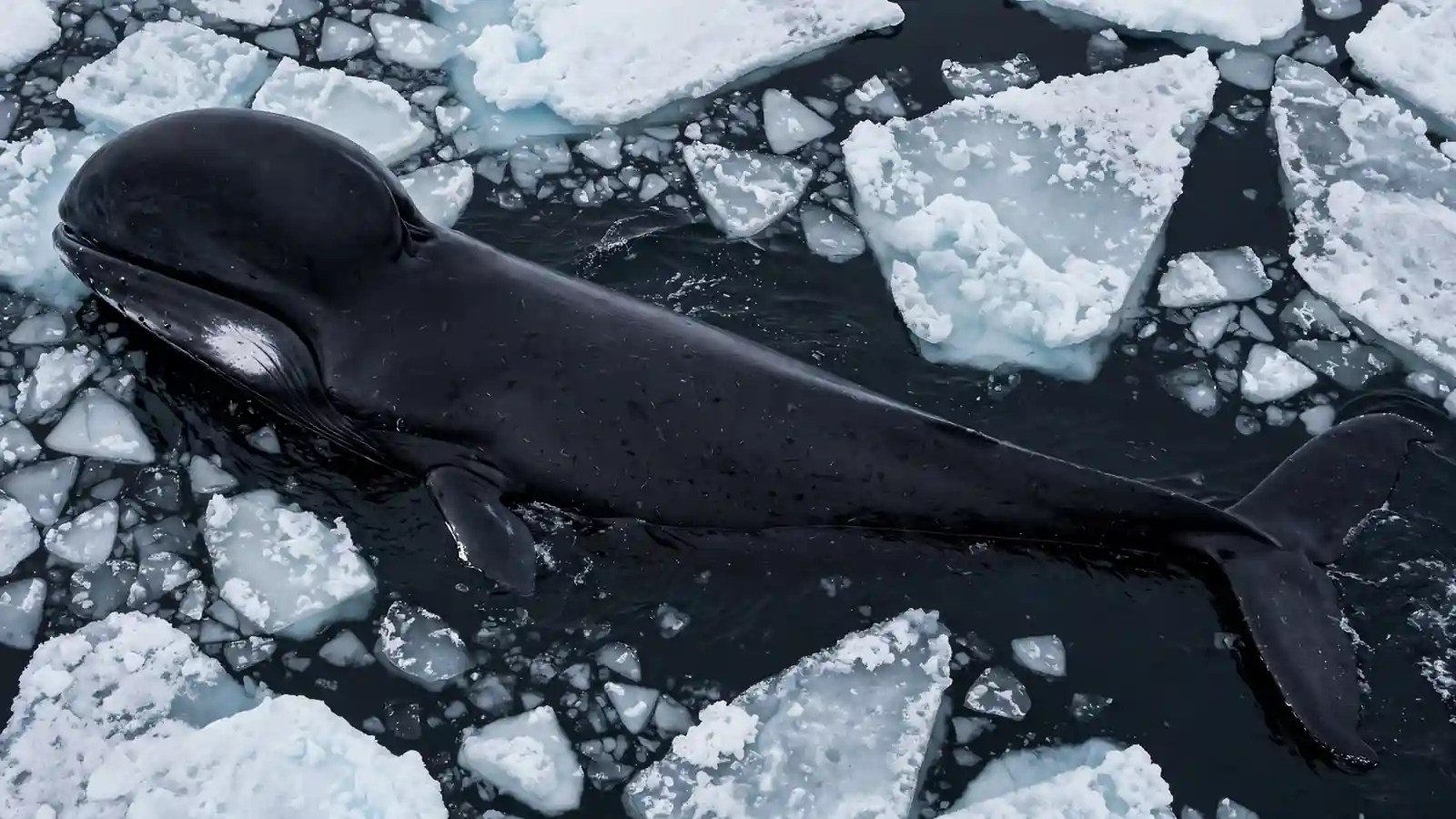
At a Glance
The bowhead whale spends its entire life in the coldest seas on Earth, following the edge of the Arctic ice as it grows and melts with the seasons. No other large whale is so completely at home in the frozen ocean.
Bowhead Whale Size and Weight
A fully grown adult usually measures between 14 and 18 metres (46 to 59 feet) from nose to tail. Females grow larger than males, reaching up to about 18 metres, while most males top out closer to 17 metres. A big adult weighs between 75 and 100 tonnes, and a generous share of that bulk is blubber.
Human comparisons help the numbers land. An 18 metre whale is as long as four family cars parked nose to tail, and a 100 tonne adult weighs about as much as eight double-decker buses. Yet for all that mass, it is a slow, deliberate swimmer, built for endurance in cold water rather than speed.
The sheer bulk is a survival tool. A body this size loses heat slowly in near-freezing water, stores enormous energy reserves in its blubber, and gives a newborn calf a mother too big for almost any predator to challenge.
Appearance and Anatomy
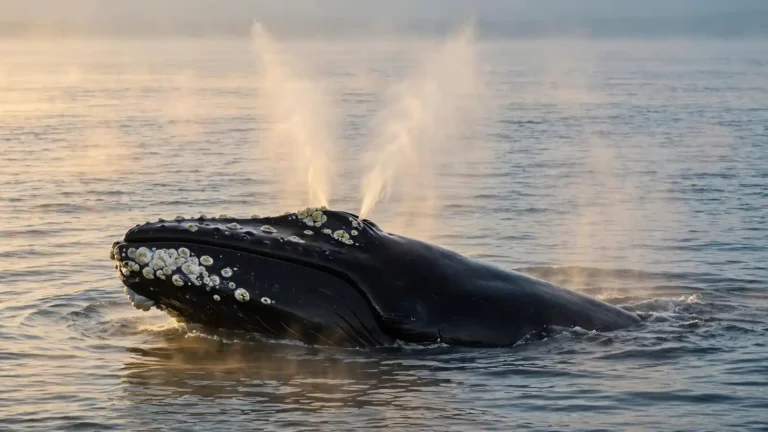
There is no mistaking this whale. The body is dark charcoal to black and exceptionally stocky, with a small paddle-shaped flipper, a broad tail, and no dorsal fin at all: the back runs in one smooth, unbroken curve from head to tail. The feature that gives it away at once is the white patch splashed across the chin and lower jaw, bright against the dark skin.
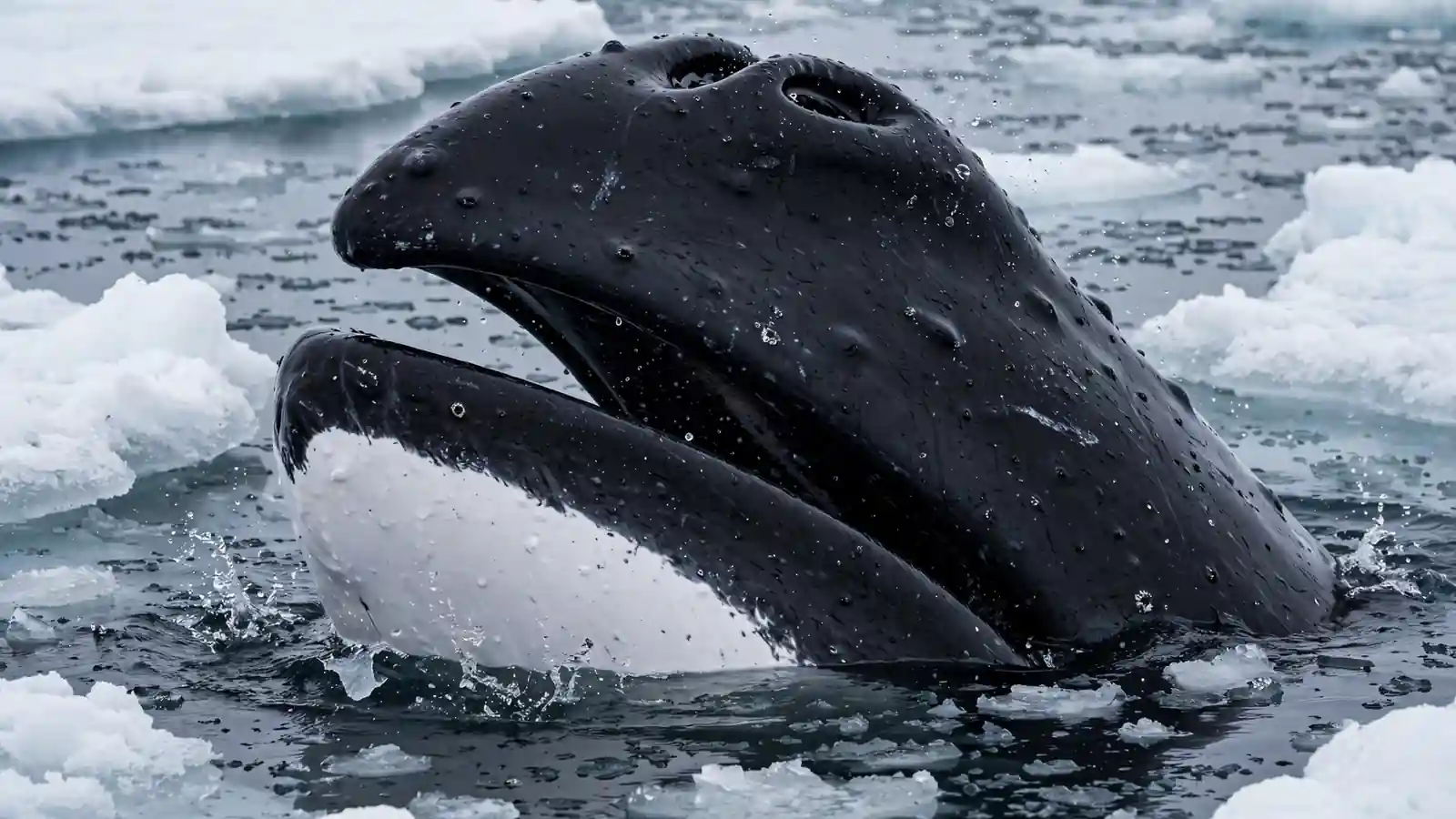
The head is enormous, making up roughly a third of the whole body. The skull alone can measure over five metres (16.5 feet) long, and it is shaped like a great arching bow, which is where the name comes from. That reinforced dome is a tool as much as a skeleton: the whale uses it to break up through sea ice about 20 centimetres (8 inches) thick to breathe, and whalers reported animals surfacing through far thicker ice still.
Under the skin sits the thickest insulation in the whale world: a layer of blubber up to about 48 centimetres (19 inches) thick, thicker than that of any other whale. On top of the head, two blowholes sit side by side on the high crown, angled so the whale can breathe through narrow cracks and holes in the ice without fully surfacing.
Habitat and Range
The bowhead whale lives further north than any other baleen whale, in the Arctic and subarctic seas between roughly 60 and 75 degrees north. Its strongholds are the Bering, Chukchi and Beaufort seas off Alaska and Russia, the waters of Hudson Bay, Foxe Basin, Baffin Bay and Davis Strait around Canada and Greenland, the Sea of Okhotsk, and the cold seas from eastern Greenland and Spitsbergen to eastern Siberia.
Its whole year is ruled by ice. In winter the whales keep near the southern edge of the pack ice, breathing through cracks and thin places. As spring breaks the ice up, they travel north into newly opened water, spending summer in bays, straits and estuaries where food gathers, then retreat south again ahead of the returning freeze.
Diet and Feeding
For so large an animal, the menu is tiny. A bowhead feeds almost entirely on small marine life, straining a varied menu of tiny Arctic crustaceans from the water: krill, copepods, mysids and amphipods, with the odd small fish taken by accident. Researchers estimate that a single adult gets through roughly 100 tonnes of this prey in a year to fuel its huge body.
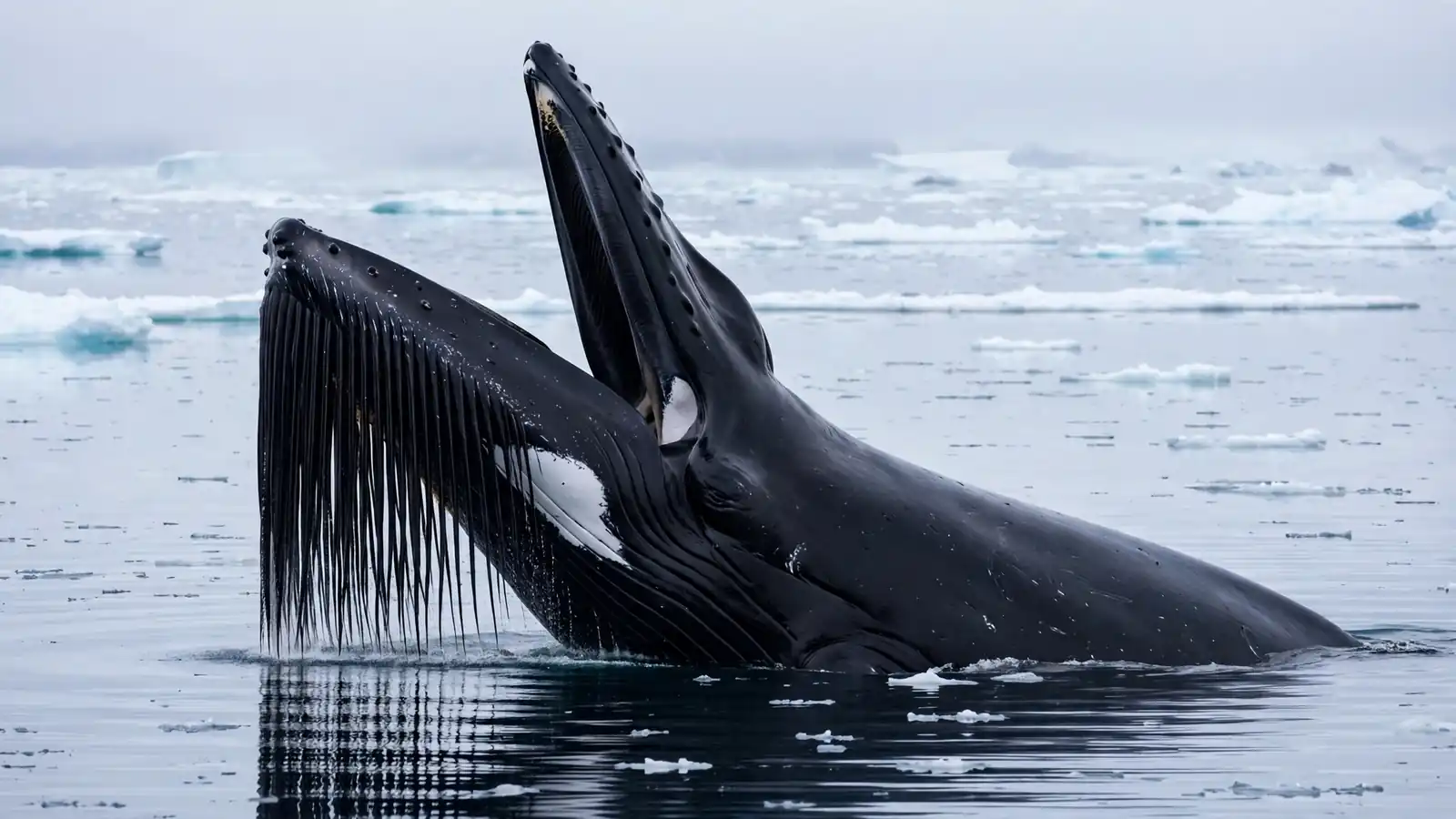
Feeding is a slow, patient business. The whale often swims along at or near the surface with its great mouth held open, letting water stream in and out across the baleen while the fringed plates trap the animals inside, then licks them off with its tongue. Groups sometimes feed side by side in a loose V formation, sweeping a rich patch of water together.
The filter itself is a record-breaker. Around 300 baleen plates hang from the upper jaw on each side, and at up to about four metres (13 feet) long they are the longest baleen plates of any whale on Earth. Fringed with fine hairs, they work like a sieve fine enough to catch creatures barely a centimetre long.
Behavior and Social Life
Bowheads are quiet, unhurried whales. They usually travel alone or in small, loose groups, and even their migrations are orderly: in spring the travelling herds sort themselves by age and size, with mothers and their new calves among the first to head north and the biggest adults bringing up the rear.
The ice is both shelter and shield. When killer whales are near, a bowhead can slip beneath the floes where its pursuers cannot follow, rising to breathe through cracks too narrow for an attacker to use. Rakes of scars from killer whale teeth are common on older animals, a reminder that even this giant has enemies.
Communication and Sound
Sound runs a bowhead whale’s world. Beneath the ice, where daylight vanishes for months and the surface is locked hard, hearing and voice do the work of eyes. These are among the most vocal of all whales, with a wide repertoire of calls used to keep contact with companions, navigate along the ice edge and find food-rich water, and some calls echo off the ice in ways that may help them feel out their surroundings.
In the late winter breeding season the calls grow into true songs: long, varied sequences that change from year to year, with individual whales weaving in new phrases like jazz musicians. A single singer may work through dozens of different tunes in one season, a variety unmatched by most other whales.
Reproduction and Babies
Life runs slowly here. A bowhead does not breed until it is in its twenties, by which time it is already around 11 to 14 metres long. Mating happens mostly in late winter and early spring, and after a pregnancy of about 13 to 14 months the female gives birth in spring, usually between April and early June, often while the herd is on its northward migration.
A newborn calf is already about four metres (13 feet) long and weighs around 900 kilograms (2,000 pounds), and it can swim from the moment it is born. It nurses for roughly a year, sheltered by its mother’s bulk and by the ice, and a female will typically wait three to four years before having another calf. That slow pace is exactly why the species recovers from losses so gradually.
Predators and Threats
An adult in good health has just one serious natural enemy: the killer whale. Packs of orcas hunt calves and weakened animals, and about one in twelve of the bowhead whales examined in Alaska carries scars from killer whale attacks.
The modern dangers are human-made. Entanglement in crab-pot lines is a growing problem, and around one in eight of the whales examined in the west carries scars from fishing gear. Ship strikes are still uncommon in the high Arctic but becoming likelier as melting ice opens the region to more shipping, and underwater noise from industry can drive feeding whales away from the quiet waters they need.
Conservation and Human Interaction
Few whales were hunted harder, or for longer. From the 1600s to the early 1900s, commercial fleets killed bowheads for their oil and their hugely valuable baleen, and because a dead bowhead floats, it was easy to recover. Worldwide numbers crashed from at least 50,000 animals to fewer than 3,000 by the 1920s, and the species came close to vanishing altogether.
Protection changed the ending. The Western Arctic population, the one hunted off Alaska, has climbed back to roughly 15,000 animals and is now the largest in the world; official assessments of the Western Arctic bowhead population’s recovery tell that story in detail. The recovery is not shared equally: the Sea of Okhotsk population still numbers only a few hundred animals, and United States law still lists the species as endangered even as its global outlook has steadily improved.
In Alaska, a small subsistence hunt by Native whaling communities continues under strict shared quotas, as it has for thousands of years, and scientists work alongside the hunters, learning something from every whale landed. For everyone else, the right way to meet one is the way you meet most Arctic wildlife: from a respectful distance, and on its own terms.
Fun Facts
- A bowhead whale may live for more than 200 years, making it the longest-lived mammal on Earth.
- Its skull alone can be over five metres long, about a third of its entire body.
- Stone harpoon tips from the nineteenth century have been found healed into the blubber of whales caught in modern times.
- Its baleen plates, at up to about four metres, are the longest of any whale and would stand taller than a basketball hoop.
- It can break through ice about 20 centimetres thick using the top of its massive head.
- The oldest bowheads alive today may have been born before the first motor car existed.
Frequently Asked Questions
How Big Is a Bowhead Whale?
It can reach about 18 metres (59 feet) long and weigh up to around 100 tonnes, making it one of the largest animals on Earth. Females grow larger than males, and roughly a third of that length is head: the skull alone can be over five metres long.
What Do Bowhead Whales Eat?
They eat tiny sea creatures: mainly krill and copepods, along with mysids, amphipods and other small crustaceans. They filter them from the water with their baleen plates, and an adult gets through roughly 100 tonnes of prey a year.
Where Does a Bowhead Whale Live?
It lives in the Arctic and subarctic seas that circle the pole: the Bering, Chukchi and Beaufort seas, the Canadian Arctic and Hudson Bay, the Sea of Okhotsk, and the waters around Greenland and Spitsbergen. It follows the edge of the sea ice all year round.
How Long Do Bowhead Whales Live?
They routinely live past 100 years, and the oldest individuals are estimated at more than 200, making them the longest-lived mammals known. Scientists work out their ages from chemical changes in the eye lens and from old harpoon tips found healed into their blubber.
Are Bowhead Whales Dangerous to Humans?
No. They are slow, shy filter feeders with no teeth and no interest in people. They are far more at risk from humans: from commercial hunting in the past and, today, from fishing gear, ship traffic and a warming Arctic.
What Is a Baby Bowhead Whale Called?
A baby is called a calf. It is born in spring, usually between April and early June during the northward migration, and it already measures about four metres (13 feet) long and weighs around 900 kilograms (2,000 pounds). It stays close to its mother and nurses for about a year.
Similar Species Worth Exploring

Keep Exploring
Still curious about the great whales? Meet the blue whale, the largest animal that has ever lived, listen in on the singing humpback whale, or browse every species in our guide to the types of whales. Wherever you wander next, the bowhead whale will be out there in the ice, quite possibly older than the ship you are sailing on.