Southern Right Whale
Southern Right Whale: the comeback giant of the southern seas
The southern right whale is the great recovery story of the whale world: hunted almost to vanishing point, protected since 1935, and now returning every winter to sheltered bays around the southern continents. Here is its size, habits and remarkable comeback.
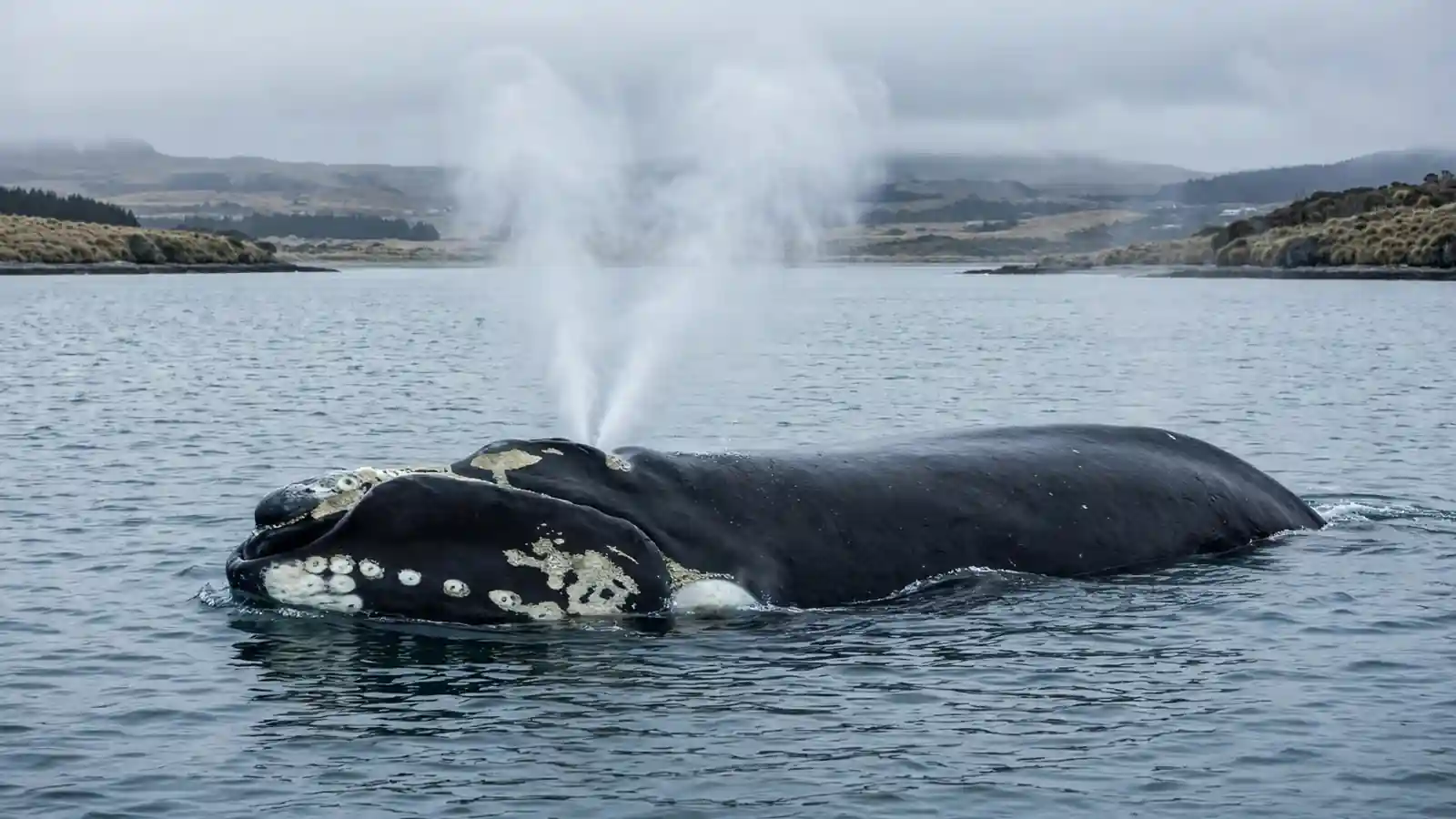
Blow: A wide V of spray
Party trick: Sails with its tail held in the wind
At a Glance
Everything about this whale is the opposite of the rorquals: slow instead of fast, round instead of sleek, finless instead of finned — and, after a century of protection, it is the proof that a whale species can come back from the very edge. Among the rorquals it is set against, the sei whale and the warm-water Bryde’s whale show how different that sleek, finned design can be.
Southern Right Whale Size and Weight
A southern right whale grows to about 18 metres (59 feet) long at most, with a typical adult female around 15 metres — and the weight is the surprise: the biggest animals reach some 80 tonnes, built like barrels, with enormous girth for their length.
Nearly a third of that length is head, an outsized skull carrying a deeply arched mouth and hundreds of long baleen plates. A newborn calf measures 5 to 6 metres and weighs 1,000 to 1,500 kilograms, then grows about 3 centimetres a day on its mother’s rich milk.
Females edge out males in size, as in most baleen whales. Put this whale next to its northern cousin and they are near-twins — the southern animal averages a touch smaller, but carries the same rotund, finless silhouette that whalers once found so profitable.
Appearance and Anatomy
Start with what is missing: there is no dorsal fin at all, and no throat grooves either. The back is broad, smooth and uniformly black, sometimes with irregular white patches on the belly, and the flippers are short, broad paddles. The full anatomy is laid out in the full species account, but two features do the real identifying.
The first is the callosities — rough, crusty outgrowths of thickened skin scattered over the head: a big patch called the bonnet on the front of the rostrum, more along the jawline, behind the blowholes and above the eyes. Colonies of pale whale lice turn them white and cream, and because no two whales share a pattern, researchers identify individuals like fingerprints.
The second is the blow. The two blowholes are set wide apart, so the spout splits into a clear V shape, visible from far off. Add the strongly arched mouth — a frown that curves up at both ends — and a southern right whale can be named from a headland long before any other detail shows.
Habitat and Range
The southern right whale lives only in the southern hemisphere, circling the Southern Ocean roughly between 20 and 60 degrees south. Its map touches the coasts of South America, South Africa, Australia, New Zealand and scattered subantarctic islands.
Winter and spring are spent in sheltered breeding bays — Península Valdés in Argentina, the South African coast around Hermanus, the Head of Bight in Australia, New Zealand’s subantarctic Auckland Islands. There, in water barely deeper than the whales are long, mothers raise calves within sight of shore.
Summer reverses the journey: long migrations south to cold, krill-rich feeding grounds in the far Southern Ocean. A mother and calf travel slowly, averaging only a few kilometres per hour across a 24-hour day, and the whole population’s year is this pendulum between nursery bays and polar feasts.
Diet and Feeding
Like its northern cousin, the southern right whale is a skim feeder living on some of the smallest animals in the sea: copepods and krill, strained from the water through 220 to 260 long baleen plates, each up to almost 3 metres in length.
It feeds two ways. At the surface it swims through dense plankton slicks with its mouth wide open and baleen exposed, a slow black hull harvesting as it goes. Below the surface it works submerged layers the same way, presumably where copepods gather thickest — researchers find whales surfacing with their heads coated in stirred-up life.
The menu explains the migration. Southern summers turn polar water into soup; a whale that needs tonnes of tiny prey cannot do better than follow the bloom south, then fast or feed lightly through the breeding season on blubber laid down in the cold.
Behavior and Social Life
This is one of the most playful and people-friendly of the great whales. Southern right whales breach — launching their barrel bodies clear of the water and crashing back sideways — slap the surface with flippers and flukes, and approach boats with a curiosity that makes them favourites of whale watchers on three continents.
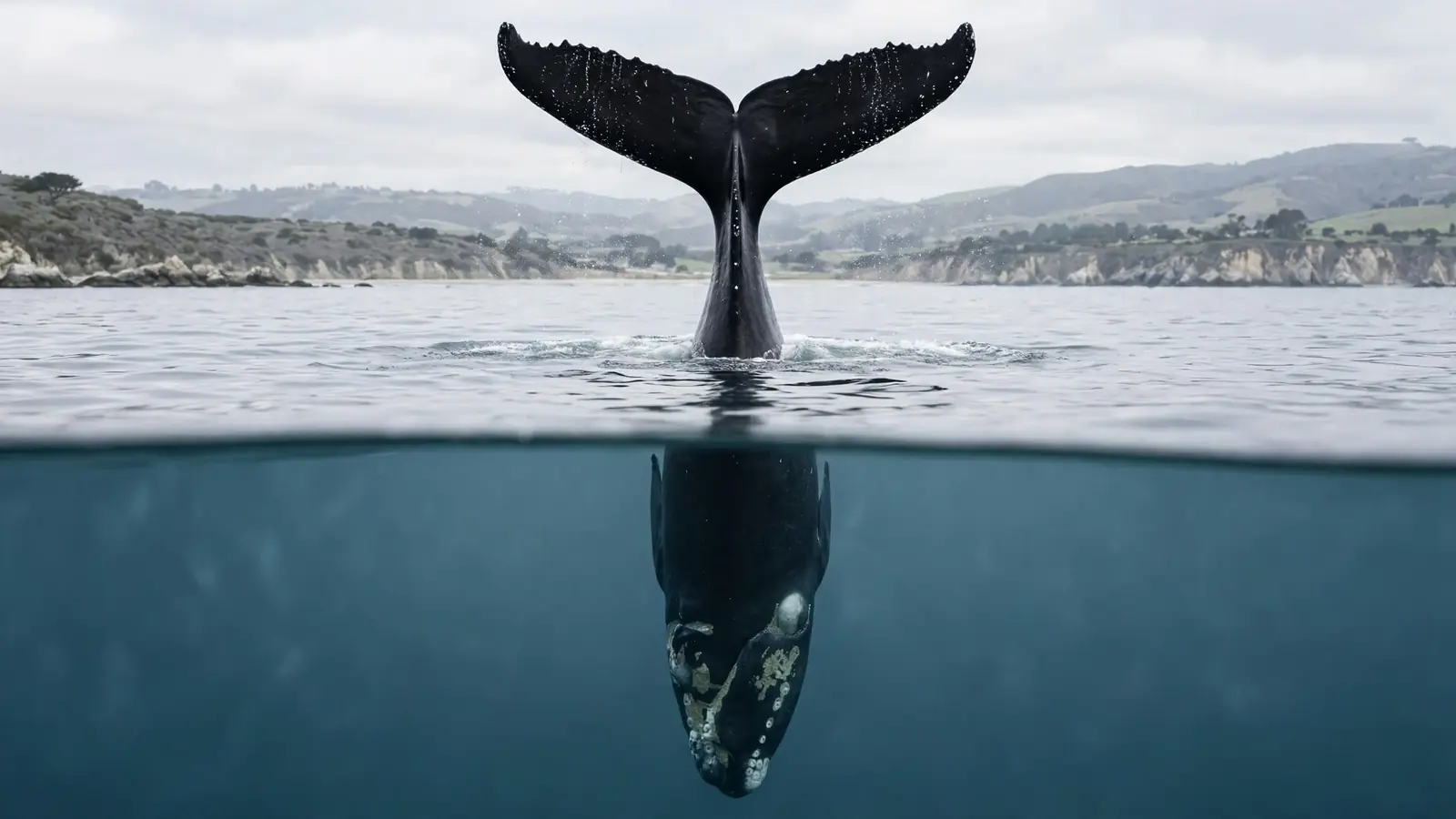
Their strangest trick is ‘sailing’: the whale tips head-down and raises its huge flukes into the wind, letting the breeze push it slowly across the bay like a black sail. It can hold the pose for minutes, rocking gently — scientists think it may be resting, cooling off, or simply playing.
Social life peaks in the breeding bays, where courtship groups of several males attend a single female in slow, tender ballets of rolling and caressing, with remarkably little aggression. Mothers, meanwhile, keep their calves close in the shallows, the pair often resting together at the surface for hours.
Communication and Sound
The voice is a repertoire of short, low moans, pulses and belch-like calls, most under 500 hertz, used to keep contact in the breeding bays. Mothers and calves exchange soft calls, and males produce a sharp ‘gunshot’ sound during the breeding season that may advertise their presence across the bay. Flip and tail slaps add a percussion section other whales hear through the water.
Reproduction and Calves
Mating and calving run from June to November in the southern winter, in the protected bays. Females mature at about ten years old; after a pregnancy of roughly a year, a single calf is born in the shallows — an unusually safe nursery, warm-adjacent and sheltered from ocean swell and predators.
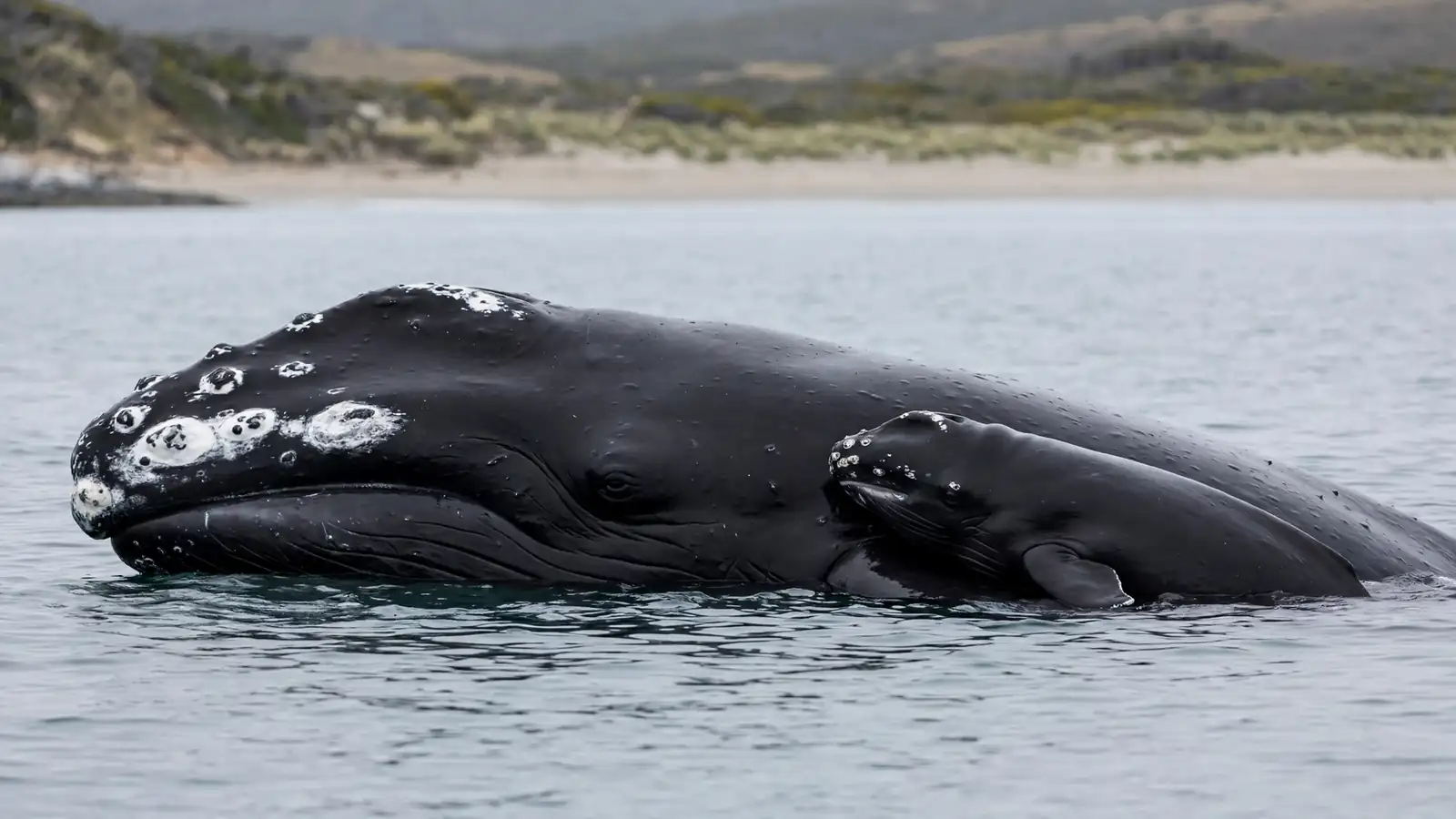
The calf nurses for several months, staying tight against its mother through its first year while it grows those 3 centimetres a day. A female typically calves every three years, and a healthy population can grow at up to about seven percent a year — the engine behind this species’ famous recovery.
Predators and Threats
Adults are nearly predator-proof, but calves face killer whales and large sharks — and, at one famous breeding bay, a stranger danger: kelp gulls have learned to land on calves’ backs and peck at the skin, a harassment researchers link to calf deaths in bad years. The historic predator, though, was the whaling fleet, and today’s risks are ships, fishing gear and a changing Southern Ocean.
Conservation and Human Interaction
The name tells the story: to whalers this was the ‘right’ whale to kill — slow, coastal, buoyant when dead and rich in oil. An estimated 150,000 or more were taken between the 1770s and 1900s, and by 1920 perhaps only a few hundred remained. International protection came in 1935, among the first ever granted to a whale.
The recovery since has been the model other whale rescues are measured against. From a few hundred survivors, the population climbed to an estimated 13,600 by 2009 and has kept growing at several percent a year in most regions — enough for the species to sit in the lowest concern category, a status no one in 1920 would have dared predict.
It is not finished. Some groups, like New Zealand’s, carry the genetic scars of a bottleneck that left perhaps 25 breeding females, and gull attacks, kelp shifts and warming southern waters press on the nurseries. The contrast with its northern twin could not be sharper — the federal species profile for the North Atlantic right whale tells of a few hundred animals still fighting ship strikes and ropes. But stand on the cliffs at Hermanus in July and the verdict is visible: the bay is full of whales again.
Fun Facts
- Right whales have the largest testes of any animal — each pair can weigh close to a tonne.
- A southern right whale can hold its tail in the wind and ‘sail’ across a bay for minutes at a time.
- Its callosity pattern is unique to each whale, so scientists run photo catalogues the way police use fingerprints.
- New Zealand’s population may have passed through as few as 25 breeding females — and is now over a thousand strong there.
- A calf grows about 3 centimetres a day in its first months, on milk rich enough to double as blubber fuel.
- The species was protected in 1935, making right whales among the very first whales shielded by international law.
Frequently Asked Questions
How Big Is a Southern Right Whale?
Up to about 18 metres (59 feet) long and 80 tonnes at the very largest, with a typical adult female around 15 metres and 47 tonnes. Almost a third of the length is head, and newborn calves measure 5 to 6 metres.
What Do Southern Right Whales Eat?
Copepods and krill — tiny crustaceans strained through 220 to 260 long baleen plates. The whale skim-feeds with its mouth open at the surface or below it, mostly in the rich feeding grounds of the far Southern Ocean.
Where Do Southern Right Whales Live?
Only in the southern hemisphere, between about 20 and 60 degrees south. They winter in sheltered breeding bays off Argentina, South Africa, Australia and New Zealand, then migrate south in summer to feed in cold polar waters.
Why Is It Called a Right Whale?
Because whalers considered it the ‘right’ whale to hunt: slow-swimming, close to shore, rich in oil and baleen, and it floated when killed. The name stuck long after the hunting stopped.
How Many Southern Right Whales Are Left?
The population was estimated at about 13,600 in 2009 and has been growing at several percent a year in most regions. That is a famous recovery from perhaps only a few hundred whales in 1920.
Do Southern Right Whales Have a Dorsal Fin?
No — right whales have no dorsal fin at all, and no throat grooves. Look instead for the smooth black back, the V-shaped blow and the white callosity patches scattered over the head.
What Is a Baby Southern Right Whale Called?
A calf. Calves are born in sheltered winter bays after a pregnancy of about a year, weigh 1,000 to 1,500 kilograms at birth, and grow roughly 3 centimetres a day while nursing.
Similar Species
Keep Exploring
Still curious about the great whales? Meet the North Atlantic right whale, this species’ endangered northern twin, or the ice-loving bowhead whale, then browse the whole family in our guide to the types of whales. The southern right whale is proof of something hopeful: given time and protection, even a giant can come back.