Gulper Eel
Gulper Eel: the deep-sea fish that is mostly mouth
The gulper eel is a deep-sea fish built around a single outrageous feature: a mouth so large it makes up a quarter of the whole animal. Behind that giant pouch, the rest of the fish is an afterthought — a thin black body and a whip of a tail tipped with a pink light. Here is how this unlikely animal feeds, glows and survives in the darkest water on Earth.
By Emily Carter · Reviewed by our vet team · Updated 10 November 2026 · 10 min read
Mouth: a quarter of its bodyLives 500–3,000 m deepTail tip glows pink and red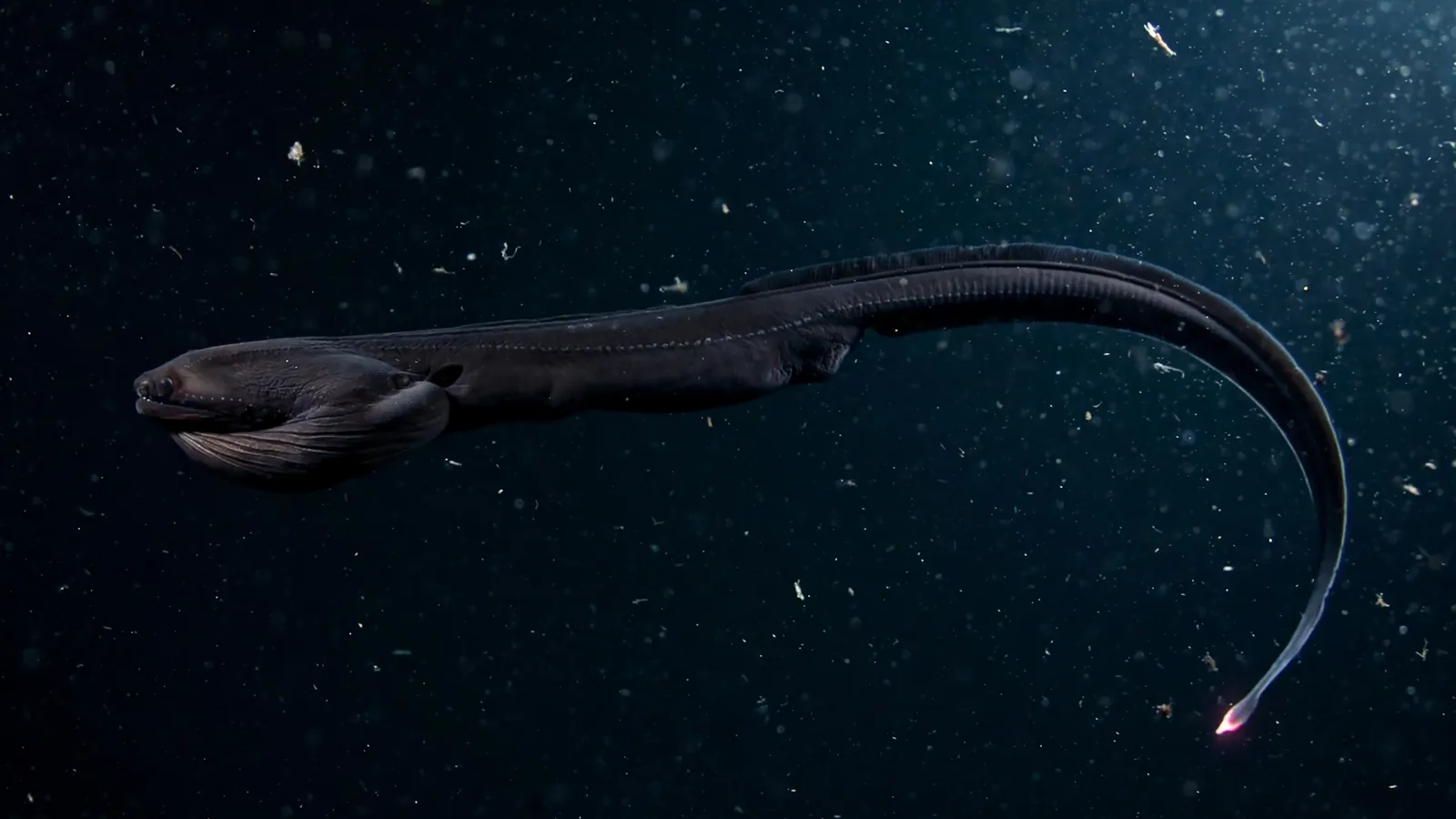
At a Glance
A gulper eel is not so much a fish with an oversized mouth as a mouth with a fish attached. Behind the huge, loosely hinged jaws trails a body so thin it looks like an afterthought, ending in a tail longer than everything else combined. Almost everything about this animal seems impossible until you understand the world it lives in: a cold, black, empty ocean where a meal of any size may not pass by for weeks.
Gulper Eel Size and Weight
The animal is a modest fish wrapped around an immodest mouth. Most adults measure between 60 and 80 centimetres (2 to 2.6 feet) long, and the very largest reach about a metre — roughly the length of a baseball bat. Almost none of that length is body in the usual sense. The jaws alone account for about a quarter of the total, and much of the rest is tail: a tapering whip that can run as long as the head and trunk together.
Weight is harder to state, because so few specimens have ever been weighed fresh, but there is very little to weigh. The bones are light, the muscles are slight, and the body wall is thin — this is an animal built for floating in midwater, not for fighting currents or tackling prey. It has no scales and no swim bladder, and it is close to neutrally buoyant, hanging in the water column for almost no effort at all.

The proportions explain the second name. Naturalists who hauled the fish up in nets saw the great pouch of skin under the jaw and named it for the one bird everyone knows with the same equipment: the pelican. It is the only species in its entire family — a design so specialised that evolution produced it exactly once.
The Pelican Eel’s Giant Mouth
Its mouth is hinged so loosely that it can swing open far beyond the angle of any ordinary fish jaw, and the skin behind it stretches into a vast pouch. Inflated, that pouch can hold a volume of water larger than the rest of the fish. In 2018 a research submersible filmed one doing exactly this in front of its cameras: the eel ballooned its mouth into a black sphere, hung there for a moment, then slowly deflated — apparently treating the vehicle to a threat display meant for something its own size.
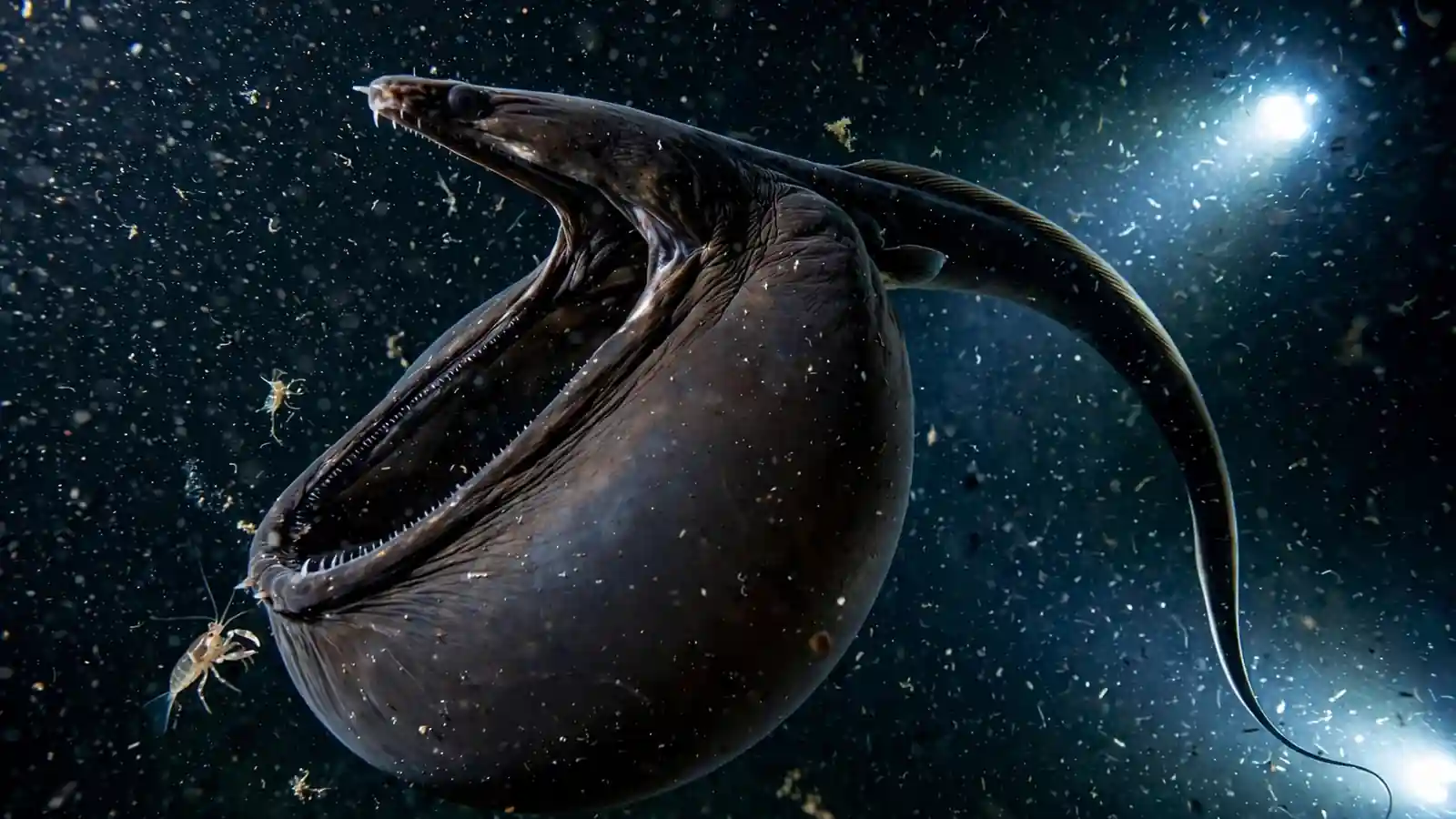
What the mouth cannot do is bite. The jaws are weakly muscled, the teeth are tiny, and there is no power in the closing snap at all. Think of it less as a set of jaws and more as a fishing net the fish carries folded under its chin. Swimming slowly with the pouch open, or simply drifting through a scatter of small animals, the eel engulfs water and prey together, then squeezes the water out through its gills and swallows whatever is left inside.
The stomach plays along. It is elastic enough to hold a meal that distends the belly into an obvious bulge — insurance for the rare day when something genuinely large blunders into the trap. But as the diet section shows, those days are not what this fish actually lives on.
Habitat and Depth: Life in the Dark Water
Gulper eels live in the open ocean, far from any shore, at depths between about 500 and 3,000 metres (1,600 to 9,800 feet). That range spans the twilight zone, where the last blue light fades, and the midnight zone below it, where no sunlight has ever reached. They are found in tropical and temperate seas all over the world — the Atlantic, Pacific and Indian oceans all hold them — wherever the water is deep enough.

It is a demanding address. The water sits a few degrees above freezing, the pressure would crush the air spaces of a surface fish flat, and food arrives mainly as a slow snowfall of dead plankton and waste sinking from the sunlit world far above. Its answer is to spend as little energy as possible: weak muscles, a slow drift, and long patience between meals.
That black skin matters more than it might seem. At these depths the only light is made by animals themselves, and anything that reflects it becomes visible to hunters. A body that swallows light is a body that disappears — which is why this fish is not just dark, but one of the blackest animals in the sea.
Diet and Feeding: Small Prey in a Huge Net
Here is the fact that surprises everyone: the eel mostly eats food far smaller than its mouth suggests. When scientists open the stomachs of specimens caught in research nets, they find small crustaceans — shrimp and their relatives — along with small fish and squid. The most famous mouth in the deep sea spends its life gathering modest mouthfuls.

The strategy still makes sense. In an ocean this empty, a feeder cannot afford to specialise. The pouch works like a plankton net scaled up: it guarantees that almost anything the eel drifts through — a knot of shrimp, a lanternfish, a small squid — can be taken in a single engulfing gulp, with the water pushed out through the gill openings afterwards. Big prey is a bonus the equipment allows, not a target the fish depends on.
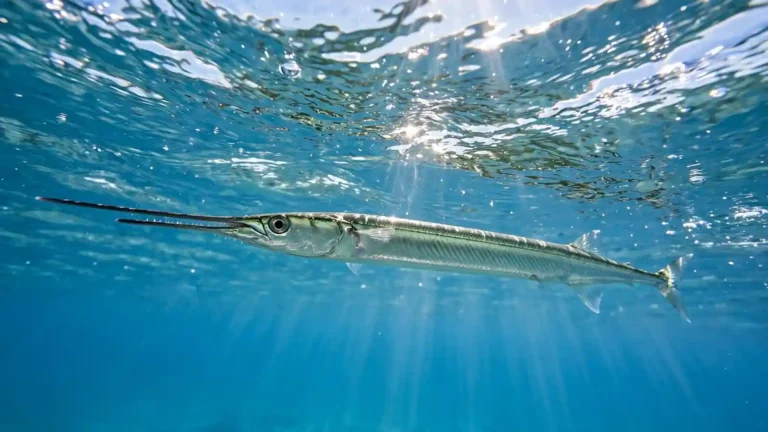
Being soft, slow and unarmoured, the animal is itself on the menu. Lancetfish — long, fanged hunters of the same dark water — are known predators, and gulper remains have been found inside their stomachs. In the deep sea, today’s trap is tomorrow’s meal.
The Gulper Eel’s Glowing Tail
Its tail is not just long. At its very tip sits a small bulbous organ — a photophore — that produces light of its own. It glows pink, and it can flash bright red: colours made by one of the very few deep-sea animals known to produce red light at all.

The leading explanation is that the glowing tip is a lure. Curled or waved near the mouth — the tail is flexible enough that old specimens have been found with theirs tied in knots — it would shine like a tiny beacon in the blackness, drawing curious shrimp and small fish toward the one place they should never go. Nobody has yet filmed a one fishing this way, so the idea remains a well-supported guess rather than a proven fact.
Red is a clever colour for a lure. Almost no deep-sea animal can see it — red sunlight is filtered out within metres of the surface, so eyes down here never evolved for it. A pink-red lantern lets the eel advertise itself in a colour most of the neighbourhood is blind to.
Reproduction and Life Cycle
Almost nothing is known about how gulper eels breed, and honesty demands saying so plainly. No one has seen them mate, found their eggs, or watched a young one grow. Everything scientists have is inference from related eels and from the larvae occasionally caught in plankton nets far above the adults’ home depths.
Like other eels, the gulper almost certainly begins life as a leptocephalus — a transparent, leaf-shaped larva that drifts in the upper ocean feeding on marine snow, before sinking and reshaping itself into the black, big-mouthed adult. Where the adults gather to spawn, how long they live and how many young they produce are open questions that only future deep-sea cameras are likely to answer.
Rarely Seen: A Fish Known From Nets and Cameras
The gulper eel was described in 1882, from specimens hauled up dead in fishing nets, and for more than a century that was nearly all anyone knew of it. A fish that lives a kilometre down and falls apart in a net does not give up its secrets easily; most museum specimens arrived crushed, deflated or distorted, which is why the old drawings of the species look so strange.

Submersible cameras changed that. Modern sightings — including the famous 2018 encounter in the Pacific’s Papahānaumokuākea reserve, where a young eel inflated its pouch at a research vehicle like a tiny black balloon animal — show a slow, graceful drifter, curious rather than fearful. You can browse the full species record for Eurypharynx pelecanoides for the distribution and depth data gathered from a century of catches. How many gulper eels there are, nobody knows — everything suggests an animal that is widespread, just almost never met.
Fun Facts
- The It is the only species in its family. Its closest relatives, the swallowers and bobtail snipe eels, are nearly as strange.
- Its scientific name, Eurypharynx pelecanoides, translates roughly as “pelican-like wide throat” — an exact description of the animal.
- Inflated, a it is mostly mouth: the pouch can hold more water than the rest of the fish’s body.
- Some specimens have been hauled up with their long tails tied in literal knots — the tail really is that flexible.
- The “balloon animal” gulper filmed in 2018 was probably bluffing: the pouch display seems to be a threat posture, not feeding.
- Despite the giant mouth, nobody has ever seen a one catch anything. Every meal on record comes from stomach samples.
Frequently Asked Questions
What Is a Gulper Eel?
A gulper eel is a deep-sea fish with a mouth so big it takes up a quarter of its body. Also called the pelican eel, it lives 500 to 3,000 metres down in tropical and temperate oceans, and it is the only species in its family, Eurypharyngidae.
How Big Is a Gulper Eel’s Mouth?
A gulper eel’s mouth is enormous: the loosely hinged lower jaw alone runs to about a quarter of the fish’s whole length, and the pouch of skin behind it can balloon out to engulf prey approaching the eel’s own size. Its teeth, though, are tiny, and its bite is weak.
Why Is It Also Called a Pelican Eel?
It is called a pelican eel because its huge lower jaw and expandable throat pouch work like a pelican’s bill: the pouch scoops up a volume of water and prey, then the water is squeezed out before swallowing. Even the scientific name agrees — pelecanoides means pelican-like.
What Do Gulper Eels Eat?
Gulper eels mostly eat small prey: little crustaceans such as shrimp, plus small fish and squid, scooped up in the great pouch of a mouth. Despite the giant jaws, big prey is the exception — stomach samples from caught specimens are dominated by small animals.
How Deep Do Gulper Eels Live?
Gulper eels live between about 500 and 3,000 metres (1,600 to 9,800 feet) down, in the twilight and midnight zones of tropical and temperate oceans all over the world. No sunlight reaches most of that range, and the water hovers just above freezing.
How Does the Gulper Eel’s Tail Glow?
The tip of the gulper eel’s long tail carries a light-producing organ called a photophore. It glows pink and can flash bright red. Scientists think the eel holds the glowing tip near its mouth as a lure, drawing curious prey within reach of the pouch — though no one has yet watched it happen.
Are Gulper Eels Dangerous?
No. A gulper eel is a fragile, slow drifter with weak jaws and tiny teeth, living hundreds of metres below the surface where people never go. It could not bite a human even if it tried — the giant mouth is a scoop, not a weapon.
Similar Species Worth Exploring
Keep Exploring
Still curious about the hunters of the dark? Meet the anglerfish, which fishes with a glowing lure of a very different kind, or browse the full line-up in our guide to the types of deep-sea fish and the parent guide to the types of fish. The midnight zone is full of improbable designs — but none is quite as single-minded as the gulper eel.