Crinoid
Crinoid: the flower that is an animal, the fossil that is still alive
The crinoid is a flower of the sea that is not a flower at all: a feathery, five-armed animal of the ocean floor, rooted like a plant or swimming like a star, with a fossil record that runs back 480 million years — older than the dinosaurs, older than the first trees.
By Emily Carter · Reviewed by our vet team · Updated 10 November 2026 · 9 min read
A flower that is an animalFossil record back 480 million yearsFeather stars swim; sea lilies stay rooted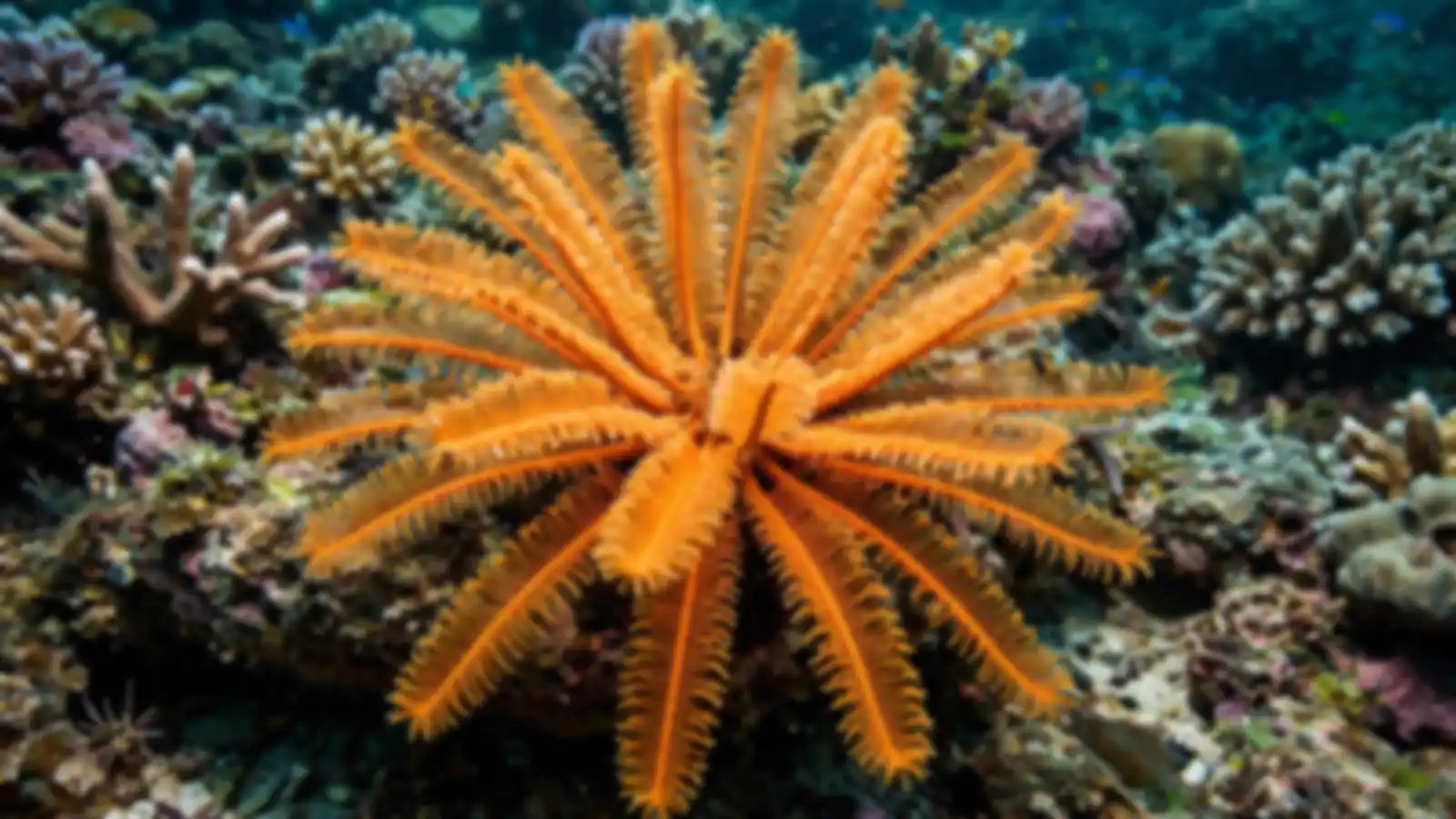
At a Glance
The crinoid is a marine animal of the class Crinoidea, the feather stars and sea lilies of the ocean floor, and it is one of the oldest animals alive: its fossil record runs back to the Early Ordovician, around 480 million years ago, and the living species, around 600 to 700 of them, look almost exactly like their fossil ancestors. It is a flower that is an animal, and a fossil that is still alive.
What Is a Crinoid?
It is an echinoderm, a relative of the starfish and the sea urchin, with five arms that branch into ten or more feathery, pinnate arms, each lined with tube feet that catch food from the water. It has no head, no brain and no heart, and its body is a small, cup-shaped calyx, the central cup that holds the organs, with the arms spreading from it like the petals of a flower. It looks like a plant, but it is an animal, and it feeds, moves and breeds like one.

Crinoids live on the ocean floor, from shallow coral reefs to abyssal depths below 9,000 metres, and they are found in every ocean. There are two kinds: the feather stars, which are free-living and can swim, and the sea lilies, which are stalked and rooted to the seabed. The feather stars are the common ones — more than 500 living species, mostly in shallow tropical waters — and the sea lilies are the rare ones, fewer than 100 living species, mostly in the deep sea.
Feather Star vs Sea Lily
The difference between a feather star and a sea lily is the stalk. A sea lily is one on a stalk: a long, jointed stem anchors the calyx to the seabed, and the arms spread above it like a flower on a stem, catching plankton from the current. A feather star has lost the stalk as an adult: it is free-living, clinging to a rock or a coral with a set of small, claw-like cirri at the base of the calyx, and it can let go and swim when it needs to.

The two kinds live in different worlds. Feather stars, more than 500 species, live mostly in shallow tropical reefs, where they perch on corals and spread their arms into the current. Sea lilies, fewer than 100 species, live mostly in the deep sea, where their stalks hold them up into the slow current above the seabed. The feather star’s story is told in our feather star guide, and the sea lily’s in our sea lily guide, where the stalk is the whole animal.
Crinoid Anatomy: Arms and Calyx
Its body is built around the calyx, a small, cup-shaped central body that holds the mouth, the gut and the reproductive organs, and from the calyx spread five arms that branch into ten or more, each arm lined with fine, feathery pinnules and tube feet. The tube feet catch plankton and organic particles from the water and pass them down grooves in the arms to the mouth, which sits on the top of the calyx, facing upwards into the current.

The skeleton is its signature: a set of calcite plates and ossicles, jointed like a chain, that make the arms flexible and the stalk strong, and that fossilise beautifully — which is why its fossil record is so rich. It is a flower made of limestone, and when it dies, its ossicles fall apart into the sediment and become crinoidal limestone, a rock made almost entirely of its parts.
What Do They Eat?
Crinoids eat plankton and organic particles, caught from the water by the tube feet on their feathery arms. One spreads its arms into the current like a net, and the tube feet trap the particles, passing them down the food grooves to the mouth. It is a passive, patient way to eat — it does not hunt, it waits, and the current brings the food to it.
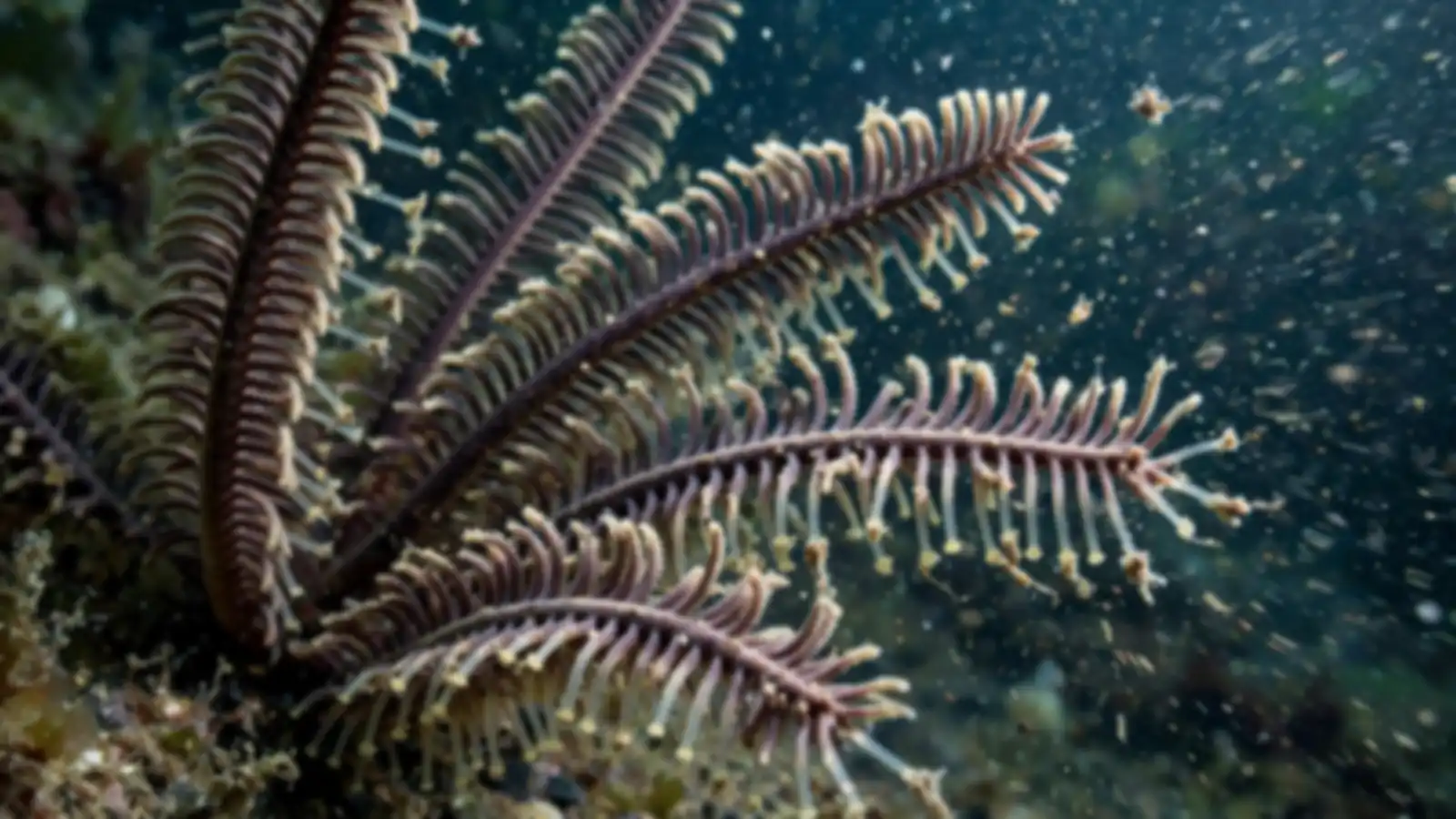
The diet is what ties it to its place: it needs a current, and it needs clean water with enough plankton in it, which is why crinoids are commonest on reefs and on seamounts where the current is steady. One that is buried in silt starves, and one in still water has nothing to catch — the arms are a net, and a net needs a current.
How They Move
Feather stars swim by waving their arms in a slow, rhythmic, alternating beat, like a bird flapping its wings, and they can swim at about seven centimetres a second — slow, but enough to move to a new perch or to escape a predator. They swim in short bursts, then settle again on a rock or a coral, clinging with their cirri and spreading their arms to feed.

Sea lilies, by contrast, do not swim at all: they are rooted to the seabed on their stalks, and they move only by bending the stalk in the current, or by crawling very slowly across the seabed on their arms. Its movement is the difference between its two kinds — the feather star is a swimmer that chooses where to feed, and the sea lily is a flower that waits where it grows.
In the Fossil Record: 480 Million Years
Crinoids have one of the longest fossil records of any animal: they appear in the Early Ordovician, around 480 million years ago, and they have been abundant in the oceans ever since, surviving five mass extinctions and the rise and fall of the dinosaurs. Their calcite skeletons fossilise so well that whole limestone formations are made of its ossicles — crinoidal limestone, a rock built from the bodies of dead crinoids, is found on every continent.

The living crinoids are a shadow of the fossil ones: in the Palaeozoic, crinoids were so abundant that they formed whole reefs, and thousands of fossil species are known, against around 600 to 700 living species today. The class account records the species count, the depth range and the fossil history behind this guide, and the feather star and sea lily guides tell the two living kinds in full.
Fun Facts
- Crinoids have a fossil record back to the Early Ordovician, around 480 million years ago — older than the dinosaurs.
- Whole limestone formations are made of its skeletons: crinoidal limestone is a rock built from dead individuals.
- Feather stars swim by waving their arms, at about seven centimetres a second.
- It has no head, no brain and no heart — its body is a cup, the calyx, with arms spreading from it.
- Sea lilies, the stalked crinoids, live mostly in the deep sea, while feather stars live mostly on shallow reefs.
- Crinoids survived five mass extinctions, and the living species look almost exactly like their fossil ancestors.
Frequently Asked Questions
What Is a Crinoid?
A crinoid is a marine animal of the class Crinoidea, the feather stars and sea lilies of the ocean floor. It has five arms that branch into ten or more feathery arms, a small cup-shaped body called the calyx, and no head, brain or heart. It looks like a flower, but it is an echinoderm, a relative of the starfish.
What Is the Difference Between a Feather Star and a Sea Lily?
A feather star is a free-living one that has lost its stalk as an adult: it clings to rocks with claw-like cirri and can swim. A sea lily is a stalked one, anchored to the seabed on a long, jointed stem. Feather stars, over 500 species, live mostly on shallow reefs; sea lilies, under 100 species, live mostly in the deep sea.
How Old Are Crinoids?
Crinoids are around 480 million years old: they appear in the fossil record in the Early Ordovician, and they have been abundant in the oceans ever since, surviving five mass extinctions. Thousands of fossil species are known, against around 600 to 700 living species today.
Can Crinoids Swim?
Feather stars can swim, by waving their arms in a slow, rhythmic beat, at about seven centimetres a second. They swim in short bursts, then settle again to feed. Sea lilies cannot swim: they are rooted to the seabed on their stalks and move only by bending in the current.
What Do Crinoids Eat?
Crinoids eat plankton and organic particles, caught from the water by the tube feet on their feathery arms. One spreads its arms into the current like a net, and the tube feet trap the particles and pass them down food grooves to the mouth, which sits on top of the calyx.
How Deep Do Crinoids Live?
Crinoids live from shallow coral reefs to abyssal depths below 9,000 metres, in every ocean. Feather stars live mostly in shallow tropical waters, while sea lilies live mostly in the deep sea, where their stalks hold them up into the slow current above the seabed.
Are Crinoids Plants or Animals?
Crinoids are animals, not plants. They look like flowers because they grow as feathery, branching arms on a stalk or a cup, but every part of it is animal: it feeds on plankton, it moves, and it breeds. The flower shape is a feeding net, not a plant.
Similar Species Worth Exploring
Keep Exploring
Keep exploring the echinoderms through the feather star, the swimming crinoid of the reefs, the sea lily, the rooted crinoid of the deep sea, and the wider world of the types of echinoderms. A flower that eats, a fossil that swims, a reef built from dead animals: that is the crinoid.