Flatworm
Flatworm: the reef’s living ribbon of colour
The flatworm is what happens when an animal gives up almost everything — bones, gut plumbing, lungs, even a second body opening — and spends the savings on colour. Marine polyclads are among the most beautiful hunters on the reef: rippling ribbons in warning colours, duelling for parenthood, feeding through a mouth in the middle of the belly. This guide anchors our marine worm cluster with the most flamboyant worms of all.
By Emily Carter · Reviewed by our vet team · Updated 10 November 2026 · 9 min read
About 800 polyclad speciesWarning colours, real toxinsFamous — and limited — regeneration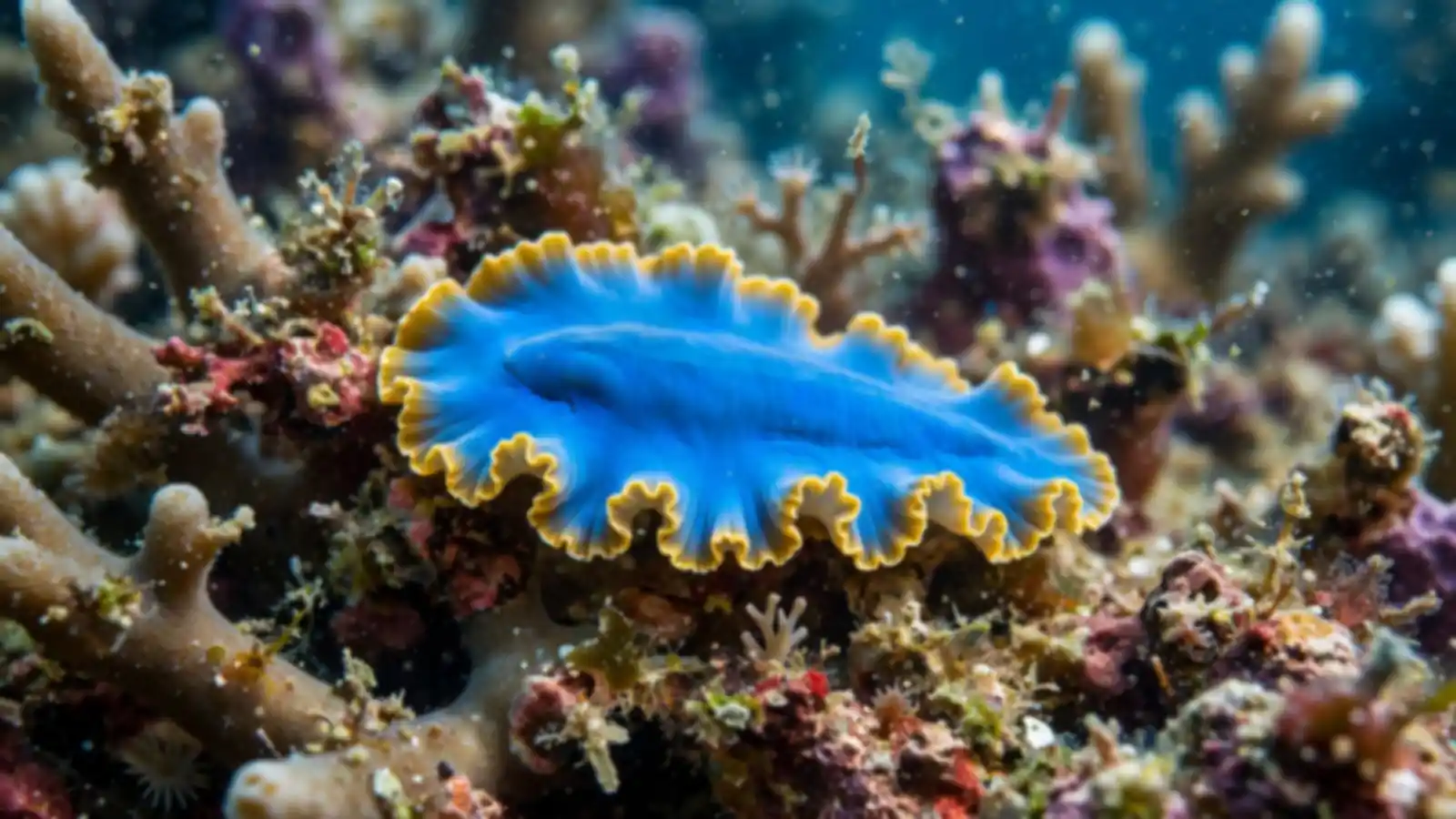
At a Glance
A flatworm is minimalism with a paint job: a sheet of living tissue, one opening for eating and waste, a branching gut that doubles as a delivery network, and colours that would shame a carnival. The marine polyclads — the subjects of this guide — are the group’s showpieces, and they hide under every reef ledge in the tropics waiting for a torch beam. Start with the colours, because the colours are the biography.
Marine Flatworm Types and Colours
Polyclad flatworms split broadly into two styles: the smooth, oval, often camouflage-spotted kinds that hug the rock, and the frilled, ruffled kinds whose margins ripple like the hem of a flamenco dress. Both wear colour with intent. Electric blue with a gold rim, scarlet with white snow, tiger stripes of orange and black — a reef ledge at night is a catwalk of worms.

Identification is a diver’s game of patterns: the arrangement of eyespots, the shape of the little ear-like pseudotentacles at the front, and above all the pattern — stripes, spots, borders — because each species wears a fixed livery. Many mimic nudibranchs, or are mimicked by them, two toxic families converging on the same warning uniforms.
Not every worm in the sea is a polyclad, and not every worm-shaped thing is a one at all. The marine roundworms — nematodes — are a separate, mostly microscopic clan of round-bodied worms that drift through sand and sediment in astronomical numbers; they get their honest mention here as the cluster’s quiet majority, thread-thin and unsegmented, the opposite of these ribbons in every way but habitat.
For classifications and species lists, the animal diversity account of the order Polycladida is the tidy reference point for the group’s diversity.
Swimming by Ripples: Movement Without Fins
On the bottom, a polyclad glides — thousands of cilia beating on a film of mucus, the body flowing over rock like poured silk. But startle one, or sweep it off the reef, and many polyclads do something magical: they swim, undulating the frilled margins of the body in slow waves, flying through the water column like a magic carpet that read the manual.

The flatness is not a limitation but the whole design. With no lungs, gills or blood system, every cell must live within diffusion distance of seawater — so the body became a sheet. The branching gut, visible through the skin as a tree of fine canals, performs the same trick for food, reaching every corner of the animal.
Sensory kit concentrates at the front: clusters of simple eyespots that read light and shadow, and the folded pseudotentacles that taste the water ahead. A polyclad out swimming is navigating by gradients of light and chemistry, a brain the size of a crumb steering a body the size of a handkerchief — adequately, elegantly, and for hundreds of millions of years.
Penis Fencing: The Hermaphrodite Duels
Every individual is both sexes at once, and that single fact produces the strangest courtship in the sea. Producing eggs is expensive; donating sperm is cheap. So when two flatworms meet, each prefers to be the father. The negotiation is not verbal. It is a duel, fought upright, stylets drawn, for up to an hour.
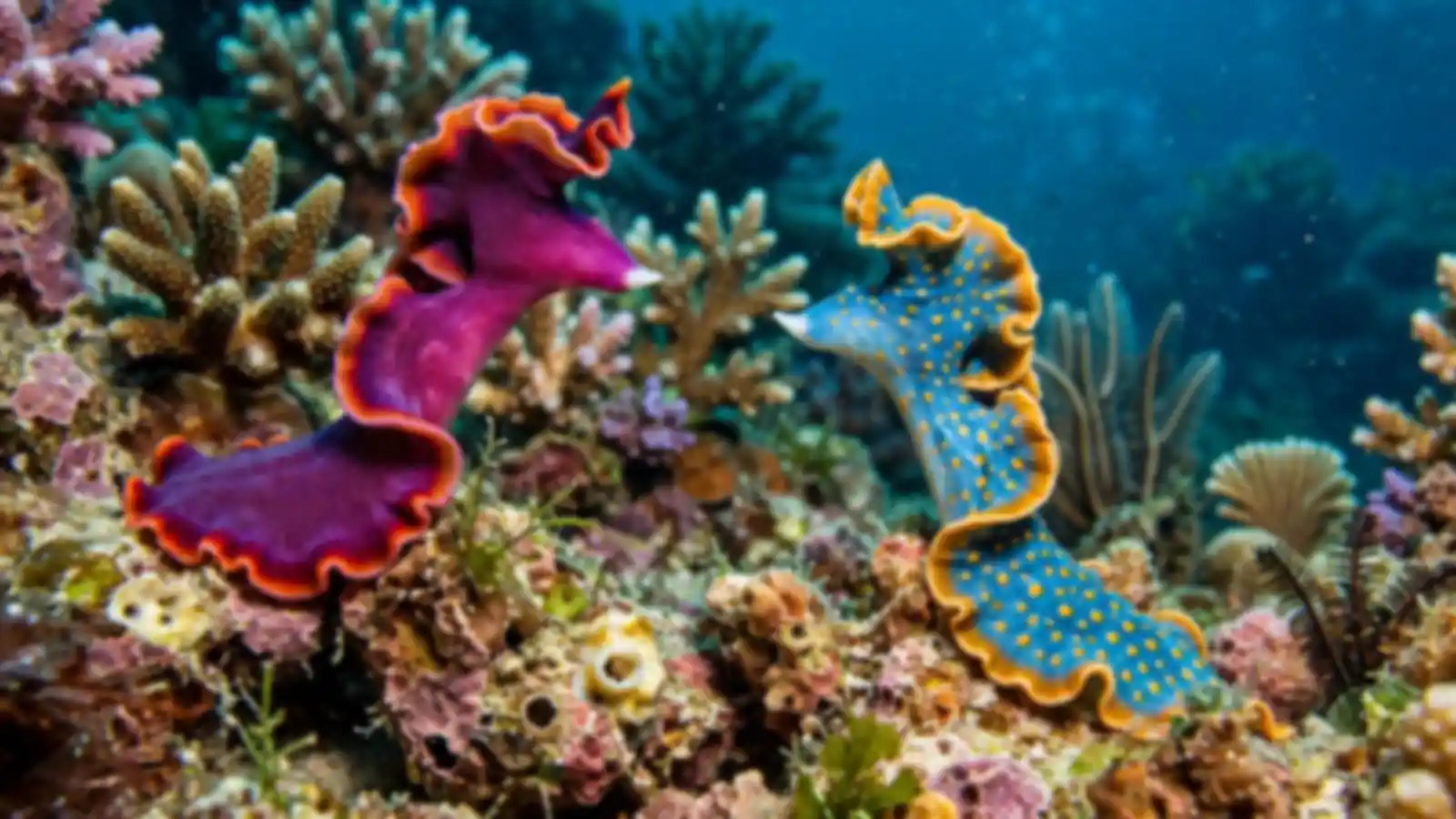
The pair rear up and fence, each trying to pierce the other’s skin and inject sperm — hypodermic insemination — while parrying the same attempt. The first successful stab wins the cheap role; the pierced partner absorbs the sperm through the wound and shoulders the cost of egg production. Biologists call it penis fencing; the flatworms, presumably, call it Tuesday.
Afterwards, eggs are laid in neat gelatinous ribbons or discs on the rock, hatching into planktonic larvae or miniature worms depending on the species. Other flatworms skip the duel economy entirely and simply split: some species reproduce by tearing themselves in two, each half regrowing what it lacks — which leads directly to the family’s most famous claim.
Flatworm Regeneration: The Miracle, Honestly Told
The legend is true — one branch of the family over. Freshwater planarians, the group’s drab cousins, are biology’s regeneration champions: their bodies are packed with stem cells called neoblasts, and a planarian cut into fragments regrows a complete worm from a piece, head, brain, eyes and all. Laboratories have built whole research careers on that one talent.
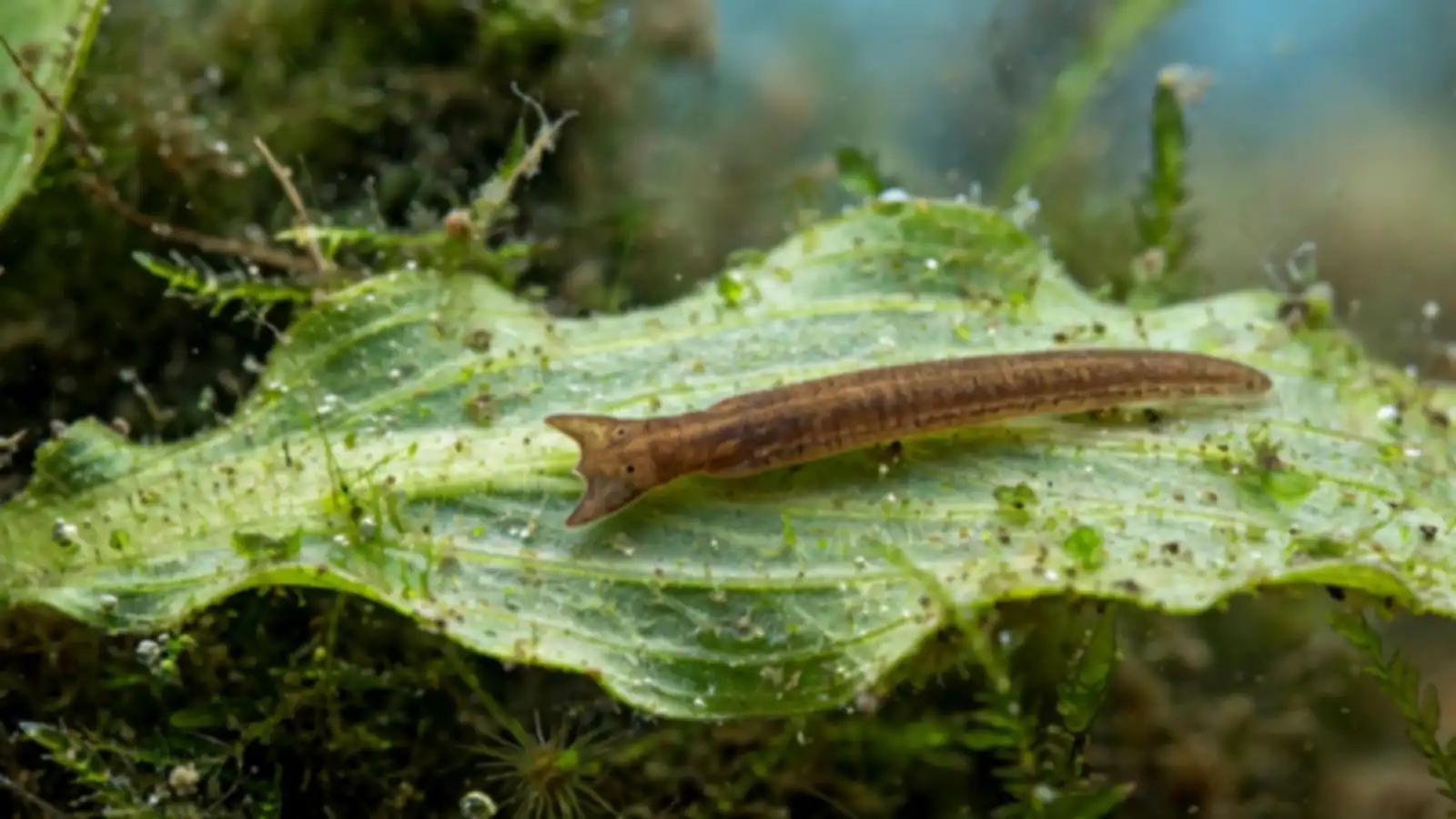
Marine polyclads deserve honesty rather than borrowed glory. They heal fast, seal wounds that would kill other animals, and can regrow lost margins and damaged tissue; a fragment that keeps part of the brain and the pharynx region can rebuild a great deal of what is missing. But lose the brain itself, and the marine animal cannot do what the planarian does — the full resurrection is a freshwater specialty.
The difference is a clue scientists prize: comparing the two groups isolates exactly which machinery unlimited regeneration needs. The polyclad is no failure — it is the control group in one of biology’s great experiments, wearing better colours while it does the job.
How Flatworms Eat: A Mouth in the Middle
Its mouth sits in the middle of its underside, and behind it sits the party trick: a muscular pharynx the animal can push right out of its body. Glide over a colony of sea squirts, drape, evert the throat over the prey, and digest dinner in place — the worm wears its stomach outside for the occasion, then reels it back in.
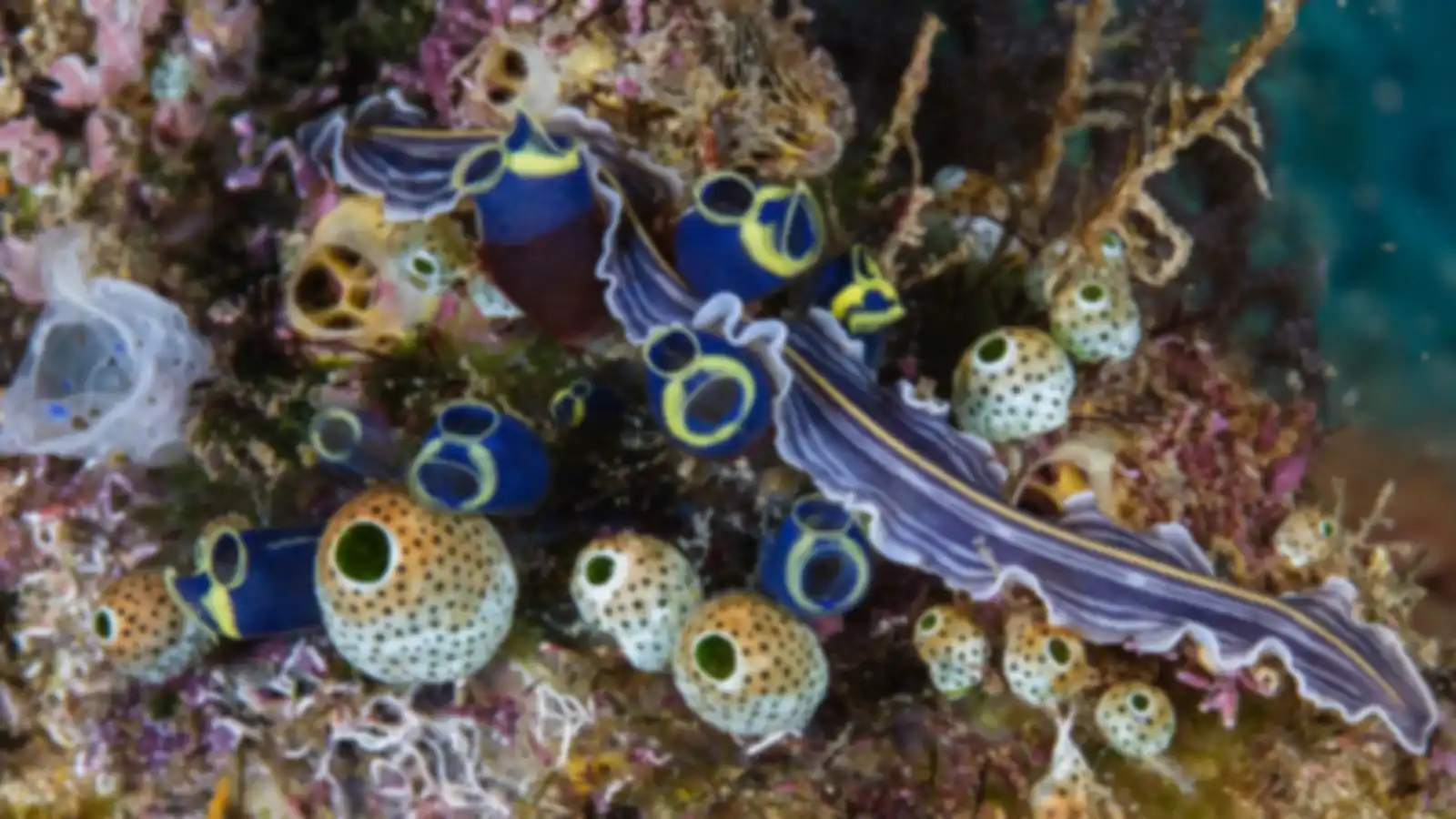
The menu is the reef’s sessile aristocracy: sea squirts are the classic course, but sponges, oysters and other bivalves, small snails and crustaceans, and even other flatworms all feature. Some polyclads are picky specialists wedded to a single prey species; others are grazers of opportunity. A few bold ones tackle prey their own size.
Digestion runs through the gut’s branching tree, and the leftovers reverse out of the same mouth — flatworms never evolved the anus, and the design has never once held them back. Waste management by U-turn: inelegant on paper, flawless across geological time.
Are Flatworms Poisonous? Colours That Tell the Truth
Usually, yes — and the colours are the label. Research on polyclads keeps finding serious chemistry: strongly distasteful and toxic compounds in the skin, including, in some species, tetrodotoxin-family toxins of the same class that arms the pufferfish. Some flatworms manufacture their defences; others concentrate them from the toxic sponges and sea squirts they specialise in eating. Either way, the warning dress is an honest advertisement.
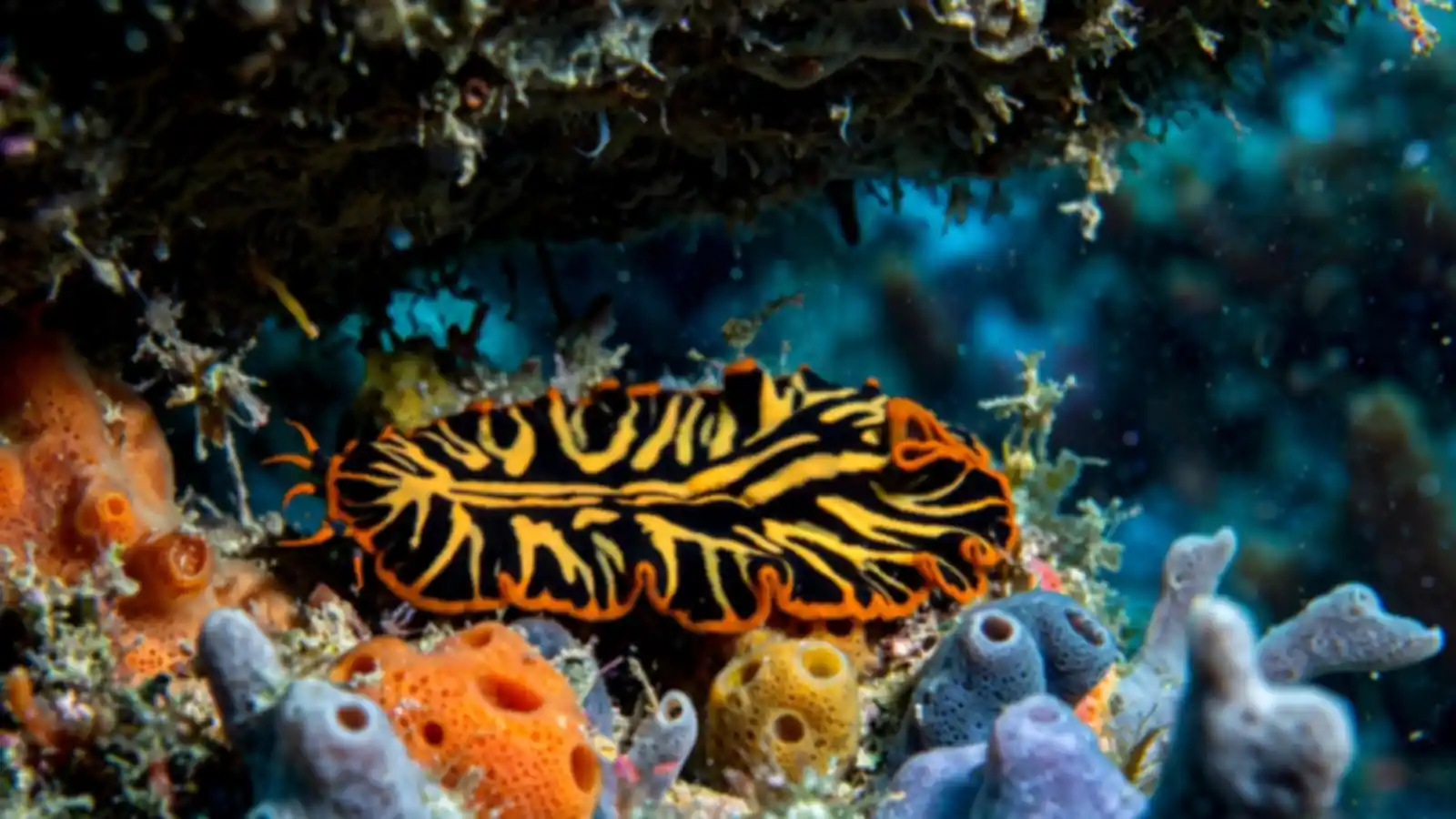
Predators learn the lesson in one mouthful. A fish that seizes a polyclad typically spits it out, shakes its head, and files the pattern under never again — which is why harmless and harmful species alike profit from sharing the same bright liveries, and why the reef’s worms can afford to hunt in broad daylight.
For people, the risk is essentially nil if you follow the diver’s rule: look, photograph, never handle. The toxins are a defence against mouths, not a weapon aimed at swimmers. The animal asks only to be left in its colours — which, given the colours, is the easiest bargain on the reef, made by the flatworm.
Fun Facts
- Flatworms have no anus: food goes in and waste comes out of the same mouth, in the middle of the underside.
- Some polyclads carry tetrodotoxin-family compounds — the same toxin class as the pufferfish — behind their warning colours.
- Penis fencing bouts between two hermaphrodite flatworms can last up to an hour; the loser pays for the eggs.
- Marine flatworms swim by rippling the frilled edges of their bodies, like flying carpets.
- Freshwater planarian cousins can regrow a whole body from a fragment; marine polyclads regenerate impressively but not the brain.
- A One can push its throat out of its body and drape it over prey, digesting dinner outside itself.
Frequently Asked Questions
What Is a Marine Flatworm?
A marine flatworm is a polyclad — a member of the order Polycladida, some 800 described species of free-living flatworms found on reefs and shores worldwide. It is a soft, flattened, often spectacularly coloured hunter with no anus, no body cavity and no specialised breathing organs: oxygen simply diffuses through the flat body, which is exactly why it is flat. Most grow to a few centimetres, though giants pass 10 centimetres.
Can Flatworms Regenerate?
Their freshwater cousins can, astonishingly: a planarian cut into pieces regrows a complete worm from a fragment, powered by stem cells called neoblasts. Marine polyclads are more limited. They heal wounds and can regrow damaged margins and, from a fragment that keeps part of the brain and pharynx region, rebuild much of the body — but the brain itself cannot be fully regrown, so the planarian’s whole-body resurrection does not apply. Celebrate the real version; it is impressive enough.
What Is Penis Fencing?
Courtship as combat. Flatworms are simultaneous hermaphrodites — every individual is both male and female — and carrying eggs costs far more than donating sperm, so each would rather inseminate than be inseminated. When two meet, they rear up and fence with their stylets, each trying to pierce the other’s skin and inject sperm while dodging the same fate. Bouts can last up to an hour; the loser bears the cost of pregnancy.
Are Marine Flatworms Poisonous?
Many effectively are. The gaudy colours are honest warnings: numerous polyclads carry potent distasteful or toxic compounds, some of them in the same toxin family as the pufferfish’s tetrodotoxin, and research shows some acquire or concentrate chemistry from the sponges and sea squirts they eat. Fish that mouth one typically spit it out and remember. They are not a danger to a watching diver — just do not handle or collect them.
How Do Flatworms Eat?
Through a mouth in the middle of the underside. The flatworm glides over its prey — sea squirts, sponges, oysters, small crustaceans, even other flatworms — everts its muscular throat (the pharynx) out of the mouth, and digests the meal in place or sucks it in. The gut branches through the whole body like a tree, delivering food to every tissue, and waste exits back through the same mouth. One opening, total efficiency.
How Big Do Marine Flatworms Get?
Most polyclads are small — a few centimetres long and tissue-thin, easily overlooked under a ledge. The giants of the group exceed 10 centimetres, and a few tropical species approach the size of a hand while remaining almost flat. Size hides in the third dimension: a big flatworm is all surface, which is the point — every cell stays close to oxygen, food and the water that carries both.
Similar Species Worth Exploring
Keep Exploring
This guide is the anchor for our survey of the types of marine worms, and it sits happily beside our sea anemone guide for another soft-bodied hunter. Under the next ledge, in colours no reef should legally allow, hunts the flatworm.