Dragonfish
Dragonfish: glowing lures and glass fangs in the midnight zone
The dragonfish is a family of deep-sea predators, around 290 species, that hunt in total darkness using lights of their own making. A glowing bulb dangles from a barbel under the chin, rows of photophores stud the belly, and the jaws carry needle fangs so transparent they are nearly invisible. One group even hunts by far-red light, a colour almost nothing down there can see, which makes these small black fish among the most specialised hunters in the ocean.
By Emily Carter · Reviewed by our vet team · Updated 10 November 2026 · 9 min read
About 290 speciesLives 200–4,500 m deepSome hunt by red light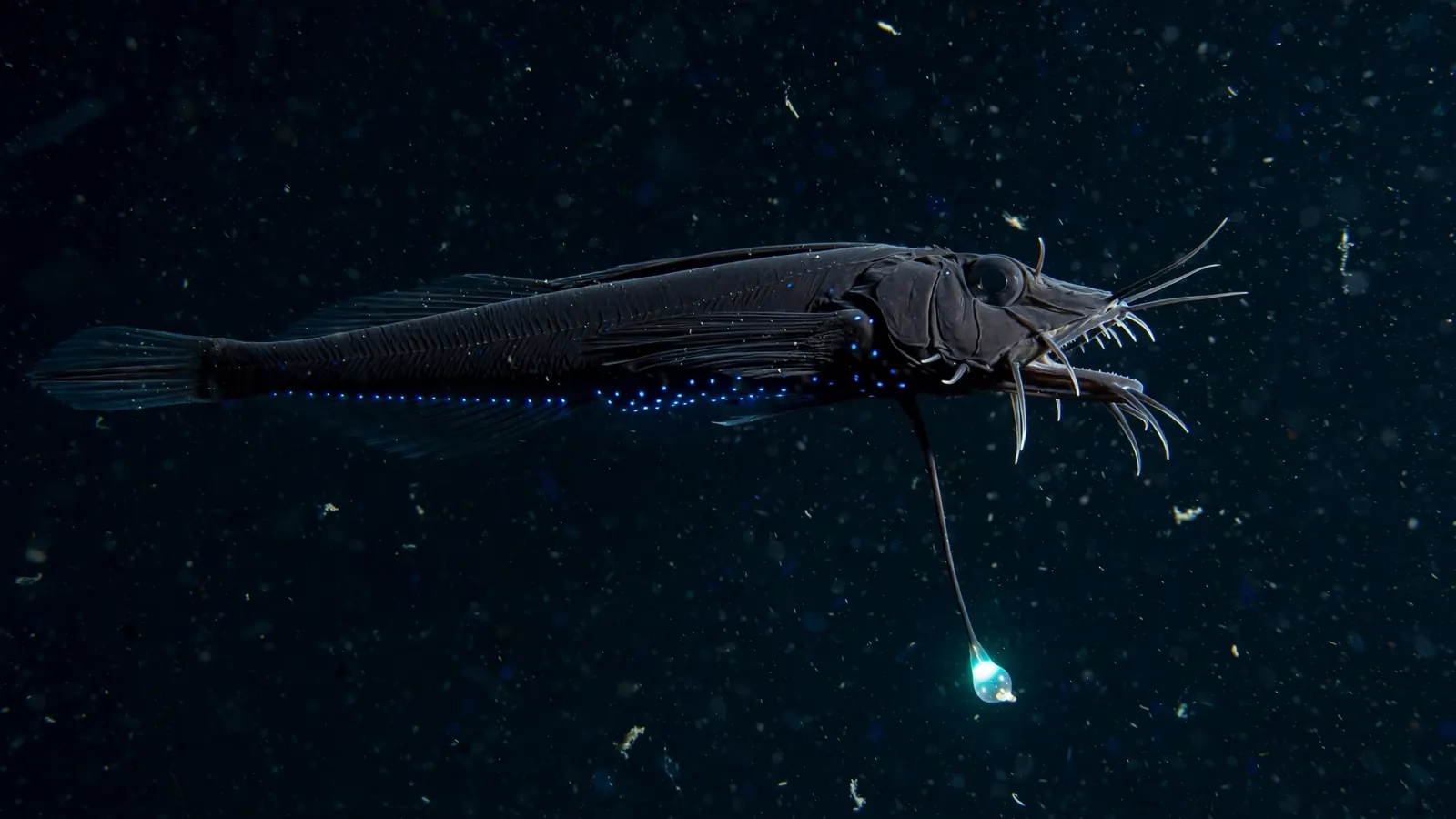
At a Glance
The dragonfish family, Stomiidae, gathers roughly 290 species of scaleless or finely scaled predators from every deep ocean, most of them between 15 and 40 centimetres long and all of them built for the same job: finding rare meals in black water. Their shared toolkit, a chin barbel ending in a light organ, chains of photophores along the body and hinged, fang-filled jaws, is catalogued in the group’s family overview, covering the loosejaws, viperfish and black ones, and it anchors the deep-sea end of this site’s fish coverage.
Dragonfish Types: A Family of 290 Deep-Sea Hunters
The family splits into distinctive tribes. Loosejaws are scaleless, floorless-mouthed hunters with the biggest light organs. Scaly ones wear rows of large hexagonal scales like armour. Black ones are eel-long ribbons of muscle. And the most famous member of all, the viperfish, takes the family plan to an extreme of fang and lure, so much so that it earns its own guide in this series. All of them sit near the top of the cast list in our tour of the types of deep-sea fish.

One mix-up to clear up, because searchers land here with it constantly: the fangtooth is not a one. The deep sea fangtooth (Anoplogaster) belongs to a different family entirely and carries the largest teeth relative to body size of any fish, solid, bone-white and impossible to miss. Their fangs are the opposite design: slender, glass-clear and close to invisible. Two deep-sea hunters, two opposite answers to the same problem, and only one of them is on this page.
The Dragonfish Lure: Barbels, Photophores and Light Organs
Start with the signature. Under the chin hangs a barbel, a whisker that in many species ends in a bulb, sometimes with filaments and glowing tips: a fishing lure grown from the face. The fish waves and flicks it in the blackness, and curious fish and crustaceans that approach the glow meet the jaws behind it. It is the same strategy the anglerfish evolved with a head-mounted rod, arrived at independently, proof that in the deep sea a light you control is worth more than eyes.

The body carries the supporting lights: twin rows of photophores along the belly, which may serve as camouflage by matching faint light from above, as recognition signals between individuals, or both. Larger organs sit behind and below the eye, in some species a veritable headlamp. The teeth complete the stealth kit: in adult fish the fangs are built from the same mineral as other teeth but structured at the nanoscale so light passes through instead of scattering, which is why a mouthful of needles can be functionally invisible until it closes.
Hunting by Far-Red Light: A Private Wavelength
Almost every bioluminescent animal glows blue-green, because that is the light that travels in seawater and the colour deep-sea eyes are built to see. Three related genera broke the rule. The stoplight loosejaw and its closest relatives produce far-red light from a large organ under the eye, and, uniquely among fish, they can see it. To everything else in the deep, the beam is invisible. The loosejaw hunts, in effect, with night-vision: a searchlight only it can perceive.

Seeing red required a workaround, since the fish’s visual pigments are tuned to blue. The loosejaw tops up its red sensitivity using a chlorophyll-like compound gathered from its food chain, originally from the copepods its prey eats, a borrowed molecule pressed into service as an eye pigment. It is one of the strangest supply chains in biology, and it buys the loosejaw a private channel in the most competitive dark on Earth.
What Do They Eat? Prey Bigger Than Themselves
They eat fish, above all the other great travellers of the deep, lanternfish and bristlemouths, plus crustaceans and squid when they cross the lure. Meals are rare at depth, so the family is built to overeat when it can: the skull hinges at the first vertebra to throw the jaws wide, the stomach is elastic, the body wall behind it unscaled and stretchy. They have been recovered with prey more than half their own length inside them, a feast that may need to last for weeks.
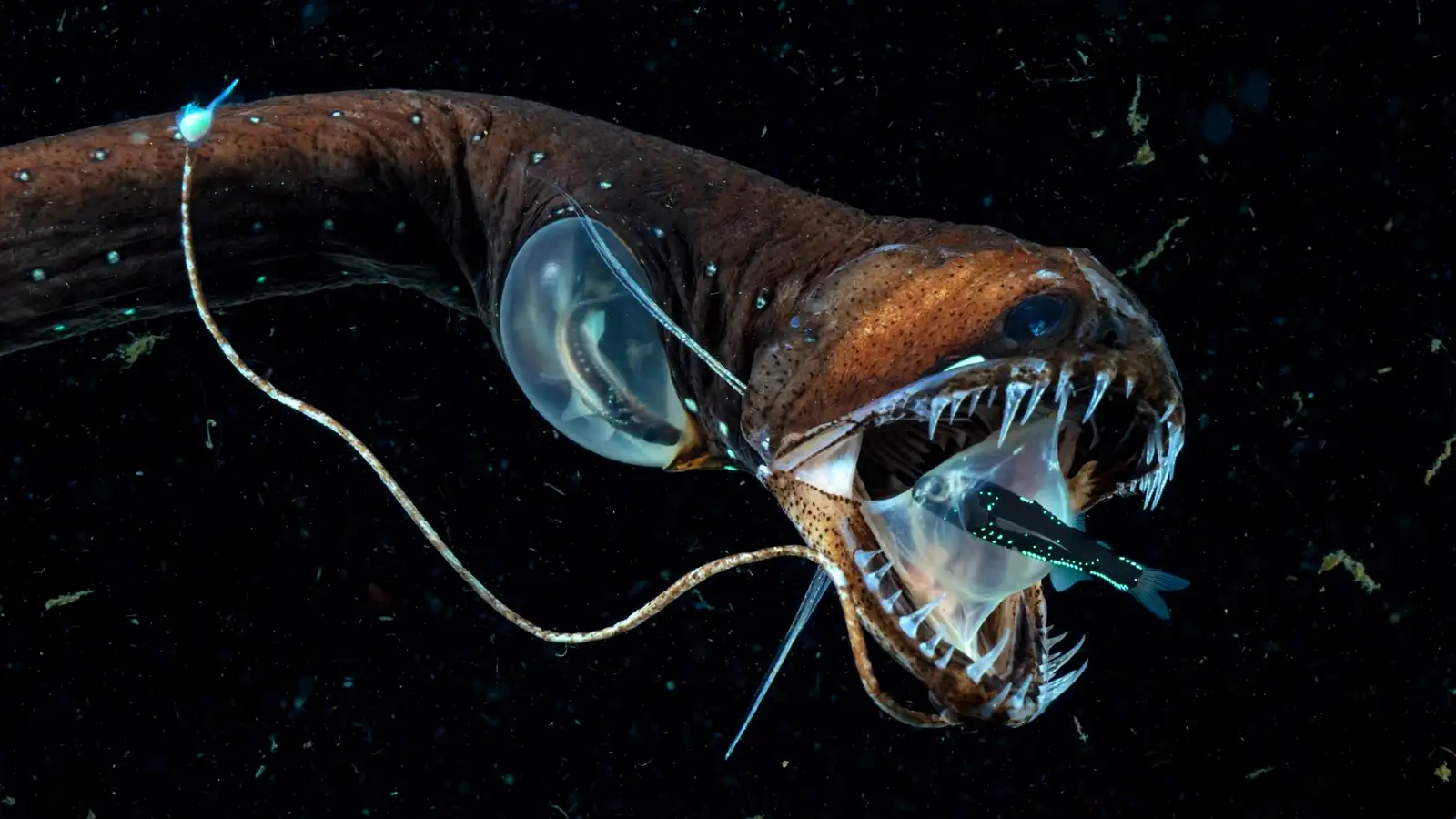
The fangs are the guarantee. Long, recurved and transparent, they cage prey rather than chew it (they swallow food whole), and the cage faces inward: what slides down does not slide back. Combined with the lure, the system is beautifully passive: hang in the dark, glow a little, and let dinner deliver itself, which in an ocean where energy is precious is the only economics that works.
Where Do They Live? Depth and the Nightly Commute
They live in the mesopelagic and bathypelagic zones, roughly 200 to 4,500 metres down, in every ocean including the cold Southern Ocean, sharing that black expanse with neighbours like the gulper eel. Many species are commuters: they rise hundreds of metres toward the surface at night to feed in richer water and sink again before dawn, part of the largest animal migration on Earth, repeated daily in darkness. Others stay deep their whole lives, hunting the midwater around hydrothermal plumes and seamounts.
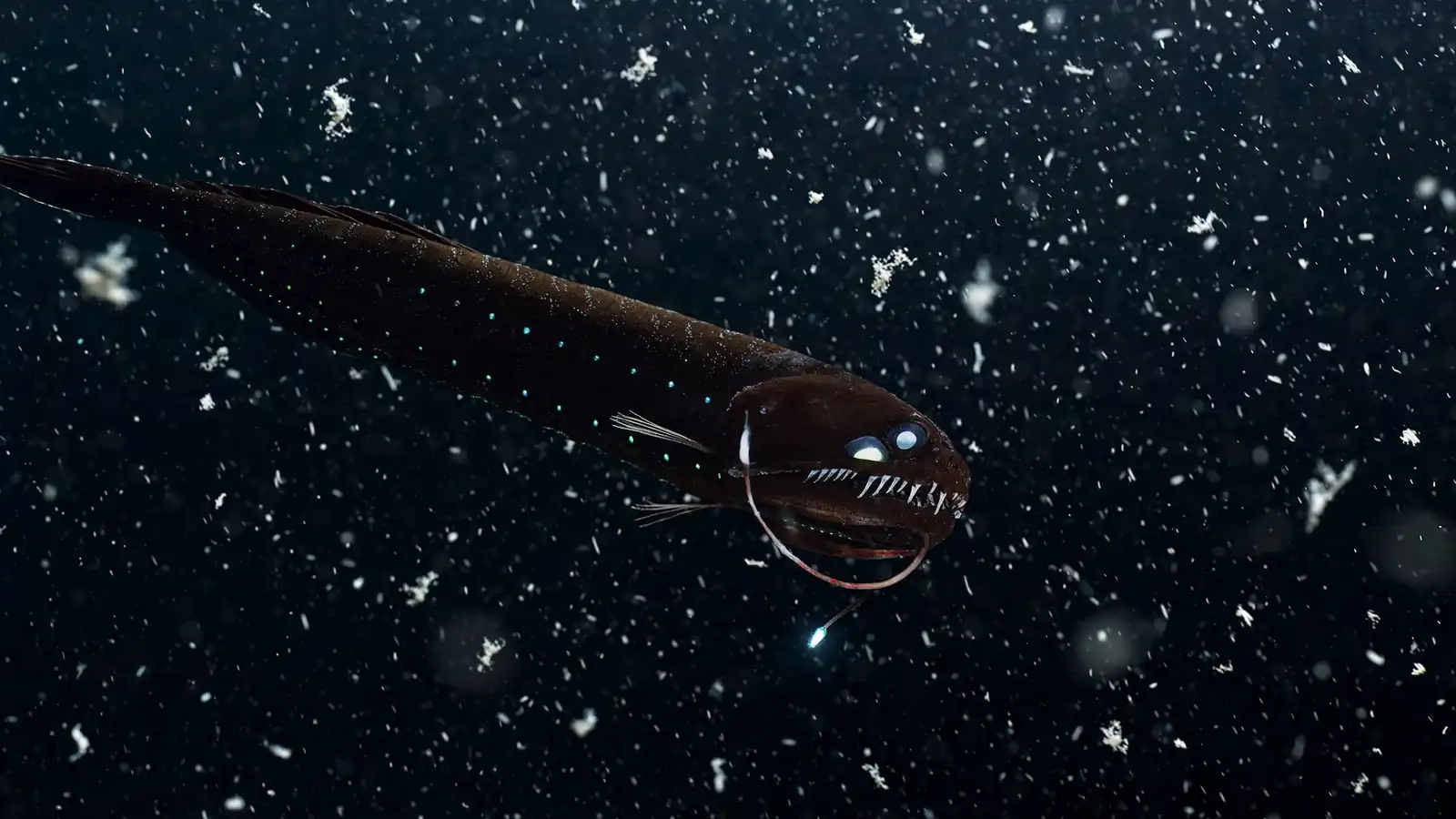
The body is tuned for pressure and cold: soft, watery flesh, reduced bone, and in the black form and relatives, skin so black it absorbs more than 99.5 percent of light that hits it, ranked among the blackest materials in nature. Against the faint searchlights of other predators, a fish wrapped in that skin is not dark. It is absent.
Females, Dwarf Males and the Black One
The black one (Idiacanthus) takes the family’s oddity furthest. The female is the full predator: eel-like, black, up to about 40 centimetres or more, with fangs, a glowing barbel and a working stomach. The male is a different creature: a few centimetres long, brown, with no teeth, no barbel and no functional gut. He is essentially a brief, swimming delivery system for sperm that never feeds as an adult, and dies once his single job is done.
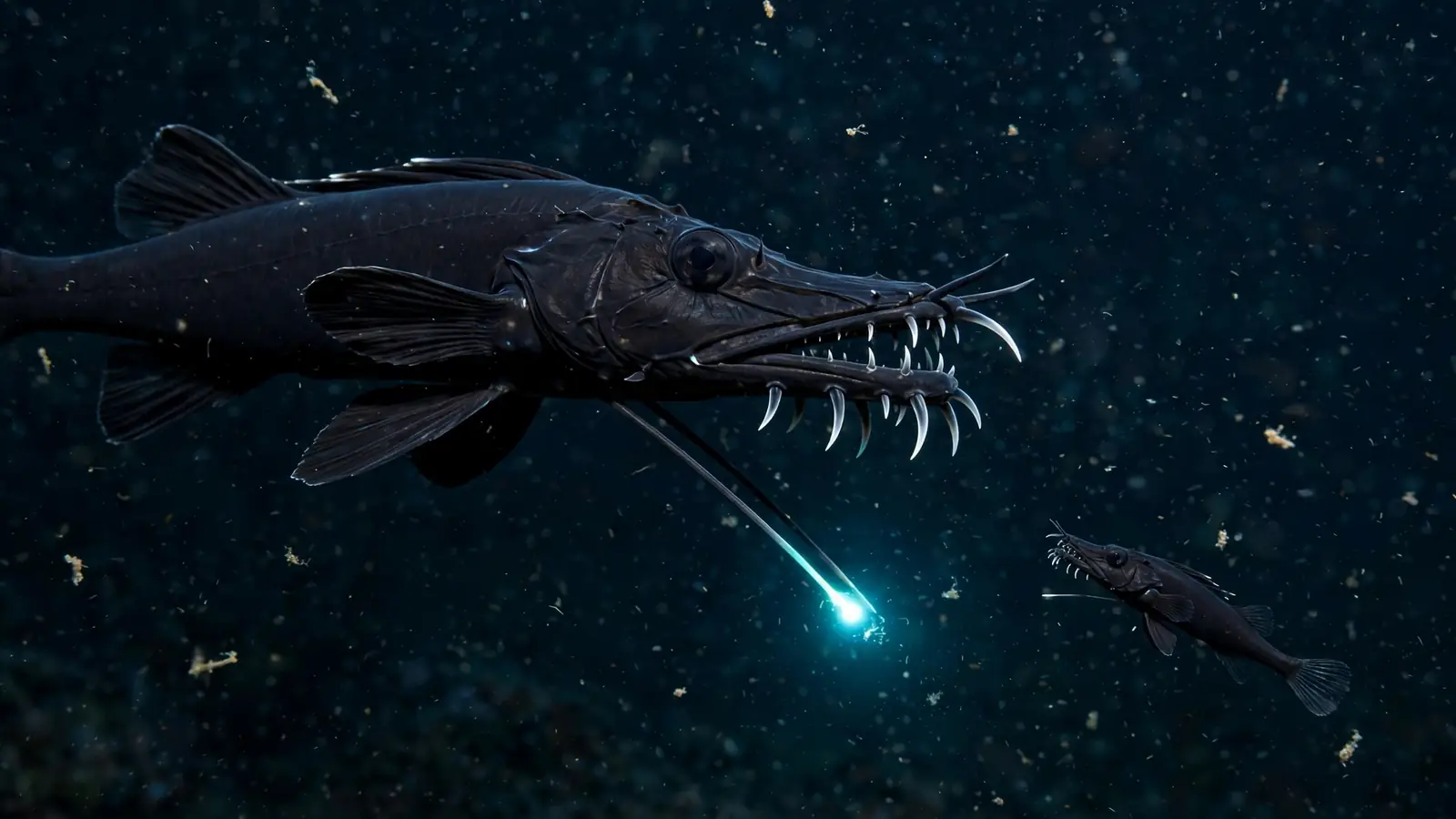
The larvae are stranger still: transparent, with their eyes dangling on long stalks that can be half the body length, reeled in as they grow. It is a reminder that in the deep sea, where mates are needles in a black haystack, evolution relaxes no rule: not that males should hunt, not that eyes belong in heads, and certainly not that a fish should be only one thing in its lifetime. For the wider family album, browse the types of fish hub.
Fun Facts
- Their teeth are nearly transparent because nanometre-scale crystals in them let light pass through instead of scattering, hiding the fangs from prey.
- The stoplight loosejaw is one of only a handful of fish that can both produce far-red light and see it, hunting on a private wavelength.
- Pacific blackdragon skin absorbs over 99.5% of light, making it one of the blackest natural materials known.
- Male black ones have no teeth, no lure and no working stomach; finding a female is their entire adult purpose.
- Their larvae have eyes on stalks that can reach half their body length, which shorten as the fish matures.
- Some specimens have been found with prey over half their own body length in their stomachs, thanks to a hinged skull and elastic gut.
Frequently Asked Questions
What Is a Dragonfish?
A fish is any member of the family Stomiidae, around 290 species of deep-sea predators found in all oceans between about 200 and 4,500 metres deep. They share a chin barbel ending in a light organ, rows of photophores along the body, hinged jaws and long transparent fangs, and most are between 15 and 40 centimetres long.
What Is a Fangtooth?
The fangtooth (Anoplogaster) is a different deep-sea fish, not a member, famous for having the largest teeth relative to body size of any fish in the ocean. The deep sea fangtooth searches that lead here mix the two up: fangtooth teeth are solid and bone-white, while the family’s fangs are slender and almost transparent. Both hunt in the midnight zone, but they belong to separate families.
How Big Do Dragonfish Get?
Most members are small: the majority of species run 15 to 40 centimetres long. Female black ones can exceed 40 centimetres, while at the other extreme the males of that species are only a few centimetres long and never feed as adults. None of the roughly 290 species is a giant; they are hand-sized hunters built for stealth, not size.
How Does the Dragonfish’s Glowing Lure Work?
Its lure is a bulb of light-producing tissue at the end of a chin barbel. The fish flicks and waves the glowing bulb in front of its jaws, drawing curious fish and crustaceans close enough to strike. The light is bioluminescence, produced chemically in an organ called a photophore, and in large species the bulb can be flashed and dimmed under the fish’s control.
Can Dragonfish Really Produce Red Light?
Yes, three genera can: the stoplight loosejaw and its close relatives produce far-red bioluminescence, and they are among the only fish able to see that colour. Most deep-sea animals see only blue-green light, so the red beam works like private night vision, illuminating prey that cannot detect it. The loosejaw boosts its red vision with a chlorophyll-like compound gathered through its food chain.
Where Do Dragonfish Live?
They live in the twilight and midnight zones of every ocean, roughly 200 to 4,500 metres deep. Many species migrate upward at night to feed in shallower, richer water and descend again by day; others remain in deep water permanently, hunting around seamounts and open midwater. Their ultra-black skin, soft bodies and light organs are all adaptations to that cold, pressurised darkness.
Is a Viperfish a Dragonfish?
Yes. The viperfish (Chauliodus) is a member of the same family Stomiidae, and one of its most famous genera, with oversized fangs that cannot fit inside its mouth and a lure on a long dorsal spine. It follows the same family plan as the other members on this page, and it is covered in its own dedicated guide in this series.
What Do Dragonfish Eat?
They eat fish above all — lanternfish and bristlemouths, the other great travellers of the deep — plus crustaceans and squid when they cross the lure, swallowing prey whole through hinged jaws into a stretchy stomach.
Are Dragonfish Teeth Really Invisible?
Nearly. In adult fish the fangs are built from the same mineral as other teeth but structured at the nanoscale so light passes through instead of scattering, which is why a mouthful of needles can be functionally invisible until it closes.
Similar Species Worth Exploring
Keep Exploring
Keep exploring the dark with the independently evolved anglerfish, the vast-mouthed gulper eel, the famous viperfish and the full cast of the types of deep-sea fish, all of them outshone for sheer invention by the dragonfish.