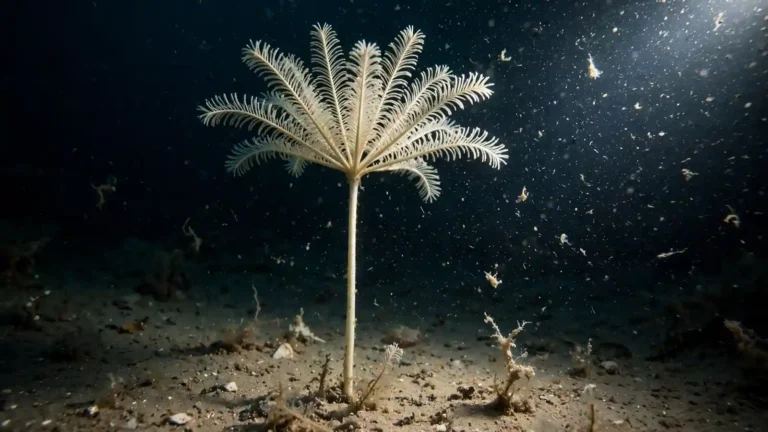
Giant Siphonophore
Giant Siphonophore: Longer Than a Blue Whale
The giant siphonophore is a colony of tiny animals up to fifty metres long — longer than a blue whale — drifting and glowing in the deep sea. It is not one animal at all, and that is the strangest part.
By Emily Carter · Reviewed by our vet team · Updated 10 November 2026 · 9 min read
Up to 50 m longNot one animalLives 700–1,000 m down
At a Glance
The giant siphonophore is one of the longest animals in the sea — and it is not one animal at all. It is a colony of tiny, genetically identical zooids, each with its own job, strung together into a ribbon up to fifty metres long that drifts through the deep, dark water.
Giant Siphonophore Length: Up to 50 Metres
It grows up to about 40–50 metres long — longer than a blue whale, and longer than any single animal except a few worms. The body is as thin as a broomstick, a transparent ribbon of zooids drifting in the dark, and it is almost invisible until the lights of a submersible catch it.
The length is a colony measurement, not a body measurement: the ribbon is a chain of hundreds of zooids, each a few centimetres long, linked end to end. Break the chain and it is not one animal cut in two — it is a colony in pieces. For a fuller account of the animal, see this guide to Praya dubia.
One Animal or Many? The Giant Siphonophore Colony
It is not one animal: it is a colony of genetically identical zooids with specialised jobs. Some zooids swim, some sting, some digest, some reproduce — and none of them can live alone. Together they make a single drifting animal that is really many.

The arrangement is the same trick the Portuguese man o’ war uses at the surface, taken to the deep sea and stretched to fifty metres. The zooids are clones, budded from a single fertilised egg, and the colony is the organism — which is why “longest animal” claims about siphonophores always come with a qualification.
The zooids are of several kinds, and each kind does one job: the nectophores swim, beating in rhythm to drive the colony forward; the gastrozooids feed, catching prey with stinging tentacles; the gonophores reproduce, releasing eggs and sperm into the water. No zooid can live alone — each is a part of an animal that is really many, and the colony is the organism in every sense that matters. The ribbon is fragile: a submersible’s lights can break it, and a broken colony does not heal — it simply becomes two shorter colonies, each drifting on alone.
Where They Live: 700–1,000 Metres Down
It lives in the mesopelagic to bathypelagic zones, 700–1,000 metres down, where the light never reaches and the water is cold and dark. It drifts in the open water, far from the sea floor and far from the surface, in the largest habitat on Earth.

At that depth there is almost nothing to see, and the siphonophore is almost invisible: a transparent ribbon in black water, lit only by its own glow and by the lights of the submersibles that find it. Most of what we know about it comes from a handful of submersible encounters.
The Glowing Lure: Bioluminescence and the Sting Curtain
It lures its prey with blue light, glowing along its stem to draw small animals into a curtain of stinging tentillae — the fine, barbed threads that hang from the colony like a net. The light is the bait, and the curtain is the trap.

The tentillae sting on contact, and the prey is hauled up to the feeding zooids. In the dark of the deep sea, a glow is the most effective lure there is, and the siphonophore’s light is bright enough to be seen by the cameras of a submersible from metres away.
What Do Giant Siphonophores Eat? Crustaceans, Fish and Larvae
It eats small crustaceans, small fish and larvae — whatever the sting curtain catches. The prey is small, but the curtain is enormous, and a fifty-metre colony sweeps a huge volume of water as it drifts.
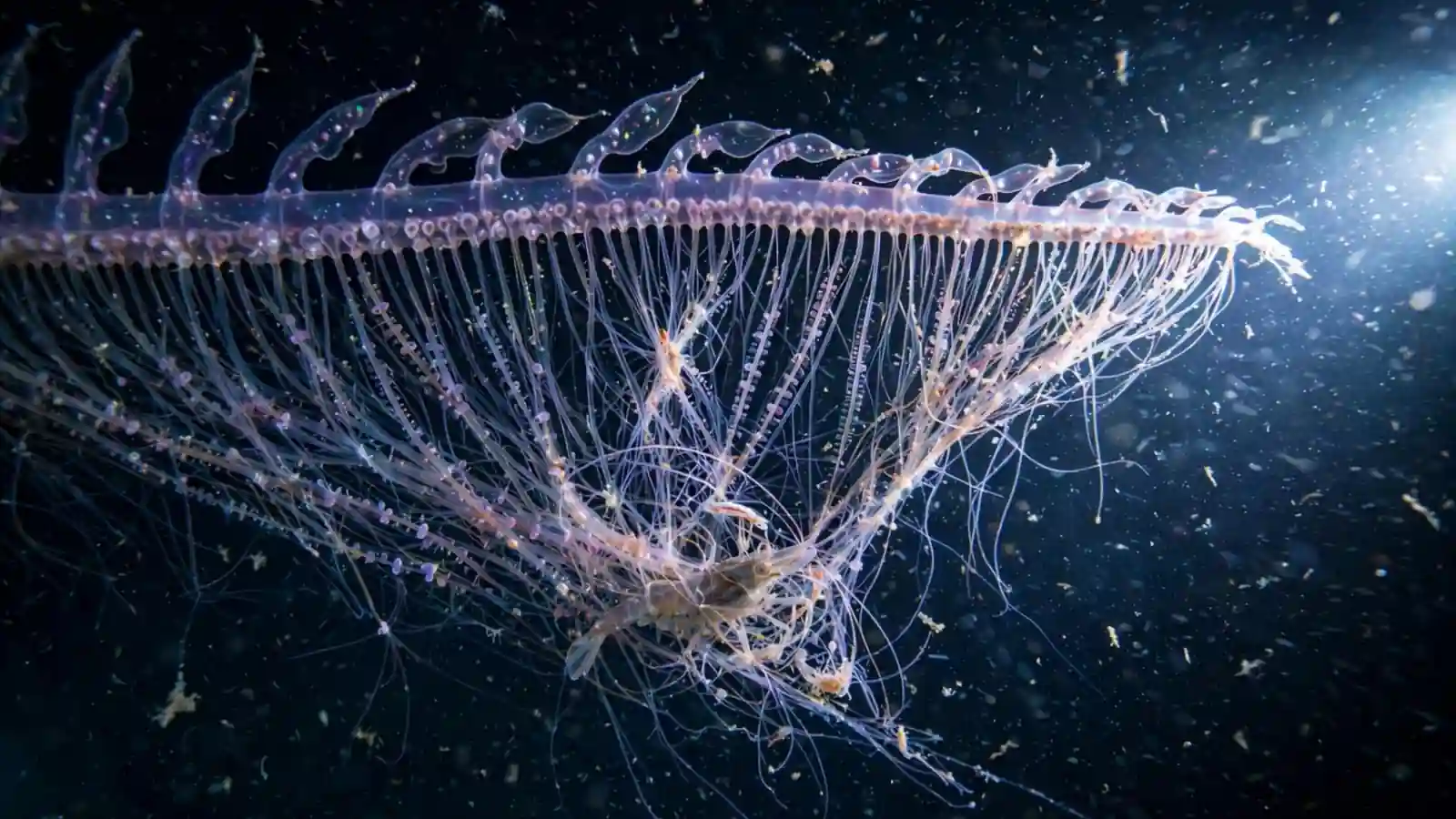
The feeding zooids digest the catch and share it with the colony, the same way a Portuguese man o’ war shares its catch. The siphonophore does not chase anything: it drifts, it glows, and the food comes to it.
The 2020 Spiral: A Different Siphonophore’s Record
In April 2020, a submersible off Ningaloo in Western Australia filmed a siphonophore coiled into a spiral with an outer ring about 47 metres across — and reports put its total length at possibly 119 metres. It was an extraordinary sight, and it was widely reported as the longest animal ever seen.

But the 119 m figure is not Praya dubia. The 2020 spiral was an Apolemia, a different genus of siphonophore. Praya dubia — the species of this guide — reaches up to about 40–50 m, and the 119 m figure belongs to its relative, not to it. The spiral is still a wonder; it is just a different wonder.
Life Cycle and the Unknown Lifespan
It begins as a single fertilised egg that buds into a colony, zooid by zooid, until the ribbon is complete. The reproductive zooids release eggs and sperm into the water, and the cycle begins again — a colony giving birth to colonies.

How long one lives is not recorded. No one has watched one from birth to death, and the deep sea keeps its secrets: the lifespan of the longest colony in the sea is simply unknown.
Fun Facts
- It can reach 40–50 metres — longer than a blue whale.
- It is not one animal but a colony of genetically identical zooids.
- Its body is as thin as a broomstick.
- It lures prey with blue light into a curtain of stinging tentillae.
- The famous 119 m spiral of 2020 was an Apolemia, a different siphonophore — not Praya dubia.
- Its lifespan has never been recorded.
Frequently Asked Questions
What Is a Giant Siphonophore?
A deep-sea colony of tiny zooids, Praya dubia, strung together into a transparent ribbon up to about 40–50 metres long. It is not one animal but many, each with a specialised job — swimming, stinging, digesting or reproducing.
How Long Is a Giant Siphonophore?
Up to about 40–50 metres, longer than a blue whale. The body is as thin as a broomstick. The famous 119 m figure from the 2020 Ningaloo spiral belongs to an Apolemia, a different genus, not to Praya dubia.
Is the Giant Siphonophore the Longest Animal in the World?
Not quite — and the claim needs a qualification. A siphonophore colony is not a single animal, so “longest animal” depends on whether colonies count, and the bootlace worm dispute is unresolved. The giant siphonophore is one of the longest organisms in the sea, colony or not.
Is a Siphonophore One Animal or Many?
Many. A siphonophore is a colony of genetically identical zooids, each with a specialised job, budded from a single fertilised egg. No zooid can live alone — together they make one drifting organism.
Where Do Giant Siphonophores Live?
In the mesopelagic to bathypelagic zones, 700–1,000 metres down, drifting in the open water of the deep sea. It lives where the light never reaches, far from the sea floor and far from the surface.
What Do Giant Siphonophores Eat?
Small crustaceans, small fish and larvae — whatever the sting curtain catches. The colony lures prey with blue light, stings it with fine barbed tentillae, and shares the catch among its feeding zooids.
How Do Giant Siphonophores Catch Their Prey?
With light and a net. The colony glows blue along its stem, drawing small animals toward it, and the prey blunders into a curtain of stinging tentillae that hang from the stem like a net. The tentillae sting on contact and haul the prey in.
Similar Species Worth Exploring
Keep Exploring
Meet the siphonophore group, the giant’s whole family, then the Portuguese man o’ war, its famous surface cousin, and browse the whole family in our types of jellyfish hub — then come back to the colony longer than a blue whale, the giant siphonophore.