Giant Squid
Giant squid: the real kraken of the deep ocean
The giant squid is the ocean’s most famous mystery animal. For centuries it existed only as legends, beach-stranded carcasses and beaks inside sperm whales — until cameras finally filmed it alive in its own dark world. This is what science actually knows about its size, its enormous eyes and its short, strange life.
By Emily Carter · Reviewed by our vet team · Updated 10 November 2026 · 11 min read
Recorded up to 13 m longEye as wide as a dinner plateFirst filmed alive in 2012 at depth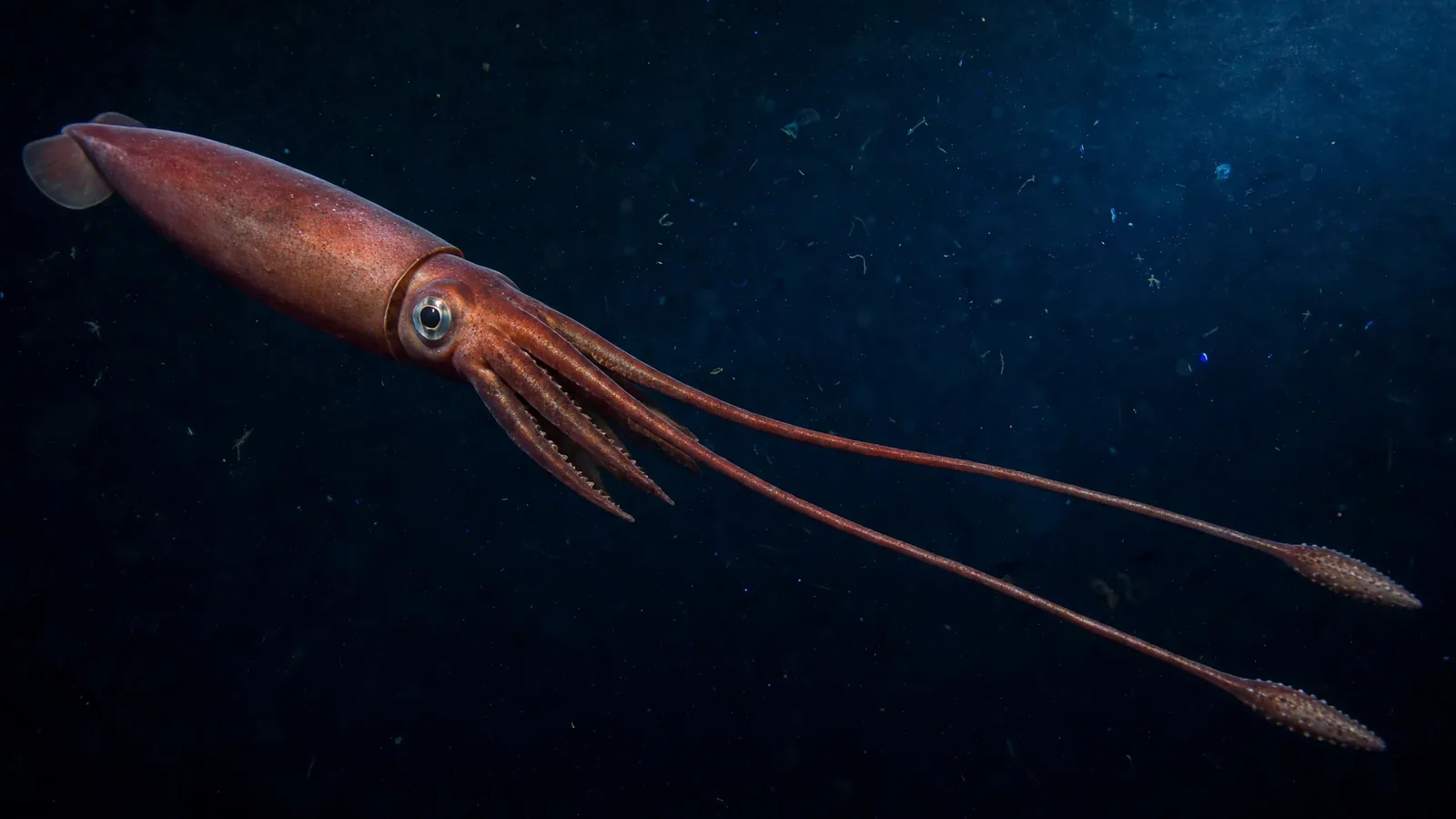
At a Glance
The giant squid has spent longer as a monster than any other animal. Sailors described a beast that could drag ships down; naturalists dismissed it as fantasy; then, one by one, enormous squid began washing ashore with tentacles as long as a bus. It turned out to be real — and stranger than the legend, because almost everything about it, from its eyes to its lifespan, breaks the rules of ordinary animals.
Giant Squid Size and Weight
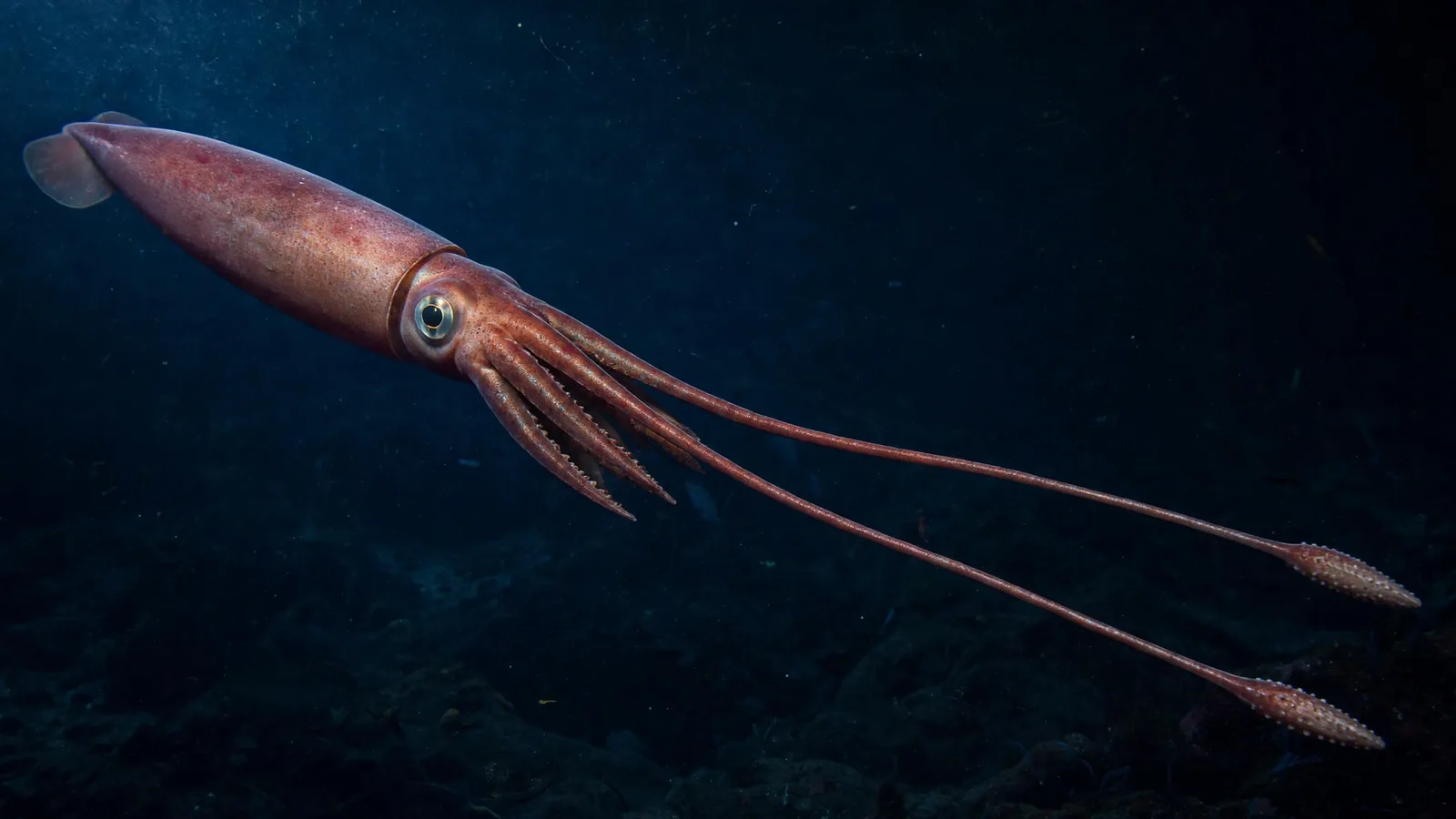
So, how big is it, honestly? The largest specimens ever measured by scientists reached almost 13 metres (43 feet) in total length — but that number needs unpacking. The body itself, the muscular tube called the mantle, tops out at about 2.25 metres (7.4 feet). Most of the famous length is arms and, above all, the two feeding tentacles, which stretch far beyond the body and can make up more than half the total when fully extended.
Claims of 20-metre monsters come from measuring beached tentacles that had stretched like elastic after death. Modern estimates, worked out from beak size, suggest truly enormous individuals could exist but have never been documented. You can explore how scientists measure the largest squid on record in detail. A big female weighs up to roughly 275 kilograms (600 pounds), and females grow larger than males — yet the squid filmed alive have mostly been a still-impressive 3 to 8 metres.
That gap between legend and measurement is the animal in miniature: genuinely gigantic, routinely exaggerated. Even at the verified numbers, it remains one of the largest invertebrates on Earth — an animal the length of a bus, built entirely without bones.
Giant Squid Eye and Body: Built for the Dark
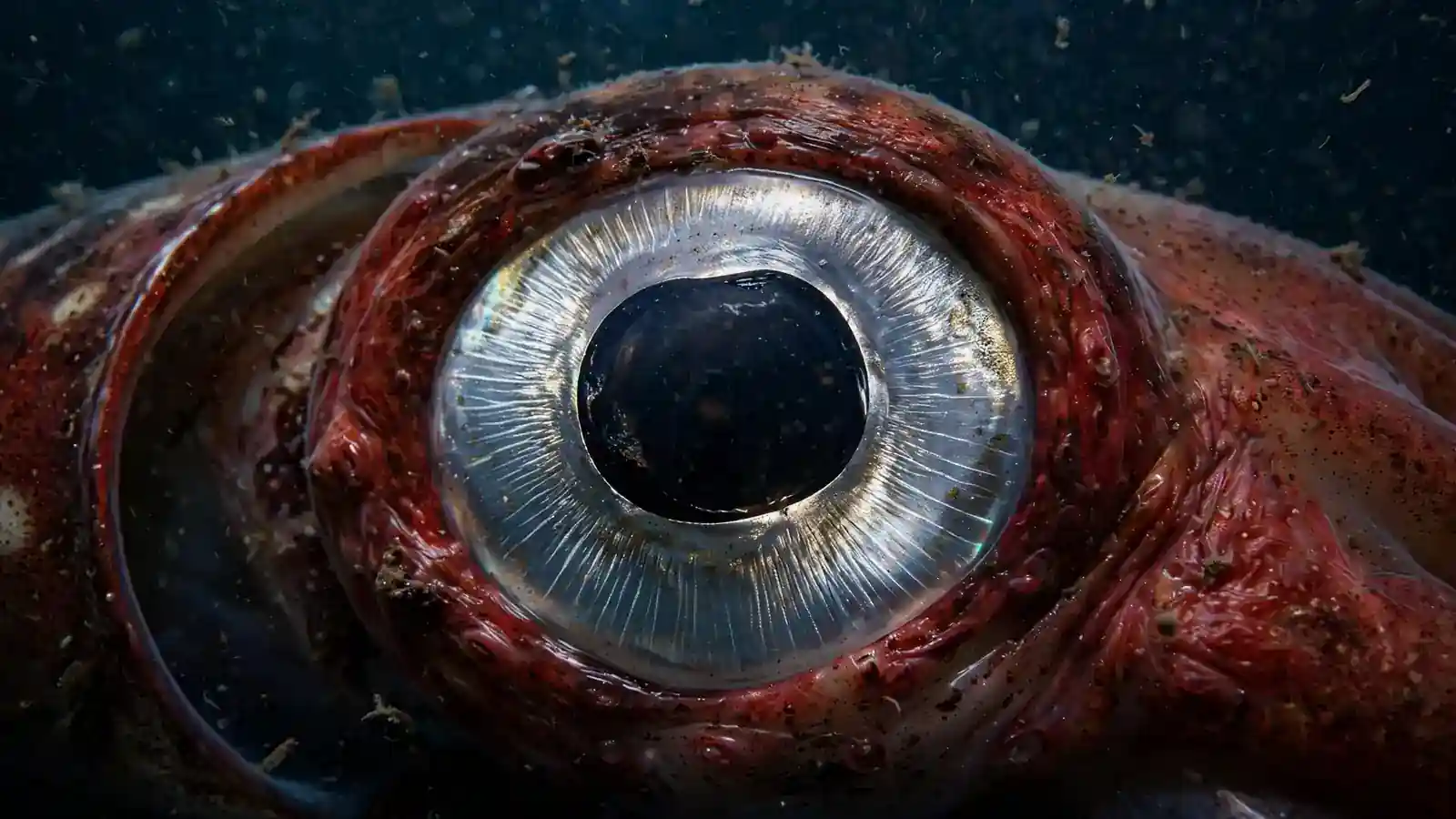
Its eye is the largest of any living animal: up to about 27 centimetres (11 inches) across, roughly the size of a dinner plate, with a lens the size of an orange. An eye that big is not for detail — it is for gathering the faintest light in near-total darkness, and researchers believe its real job is spotting the silhouette and bioluminescent wake of an approaching sperm whale in time to escape.
The body plan is classic squid, scaled up enormously. Eight arms lined with toothed, sharp-rimmed suckers surround a parrot-like beak at the centre, and two much longer feeding tentacles end in flattened clubs studded with suckers. The skin is reddish in life, shifting colour with pigment cells, and the whole animal swims by jet propulsion and gentle undulations of the fins at the mantle’s tip.
Inside, almost everything runs on efficiency: three hearts, blue copper-based blood, and a brain wrapped around the throat, so food passes through it on the way down. It is a mollusk engineered like a deep-sea submarine — soft outside, ruthlessly specialised within.
Habitat: The Twilight and Midnight Zones
Its habitat is the deep open ocean, worldwide except for the polar extremes. Most evidence — strandings, whale stomachs and the few live encounters — points to depths between about 300 and 1,000 metres (1,000 to 3,300 feet), along continental slopes and around deep islands and seamounts where prey gathers. By day the squid likely stay deep; some may rise a little at night, following the fish and smaller squid they hunt.
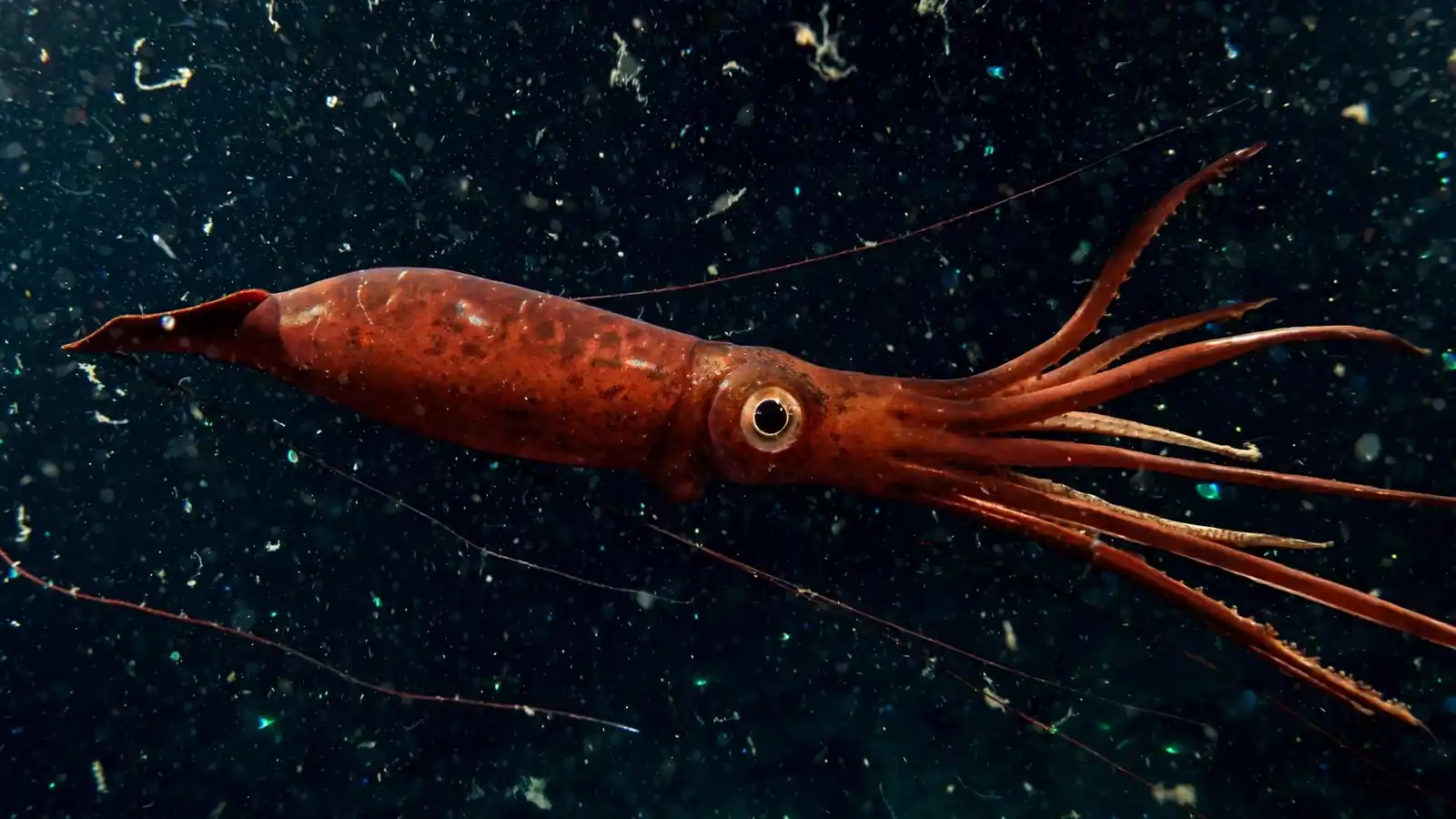
For most of history that habitat kept them invisible. The turning points came from Japan: a live one was photographed in 2004, filmed at the surface in 2006, and finally, in 2012, filmed in its natural habitat hundreds of metres down by a team using a quiet submersible and lights most deep animals cannot see. A 2019 encounter in the Gulf of Mexico gave the United States its first footage — the animal filmed alive is still an event rare enough to make international news.
Those films changed the animal’s image. Instead of a thrashing monster, the squid on camera is calm, curious and almost delicate, reaching toward the lights with slow arms. The kraken, it turns out, is shy.
Diet and Feeding
It hunts by ambush and reach. The two feeding tentacles can shoot out to seize prey up to about 10 metres (33 feet) away, their clubs gripping with hundreds of suckers whose sharp, toothed rims bite in. The catch — deep-sea fish such as orange roughy and hoki, plus other squid, possibly including smaller ones — is drawn to the arms and the beak, which slices it into pieces small enough to swallow.
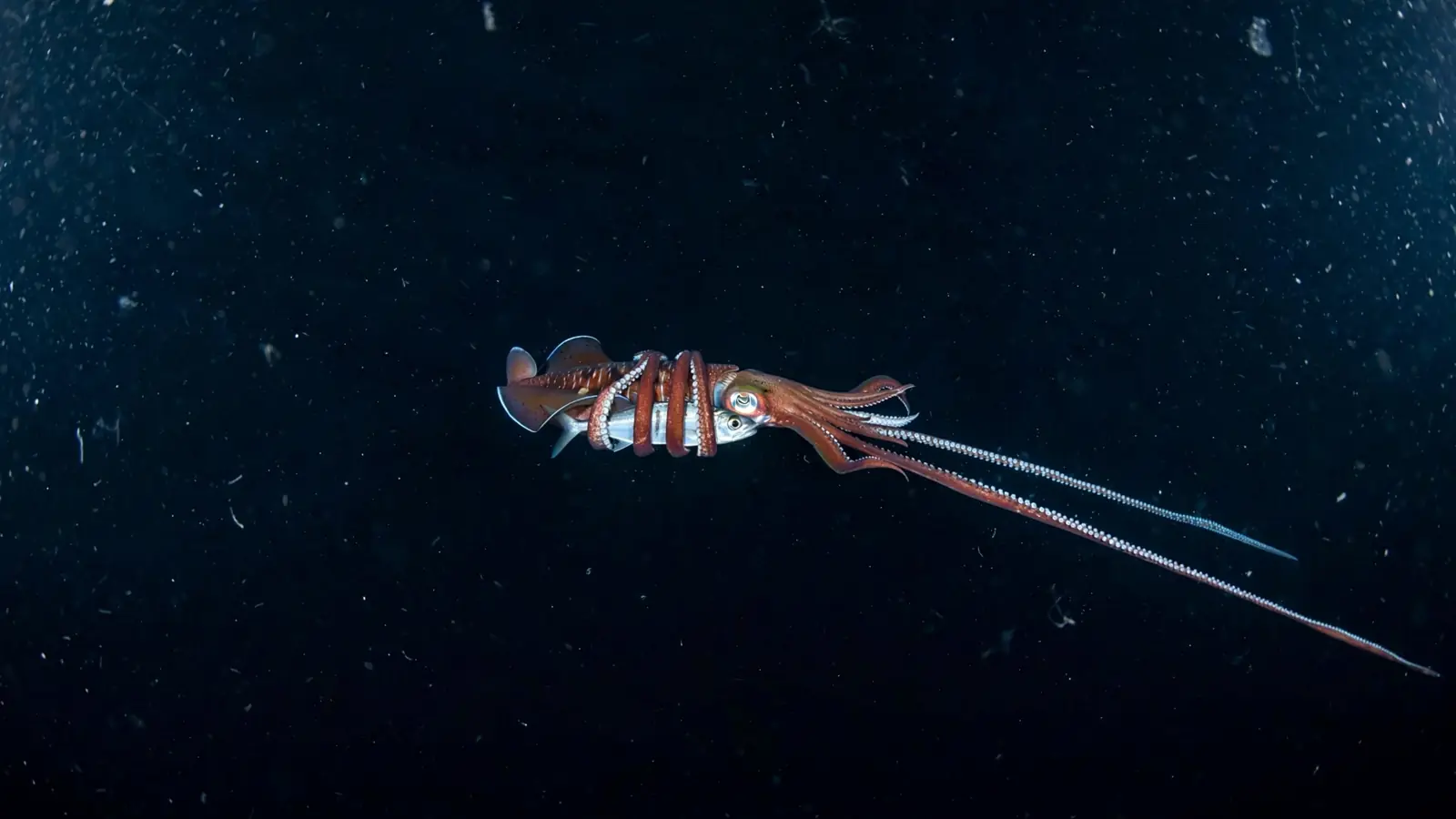
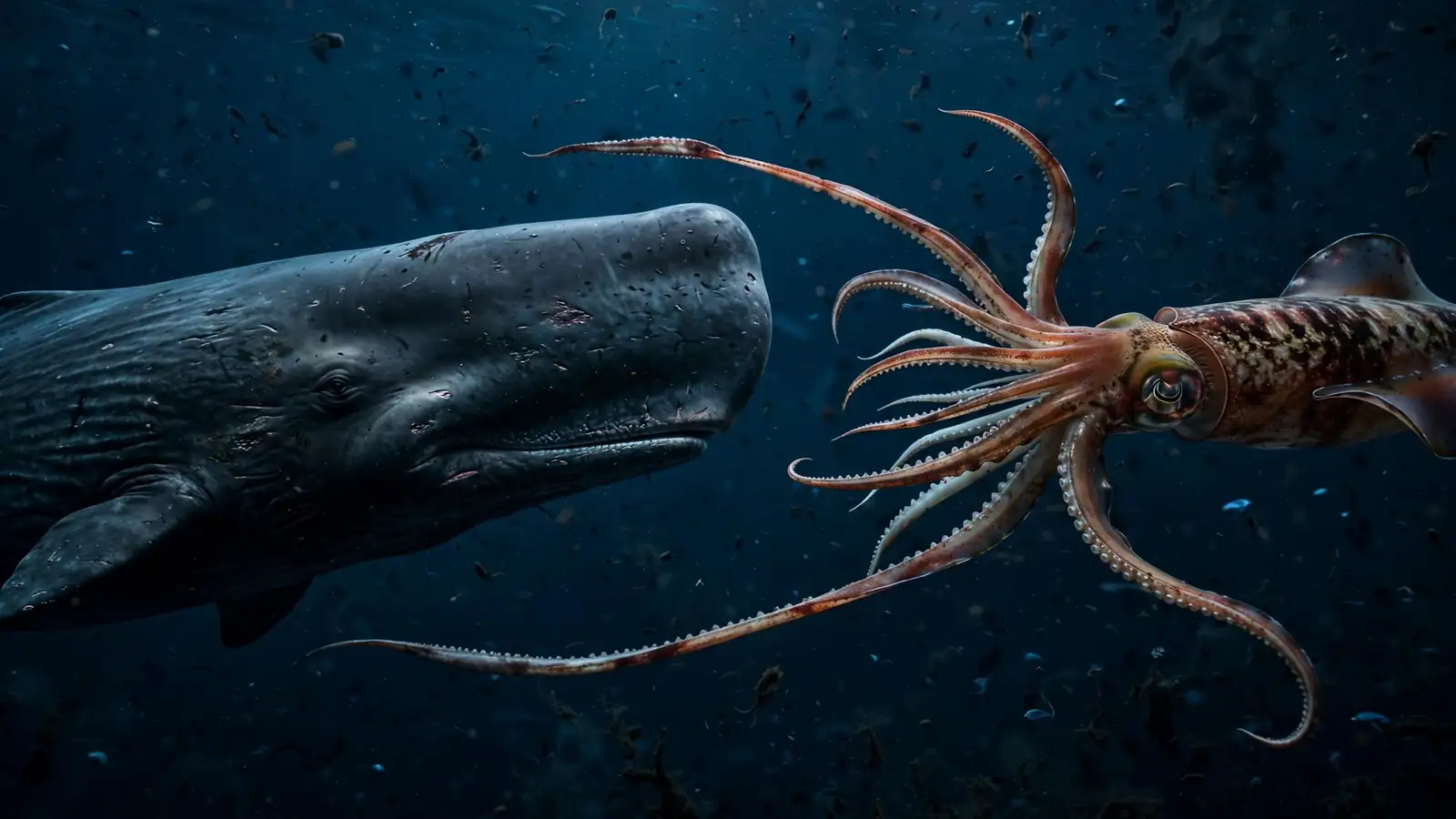
The relationship runs both ways. Its great predator is the sperm whale, which dives a kilometre or more to hunt them; whale stomachs full of indigestible squid beaks were for decades the main proof the species existed, and whales often carry round sucker scars on their skin. Squid are thought to be a staple of the sperm whale’s diet across whole oceans.
Feeding leaves one more clue behind: those beaks accumulate in whale stomachs because nothing can digest them, and by counting and measuring beaks, scientists estimate both squid sizes and how many the whales eat. The monster’s biography was written, for a century, inside its enemy.
Reproduction and Lifespan
For all its size, this animal lives fast. Studies of growth rings in the small balancing organs called statoliths suggest a lifespan of only about five years — a bus-length predator that grows from a millimetre-scale larva, matures, breeds once and dies, all before a human child starts school. Males transfer packets of sperm to females with a specialised arm, and females are thought to release their eggs in a huge, floating, gelatinous mass containing enormous numbers of tiny eggs.
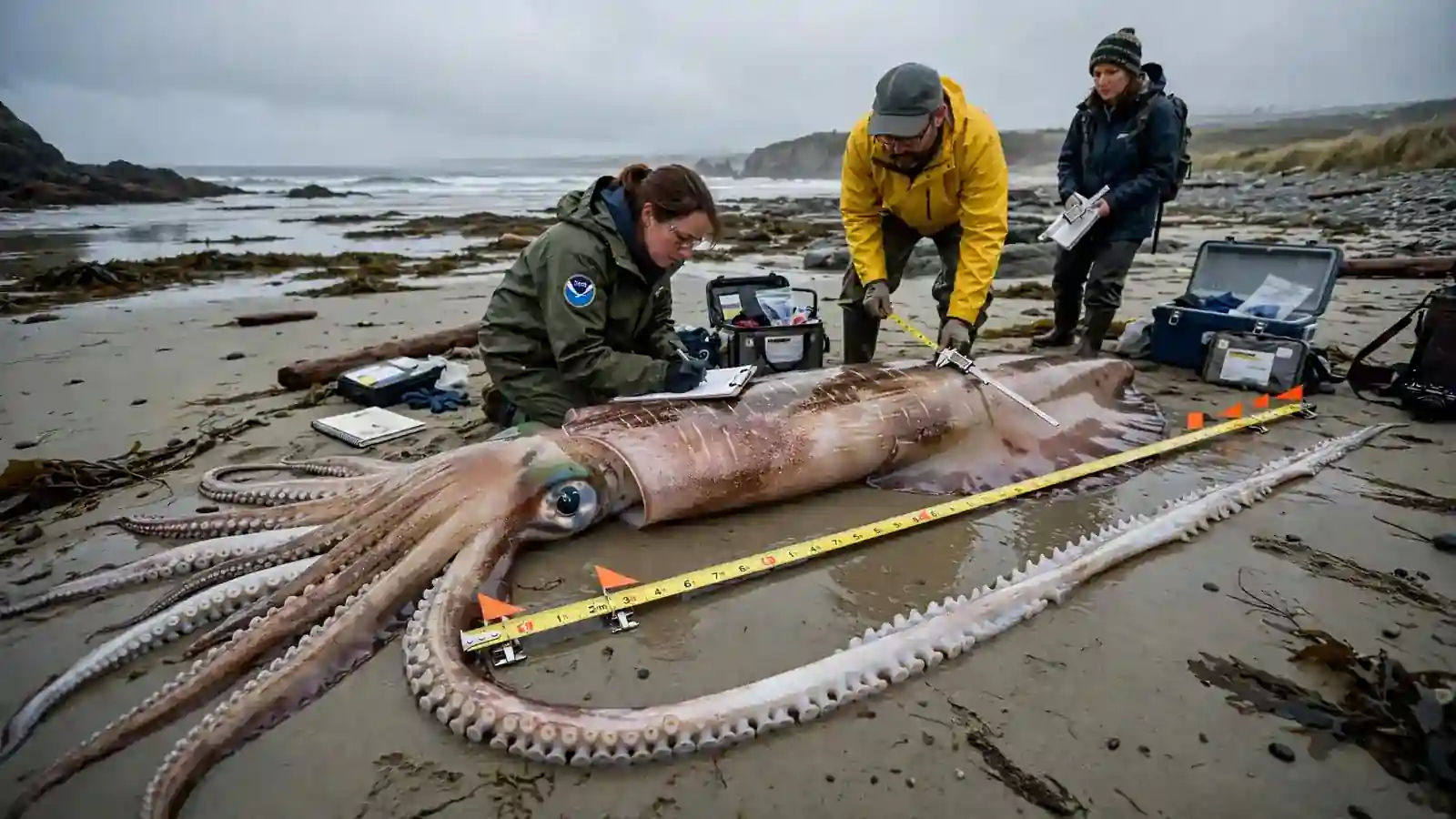
Almost none of that has been witnessed. No one has seen them mate, found a confirmed egg mass in the wild, or watched a larva grow. The stranded giants measured on beaches worldwide — like the specimens scientists still race to examine whenever one washes ashore — remain the main source of knowledge about their bodies, which is why every stranding is treated as a scientific event.
The contrast is the fascination: the largest invertebrate predator in the sea lives one of the shortest lives of any big animal. It grows at extraordinary speed in cold, dark water, on a diet scientists are still piecing together, and then it is gone.
Threats, Predators and Conservation
It is listed as Least Concern, because it lives across the whole deep ocean, far from most human activity, and its numbers are probably large — sperm whales alone may eat millions of tonnes of squid a year. It is not fished commercially, and its inedible, ammonia-rich flesh holds little appeal. Its real enemies are natural: above all the sperm whale, whose dives it spends its life watching for with those enormous eyes.
That does not make it untouchable. Deep-sea trawling can take individuals as bycatch, warming and deoxygenating deep water may shift its prey, and plastic and chemical pollution now reach even its habitat. Because scientists cannot count a population they can barely find, the honest status is common but unmeasured — protected mainly by the same darkness that hid it for centuries.
Its even larger Antarctic relative, the colossal squid, shares that darkness, and the two are often confused: the comparison with the colossal squid comes down to a heavier, shorter body and even bigger eyes in the colossal, against the giant’s greater length. A full colossal squid guide is planned for this site; for now, the kraken facts below belong to the giant.
Fun Facts
- Its eye, at up to 27 centimetres across, is the largest in the animal kingdom — big enough to spot a sperm whale approaching through the dark from over a hundred metres away.
- It has three hearts and blue blood, and its brain is shaped like a doughnut, with the food pipe passing through the middle.
- It was photographed alive for the first time in 2004 and filmed in its natural habitat in 2012, off the Ogasawara Islands of Japan.
- The sharp-rimmed suckers on its arms and tentacle clubs leave round scars on sperm whales that fight it — scars that grow with the whale, exaggerating old battles.
- Despite reaching the length of a bus, it probably lives only about five years, growing faster than almost any animal its size.
- Sailors’ tales of the kraken seizing ships were almost certainly inspired by giants seen at the surface or washed ashore, magnified by retelling.
Frequently Asked Questions
How Big Is a Giant Squid?
It can reach about 13 metres (43 feet) in total length including its tentacles, though the mantle itself is at most about 2.25 metres and most adults are smaller. Females grow larger than males and can weigh up to about 275 kilograms.
How Big Is a Giant Squid’s Eye?
Its eye is up to about 27 centimetres (11 inches) across — roughly a dinner plate, and the largest eye of any animal. Its size helps it gather faint light and spot approaching sperm whales in the dark deep ocean.
Where Do Giant Squid Live?
They live in deep ocean water worldwide, mainly between about 300 and 1,000 metres (1,000 to 3,300 feet) deep along continental slopes and around deep islands. They are rarely seen because they almost never come near the surface while alive and healthy.
What Do Giant Squid Eat?
They eat deep-sea fish and other squid, seizing prey up to about 10 metres away with their two long feeding tentacles. Their sharp-rimmed suckers grip the catch while the central beak slices it into swallow-sized pieces.
Do Giant Squid Attack Humans?
No, they do not attack humans. Every encounter has involved a squid that was hooked, netted or filmed from a submersible, and the animals are shy, fragile deep-sea creatures. There is no verified record of a healthy one harming a person.
How Long Do Giant Squid Live?
They probably live only about five years, based on growth rings in their statoliths. In that short life a female grows from a tiny larva to many metres long, breeds once, and dies — one of the fastest lives of any very large animal.
Is the Giant Squid Behind the Kraken Legend?
Yes, it is widely believed to be behind the kraken legend. Sailors who saw huge squid at the surface, or found their enormous carcasses ashore, told stories of a ship-seizing monster that grew with every retelling until science confirmed the real animal.
Similar Species Worth Exploring
Keep Exploring
Ready to explore the whole family? Browse the guide to the types of cephalopods, or meet another deep-sea legend, the goblin shark. However the legends grow, no exaggeration is needed for the real giant squid.