Manatee
Manatee: the Gentle Sea Cow With Three Surviving Species
Slow, whiskery and entirely peaceful, these grey giants spend their days grazing underwater meadows in warm rivers and bays on three continents. They are the last of an ancient line of sea cows — and every one of the three species now needs our protection. Here is their size, diet, habitat, family life and story.
By Emily Carter · Reviewed by our vet team · Updated 10 November 2026 · 10 min read
3 species worldwideLength up to 4 mLifespan 50–60 years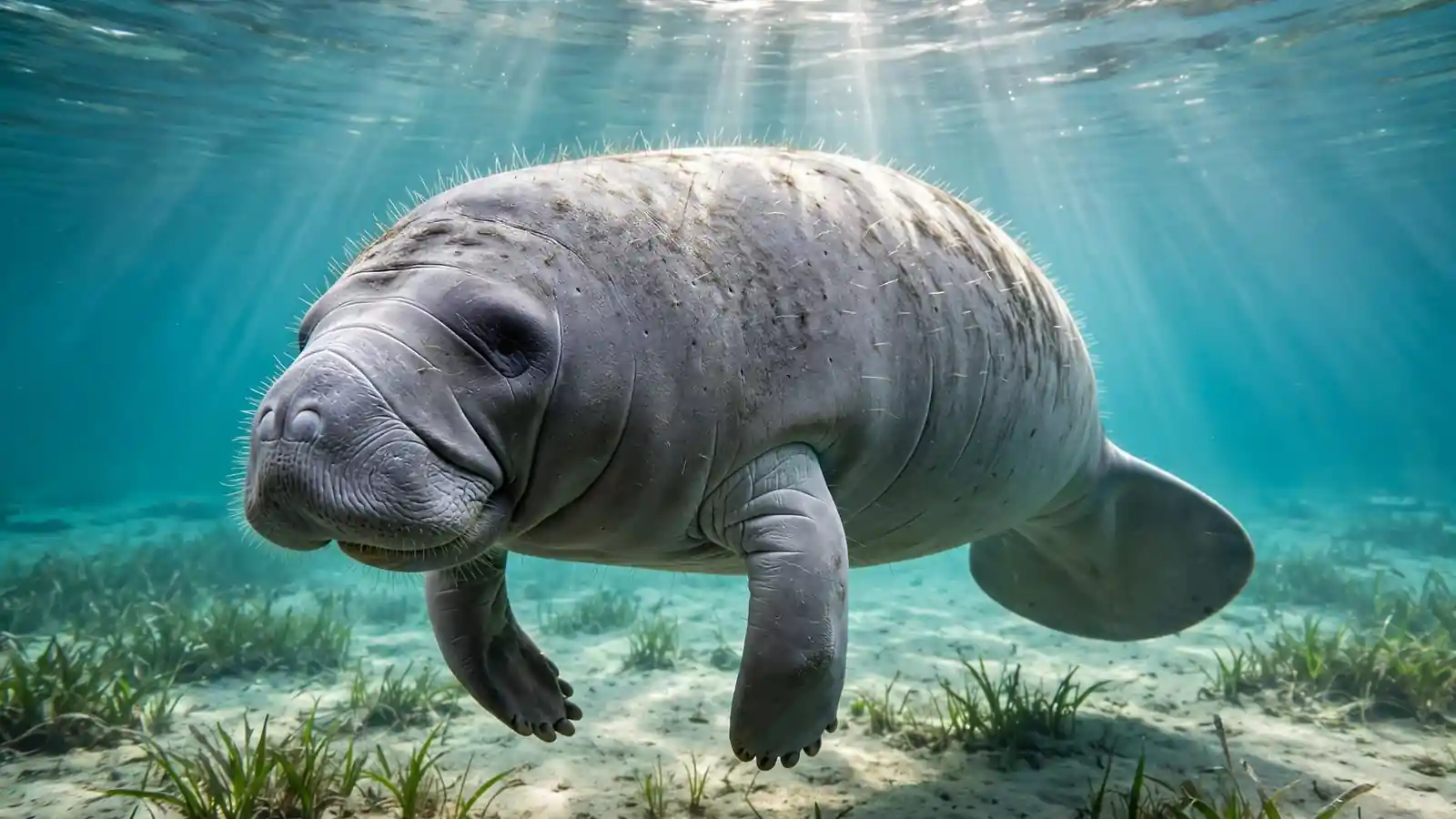
At a Glance
The manatee is a sea cow: a fully aquatic, plant-eating mammal of the order Sirenia, which it shares with just one other living family member, the dugong. Three species survive — the West Indian, the Amazonian and the African — and although they live an ocean apart, they share the same slow pace, the same wrinkled grey skin and the same gentle, grazing way of life.
Manatee Size and Weight
The best-known species, the West Indian manatee, typically measures about 3 to 3.5 metres (10 to 11.5 feet) long and weighs between 350 and 600 kilograms, although exceptional old females can grow beyond 4 metres and past 1,500 kilograms. The Amazonian species is the smallest of the three at roughly 2.5 to 3 metres and seldom more than about 400 kilograms, while the African species falls in between, close in build to its American cousin.
That bulk is not blubber alone: the bones are unusually dense and heavy, acting as built-in ballast that helps a body full of fermenting vegetation hang level in the water. Against a human, an average adult is about twice as long and six times as heavy — yet it is all slow muscle and patience, with no weapons of any kind. A newborn calf measures about 1 to 1.3 metres and weighs around 30 kilograms.
Appearance and Anatomy
The body is a lesson in slow-streamlined design: a torpedo of thick, deeply wrinkled grey skin sparsely sprinkled with hairs, no dorsal fin, small paddle flippers at the front, and a broad, rounded, paddle-shaped tail that drives the animal with slow up-and-down beats. That round tail is the surest field mark of the family — its cousin the dugong swims with a forked, whale-like fluke instead, a difference we break down fully in our dugong vs manatee comparison.

The head is all about grazing. The blunt muzzle carries a divided, highly mobile upper lip studded with stiff whiskers, used like fingers to feel, grasp and stuff plants into the mouth, and hundreds more sensory hairs cover the body, letting the animal feel water movement in murky rivers. Inside, the teeth are extraordinary: cheek teeth form a conveyor belt, marching forward through the jaw and dropping out at the front as worn replacements erupt behind — an endless renewal system for a life spent grinding gritty plants.
The Three Species of Manatee
The West Indian manatee (Trichechus manatus) is the species most people picture: it lives in warm coastal waters, rivers and springs from Florida and the Gulf of Mexico through the Caribbean to Brazil, in two subspecies — the Florida animals and the Antillean animals of the Caribbean. It carries small nails on its flippers, and in a Florida winter hundreds gather in the warm outflow of springs and power stations, stacking flank to flank in the steam.
The Amazonian manatee (Trichechus inunguis) never touches salt water. Confined to the Amazon basin’s rivers, lakes and flooded forests, it is the smallest and sleekest of the three, with smoother skin, no nails on its flippers, and often a pale patch on the chest. Its life rises and falls with the flood pulse: feasting in the drowned forest in high water, fasting in shrinking lakes through the dry season.
The African manatee (Trichechus senegalensis) is the least known of all. It haunts the coasts, lagoons and great rivers of West Africa from Senegal to Angola, looks much like its West Indian relative but with a blunter snout and more prominent eyes, and is the most omnivorous of the three — alongside plants it will take molluscs and small fish. Centuries of hunting and its own wariness make it the hardest sea cow in the world to study.
Habitat and Range
Warmth rules everything. Manatees have a slow metabolism and almost no insulation against cold, so they are confined to waters that stay mild year-round — tropical and subtropical coasts, estuaries, rivers and spring systems across the Americas and West Africa. Sustained cold below about 20°C can kill them, which is why the Florida animals crowd into artesian springs each winter and why the species reaches no further north than the Gulf coast and Georgia in summer.
Within that warm belt they are homebodies with long memories. Individuals return to the same grazing beds, resting hollows and freshwater sources year after year, travelling well-worn routes between them at a stately 5 kilometres per hour. Mothers teach calves these routes, so a local population carries a map of its waters that is passed down the generations — one more reason the loss of old females hurts so much.
Diet and Feeding
These are the ocean’s cattle, and grazing is the whole day’s work. A large adult puts away around a tenth of its body weight in vegetation daily — seagrasses in the sea, and in rivers a long list of water plants, grasses and even bankside leaves pulled down to the water. Feeding bouts can total eight hours a day, the split lip and whiskery muzzle working like hands to gather, shake the sand off, and deliver each mouthful.

The gut is built for the job: a huge hindgut ferments the tough fibres with microbial help, extracting energy from food most animals would starve on. All that grazing is also quiet ecosystem engineering — cropped seagrass beds grow back lusher, droppings fertilise the meadows, and channels kept open through river weed serve fish and other wildlife. Where the sea cows vanish, their meadows measurably decline.
Behavior and Social Life
Nothing about this animal is hurried. A typical day alternates two-to-four-hour grazing sessions with long rests, either hanging suspended just under the surface or lying on the bottom in a resting hollow, rising every few minutes for a quiet breath — or, when deeply asleep, as seldom as every twenty minutes. Travel is a slow cruise at about 5 kilometres per hour, though a startled animal can burst to around 25 for a short dash.
Society is loose and peaceable. Apart from mothers with calves, bonds are casual: animals gather where food, warmth or fresh water concentrates them, greet with nose touches and squeaks, and drift apart without ceremony. There is no territory, no hierarchy worth the name and almost no aggression — the nearest thing to excitement is the mating herd, where several males attend one female for days in a slow, rolling scrum.
Communication and Sound
For such quiet-looking animals they talk a great deal, in chirps, squeaks and whistles that sound almost bird-like through a hull or hydrophone. Each animal’s voice is distinctive, and mothers and calves call back and forth constantly — the calf’s higher, more urgent chirps answered by the mother — which is how a baby finds its way back in cloudy water where eyes are nearly useless. Touch matters just as much: those body-wide whiskers read the water the way our fingertips read a page.
Reproduction and Babies
Life runs slowly here too. Females mature at somewhere between five and nine years, and after a pregnancy of about 12 to 14 months a single calf is born underwater — twins are rare — already about 30 kilograms and able to swim, surfacing for its first breath with its mother’s help. The calf nurses underwater from a teat tucked behind the mother’s flipper, and although it nibbles plants within weeks, it may keep nursing and travelling at her side for up to two years.
That investment means a female raises a calf only every two to five years, one of the slowest breeding rates of any marine mammal. Populations therefore recover from losses at a crawl: a bad year of boat strikes or a lost seagrass meadow echoes for decades.
Predators and Threats
Adults have almost no natural enemies — only the largest sharks, saltwater crocodiles and, in the Amazon, jaguars are any threat, and calves are the usual targets. People are another matter entirely. Across the Americas the great killer is the boat: propeller and hull strikes account for a large share of recorded deaths of the Florida animals, and the survivors carry the scars like service records. In the Amazon and West Africa, hunting for meat continues despite legal protection.
Conservation and Human Interaction
All three species are classed as Vulnerable, and the threats are converging: boats, hunting, drowning in nets, and the loss of the seagrass meadows and warm refuges the animals cannot live without. In Florida, winters now bring mass gatherings at a handful of warm-water sites, and recent seagrass die-offs have caused starvation events on a scale nobody alive had seen before. Against that stand decades of protection, speed zones, rescue networks and sanctuaries — and genuine public affection, the one resource these animals have in abundance.
The Florida story shows recovery is possible: careful protection lifted its numbers enough that its legal status was eased from endangered to threatened in 2017, even as new pressures arrived. For readers wanting the deeper biology in one place, the full scientific account of the best-studied species gathers the research on its senses, life history and behaviour.
Fun Facts
- Manatees are among the very few mammals with just six neck vertebrae — almost every other mammal, giraffes included, has seven.
- Their cheek teeth march forward through the jaw like a conveyor belt, replaced from behind throughout life.
- A resting animal can hold its breath for up to 20 minutes, surfacing without fully waking.
- Their closest living relatives on land are elephants — both descend from the same ancient line of hoofed mammals.
- Sparse whiskery hairs over the whole body work like fingertips, reading currents and touch in murky water.
- One famous captive animal, Snooty of Florida, lived to 69 — among the oldest ages ever recorded for the family.
Frequently Asked Questions
How Big Is a Manatee?
It depends on the species. The West Indian is the largest: typically 3 to 3.5 metres long and 350 to 600 kilograms, with rare giants passing 4 metres and 1,500 kilograms. The Amazonian is smallest at about 2.5 to 3 metres, and the African sits between the two.
How Many Types of Manatee Are There?
Three species: the West Indian of Florida, the Caribbean and northern South America; the Amazonian, found only in the fresh waters of the Amazon basin; and the African, along the coasts and rivers of West Africa. Together with the dugong they are the last of the sea cows.
What Do Manatees Eat?
Plants, and a great deal of them — around a tenth of their body weight a day. In the sea that means seagrasses; in rivers, a wide range of water plants and bankside greenery. The African species also takes some molluscs and small fish, but grazing is the family trade.
Where Do Manatees Live?
In warm, shallow water on three continents: the coasts and rivers of Florida, the Caribbean and northern South America; the Amazon basin; and the coasts and great rivers of West Africa. They need mild water year-round, because cold below about 20°C can kill them.
How Long Do Manatees Live?
Typically 50 to 60 years in the wild, and one captive animal reached 69. Females mature at five to nine years and raise a single calf every two to five years, so populations grow — and recover from losses — very slowly.
Are Manatees Related to Elephants?
Yes — surprisingly closely. Sea cows and elephants descend from the same ancient group of hoofed mammals, and they share odd details such as marching replacement teeth. The dugong, not any seal or whale, is the other close relative alive today.
What Is a Baby Manatee Called?
A calf. Calves are born underwater after a pregnancy of about 12 to 14 months, weigh around 30 kilograms, and nurse behind their mother’s flipper. They stay with her for up to two years, learning the routes between feeding grounds and warm refuges.
Similar Species Worth Exploring
Keep Exploring
Start with the closest relative: read the dugong guide, then settle the classic mix-up once and for all with our dugong vs manatee comparison. Every marine guide here, this guide included, follows the same layout, so the facts are always in the same place.