North Pacific Right Whale
North Pacific Right Whale: the rarest giant of the northern seas
The North Pacific right whale may be the rarest large whale on Earth. Only around 500 survive, split between two coasts of a vast ocean, and the eastern group numbers barely thirty animals. Here is its size, its curious fingerprint head, its slow skim feeding and the long road back from the whaling era.
By Emily Carter · Reviewed by our vet team · Updated 10 November 2026 · 9 min read
Length up to 18 mAround 500 leftNo dorsal fin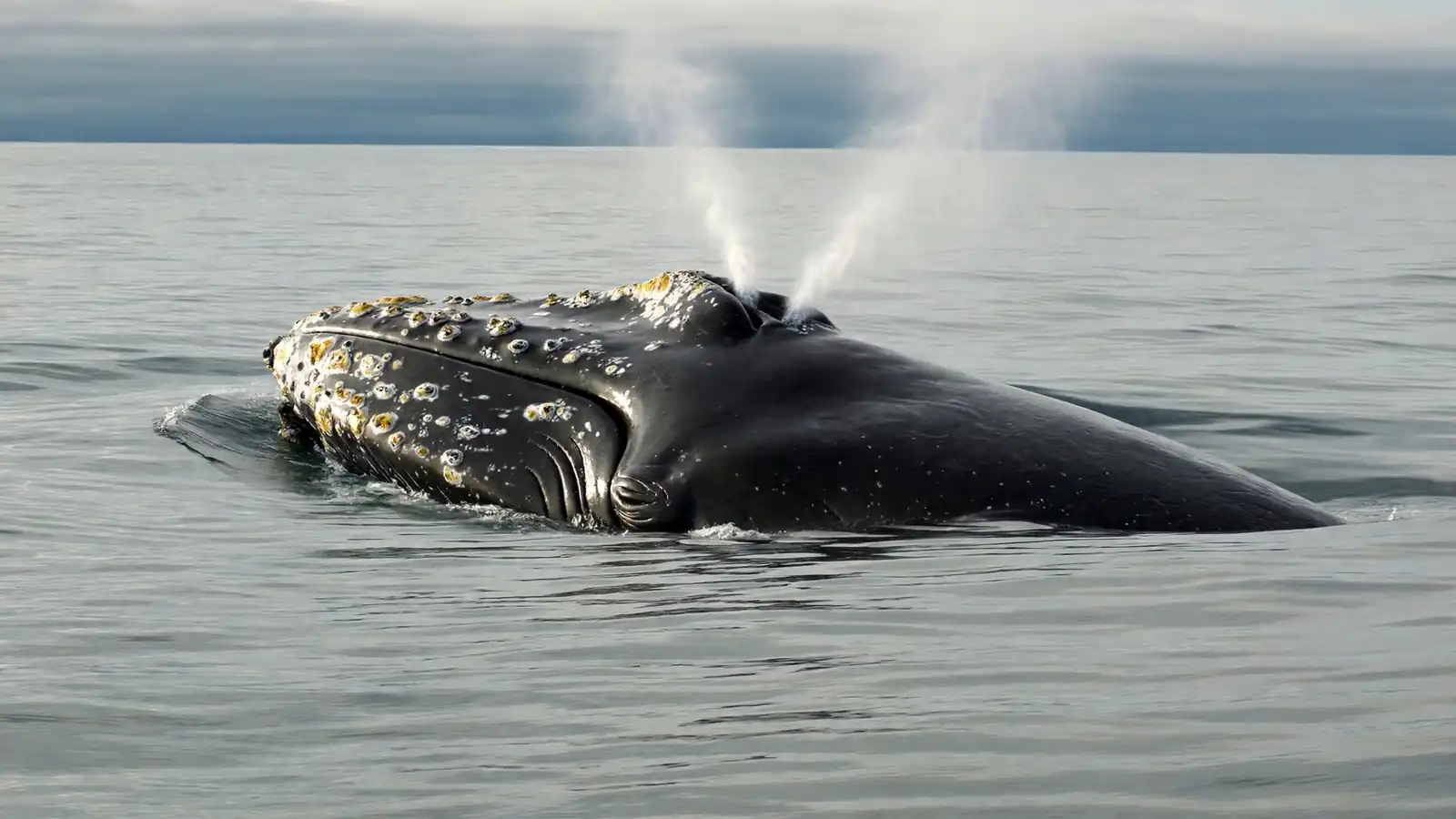
At a Glance
The North Pacific right whale is built on bulk and patience. It carries blubber thick enough for near-freezing seas, feeds by drifting slowly through clouds of tiny prey, and can live for 70 years or more — if it can stay out of harm’s way.
North Pacific Right Whale Size and Weight
A North Pacific right whale measures 15 to 18 metres (49 to 59 feet) long — longer than a city bus — and a big adult weighs between 50 and 100 tonnes, roughly twice the weight of a humpback whale of similar length.
Females grow slightly larger than males, and both sexes are built round: the head takes up about a quarter of the body length, and a deep blanket of blubber rounds out the rest. That girth is easy to picture — measured in front of the flippers, the body’s circumference can reach nearly three quarters of its whole length.
A newborn calf is already 4.5 to 6 metres (15 to 20 feet) long, about the length of a large car, and it grows quickly on its mother’s rich milk through its first year.
Appearance and Anatomy
There is no mistaking this whale at the surface. The body is uniformly black and exceptionally stocky, with a smooth, broad back and no dorsal fin at all — a clean silhouette shared with its two cousins, the North Atlantic right whale and the southern right whale.
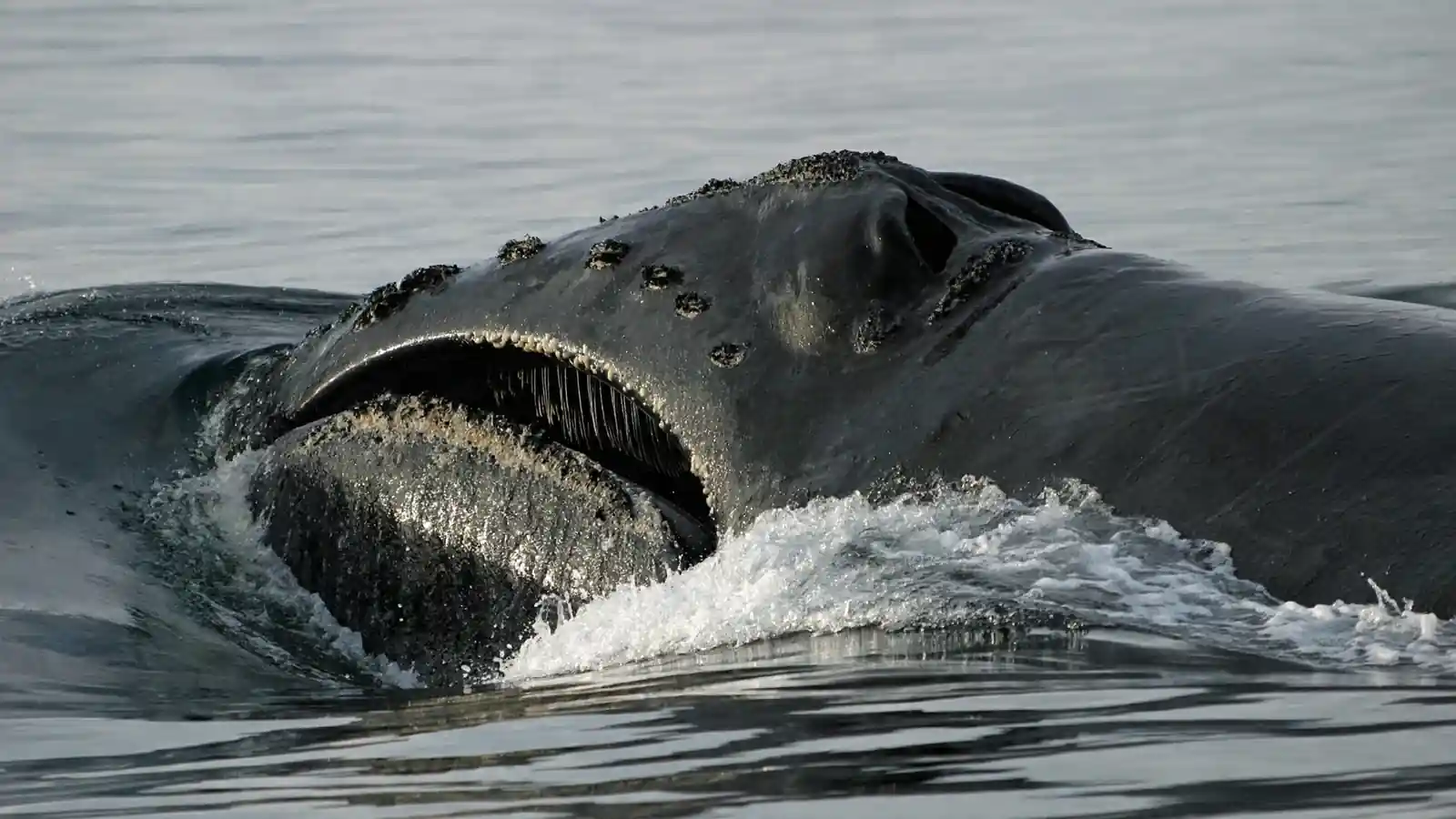
The head carries the real signature: rough, crusty patches of thickened skin called callosities, scattered over the top of the snout, the chin, the lower lip and around the blowholes and eyes. The patches look white, yellow or orange because they are colonised by tiny crustaceans known as whale lice. Every whale’s pattern is unique, so researchers recognise individuals the way we recognise faces — read more in the full species account of this whale’s anatomy and history.
The mouth is a dramatic high arch, built to hold 200 to 270 long baleen plates on each side — narrow, flexible plates up to 3 metres long with a fringe of very fine hairs. There are no throat grooves, so unlike the rorquals this whale cannot expand its throat, and the flippers are short, broad and paddle-shaped. When it breathes out, its two blowholes produce a distinctive V-shaped blow.
Habitat and Range
The North Pacific right whale lives only in the North Pacific, in a range that once stretched in a great arc from Japan and Russia across to Alaska and British Columbia, and down the American west coast as far as Mexico.
Today the map has shrunk to scattered pockets. In the west, a few hundred whales still gather in the Sea of Okhotsk and around the Kuril and Commander islands. In the east, the survivors — perhaps thirty animals — are seen mainly in the south-eastern Bering Sea and occasionally in the Gulf of Alaska, with rare sightings further south.
Where the whales go in winter is still one of the species’ mysteries. No calving ground has ever been found in the North Pacific, and animals simply vanish from the feeding areas for months, presumably moving into offshore waters far from shipping and observers alike.
Diet and Feeding
For all its bulk, the North Pacific right whale eats some of the smallest animals in the sea: copepods — rice-sized crustaceans that drift in dense swarms — along with krill and the larvae of other small crustaceans.

It feeds by skim feeding: swimming slowly with its mouth open, at the surface or deep below, while water streams through the baleen plates. The fine fringe on the plates traps the animals like a sieve, and the whale periodically closes its mouth and swallows the collected mass. A single whale can filter several tonnes of copepods in a day this way.
Because a meal is only worth opening that enormous mouth for when prey is packed tightly together, the whales return faithfully to the same cold, rich patches of ocean — which makes finding those patches, and protecting them, central to saving the species.
Behavior and Social Life
This is one of the slowest of the great whales, cruising at little more than walking pace and rarely hurrying anywhere. The North Pacific right whale spends long spells at or just below the surface, resting, feeding or socialising in the top few metres of the sea.
Whales are usually seen alone or in twos and threes, but they do gather in surface-active groups: rolling, splashing gatherings where several males court a single female. Recordings and sightings suggest these meetings can be boisterous, with whales pushing, bumping and calling around each other.
For such a slow animal it can be surprisingly theatrical. Right whales sometimes breach, hurling their huge bodies clear of the water and crashing back with a thunderous splash, and they slap the surface with their flippers and flukes — sounds that carry well beyond the group.
Communication and Sound
Right whales keep in touch with low-frequency moans, groans and gunshot-like pulses that travel far through cold water. The best-known call is the upcall, a rising whoop lasting about a second, used as a contact call between whales scattered across a feeding ground.
Listening has become one of the main ways to find this species at all. Moorings anchored in the Bering Sea record passing calls month after month, and a detected upcall may be the only sign that one of the last eastern whales has swum through an otherwise empty stretch of ocean.
Reproduction and Calves
A female becomes ready to breed at around nine or ten years old and, after a pregnancy of about a year — twelve to thirteen months — gives birth to a single calf. In the western population, mothers are thought to use sheltered coastal waters, but no nursery area has ever been confirmed.
The calf nurses for about a year and stays close to its mother, growing fast on rich milk. A healthy female can calve every three to five years, so every calf in the tiny eastern population — where only about eight breeding females are known — carries an outsized share of the species’ future.
Predators and Threats
Adult right whales are too big for almost any hunter, but calves can be taken by killer whales and large sharks. The overwhelming dangers, though, are human: entanglement in fishing ropes and collisions with ships are the two leading causes of death for the North Pacific right whale today.
History dealt the worst blow. Right whales were hunted intensely from the 1830s, and illegal whaling in the twentieth century removed thousands more even after protection was agreed. From a population once numbered in the tens of thousands, recovery has barely begun.
Conservation and Human Interaction
The species is listed as Endangered, and the eastern population — down to around thirty whales — is treated as critically endangered in its own right. Protection on paper dates back to 1935, yet the eastern group has shown no clear recovery, hemmed in by ship traffic, fishing gear and its own tiny numbers.
There is still real hope, and it is practical. Ship speed limits in busy lanes, weaker ropes and ropeless fishing gear, and teams that track and free tangled whales all target the exact dangers that kill these animals. You can follow the official recovery work in the federal species profile.
Unusually for a wild animal, almost every eastern individual is known by face. Researchers photograph each whale’s callosity pattern and file it in a shared catalogue, so births, deaths, scars and sightings are tracked whale by whale — a census of neighbours, not a sample.
Fun Facts
- Its blubber is among the thickest of any whale’s, which is why a dead right whale floats instead of sinking — a trait that made it the ‘right’ whale to hunt.
- No two right whales wear the same callosity pattern, so scientists can identify and even name individuals from photographs.
- Before commercial whaling, more than 20,000 right whales are thought to have swum the North Pacific; today the total is around 500.
- Right whales have no dorsal fin and no throat grooves — their smooth backs puzzle people expecting a humpback’s profile.
- A right whale’s baleen plates can reach 3 metres long, each fringed with hairs fine enough to strain out animals the size of rice grains.
- Nobody has ever found where the eastern population goes to calve — the nursery grounds remain one of the great whale mysteries.
Frequently Asked Questions
Q How Big Is a North Pacific Right Whale?
Adults grow 15 to 18 metres (49 to 59 feet) long and typically weigh 50 to 100 tonnes, with females slightly larger than males. The head alone makes up about a quarter of the body length, which gives the species its stocky, top-heavy look.
Q What Do North Pacific Right Whales Eat?
Mostly copepods — tiny crustaceans no bigger than grains of rice — plus krill and other small zooplankton. The whale skim-feeds with its mouth open, straining the animals from the water through hundreds of fringed baleen plates.
Q Where Do North Pacific Right Whales Live?
Only in the North Pacific. A few hundred survive in the west, around the Sea of Okhotsk and the Kuril Islands, while perhaps thirty remain in the east, mainly in the south-eastern Bering Sea and the Gulf of Alaska.
Q How Many North Pacific Right Whales Are Left?
Around 500 in total. The western population numbers a few hundred, but the eastern population is down to roughly thirty animals, including only about eight breeding females — one of the smallest populations of any large whale.
Q How Long Do North Pacific Right Whales Live?
They are thought to live 70 years or more, and perhaps past 100. Because so few calves are born, though, each long life matters: a female may produce only a handful of calves across her whole lifetime.
Q How Can You Tell a North Pacific Right Whale Apart?
Look for a stocky black whale with no dorsal fin, a strongly arched mouth and rough, pale callosity patches on the head colonised by whale lice. Its blow splits into a wide V, and its close cousins live in the North Atlantic and the southern oceans.
Q What Is a Baby North Pacific Right Whale Called?
A calf. Calves are born after a pregnancy of about twelve to thirteen months and measure 4.5 to 6 metres (15 to 20 feet) at birth. A newborn nurses for about a year and stays tight against its mother’s side.
Similar Species Worth Exploring
Keep Exploring
Still curious about the great whales? Meet the bowhead whale, the ice-loving cousin built to the same finless plan, or browse the whole family in our guide to the types of whales. However you wander, the north pacific right whale — all 500 or so of them — is the story that matters most.