Peacock Mantis Shrimp
Peacock Mantis Shrimp: The Punch That Breaks Shells
The peacock mantis shrimp punches at 50 miles an hour, sees sixteen kinds of colour, and is not a shrimp at all. It is a stomatopod — a reef-dwelling hunter with a club for a fist and the most complicated eyes in the animal kingdom.
By Emily Carter · Reviewed by our vet team · Updated 10 November 2026 · 10 min read
Punches at 50 mphSees 16 coloursNot a true shrimp
At a Glance
The peacock mantis shrimp is the most famous mantis shrimp in the world, and the most misunderstood. It is called a shrimp, it looks a little like a shrimp, and it is not a shrimp at all: it is a stomatopod, a member of an order of crustaceans that split from the true shrimps hundreds of millions of years ago. Everything about it — the punch, the eyes, the colours — is a stomatopod’s, not a shrimp’s.
Not a Shrimp: What a Mantis Shrimp Really Is
A mantis shrimp is a stomatopod, not a true shrimp. True shrimps are decapods, in the same group as crabs and lobsters; mantis shrimps are stomatopods, a separate order of crustaceans that branched off long before the decapods existed. The name comes from the front legs, which fold like a praying mantis’s — but the animal is no more a shrimp than a mantis is a grasshopper.

It is one species in that order, Odontodactylus scyllarus, and it is the showiest of them: green, blue, red and orange, with a leopard-spotted carapace and a tail fan like a peacock’s. It lives in a burrow in the sand or the rubble of a coral reef, in the warm water of the Indo-Pacific, and it defends that burrow against anything that comes near.
This guide is about this species specifically. The mantis shrimp group as a whole — the whole order, with its smashers and its spearers, its sizes and its ranges — is covered in the mantis shrimp group guide on this site, and the two guides link to each other: the group guide for the family, this guide for the peacock.
Peacock Mantis Shrimp Punch: The Fastest Strike in the Animal Kingdom
Its punch is the fastest strike in the animal kingdom. The club — the enlarged second pair of front legs — accelerates to about 23 metres a second, around 50 miles an hour, and hits with a force of about 1,500 newtons, roughly the force of a bullet. The strike is so fast that it boils the water in front of it, creating a cavitation bubble that collapses with a second shockwave, so the prey is hit twice: once by the club, and once by the bubble.

The punch is a spring, not a muscle. The club is cocked back and locked, the muscles load a spring-like structure in the arm, and the lock is released — the club snaps forward faster than any muscle could drive it, in a few milliseconds. The mechanism is the same one a flea uses to jump, scaled up to a fist, and it is the reason the strike is too fast to see: the whole punch, from cocked to impact, takes less time than a blink.
The numbers need care. One figure that circulates — three thousand kilojoules — is a unit error, and it should never be printed: it confuses energy with force, and it is wrong by orders of magnitude. The correct figures are the speed, about 23 metres a second, and the force, about 1,500 newtons, and the cavitation bubble that follows. Those are extraordinary enough without the error.
Eyes That See Sixteen Colours
It has the most complicated eyes in the animal kingdom. Each eye sits on a stalk and moves independently, and each eye sees in three parts at once — a trinocular vision that gives the animal depth perception from a single eye. The eyes see twelve to sixteen kinds of colour, where a human sees three, and they see ultraviolet light and polarised light that humans cannot see at all.
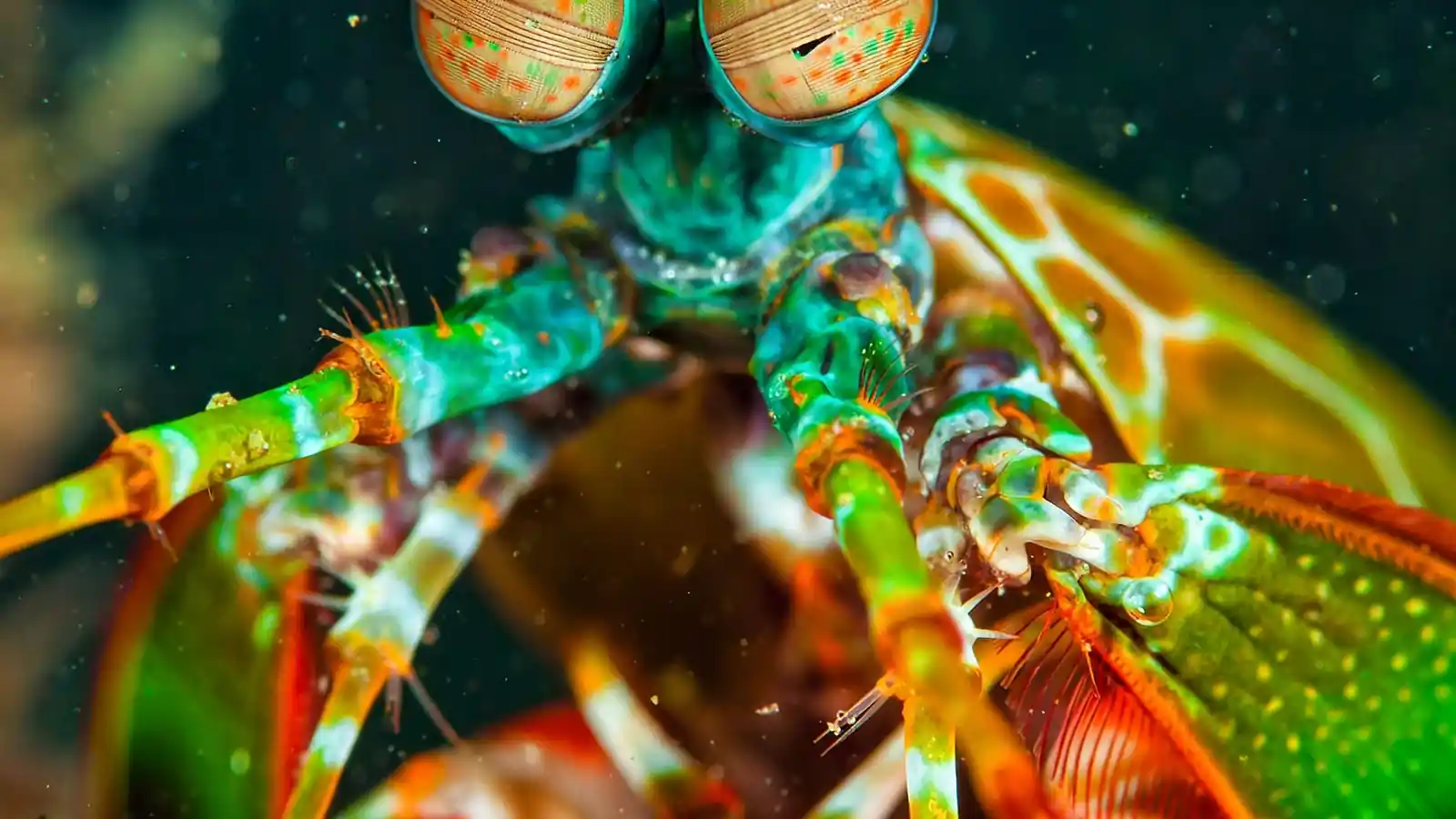
The colour vision is the famous part, and it is also the most misunderstood. Twelve to sixteen photoreceptor types does not mean the animal sees sixteen times as many colours as a human: it means the animal’s eyes sort colour differently, recognising shades directly where a human brain must compare signals. The shrimp does not see a richer world; it sees a world sorted faster, in more categories, with less thinking.
The eyes are also the animal’s warning system. The stalks swivel constantly, scanning the reef, and the animal can watch its burrow entrance and the water above it at the same time. A mantis shrimp that sees a threat strikes first and asks questions later — and the eyes are the reason it so rarely has to.
The Peacock Colours
It is named for its colours: a green carapace, a blue and red tail fan, orange legs and leopard spots, in a combination that looks painted on. The colours are a warning, not a decoration — the animal is advertising the punch, and the message is that the burrow is defended. A predator that recognises the colours knows what lives inside.

The colours change with the moult. A mantis shrimp sheds its shell as it grows, and the new shell is pale and soft until it hardens and the colours return. During the moult the animal hides in its burrow, vulnerable and unarmed, and it does not eat until the new shell is hard. The moult is the most dangerous time in a mantis shrimp’s life, and the colours are the reward for surviving it.
The colour is also how the sexes are told apart, roughly. Males are brighter and more saturated; females are duller, with a less vivid tail fan. The difference is not absolute, and the colours vary between individuals and between reefs — but one, male or female, is unmistakable: there is no other animal on the reef that looks like it.
What Do Peacock Mantis Shrimp Eat?
They eat snails, crabs and molluscs — the hard-shelled animals of the reef, the ones other predators cannot open. The punch is the tool: the club smashes the shell, the cavitation bubble finishes the job, and the shrimp picks out the meat. One can break a snail shell that a human would need a hammer to open, and it does it with a single strike.
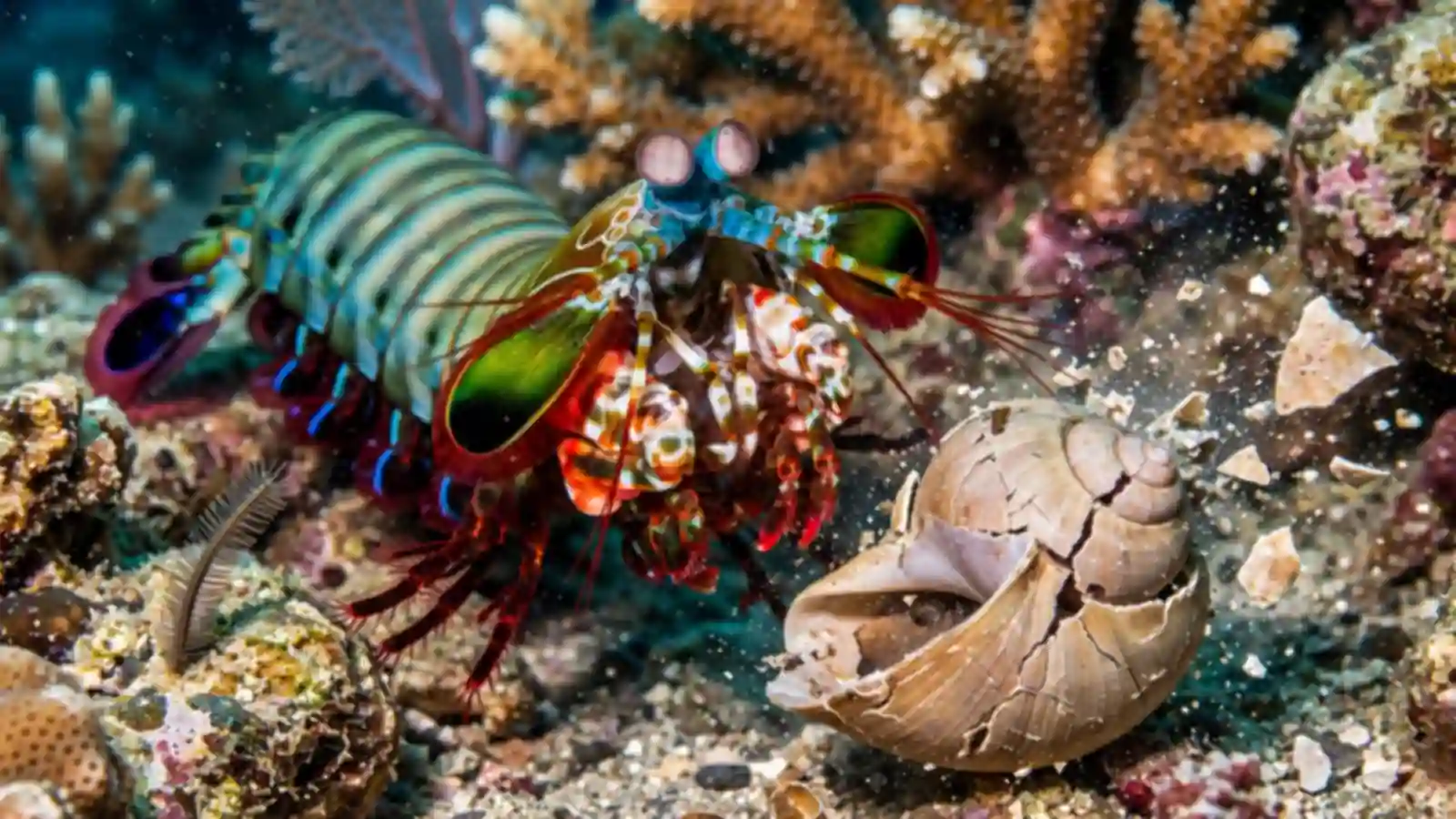
The hunting is done from the burrow. The shrimp waits at the entrance, eyes scanning, and when a snail or a crab comes within reach, it strikes — and the prey is dragged into the burrow before it knows what happened. The shrimp eats in the burrow, and the shells pile up outside the entrance, a midden of broken snail shells that marks the burrow as occupied.
The diet is the reason the shrimp is famous in aquariums. One in a home tank will eat the snails, the crabs and the other crustaceans, and it is reported to crack aquarium glass — a claim that is often repeated and never settled. The glass is thick, the punch is strong, and the reports exist; but no controlled test has confirmed it, and the claim should be printed as reported, not as fact. The full species guide, including the diet and the punch, is in the peacock mantis shrimp species guide.
Smashers vs Spearers
Mantis shrimps come in two kinds: smashers and spearers. This species is a smasher — it has a club, a blunt, hammer-like appendage built for breaking shells. The spearers have a different weapon: long, barbed, spear-like appendages that they use to impale soft-bodied prey, especially fish. The two kinds hunt differently, live differently, and look different.
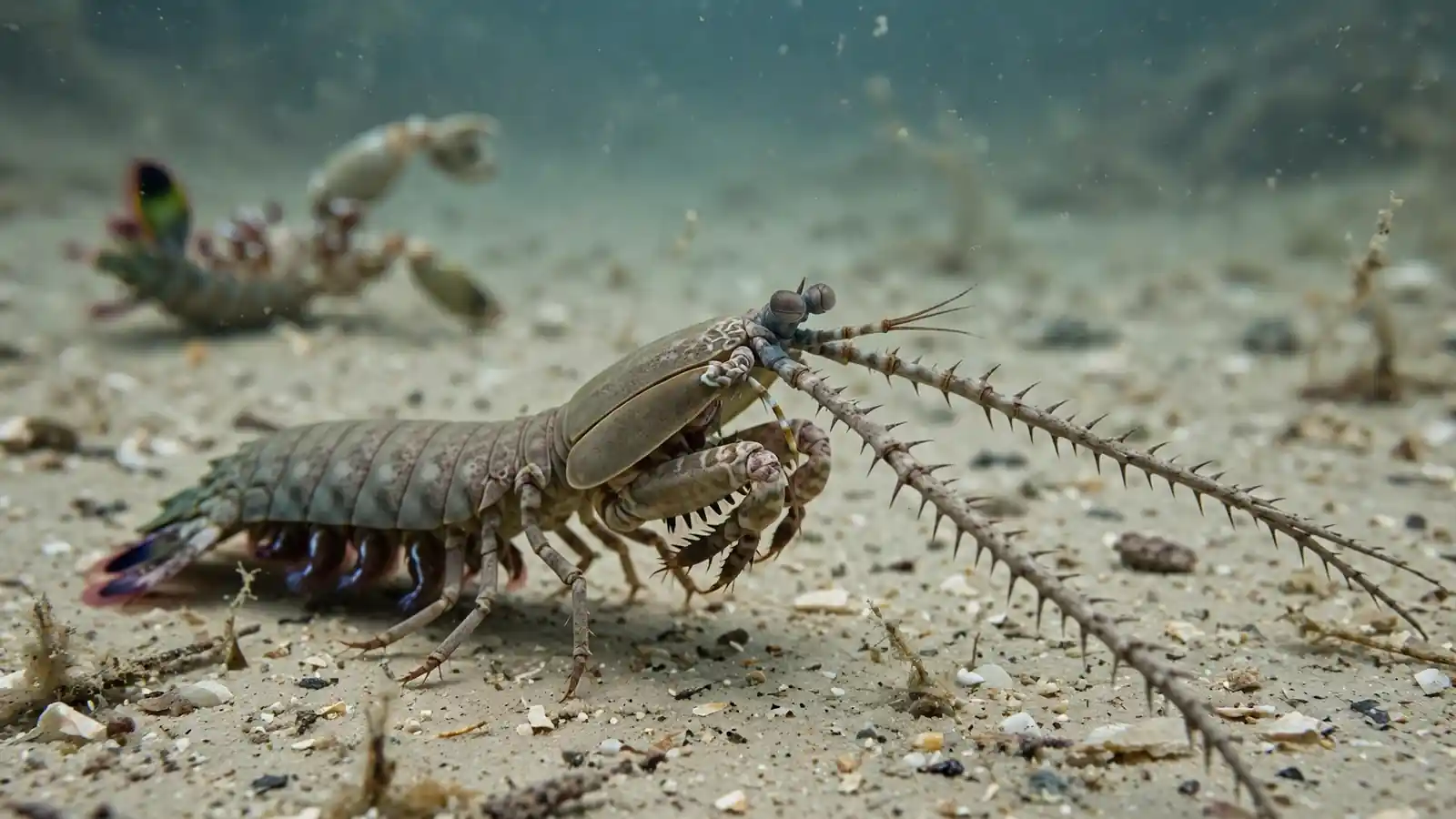
The spearers are the ambush hunters. They live in burrows in the sand, with only their eyes and their spears showing, and they strike upward at fish that swim past, impaling them and dragging them down. The smashers are the shell-breakers: they live in burrows in the rubble and the reef, and they hunt the hard-shelled animals that the spearers cannot open. The peacock is the most famous smasher; the spearers are less known, but no less remarkable.
The distinction matters because the two kinds are often confused, and the peacock’s punch is often attributed to mantis shrimps in general. It is not general: the spearers do not punch, and the smashers do not spear. It punches because it is a smasher, and the punch is the smasher’s weapon — the club, the spring, the cavitation bubble, and the shell that breaks under it.
Fun Facts
- It punches at about 23 metres a second — around 50 miles an hour.
- The punch creates a cavitation bubble that hits the prey a second time, after the club.
- Each eye sees in three parts at once, and the animal sees twelve to sixteen kinds of colour.
- A mantis shrimp is a stomatopod, not a true shrimp — the two split hundreds of millions of years ago.
- The shrimp is reported to crack aquarium glass, but no controlled test has confirmed it.
- The punch is a spring, not a muscle — the club is cocked, locked, and released like a crossbow.
Frequently Asked Questions
Is a Peacock Mantis Shrimp a True Shrimp?
No. A mantis shrimp is a stomatopod, not a true shrimp. True shrimps are decapods, in the same group as crabs and lobsters; mantis shrimps are stomatopods, a separate order of crustaceans that branched off long before the decapods existed. The name comes from the front legs, which fold like a praying mantis’s — but the animal is no more a shrimp than a mantis is a grasshopper.
How Strong Is a Peacock Mantis Shrimp Punch?
The club accelerates to about 23 metres a second, around 50 miles an hour, and hits with a force of about 1,500 newtons — roughly the force of a bullet. The strike is so fast it boils the water in front of it, creating a cavitation bubble that collapses with a second shockwave, so the prey is hit twice. The figure of three thousand kilojoules that sometimes circulates is a unit error and should never be used.
How Many Colours Can a Peacock Mantis Shrimp See?
Twelve to sixteen kinds of colour, where a human sees three — and the shrimp also sees ultraviolet light and polarised light that humans cannot see at all. Each eye sits on a stalk, moves independently, and sees in three parts at once, giving the animal depth perception from a single eye. The extra receptors sort colour directly, rather than comparing signals the way a human brain does.
Can a Peacock Mantis Shrimp Break Glass?
It is reported to crack aquarium glass, but no controlled test has confirmed it. The punch is strong and the reports exist, but the claim should be printed as reported, not as settled fact. What is certain is that the shrimp can break snail and crab shells that a human would need a hammer to open.
What Do Peacock Mantis Shrimp Eat?
Snails, crabs and molluscs — the hard-shelled animals of the reef. The shrimp waits at its burrow entrance, strikes when a snail or a crab comes within reach, and drags the prey into the burrow. The club smashes the shell, the cavitation bubble finishes the job, and the shells pile up outside the entrance as a midden.
What Is the Difference Between a Smasher and a Spearer?
Smashers, like the peacock mantis shrimp, have a club — a blunt, hammer-like appendage built for breaking shells. Spearers have long, barbed, spear-like appendages that they use to impale soft-bodied prey, especially fish. The two kinds hunt differently and live differently: spearers ambush fish from burrows in the sand, while smashers break shells on the reef.
Where Do Peacock Mantis Shrimp Live?
In burrows in the sand or the rubble of coral reefs, in the warm water of the Indo-Pacific. The burrow is the animal’s home and its fortress: the shrimp defends it against anything that comes near, and it eats, moults and sleeps inside it. The shells of past meals pile up outside the entrance, marking the burrow as occupied.
Are Peacock Mantis Shrimp Dangerous to Humans?
They are not deadly, but the punch deserves respect: the club strike reaches about 23 metres a second and hits with a force of about 1,500 newtons, roughly the force of a bullet, and it is reported to crack aquarium glass. Keep your hands out of a mantis shrimp’s burrow and tank.
Why Are They Called Peacock Mantis Shrimp?
The peacock is for the colours — green, blue, red and orange, with a leopard-spotted carapace and a tail fan like a peacock’s. The mantis is for the front legs, which fold like a praying mantis’s — though the animal is no more a shrimp than a mantis is a grasshopper.
Similar Species Worth Exploring
Keep Exploring
Meet the mantis shrimp, the group guide for the whole stomatopod order, then the pistol shrimp, the other great puncher of the reef, and browse the whole family in our types of crustaceans hub — then come back to the reef’s most colourful boxer, the peacock mantis shrimp.