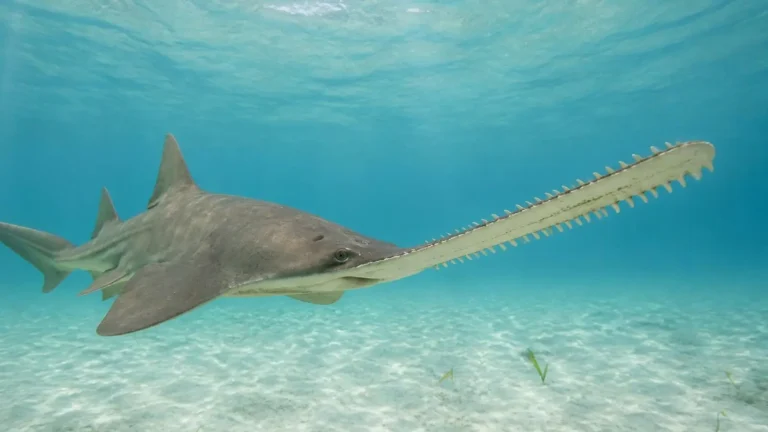
Types of Deep-Sea Fish
Types of Deep-Sea Fish: a tour by depth zone
The types of deep-sea fish change with every hundred metres you sink: silver commuters in the twilight gloom, then lure-fishers, balloon-swallowers and fish with transparent heads in the midnight dark. This hub profiles 12 of them, organised the way the ocean is — zone by zone, from 200 metres down to the abyssal floor.
By Emily Carter · Reviewed by our vet team · Updated 10 November 2026 · 8 min read
12 profiles by depth zoneTwilight: 200–1,000 mMidnight: 1,000–4,000 m
At a Glance
The types of deep-sea fish live where sunlight gives out, meals arrive as a slow snowfall of other animals’ leftovers, and finding a mate can be the hardest problem of a lifetime. Their solutions — built-in lanterns, elastic stomachs, transparent heads, stilts — read like inventions, and every one of them is real. The organising principle of the deep is depth itself, so this hub descends the way a submersible does.
The Twilight Zone: 200–1,000 Metres
The mesopelagic — the twilight zone — is dim, blue and busy. Its signature among the types of deep-sea fish is the lanternfish, a palm-sized commuter with rows of belly lights, which rises to the surface plankton every night in the largest migration on Earth. Around it patrol the mirrored hatchetfish, which hides by matching the faint light from above; the dragonfish, which hunts with red light its prey cannot even see; and the shallows are visited by giants — the ribbon-like oarfish, longest bony fish alive, and the fragile ribbonfish.

The Midnight Zone: Dragonfish, Gulper Eel and the 1,000–4,000 Metre Hunters
Below a kilometre the sun is a rumour. Here lives the anglerfish, fishing with a glowing lure in front of a trap of teeth; the gulper eel, whose pelican mouth could, in theory, take prey nearly its own size — though stomachs say it mostly settles for shrimp-sized snacks; the blobfish, gelatinous and content at pressure, and only ‘ugly’ when dragged into ours; and the viperfish, whose hinged jaw and fangs make it the zone’s pike.

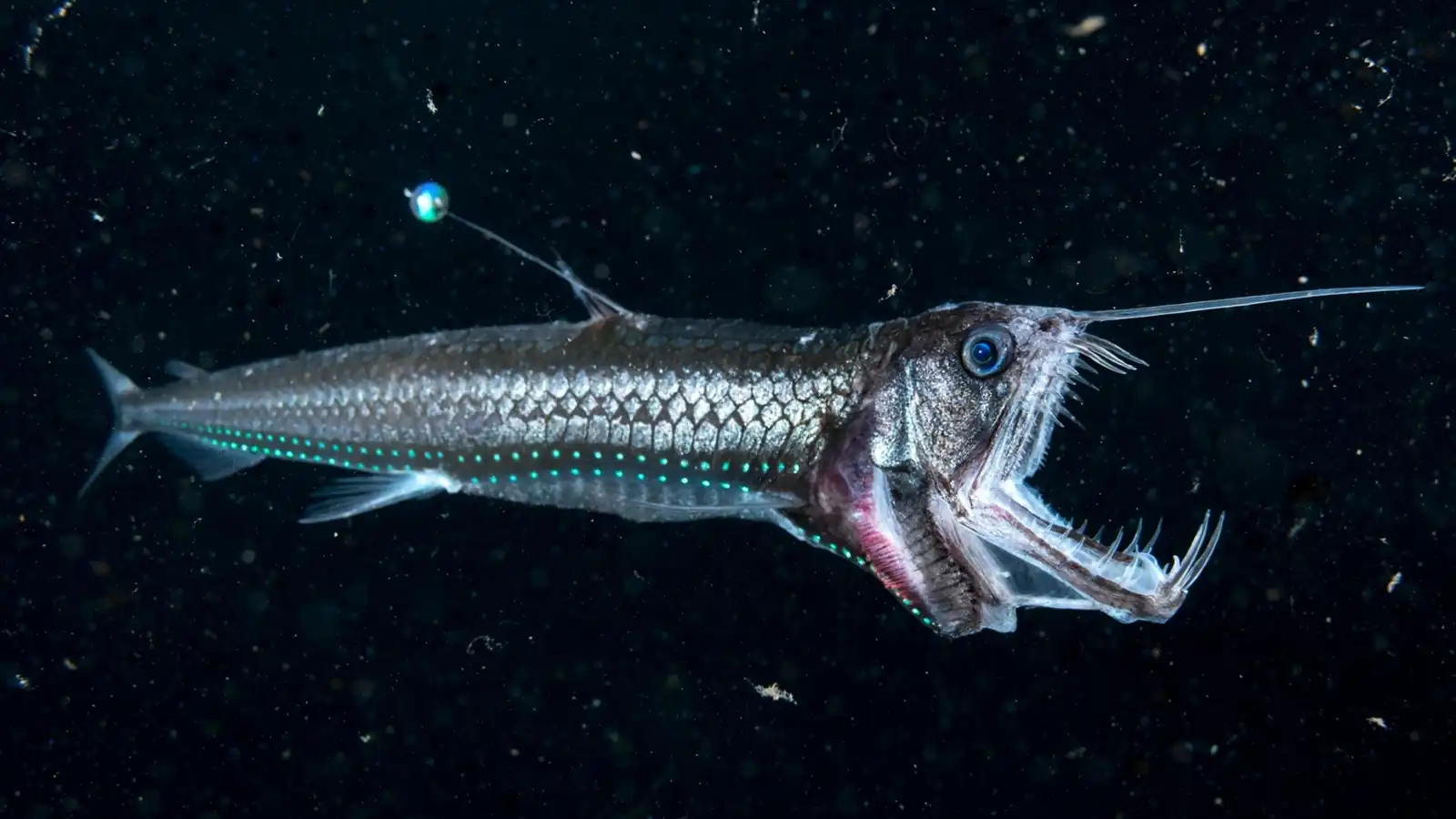
The midnight zone also holds the great optical experiment of all types of deep-sea fish: the barreleye fish, whose eyes sit inside a transparent, fluid-filled dome, staring up through its own forehead at the silhouettes of prey — and able to rotate forward when it strikes. And its great swallowing trick: the black swallower, which can engulf fish longer than itself, its stomach ballooning and the victim’s tail coiling down its belly like a signature.

The Abyssal Floor: Standing in the Snowfall
Where the water column ends, the strategy changes from hunting to waiting. The tripod fish is the master of this patience: it perches on three elongated fin rays — stilts half a metre tall — facing into the bottom current, essentially blind, feeling for the small crustaceans the current delivers to its mouth. Energy is so scarce down here that standing still for a living is a winning design.

How Deep-Sea Fish Survive
Across both zones, the types of deep-sea fish share one toolkit. Light is manufactured, because three-quarters of deep animals glow. Mouths are huge and stomachs elastic, because a meal may be the month’s only one — and must never be refused for being too big. Bodies are watery, boneless-ish and unhurried: no swim bladders to implode, metabolisms ticking at a fraction of surface speed, lifetimes stretched to match. Pressure, the thing we imagine crushing them, is mostly a non-issue for a body with no air in it — it is the trip to the surface, not life at depth, that destroys them. For the physics and the fauna together, the deep sea fish overview is a solid companion read. This hub sits inside our types of fish collection, beside the sunlit types of reef fish — the same phylum, the opposite extreme.
Fun Facts
- Lanternfish are so abundant that sonar operators once mistook their massed swim bladders for a false sea floor.
- The gulper eel’s closest relative is not another deep fish — it shares its odd lineage with the surface eels, re-engineered for the dark.
- A black swallower was once found floating at the surface, killed by its own ambition: the fish it swallowed was decomposing faster than it could be digested.
- Some dragonfish produce red bioluminescence — almost unique in the deep — giving them a searchlight invisible to their prey.
- The barreleye’s transparent head was only confirmed in 2009, when a living specimen was finally filmed intact.
- Tripod fish are simultaneous hermaphrodites — in the loneliest habitat on Earth, any meeting between two of them can produce eggs.
Frequently Asked Questions
How Many Types of Deep-Sea Fish Are There?
Thousands — the deep sea is the largest habitat on Earth, and new species are described every year. This hub profiles 12 types of deep-sea fish organised by depth zone: 5 from the twilight zone (200 to 1,000 metres) and 7 from the midnight zone below it (1,000 to 4,000 metres), from the lanternfish — possibly the most abundant vertebrate on the planet — to the tripod fish standing on the abyssal mud.
What Is the Most Common Deep-Sea Fish?
By most estimates, the lanternfish. There are around 250 lanternfish species, their combined biomass is reckoned in the hundreds of millions of tonnes, and every night they rise hundreds of metres toward the surface to feed — the largest migration on Earth, repeated daily. Bristlemouths, close twilight-zone relatives, may be even more numerous still.
Why Do Deep-Sea Fish Glow?
Because below about 200 metres there is no sunlight to see by, so they make their own. Bioluminescence — light produced by chemistry, often with the help of glowing bacteria — is used to attract prey (the anglerfish’s lure), to hide (belly lights that cancel out a lanternfish’s silhouette), to flash signals at mates, and to startle predators. Roughly three-quarters of deep-sea animals can glow.
What Is the Deepest Fish Ever Found?
A snailfish. Snailfish have been filmed at depths beyond 8,000 metres — deeper than any other fish — including one recorded at about 8,336 metres in the Izu-Ogasawara Trench, the deepest fish ever observed. Below roughly 8,400 metres, fish physiology appears to hit a hard limit, and invertebrates rule alone.
How Do Deep-Sea Fish Survive the Pressure?
Mostly by being made of water. With no air-filled spaces to crush — many have reduced or absent swim bladders — pressure passes through them rather than squeezing them. Their cells add pressure-proofing chemistry, including compounds that keep proteins folded correctly, and their bones are often reduced and cartilage-light. The famous ‘melted’ look of a blobfish at the surface is what happens when that support is suddenly removed.
Do Deep-Sea Fish Come to the Surface?
Some do — nightly. Lanternfish, hatchetfish and many others commute upward after dark to feed in the plankton-rich shallows, then sink again before dawn: the largest animal migration on Earth by weight, happening every 24 hours. True midnight-zone specialists like the gulper eel and tripod fish, though, spend their whole lives in the dark.
Are Deep-Sea Fish Dangerous to Humans?
Essentially, no. Most are small, slow and live far beyond any diver’s reach; the fiercest-looking — viperfish, dragonfish, gulper eels — top out at sizes that threaten shrimp and other fish, not people. The deep sea’s monsters are mostly a matter of scale and lighting.
What Is a Deep-Sea Fish?
A deep-sea fish is a fish that lives below about 200 metres, where sunlight no longer reaches, and survives the dark, cold and pressure with tools like bioluminescence, huge eyes, hinged jaws and expandable stomachs.
At What Depth Does the Deep Sea Start?
The deep sea starts below about 200 metres, where sunlight fades out. This hub’s twilight zone runs from 200 to 1,000 metres, and the midnight zone below it from 1,000 to 4,000 metres.
What Fish Live in the Midnight Zone?
Seven of the twelve fish profiled here live in the midnight zone, 1,000 to 4,000 metres down: the anglerfish, gulper eel, blobfish, viperfish, barreleye, dragonfish and tripod fish.
All 12 Types of Deep-Sea Fish Profiles
Keep Exploring
Surface slowly through the types of fish hub, compare the sunlit types of reef fish, then dive again with the two profiles that bookend the dark: the anglerfish and the gulper eel. Every expedition down changes how you see the types of deep-sea fish.