Viperfish
Viperfish: the deep-sea hunter with teeth too big for its own mouth
The viperfish is the deep sea’s nightmare made real: a slender, dark fish with needle-like fangs so large they do not fit inside its mouth, a jaw that hinges open like a trapdoor, and a lure that glows in the dark. It holds a world record — the biggest teeth, relative to head size, of any fish — and it earns it every night.
By Emily Carter · Reviewed by our vet team · Updated 10 November 2026 · 9 min read
Biggest teeth relative to head sizeJaw hinges open to 90 degreesLure glows in the dark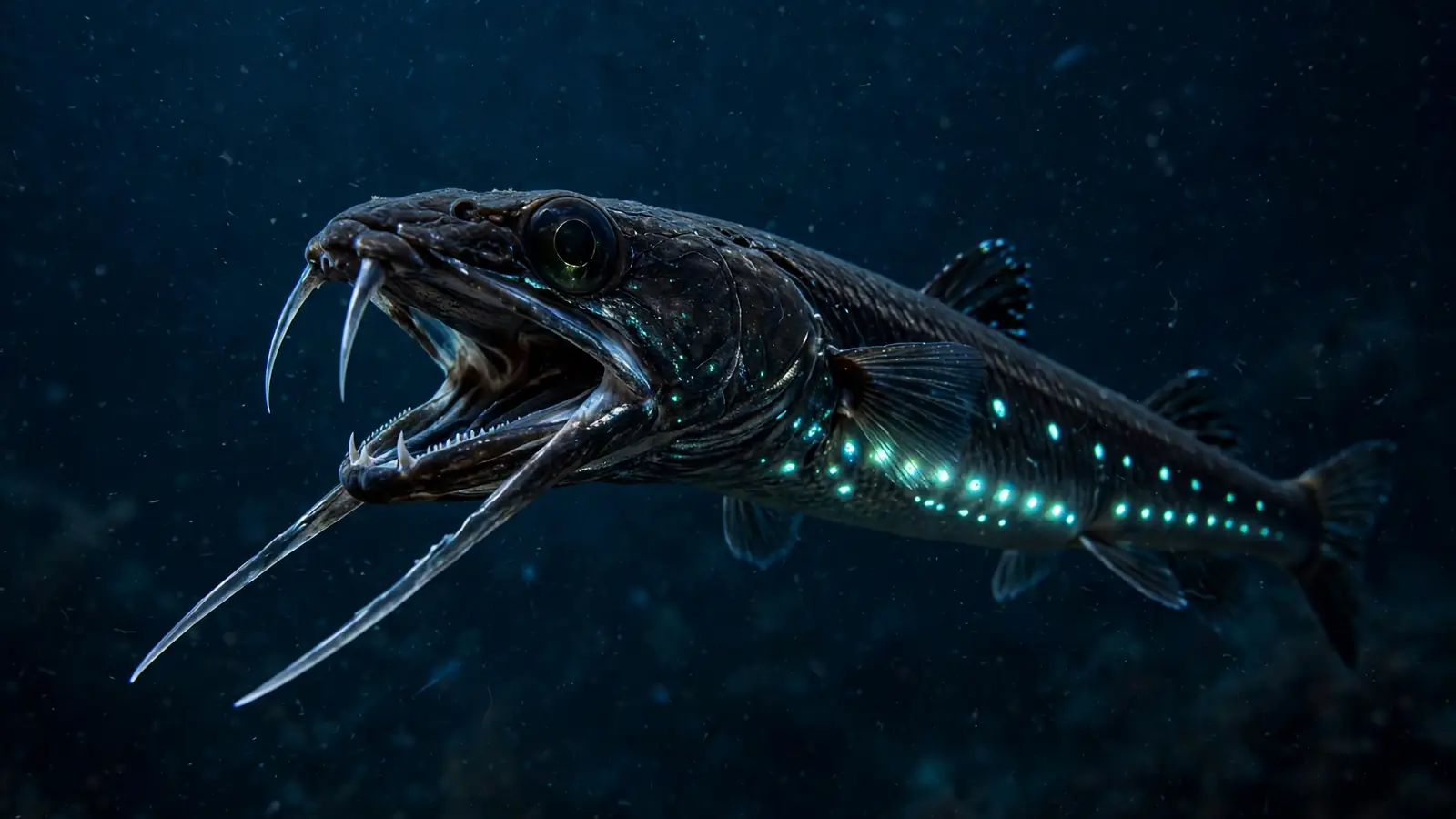
At a Glance
The viperfish is a deep-sea predator of the genus Chauliodus, nine species strong, centred on Sloane’s, Chauliodus sloani, the most widespread of them all. It lives in the twilight zone of the open ocean, the mesopelagic, hunting in the dark with a hinged jaw, a glowing lure and the largest teeth, relative to head size, of any fish alive.
Viperfish Teeth: Too Big for the Mouth
Its teeth are its claim to fame: long, needle-like fangs, curved and glass-clear, so large that they do not fit inside the mouth and stick out even when the jaws are closed. The record they hold is relative, not absolute — the largest teeth relative to head size of any fish, measured against the size of the head that carries them — and the honest way to state it is exactly that: biggest for its head, not biggest in the sea. Absolute lengths are disputed in the sources, with one giving about a centimetre and another claiming up to five, so this guide prints no hard fang length and lets the record speak for itself.

The teeth are made to hold, not to chew. It swallows its prey whole, and the fangs act like a cage, trapping the fish inside the mouth while the hinged jaw closes around it. The teeth are hinged themselves in some species, folding back to let prey slide in and snapping upright to stop it sliding out — a one-way door made of glass.
How Big Do They Get?
They are small fish with a big reputation: most are 20 to 30 centimetres long, about the length of a ruler, and the largest reach around 35 centimetres. They are slender, dark and almost weightless-looking, with a body built for the deep rather than for bulk. One beside a human hand looks like a toy — until it opens its mouth.
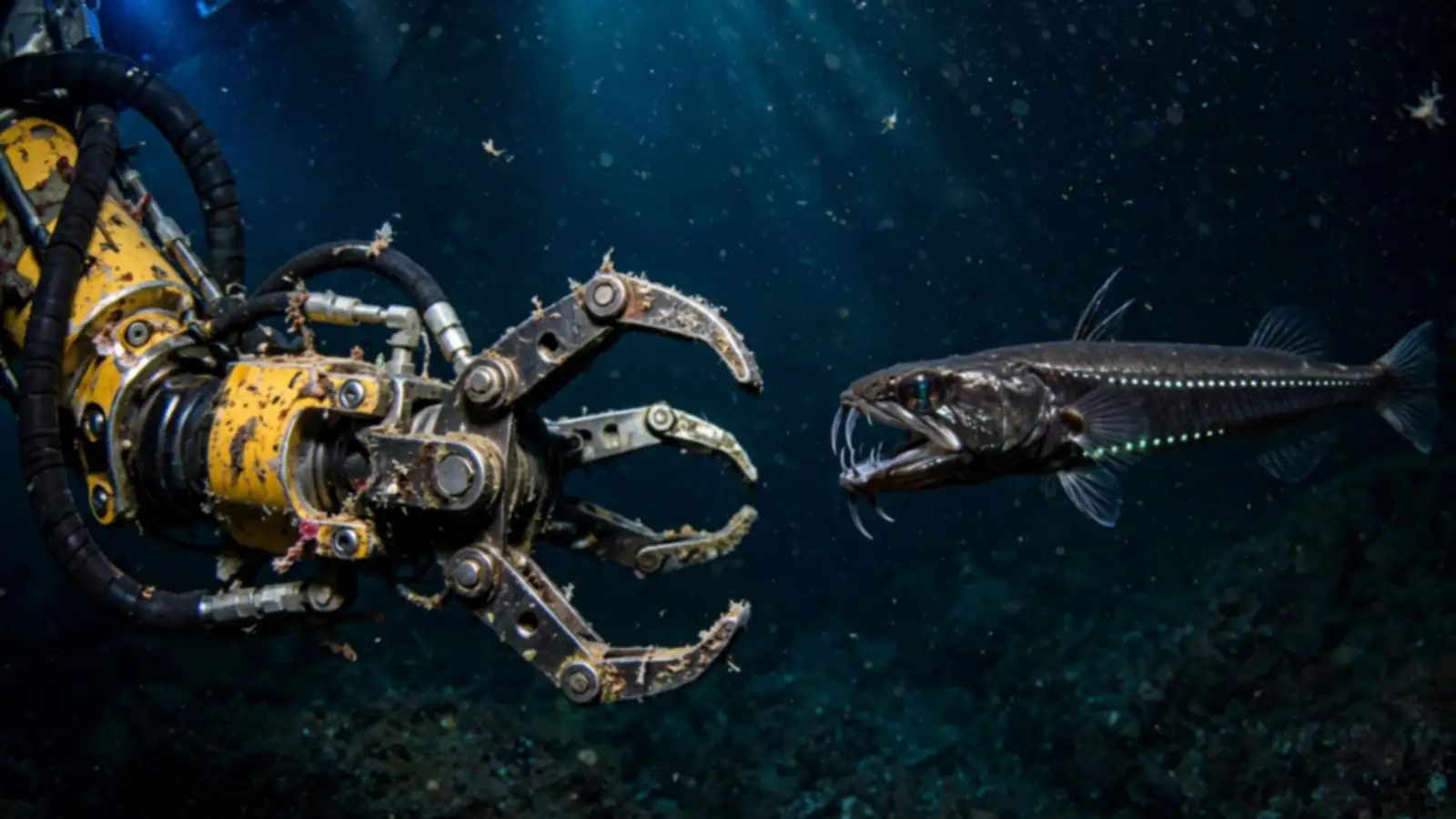
The nine species of the genus Chauliodus differ mostly in size and in the details of their lights and fins, and Sloane’s, the focus of this guide, is the most widespread and the best studied. The others — the Pacific, Dana’s and the rest — live in the same twilight zone in different oceans, and they all hunt the same way, with the same fangs and the same hinged jaw.
The Hinged Jaw
Its lower jaw hinges open to about 90 degrees, dropping down like a trapdoor and opening a mouth that can swallow prey up to 63% of the fish’s own body length. The jaw is the strike: the fish lunges, the jaw drops, and the prey is inside before it can turn. The fangs close the trap, and the stomach stretches to hold a meal that can be more than half the hunter’s size.

After the strike, the jaw does the slow work. Its stomach can expand to hold a huge meal, and the fish may not need to eat again for days or weeks. It is a feast-or-famine life in the deep, and the hinged jaw is what makes the feast possible — a mouth that opens wider than the fish looks able to open, and closes on prey that looks too big to eat.
Where They Live
They live in the mesopelagic twilight zone, the deep, dim layer of the open ocean between about 200 and 1,000 metres down by day, rising shallower at night to hunt. Specimens have been collected as deep as 2,800 metres, and some sources give a wider range of 200 to 5,000 metres — the honest statement is the day range with the collected depth, and the wider figure reported as a claim, not as a fact. They are found in tropical and temperate oceans worldwide, wherever the twilight zone is deep and dark.

By day they hold in the dark, saving energy; by night they rise with the lanternfish and the krill, hunting in the great nightly migration of the deep. It is a creature of the open ocean, not the seabed — it never touches the bottom, and it lives its whole life in the water column, drifting and hunting in the dark. The barreleye fish lives in the same dark water, a deep-sea fish that sees through its own transparent head.
Viperfish Photophores and Camouflage
It carries light organs, photophores, along its belly, and a lure on the first ray of its dorsal fin, and both are tools of the hunt. The belly lights glow downwards, matching the faint light from above and erasing the fish’s silhouette from predators looking up — the same counterillumination trick the lanternfish uses. The dorsal lure glows too, dangling in front of the mouth like a lantern, drawing curious prey within reach of the fangs.
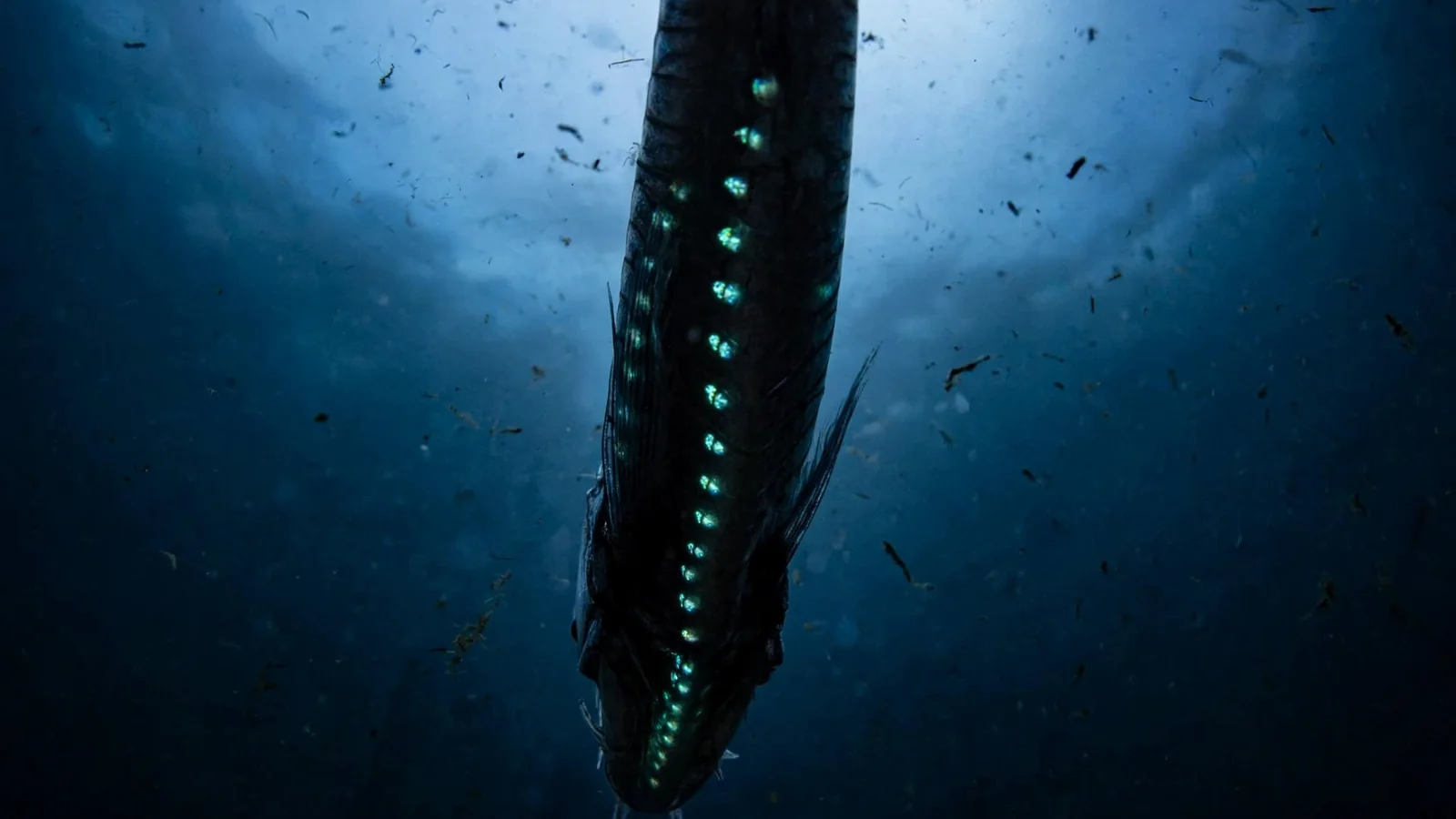
The camouflage is the darkness itself. It is dark brown or black, with a body that absorbs light rather than reflecting it, and in the twilight zone it is nearly invisible until its lights come on. The dragonfish, its close cousin in the same family, hunts the same way with a chin-barbel lure instead of a dorsal one, and the two are often confused — our dragonfish guide tells the cousin’s story, and the difference is the lure’s position and its hinged jaw.
What Do They Eat?
They eat lanternfish above all, plus small fish, shrimps and other crustaceans of the twilight zone. They hunt at night, rising with their prey, and they strike with the hinged jaw and the fangs, swallowing fish up to 63% of their own length. One that catches a lanternfish has caught a meal as big as its own head, and it eats it whole.

The diet is what ties it to the lanternfish’s nightly migration: where the lanternfish rise, they follow, and the two species’ lives are locked together in the dark. The Sloane’s account records the size, depth and jaw figures behind this guide, and the gulper eel, another deep-sea hunter of the same waters, is told in our gulper eel guide, where the mouth is even bigger and the teeth are smaller.
Fun Facts
- It holds the record for the biggest teeth relative to head size of any fish.
- Its lower jaw hinges open to about 90 degrees, letting it swallow prey up to 63% of its own body length.
- They live in the twilight zone, 200 to 1,000 metres down by day, rising shallower at night.
- Specimens have been collected as deep as 2,800 metres in the open ocean.
- Its belly photophores glow downwards to erase its silhouette — the same trick the lanternfish uses.
- Its teeth are hinged in some species, folding back to let prey in and snapping upright to keep it there.
Frequently Asked Questions
How Big Do Viperfish Get?
They are small fish: most are 20 to 30 centimetres long, about the length of a ruler, and the largest reach around 35 centimetres. They are slender and dark, built for the deep rather than for bulk, and the nine species of the genus Chauliodus differ mostly in size and in the details of their lights and fins.
Why Do Viperfish Have Such Big Teeth?
They have the biggest teeth relative to head size of any fish, and the teeth are made to hold, not to chew: long, needle-like fangs that trap prey inside the mouth while the hinged jaw closes around it. The teeth are hinged in some species, folding back to let prey slide in and snapping upright to stop it sliding out.
How Deep Do Viperfish Live?
They live in the mesopelagic twilight zone, 200 to 1,000 metres down by day, rising shallower at night to hunt. Specimens have been collected as deep as 2,800 metres, and some sources give a wider range of 200 to 5,000 metres — the wider figure is reported as a claim, not as a measured fact.
What Do Viperfish Eat?
They eat lanternfish above all, plus small fish, shrimps and other crustaceans of the twilight zone. They hunt at night, rising with their prey, and they swallow fish up to 63% of their own body length, whole, with the hinged jaw and the fangs.
Do Viperfish Glow?
Yes. They carry photophores, light organs, along their belly, and a glowing lure on the first ray of their dorsal fin. The belly lights glow downwards to erase the fish’s silhouette from predators below, and the lure draws curious prey within reach of the fangs.
Are Viperfish Dangerous to Humans?
No. They are small, deep-sea fish that never come near the surface in daylight and never meet people. Their fangs are for catching lanternfish, not for biting humans, and one brought to the surface would die long before it could bite anyone.
How Many Viperfish Species Are There?
There are nine recognised species in the genus Chauliodus, centred on Sloane’s, Chauliodus sloani, the most widespread and best studied. The others live in the same twilight zone in different oceans, and they all hunt the same way, with the same fangs and the same hinged jaw.
Similar Species Worth Exploring
Keep Exploring
Keep exploring the deep sea through the dragonfish, the close cousin with the chin-barbel lure, the gulper eel, whose mouth is even bigger, and the wider world of the types of deep-sea fish. Fangs too big for its mouth, a jaw like a trapdoor, and a lure in the dark: no fish in the twilight zone hunts harder than the viperfish.