Thresher Shark
Thresher Shark: the shark that hunts with its tail
The thresher shark is the only shark that hunts with its tail, a scythe of fin as long as the rest of its body that it whips through schools of fish like a cracking lash. Three species share the design: the big-eyed common thresher, the slender pelagic thresher and the deep-water bigeye. Here is how the tail works, how the three species differ, and why every one of them is now under threat.
By Emily Carter · Reviewed by our vet team · Updated 10 November 2026 · 9 min read
Tail as long as its bodyStuns fish with tail slapsThree species worldwide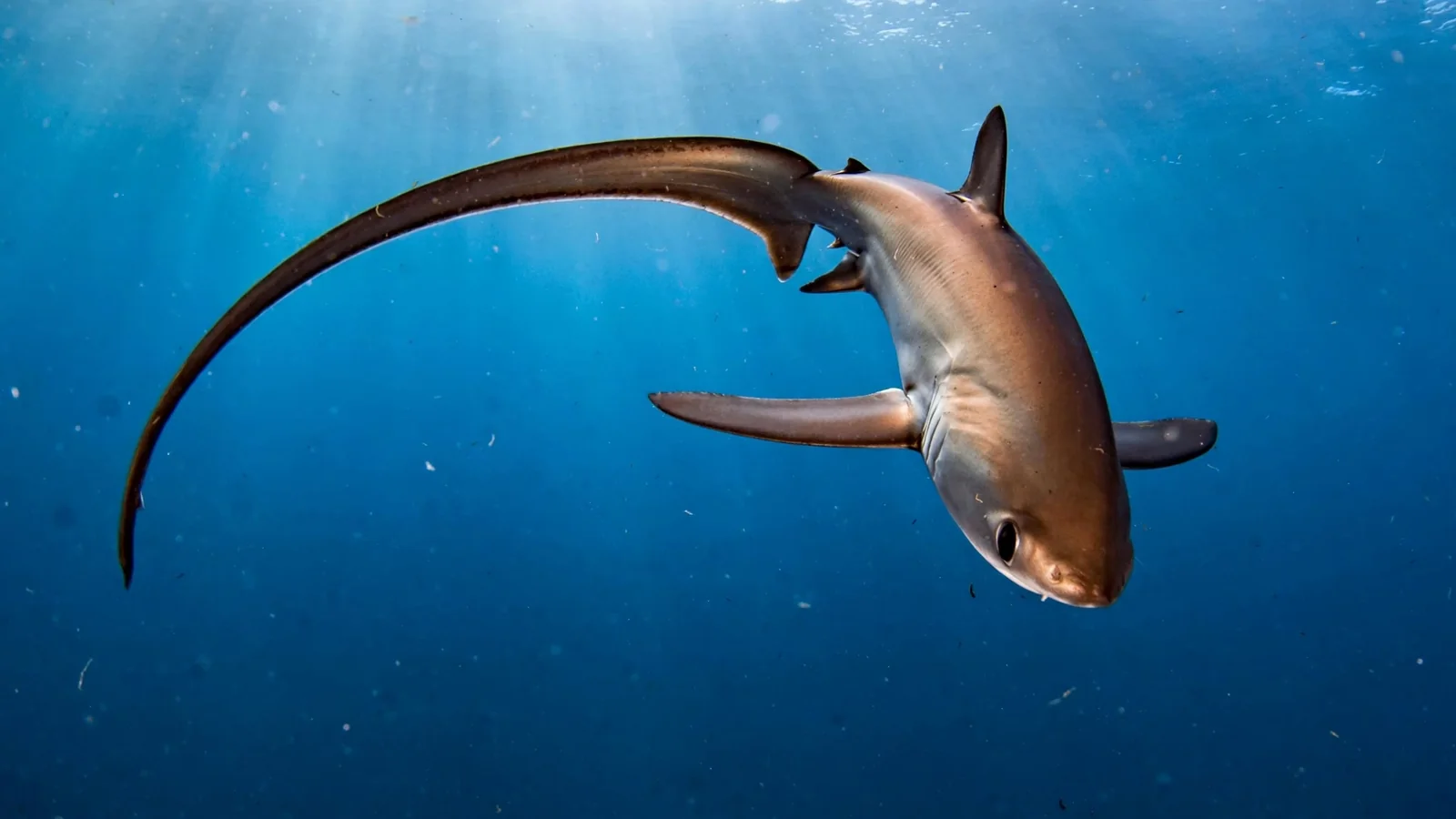
At a Glance
A thresher shark is two animals in one: a sleek, big-eyed hunting shark in front, and a long, curved blade behind. That tail is not decoration or a rudder — it is a weapon, measured to the tip in every serious study of the species, and filmed cracking through bait balls with enough speed to stun several fish at once. This guide covers all three thresher species, with the common thresher in the lead role.
Thresher Shark Size and Weight
Half of a thresher shark is tail, and every measurement has to say so. The common thresher, the largest of the three species, reaches a total length of about 5.7 to 6 metres (19 to 20 feet), but its actual body is only around 3 metres of that; the rest is the sweeping upper lobe of the tail fin. The biggest individuals weigh up to about 500 kilograms (1,100 pounds).
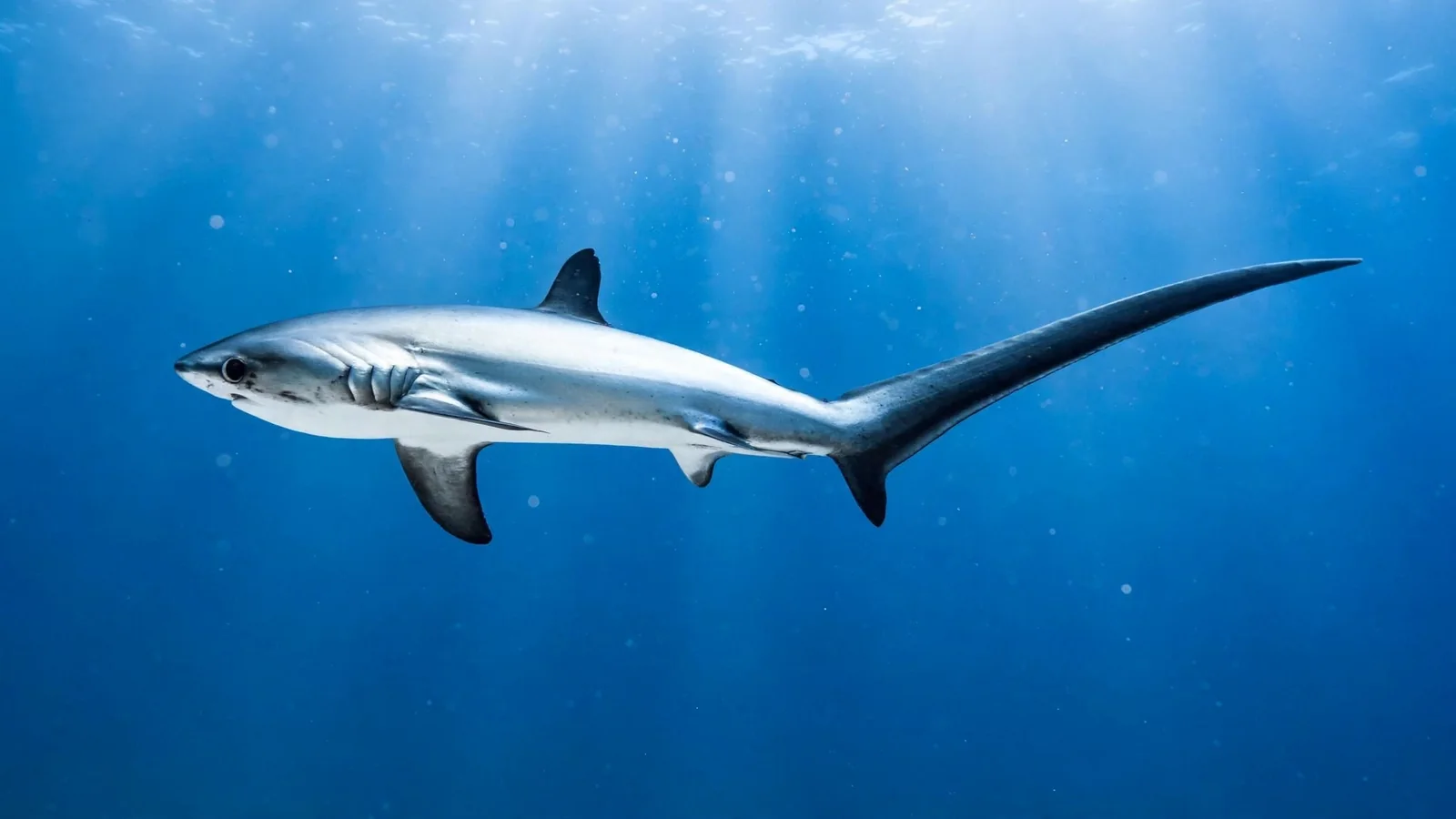
You can browse the full species record for the common thresher, Alopias vulpinus, for its measured growth data. The pelagic thresher shark is the smallest of the family at about 3.65 metres (12 feet) at most, and the bigeye sits between them at roughly 4.8 metres. All three share the same unmistakable proportions, the same large eyes, and a compact, torpedo-shaped body built for speed in open water.
Growth is slow and maturity late, as with so many sharks. Females carry just two to four large pups at a time after a pregnancy of about nine months, and the embryos practise a shark speciality called oophagy: they eat unfertilised eggs inside the mother until they are born, already a metre long and ready to hunt.
The Tail Slap: Hunting With a Scythe
For a century, fishermen swore that threshers lashed fish with their tails, and scientists politely doubted them. Then the cameras arrived. In 2010 researchers filmed common threshers striking with their tails, and in 2013 a famous study off Pescador Island in the Philippines recorded pelagic threshers doing the same: the shark charges a school of sardines, brakes hard, and throws its whole body into an overhead whip that sends the tail tip cracking through the water faster than the school can scatter.

The physics is brutal. The tail tip accelerates so violently that it can stun or kill several fish in a single pass, and the strike is sometimes followed by a shock of tiny cavitation bubbles as the water itself is torn by the speed. The shark then circles back at leisure and picks up the floating casualties one by one — a hunting method with almost no wasted energy.
The tail does quieter work too. Thresher sharks herd prey before they strike, using the long fin to corral sardines and anchovies into a tighter ball, and observers have watched them slap the surface near seabirds or use the tail to flick individual fish backwards over their heads. It is a tool, a weapon and a herding dog in one long fin.
Three Types of Thresher Sharks
Types of thresher sharks divide neatly into three. The common thresher shark is the coastal heavyweight, found in temperate seas worldwide, bronze-brown above and white below, with white that climbs visibly above the pectoral fins. It is also the athlete of the family: it keeps its swimming muscles warm with a counter-current heat exchanger, a trick it shares with the fastest sharks and tunas, and it can leap clear of the water.
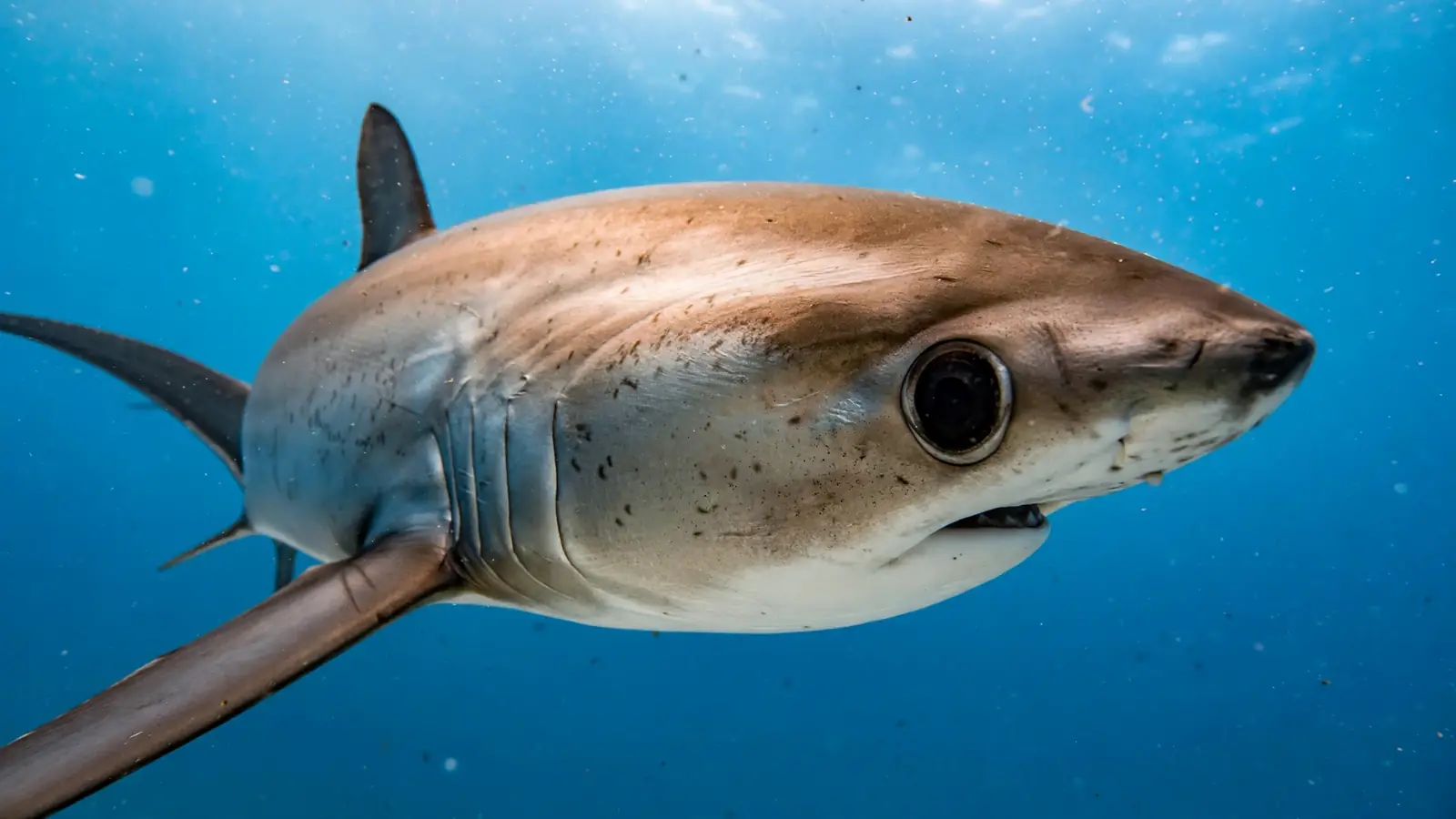
The pelagic thresher is the open-ocean specialist of the Indo-Pacific, darker blue-grey, slimmer, and grooved along the head. The bigeye thresher is the deep diver, built around a pair of enormous eyes that reach up onto the top of its head, the better to hunt squid and fish in near darkness hundreds of metres down; it rises towards the surface at night and sinks away again at dawn.
All three are in trouble. The common and bigeye threshers are listed as Vulnerable and the pelagic thresher as Endangered, their meat, fins and sport value all counting against them, and their two-to-four-pup litters giving them no way to replace losses quickly. The rest of this guide follows the common thresher as the lead species, with its smallest cousin given a section of its own below.
The Pelagic Thresher: Smallest of the Three
The pelagic thresher is the thresher most divers will ever meet, because it does something the others rarely do: it visits. At Monad Shoal off Malapascua in the Philippines, pelagic threshers rise from deep water at dawn to be cleaned by reef fish, circling slowly over the plateau while divers watch from the sand below — one of the most reliable big-shark encounters anywhere on Earth.

It is a genuinely smaller animal, usually under 3 metres and never much beyond 3.65 metres (12 feet), with a narrower head, straighter pectoral fins and deep grooves running back from its eyes. Its hunting was the performance filmed in 2013: overhead tail slaps through sardine schools above the drop-offs of Pescador Island, each strike timed and aimed rather than random.
That small size has not protected it. The pelagic thresher is the most threatened of the three, listed as Endangered, taken in tuna and swordfish fisheries across the Indo-Pacific and targeted for its fins. The Malapascua sharks are guarded by their fame; the rest of the population swims unprotected in the same seas.
Where Thresher Sharks Live: Habitat and Range
Thresher sharks live in temperate and tropical oceans all over the world, in two different kinds of water at once. They are open-ocean sharks that cross deep basins far from land, and they are also coastal sharks that patrol kelp forests, drop-offs and continental shelves, sometimes wandering into shallow bays. The common thresher favours cooler temperate water; the pelagic and bigeye lean warmer and deeper.

Depth depends on the species and the hour. Common threshers spend most of their time in the top 200 metres, while bigeyes run a daily commute between roughly 500 metres by day and the surface layers at night, following the squid and lanternfish they hunt. Young common threshers stick close to shore in nursery areas along the coast, where the water is warm, food is dense and big predators are few.
It is a range with no refuge in it. A shark that swims everywhere meets every fishery somewhere, and the thresher’s slow breeding makes each meeting expensive. The same ocean-wide map that makes the genus a success story makes it a conservation headache.
Diet and Feeding
Schooling fish are the whole menu’s centre. Sardines, anchovies, herring, mackerel and lanternfish make up most of the diet, with squid a close second and crabs, shrimp and the odd seabird as garnish. Almost everything a thresher eats travels in crowds, because the entire design of the animal — the herding, the stunning tail, the patient pickup afterwards — is a machine for harvesting schools.
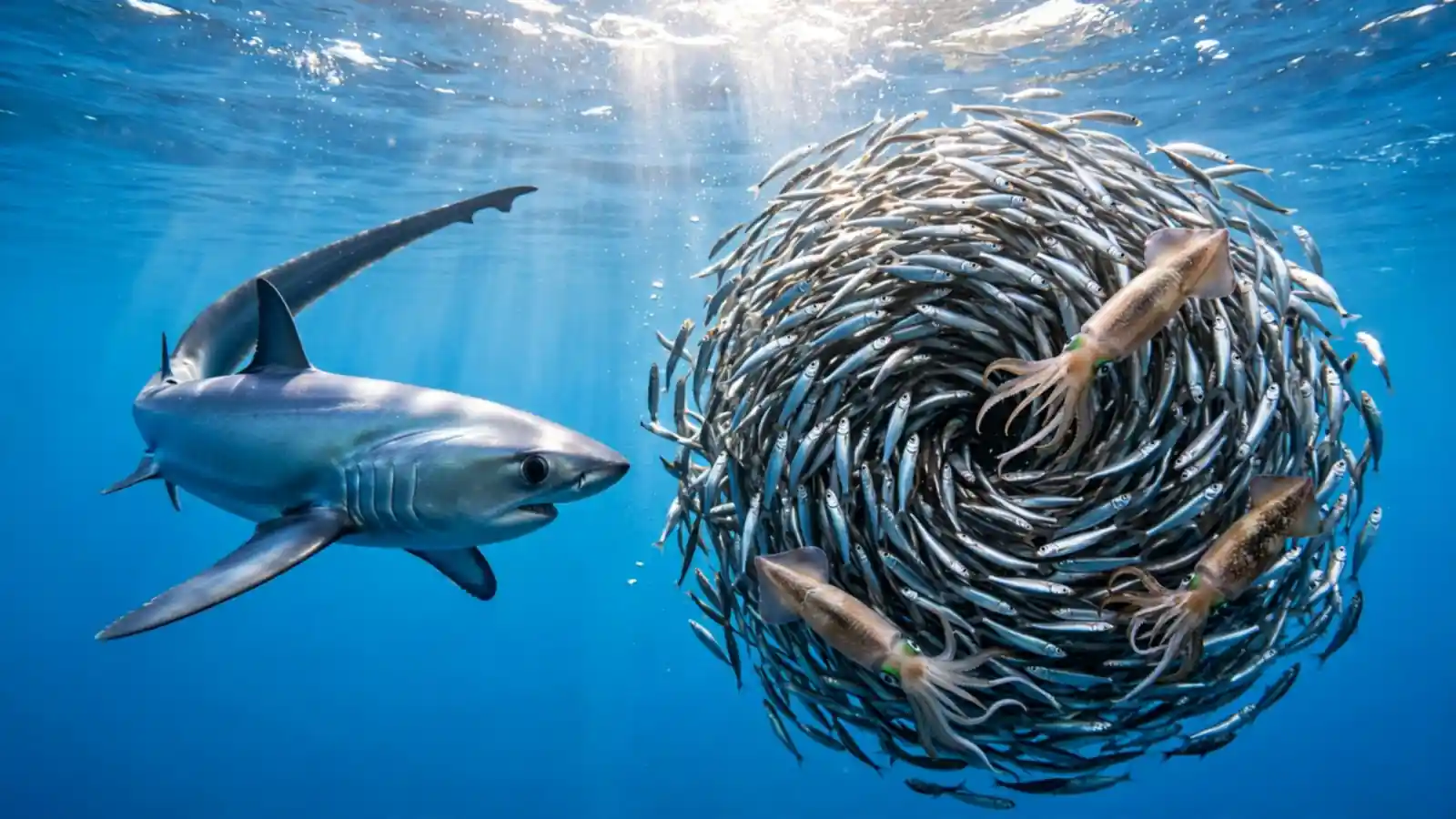
The common thresher adds one more trick: warmth. Its red swimming muscles are plumbed with heat-exchanging blood vessels that hold the body several degrees above the surrounding water, powering faster reactions, better eyesight in cold water and hunting trips into chillier, richer seas than its cousins can work. Among sharks, only the fastest families share the design.
Feeding peaks where the schools are thickest, at upwellings, seamounts and shelf edges, which is exactly where the world’s longline and net fleets also gather. The open-ocean partner in this guide, the blue shark, works the same crowded water and pays the same price for it — a reminder that the richest hunting grounds are also the most dangerous places in the sea.
Fun Facts
- The upper lobe of the tail is about as long as the rest of the body — no other shark carries proportions like it.
- A tail slap can stun several fish at once, and the tip moves so fast it can tear tiny cavitation bubbles in the water.
- Thresher shark embryos eat unfertilised eggs inside their mother, a strategy called oophagy, and are born about a metre long.
- The bigeye thresher’s eyes are so large they extend onto the top of its head, pointing up into the dark above it.
- Pelagic threshers queue at dawn cleaning stations off Malapascua in the Philippines to have parasites picked off by reef fish.
- The common thresher keeps its swimming muscles warm like a tuna, several degrees above the temperature of the sea around it.
Frequently Asked Questions
Why Do Thresher Sharks Have Such Long Tails?
The long tail is a hunting weapon. A thresher shark herds schooling fish together, then whips its tail overhead through the school at extreme speed, stunning or killing several fish with one strike. The tail’s upper lobe is about as long as the rest of the body.
Do Thresher Sharks Use Their Tails to Hunt?
Yes. Tail-slap hunting was filmed in common threshers in 2010 and in pelagic threshers off Pescador Island in the Philippines in 2013. The shark charges the school, brakes, and cracks its tail through the water like a whip, then circles back to eat the stunned fish.
How Big Do Thresher Sharks Get?
The common thresher is the largest, reaching about 5.7 to 6 metres (19 to 20 feet) in total length — though half of that is tail — and up to about 500 kilograms. The bigeye reaches roughly 4.8 metres and the pelagic thresher about 3.65 metres.
How Big Does a Pelagic Thresher Get?
The pelagic thresher is the smallest of the three species. Most adults are under 3 metres long, and the maximum is about 3.65 metres (12 feet), including its long tail. It is listed as Endangered.
How Many Types of Thresher Shark Are There?
There are three species: the common thresher of temperate coasts, the pelagic thresher of the Indo-Pacific open ocean, and the bigeye thresher, a deep-water species with enormous upward-pointing eyes. All three are threatened.
What Do Thresher Sharks Eat?
Thresher sharks eat schooling fish above all — sardines, anchovies, herring and mackerel — plus squid, crabs and shrimp. Their long tails are built to hunt these schools, stunning several fish with a single slap.
Are Thresher Sharks Dangerous to Humans?
Thresher sharks are shy, open-water animals and are not considered dangerous. There is no record of a fatal attack, and incidents are vanishingly rare and provoked. Pelagic threshers at Malapascua in the Philippines tolerate divers calmly at cleaning stations every day.
Similar Species Worth Exploring
Keep Exploring
Still curious about sharks? Meet the blue shark, the thresher’s fellow traveller of the open ocean, or browse every species in our guide to the types of sharks. None of them hunts quite like the thresher shark.