Sea Anemone
Sea anemone: the flower that hunts
A sea anemone looks like a flower and behaves like a trap: a brainless predator armed with microscopic harpoons, host to the most famous partnership in the sea. More than a thousand species of them bloom on every coast — from the crimson beadlet on a holiday rockpool to carpets a metre wide sheltering whole clownfish families. This is how an animal with no brain runs one of the reef’s smartest setups.
By Emily Carter · Reviewed by our vet team · Updated 10 November 2026 · 9 min read
An animal, not a plantHarpoons fire in under a millisecondClownfish live inside the sting
At a Glance
A sea anemone is the ocean’s reminder that looks deceive: no brain, no heart, no skeleton — and a fully working ambush predator that has held its ground on Earth’s shores for hundreds of millions of years. It sits, blooms, stings and eats, and in the tropics it rents out its weaponry to the bravest little fish in the sea. Begin with the family album.
Types of Sea Anemones: From Beadlets to Giants
More than 1,000 species of sea anemone fill the order Actiniaria, and the range is absurd: the beadlet anemone of Atlantic rockpools is a crimson blob the size of a plum, recognisable by the ring of blue spots at its base, tough enough to survive hours of low tide shrivelled like a jelly sweet. At the other extreme, giant carpet anemones spread a metre or more across tropical sand.

Cold shores have their own stars. The giant green anemone of the North Pacific — like the beauty in this guide’s hero photograph — colours its tissues with algae and pigments until it glows emerald in the tidepool, and can span 25 centimetres of pure patience. Plumose anemones stand like white and orange cauliflowers on pier legs and wreckage.
Every species is the same basic machine — a muscular column, a flat disc, a mouth ringed with stinging tentacles, and a stomach below — tuned to a different shore, depth and menu. Browse the diversity overview of the order Actiniaria to see just how many variations that one body plan supports.
The Clownfish Partnership: Life Inside the Sting
It is the most famous address in the sea. A clownfish spends its life inside a host anemone’s tentacles — sleeping, feeding, courting and laying its eggs at the base — protected by a fortress that paralyses everything else. Only about ten anemone species host fish, and the clownfish that use them are utterly dependent: remove the anemone and the fish are eaten within hours.

The passkey is chemistry. The clownfish’s mucus coat carries a signature the anemone’s stinging cells fail to recognise as prey — so the harpoons simply never fire. A new fish acclimates carefully, touching the tentacles in longer and longer brushes, and may pick up some of the host’s own surface compounds into its coat along the way.
Rent flows both directions. The anemone gets a territorial guard who chases off polyp-nipping butterflyfish, a cleaner who removes debris, nutrients from the fish’s waste, and water movement from its constant fidgeting. Few deals in nature are this balanced — which is why the partnership has lasted, in fossil terms, for a very long time.
Do Sea Anemones Sting? The Harpoon Cells
Yes — with the fastest weapon in the animal kingdom. The tentacles are studded with cells called nematocysts, each a pressurised capsule holding a coiled, barbed thread soaked in venom. Triggered by touch and the chemistry of prey, a capsule fires its harpoon in under a millisecond, piercing the victim’s skin and injecting the venom. No muscle on Earth moves that fast; the capsule simply explodes in a controlled direction.

For fish and shrimp, the result is paralysis within seconds, and the tentacles fold the catch toward the mouth. For humans, most anemones rate between a sticky touch and a nettle-like rash — though the fire anemones and big tropical carpets can deliver a genuinely painful, blistering sting. Treat them like bees: admire, photograph, never grab.
The system has one famous blind spot, covered in the section above: it fires on chemistry, not sight, which is exactly the loophole the clownfish’s mucus exploits. The anemone is not being merciful. It simply cannot detect its lodger as food.
Tube Anemones and Colonial Anemones: The Odd Relatives
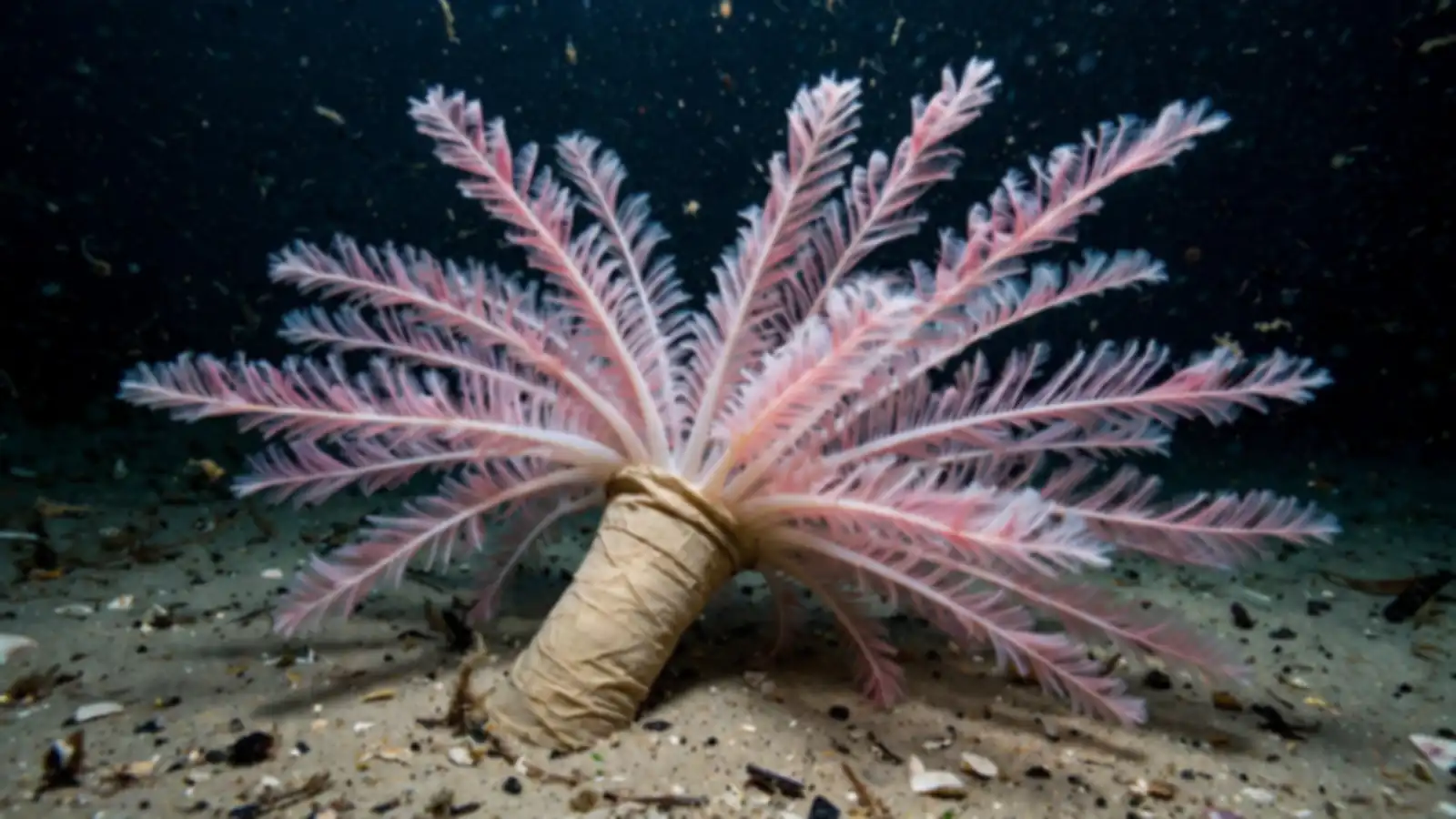
Not every member of the family lives glued to a rock. The tube anemone builds its own house: a smooth, parchment-like tube buried in sand or mud, from which it spreads a crown of long, feathery tentacles at night to snare plankton. Disturbed, the whole animal vanishes down the tube in a blink — a burglar alarm and a body that fits through its own front door.
Colonial anemones take togetherness further. Species such as the aggregating anemone spread by splitting into clones, forming mats of hundreds of identical individuals carpeting whole boulders — a single genetic animal wearing hundreds of bodies. Neighbouring clone colonies even wage slow border wars with specialised fighting tentacles.
Burrowing anemones plough through sand, jewel anemones stud cave walls like gemstones, and deep-sea species ride on hermit crab shells in exchange for guarding the crab. The family that began as a simple polyp has colonised nearly every arrangement the seabed offers.
What Sea Anemones Eat: Hunting Without a Brain
A sea anemone eats whatever its tentacles can hold, and the menu is wider than the flower suggests: small fish, shrimp, crabs, mussels torn from their moorings, drifting plankton and general marine snowfall. Prey is harpooned, folded to the mouth at the disc’s centre, and swallowed into a sac stomach where enzymes do the rest; the husks and shells are later spat back out of the same opening.

Coordination without a brain runs on a nerve net — a loose web of neurons that spreads signals around the body. One tentacle’s catch becomes a whole-disc response: neighbours bend in to help, the mouth gapes, the column leans. It is intelligence at its most distributed, and it has worked since before fish existed.
Many shallow-water species hedge their diet with farming. Symbiotic algae live inside their tissues, photosynthesise in the sunlit shallows, and leak sugars to their host — the reason so many anemones glow green or gold, and the reason they bloom wide on sunny days like the flowers they pretend to be.
How Long Do Sea Anemones Live? The Slow Lane
A long time — though exactly how long is a genuine scientific argument. Anemones show few signs of ageing: they keep growing, keep breeding, and can regenerate lost parts, and many familiar species are confidently measured in decades. Aquarium individuals have lived 60 to 80 years and beyond, and some researchers argue that, barring accident and predators, certain anemones may be effectively ageless. Claims of a single universal lifespan should be treated as the one thing anemones avoid: simple.

Reproduction hedges every bet. A spring tide may see adults broadcast eggs and sperm into the current, their larvae drifting to new shores; the same animal can also split in two, bud off a fragment of its base, and rebuild a whole anemone from a scrap of tissue. A tidepool’s ten identical anemones are often one individual ten times over.
Predators are few — nudibranchs that steal their stinging cells for their own defence, some sea stars, turtles and the odd fish — and the greater threats are storms, heatwaves and collectors. Give one a quiet rock and it may still be there, blooming at the same address, when the clownfish’s great-grandchildren come looking for the sea anemone.
Fun Facts
- A sea anemone’s stinging harpoon fires in under a millisecond — among the fastest movements in all of biology.
- Anemones have no brain, heart or blood; a loose nerve net coordinates the whole hunt.
- A clownfish’s mucus coat stops the anemone’s stinging cells from firing at all — the fish is chemically invisible as food.
- Many anemones clone themselves by splitting in half; a carpet of identical anemones is usually one genetic individual.
- Some anemones have lived 60 to 80 years or more in aquariums, and researchers debate whether some species age at all.
- The giant green anemone gets its emerald colour partly from algae living inside its own tissues.
Frequently Asked Questions
Is a Sea Anemone an Animal or a Plant?
An animal — and a predator. A sea anemone is a cnidarian, a relative of jellyfish and corals, with a mouth, a stomach, muscles and a nerve net. It has no brain, no heart and no bones, but it hunts: its tentacles carry stinging harpoons that paralyse fish and shrimp, which are then drawn into the mouth at the centre of the disc. The flower-like look is camouflage for an ambush.
Do Sea Anemones Sting Humans?
Most feel like a mild nettle rash or a sticky touch; a few species give a genuinely painful sting, and the great carpet anemones can grip hard enough to be memorable. Fire anemones and certain tropical species deserve real respect. The rule is the same as on shore: look, photograph, and do not handle — for your skin’s sake and the anemone’s, since oils and pressure damage its delicate tissues.
Why Don’t Clownfish Get Stung?
A clownfish wears a coat of mucus that the anemone’s stinging cells do not recognise as prey, so the harpoons never fire. The fish builds and maintains that protection by carefully acclimating to its host, brushing the tentacles in short touches. Some of the anemone’s own surface chemistry ends up in the coating. The result is total access: the clownfish lives inside a weapon nothing else dares approach.
How Many Types of Sea Anemones Are There?
More than 1,000 described species in the order Actiniaria, in every ocean from rockpools to the deep sea. They span the marble-sized beadlet anemone of Atlantic shores, the giant green anemone of Pacific tidepools, metre-wide tropical carpets and host anemones, tube anemones on sandy plains, and colonial anemones that spread as connected mats. New species are still being described.
What Do Sea Anemones Eat?
Whatever the tentacles can hold: small fish, shrimp, crabs, plankton and drifting scraps, paralysed by stinging cells and passed to the mouth. Anything indigestible is later expelled back through the same mouth — anemones have one opening doing both jobs. Many tropical species also farm sunlight through symbiotic algae in their tissues, which adds a steady second income of sugars.
How Do Sea Anemones Reproduce?
Several ways at once. Sexually, adults release eggs and sperm into the water, producing free-swimming larvae that settle and grow into new anemones. Asexually, many species clone themselves — splitting down the middle, budding off pieces, or leaving fragments of the base behind as the animal creeps along, each fragment becoming a new anemone. A patch of identical anemones is usually one animal, many times.
Similar Species Worth Exploring
Keep Exploring
Meet the tenant in our clownfish guide, or compare the drifting side of the family in our guide to the types of jellyfish. It never swims, never chases, never even thinks — yet it has outlasted dinosaurs on the same few rocks: the sea anemone.