Bigeye Thresher Shark Facts: Eyes, Tail and Diving
Bigeye Thresher: Giant Eyes and a Whip for a Tail
The bigeye thresher is the deep-diving shark with eyes the size of grapefruits and a tail half its body long — a twilight-zone hunter that stuns its prey with a whip-crack of its tail.
By Emily Carter · Reviewed by our vet team · Updated 10 November 2026 · 7 min read
Grapefruit-sized eyesTail half its bodyVulnerable (2018)
At a Glance
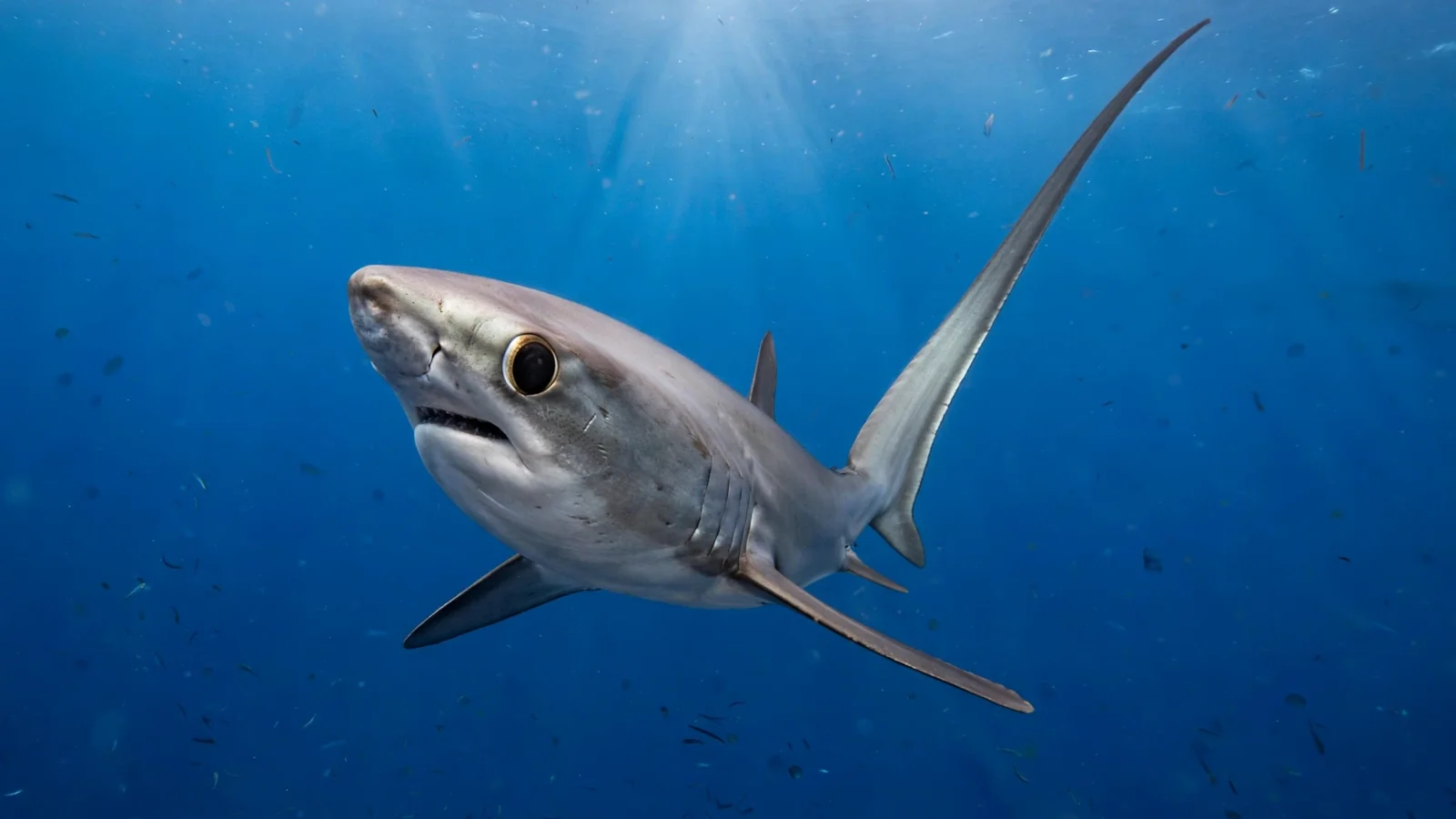
The bigeye thresher is the thresher built for the dark. Its eyes are up to 10 cm across — the largest, relative to body size, of any shark — and they point upward, watching for the silhouettes of prey against the faint light from above. By day it hunts at 300 to 500 metres down; by night it rises to the surface to feed. This guide covers the eyes, the tail whip, the deep-diving life, and why a shark that lives so far from shore is still listed as Vulnerable.
Bigeye Thresher Size: A 4.9-Metre Tail-Whipper
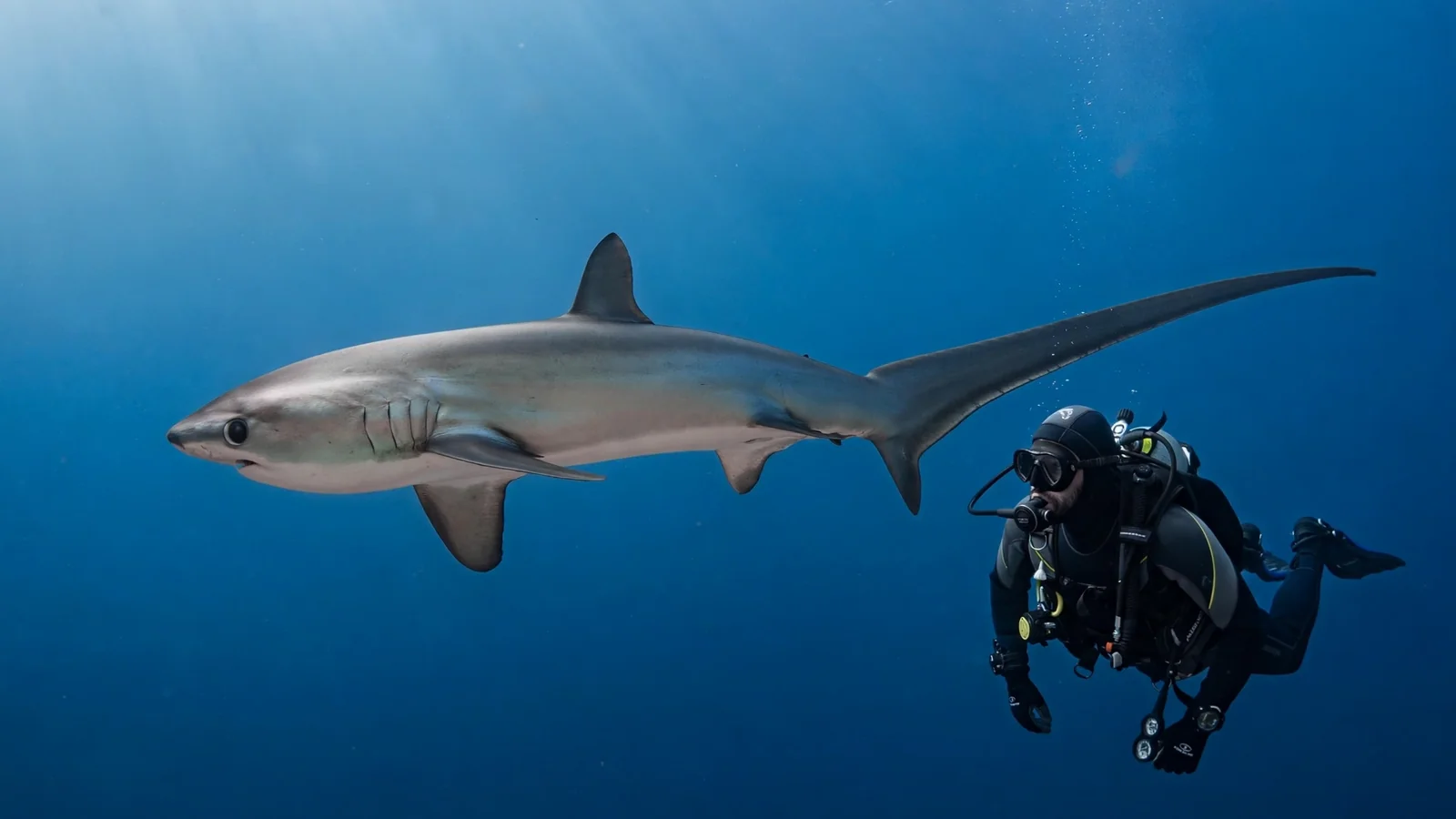
It grows to 4.9 metres long and 364 kg, though most adults measure 3.3 to 4 metres. Nearly half of that length is tail: the upper lobe of the tail fin is almost as long as the rest of the body, a proportion no other shark matches. The body itself is a typical thresher shape — streamlined, grey-brown above and white below — but the tail and the eyes are what mark the species. For the full species record, see the full species profile.
Half fish, half whip is not a figure of speech. The tail is not a decoration on the design — it is the design, a hunting weapon as long as the body that carries it, and the eyes are the targeting system. Everything else about the animal is ordinary thresher; those two features are the species.
Size is a slow business for this shark. It grows slowly, matures late and produces only two pups at a time — usually two, occasionally up to four — which means every adult matters to the population. A shark that takes years to replace itself cannot afford to be caught in large numbers.
The Giant Eyes: Built for the Twilight Zone
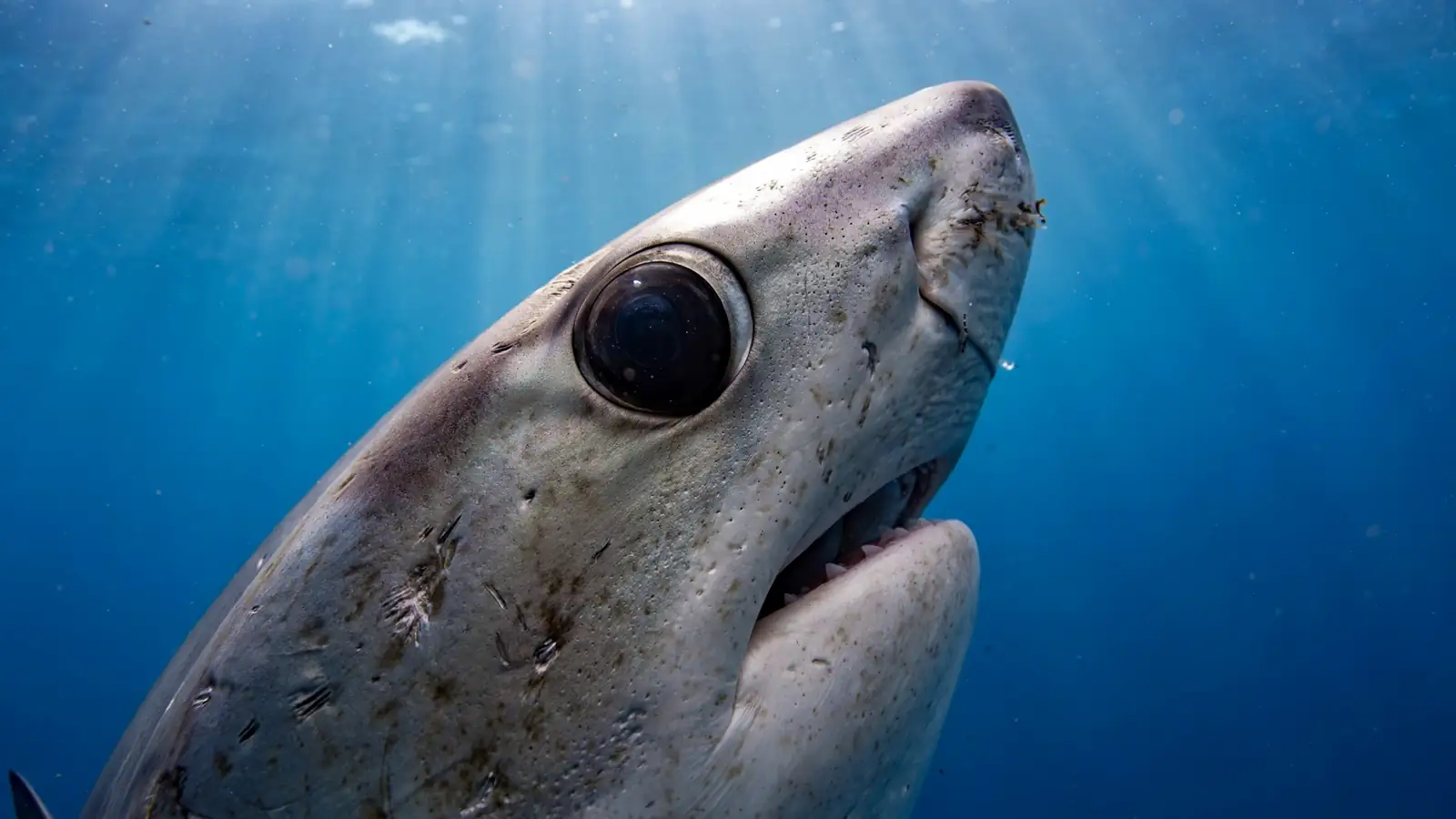
Its eyes are up to 10 cm across — about the size of a grapefruit — and they are the largest eyes, relative to body size, of any shark. They sit high on the head and point upward, gathering the faint light that filters down from the surface and watching for the dark shapes of prey swimming above.
Upward eyes are a deep hunter’s logic. Light falls from above even at 400 metres, so prey shows as a silhouette against the bright ceiling — and an eye built like a grapefruit, aimed permanently up, never misses it. The shark hunts from below in near-darkness, reading the surface the way we read a lit window.
The eyes are the key to the bigeye’s whole way of life. In the twilight zone, 300 to 500 metres down, there is not enough light to hunt by shape and colour — only by silhouette. The bigeye’s huge, upward-looking eyes are built to spot those silhouettes, and the shark’s pale belly hides its own silhouette from the prey below.
The Tail: Half the Body, Used Like a Whip
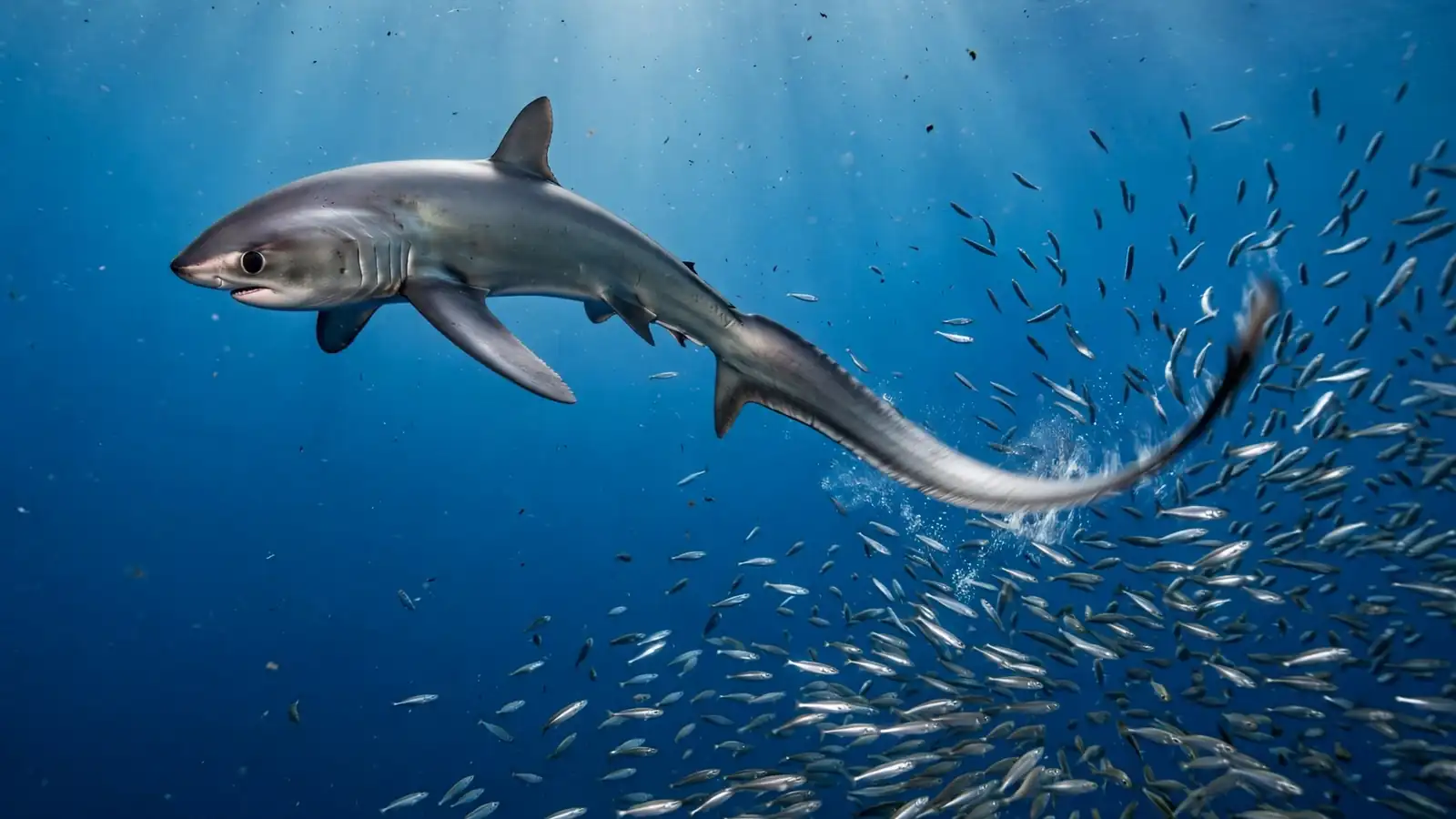
Its tail is a weapon. The upper lobe is nearly as long as the rest of the body, and the shark uses it like a whip: it swims into a school of fish, stops suddenly, and cracks the tail forward over its head, stunning and injuring fish with the blow. The stunned fish are then picked up one by one.
The whip-crack is physics, not flailing. A sudden stop throws the long upper lobe forward over the head, and the tip moves faster than the shark ever swims — fast enough to stun fish it never touches. One crack can cripple several fish at once, and the hunter then circles back through its own handiwork at leisure.
The tail whip is one of the most spectacular hunting moves in the sea, and it is the reason for the thresher’s whole shape. The long tail is a lever, and the shark’s powerful body is the engine that drives it. No other shark hunts this way, and the bigeye — with the longest tail of the three thresher species — is the most committed tail-whipper of all.
Where Bigeye Threshers Live: Open Ocean Worldwide
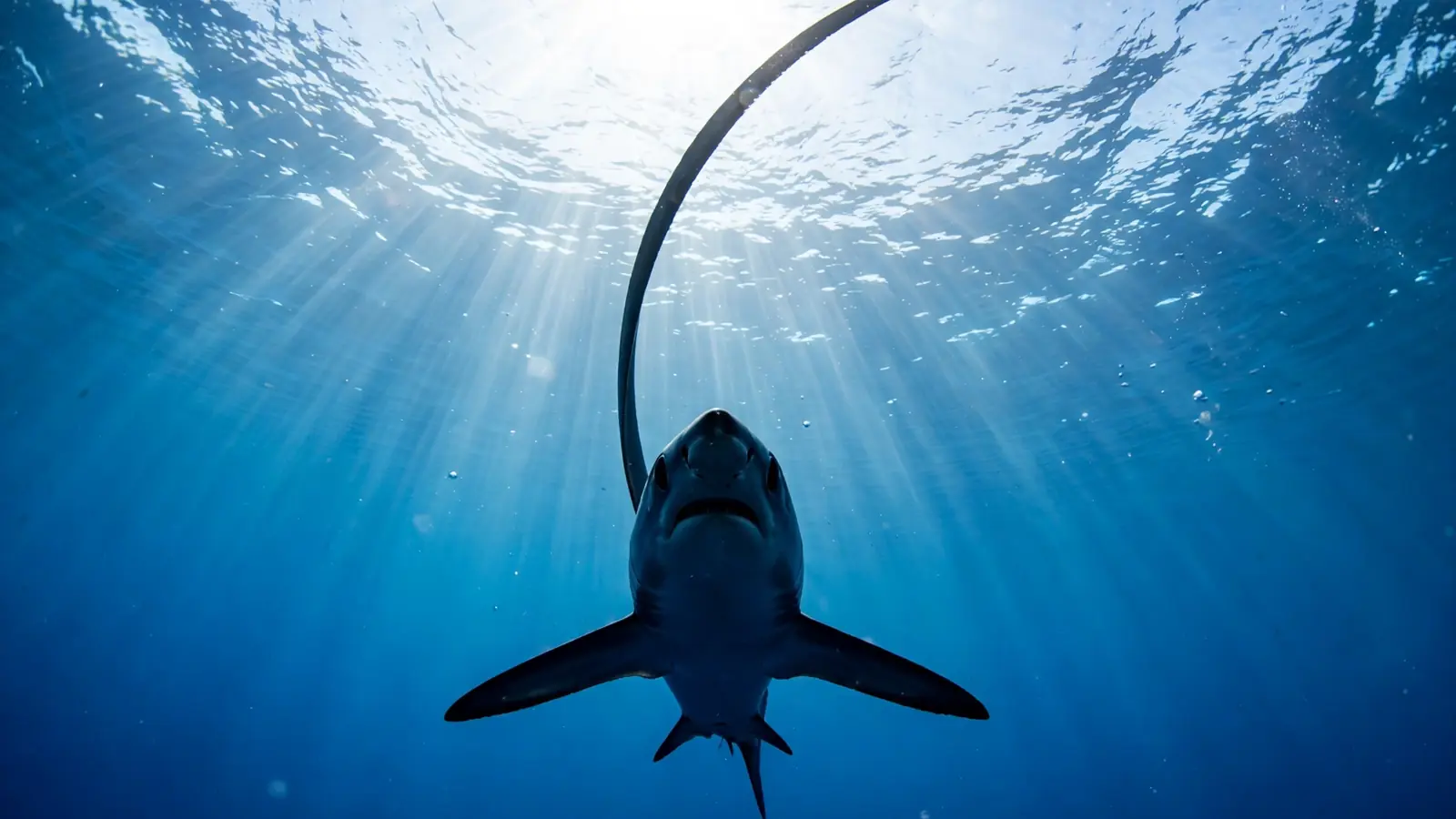
Bigeye threshers live in the open ocean of tropical and temperate seas around the world. They are pelagic sharks, at home in deep blue water far from land, and they follow the movements of the schooling fish they hunt — the lanternfish, lancetfish, small tunas and squid of the open sea.
They are the deepest-diving of the three thresher species. Where the common thresher hunts in shallow coastal water and the pelagic thresher stays near the surface, the bigeye goes deep — and that depth is what its eyes and its slow, energy-saving swimming style are built for.
Bigeye Thresher Depth: Deep by Day, Shallow by Night
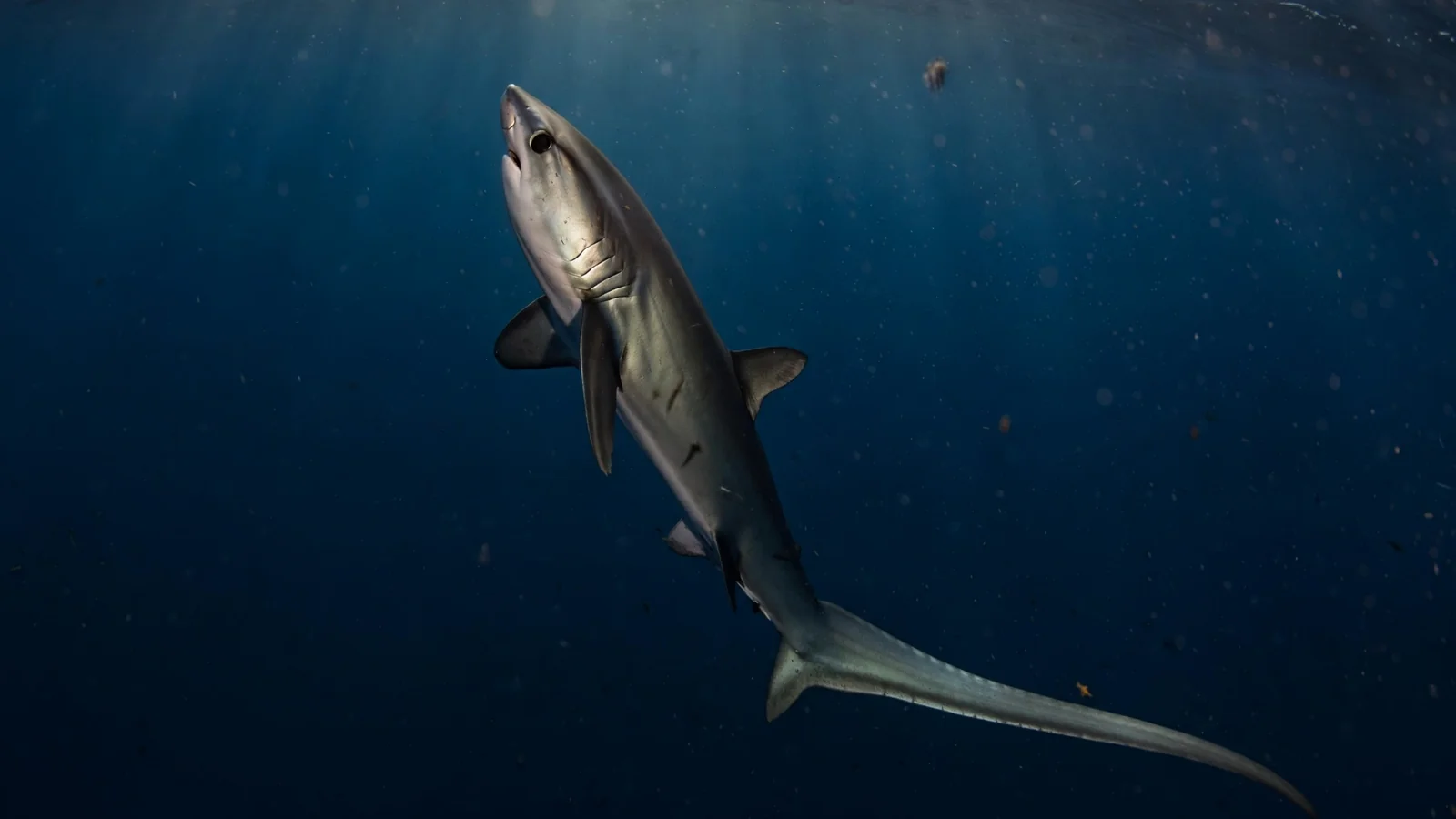
By day it lives at 300 to 500 metres down, in the twilight zone where the light is faint and the water is cold. It has been recorded to about 955 metres, though the tracked figure is 723 metres — either way, it is a shark that spends its days deeper than most sharks ever go.
The daily commute is the species’ rhythm. Down at dawn to the cold, faint twilight where lanternfish hide by day; up at dusk to the surface waters where the feeding is rich at night. Few sharks live in two worlds so completely — the commute between them is hundreds of metres, twice a day, every day of its life.
By night it rises. As the sun sets, the bigeye follows its prey up toward the surface, hunting in the dark upper water where schooling fish gather. The daily migration — deep by day, shallow by night — is one of the largest vertical movements of any shark, and it is driven entirely by food.
What Do Bigeye Threshers Eat? Schooling Fish and Squid
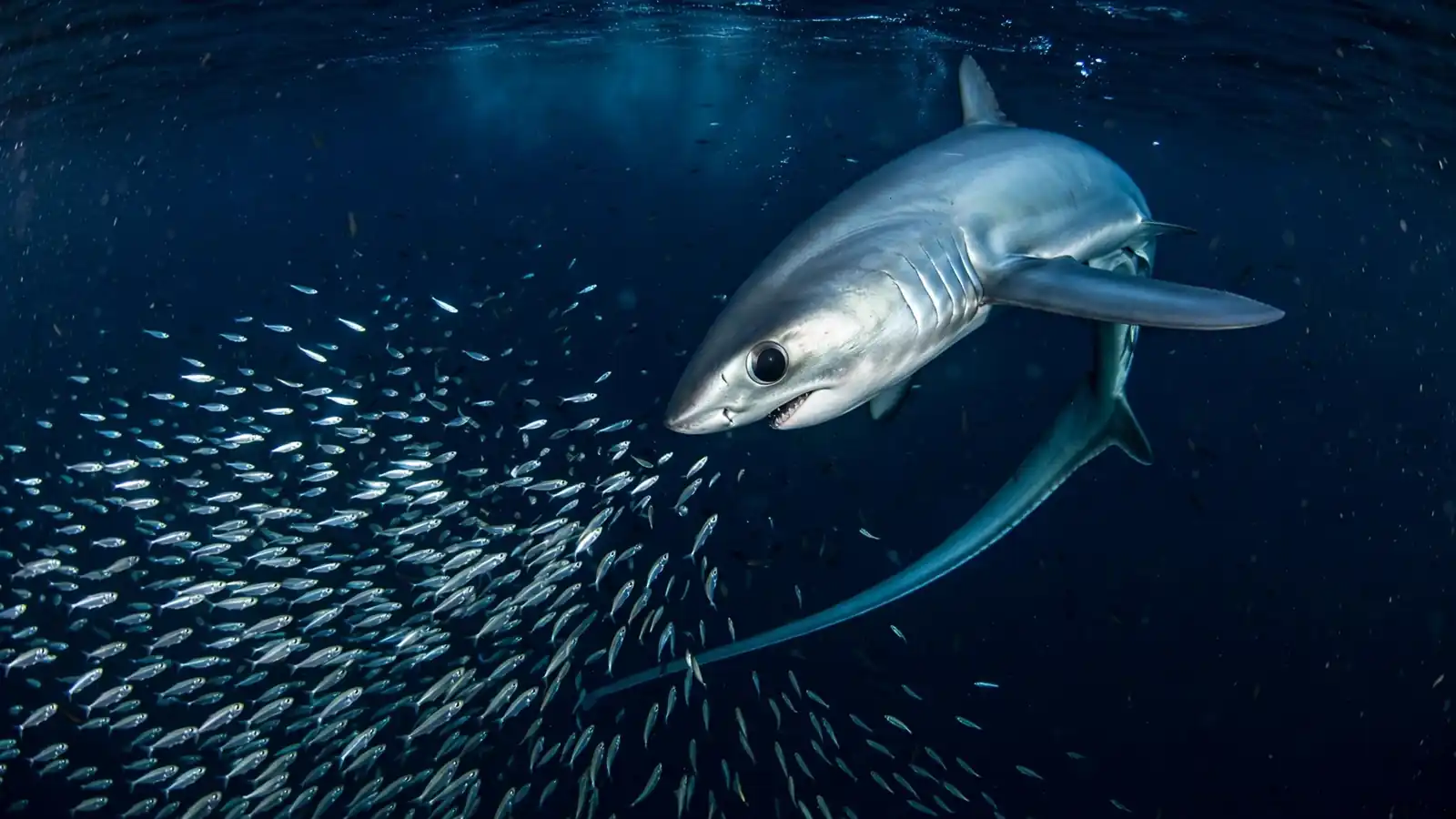
Schooling fish are the core of its diet: lanternfish, lancetfish, small tunas and herring-like fishes, taken in the open ocean by the tail-whip method. Squid are the other staple, hunted in the same way — stunned by the tail, then eaten at leisure.
The diet is a deep-water diet, and it is what keeps the bigeye so far from shore. The fish it hunts live in the open ocean and in the deep scattering layer, a vast, moving band of small fish and squid that rises and falls with the light. The bigeye follows that layer up and down, day and night.
Conservation: A Vulnerable Slow Breeder
It is listed as Vulnerable, a status set in a 2018 assessment and published in 2019. Older guides still cite a 2007 assessment, but that is the older listing. The current picture is a slow-breeding shark caught as bycatch in longlines and gillnets across its whole range, with too few pups to replace the losses.
What it needs most is what every open-ocean shark needs — limits on longline bycatch, and a recognition that a shark which produces two pups at a time cannot be fished like a fish that produces two million eggs. The bigeye lives in the dark and hunts with a whip; it deserves better than to be an accidental catch.
Accidental is the operative word. Nobody fleets out to hunt a twilight-zone shark that yields so little; the losses are the bycatch of longlines set for other fish, multiplied across every ocean it swims. Two pups at a time cannot balance that arithmetic — the species spends in a single tow what takes it years to earn.
Fun Facts
- Its eyes are up to 10 cm across — the largest, relative to body size, of any shark.
- Its tail is nearly as long as the rest of its body and is used like a whip to stun prey.
- It dives to 300–500 metres by day and rises to the surface at night to feed.
- It usually has just two pups at a time.
- It is the deepest-diving of the three thresher species.
- Its eyes point upward, watching for prey silhouettes against the light from above.
Frequently Asked Questions
How Big Do Bigeye Thresher Sharks Get?
Bigeye threshers grow to 4.9 metres and 364 kg, though most adults measure 3.3 to 4 metres. Nearly half of that length is the tail.
Why Do Bigeye Thresher Sharks Have Such Big Eyes?
Its eyes are up to 10 cm across and point upward, built to spot the silhouettes of prey against the faint light in the twilight zone.
How Does a Bigeye Thresher Use Its Tail?
It cracks its long upper tail lobe forward like a whip, stunning schooling fish, then turns back to eat them.
How Deep Do Bigeye Thresher Sharks Dive?
Bigeye threshers spend their days at 300 to 500 metres and have been recorded to about 955 metres, rising to the surface at night to feed.
What Do Bigeye Thresher Sharks Eat?
It eats schooling fish — lanternfish, lancetfish and small tunas — plus squid, all stunned with its tail.
Are Bigeye Thresher Sharks Dangerous to Humans?
No. Bigeye threshers are deep-water, open-ocean sharks that avoid people; no unprovoked bite has ever been recorded.
Are Bigeye Thresher Sharks Endangered?
It is listed as Vulnerable, a status set in a 2018 assessment, driven by longline bycatch and its very slow breeding.
Similar Species Worth Exploring
Keep Exploring
Still exploring open-ocean shark country? Meet the biggest shark of all, the Whale Shark, race the Shortfin Mako through the blue, dive into the Types of Deep-Sea Fish hub, and then come back to the twilight zone to meet the bigeye thresher.