Anglerfish
Anglerfish: The Lantern Fish of the Deep
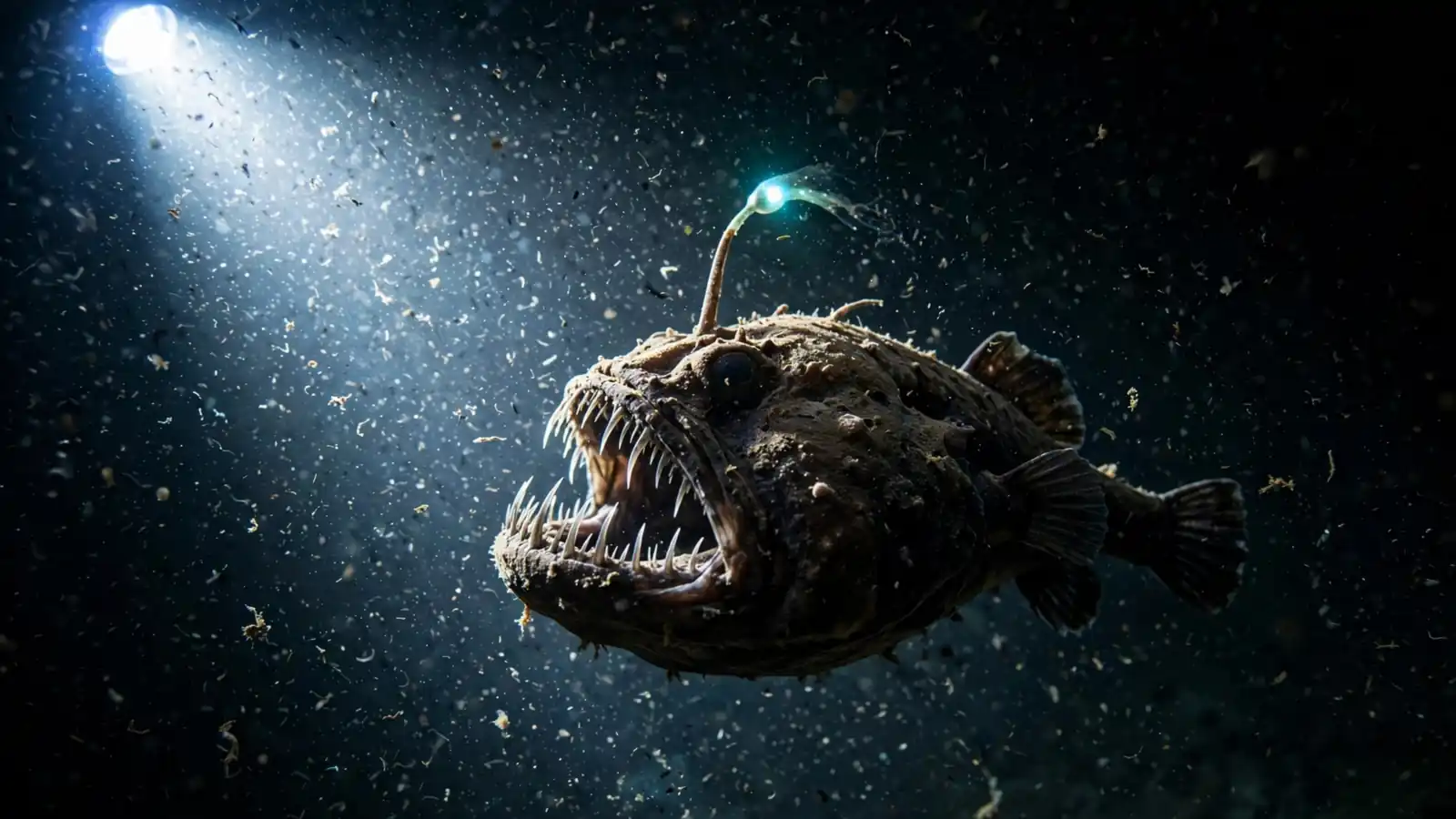
The anglerfish is the deep ocean’s most famous monster: a fish that fishes, dangling a glowing lantern in permanent darkness above a mouth full of glass teeth. But the lantern is not even its strangest feature — wait until you meet the males. Here is the real fish, from its bacterial light to the most extreme marriage in the animal kingdom.
By Emily Carter · Reviewed by our vet team · Updated 10 November 2026 · 10 min read
200+ species in the orderFound 100 to 4,500 m downMales can fuse for life
At a Glance
An anglerfish is any member of the order Lophiiformes — more than 200 species united by a single invention: the first ray of the dorsal fin has moved forward onto the head and become a fishing rod. The rod is called the illicium, and the bait at its tip is the esca.
The famous glowing kinds are the deep-sea ceratioids, about 168 species in 11 families that live in the dark midwater of the oceans — in fact, they are the most species-rich group of vertebrates in the bathypelagic zone, the black water below about 1,000 metres. Their relatives include the seabed monkfish of fish markets and the frogfish of shallow reefs, which fish with lures that mimic worms and shrimps instead of glowing.
Anglerfish Size: Giants and Dwarfs
Size depends on which of the two sexes — and which species — you meet. Most deep-sea females are modest fish: the best-known of all, the humpback, tops out at just 18 centimetres, about the length of a smartphone. The giant of the group, Krøyer’s deep-sea angler, is another world: her females usually measure around 77 centimetres and the largest reach about 1.2 metres, with jaws to match.
Then there are the males. A male of the deep-sea kinds is typically one to three centimetres long — small enough to sit on a thumbnail — and may weigh a tiny fraction of his mate. It is the most extreme size gap between the sexes of any vertebrate: in the most dramatic species, a female can be dozens of times longer and hundreds of thousands of times heavier than the male attached to her.
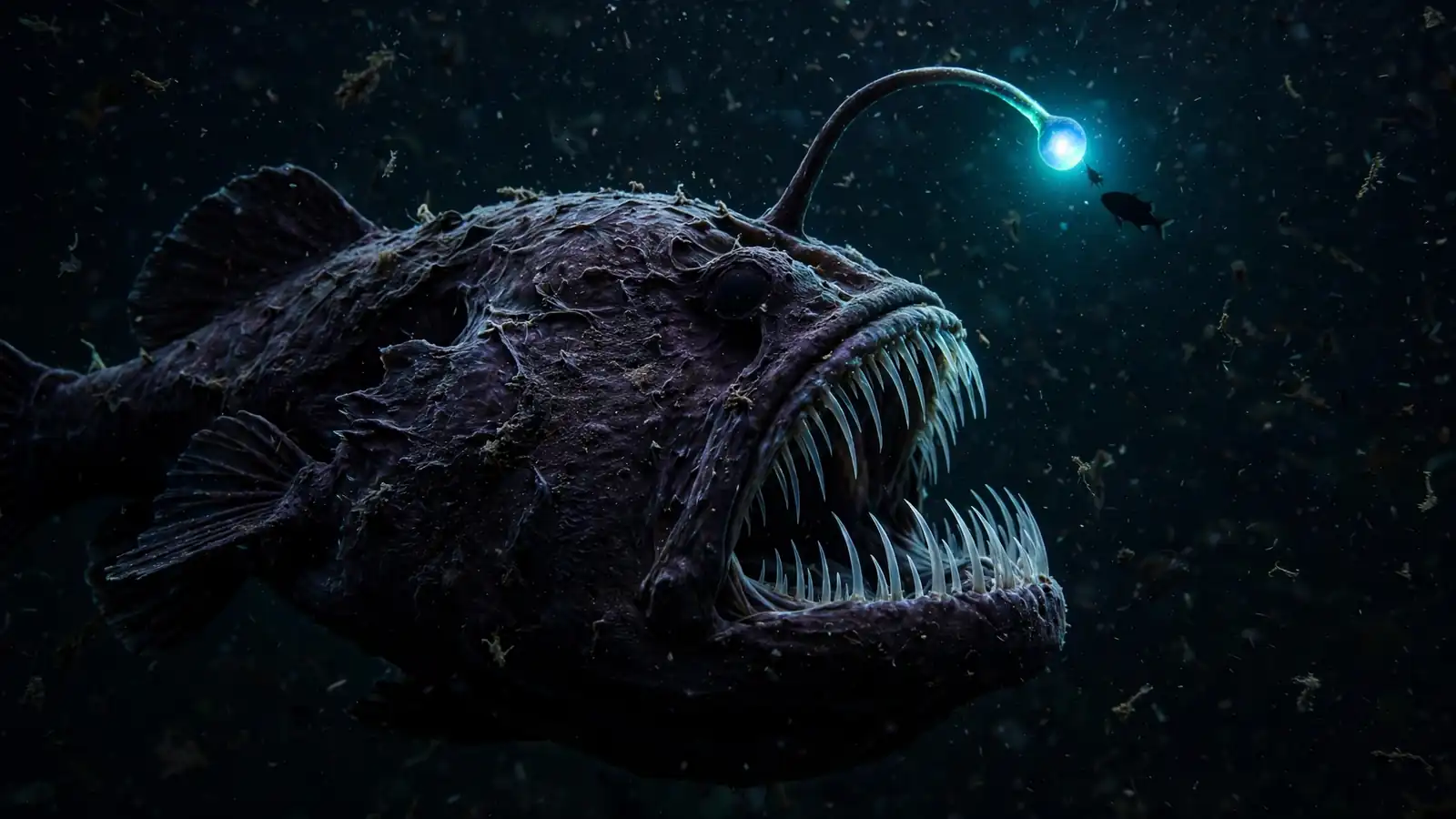
Size is written in the teeth, too. The humpback carries between 48 and 134 teeth in its upper jaw alone and up to 78 below — long, translucent fangs that hinge inward, letting prey slide in but never back out. You can explore the full species record for the humpback, from its measurements to its bizarre stomach contents.
The Anglerfish Lure: A Lantern Full of Bacteria
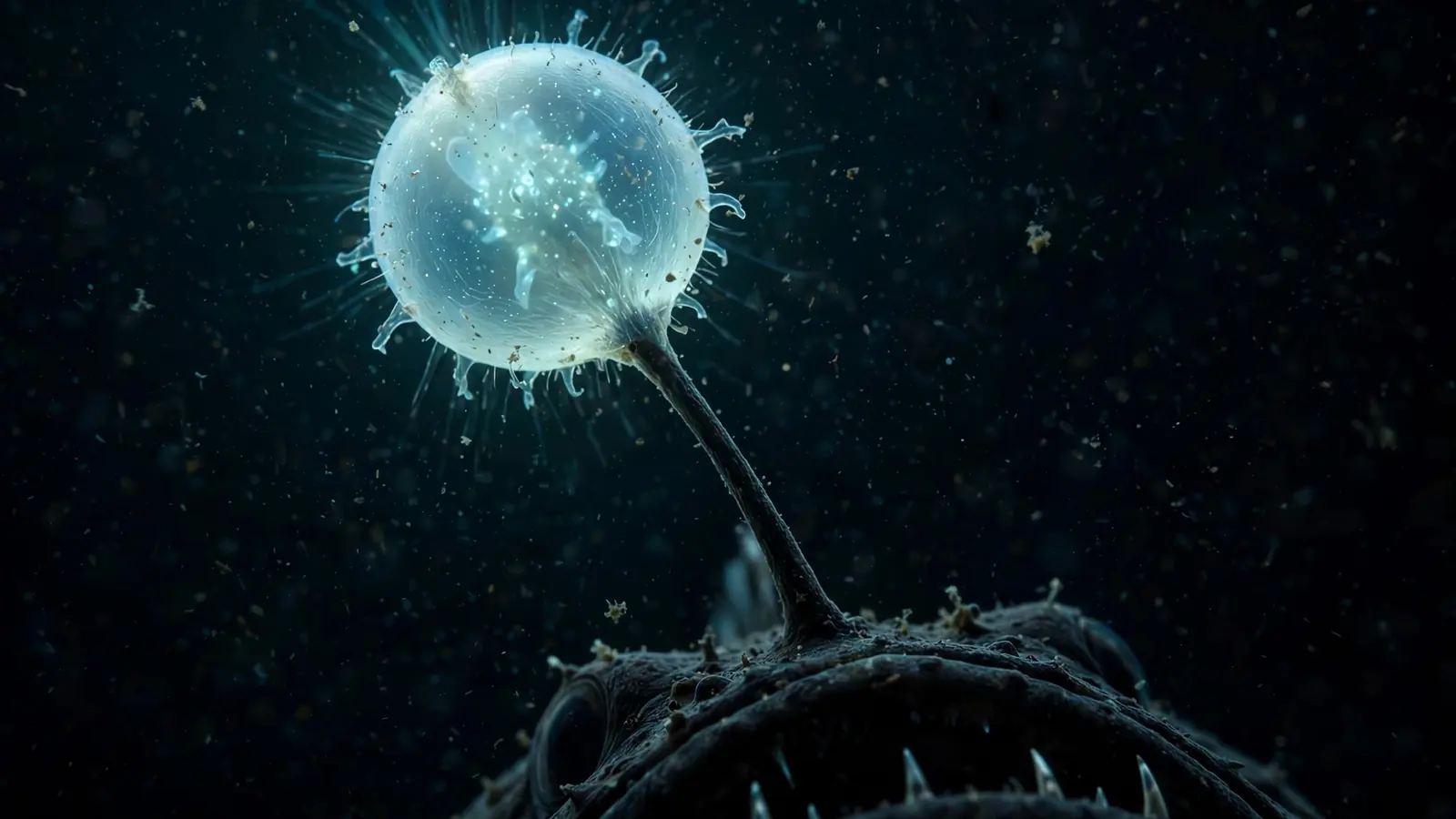
The lure is two inventions in one. The rod — the illicium — is a modified dorsal-fin spine that the fish can wave, twitch and dangle like an angler working a fly. The esca at its tip is shaped by natural selection into whatever the local prey finds irresistible: a glowing bulb in deep-sea species, but in others a tuft of filaments, a worm-like wiggle, or a shrimp shape. Because each species fishes for different prey, esca shapes are among the most varied structures in the fish world — and scientists use them to tell species apart.
The light itself is not the fish’s own. The esca is a hotel for symbiotic bacteria — in the humpback, a species named Enterovibrio escacola — that glow blue-green, the colour that travels farthest through deep water. The fish is born without them: the young pick up their bacteria from the surrounding seawater, then farm them in the lure for life, feeding them and, scientists believe, dimming or shading the glow when a bright light might attract a predator instead of a meal.
Where Do Anglerfish Live? Life in the Deep Sea
The deep-sea kinds live where sunlight never reaches. The humpback has been recorded between 100 and 4,500 metres down, most often in the 100 to 1,500 metre band, in the tropical and temperate parts of every ocean. Down there it is permanently dark, a few degrees above freezing, and food is desperately scarce — only about five per cent of the nutrition produced in the sunlit surface waters ever sinks to these depths. Every adaptation, from the lure to the expandable stomach to the fused males, is an answer to that emptiness.
Not all are deep-sea fish, though. Monkfish rest on continental shelves and slopes, half-buried in sediment, fishing with a small non-glowing lure. Frogfish stalk coral reefs and sponge gardens in water you could stand in. The glowing ceratioids are simply the branch of the family that followed the lure into the dark — and became the largest vertebrate group in that darkness.

Diet and Feeding: The Trap With Teeth
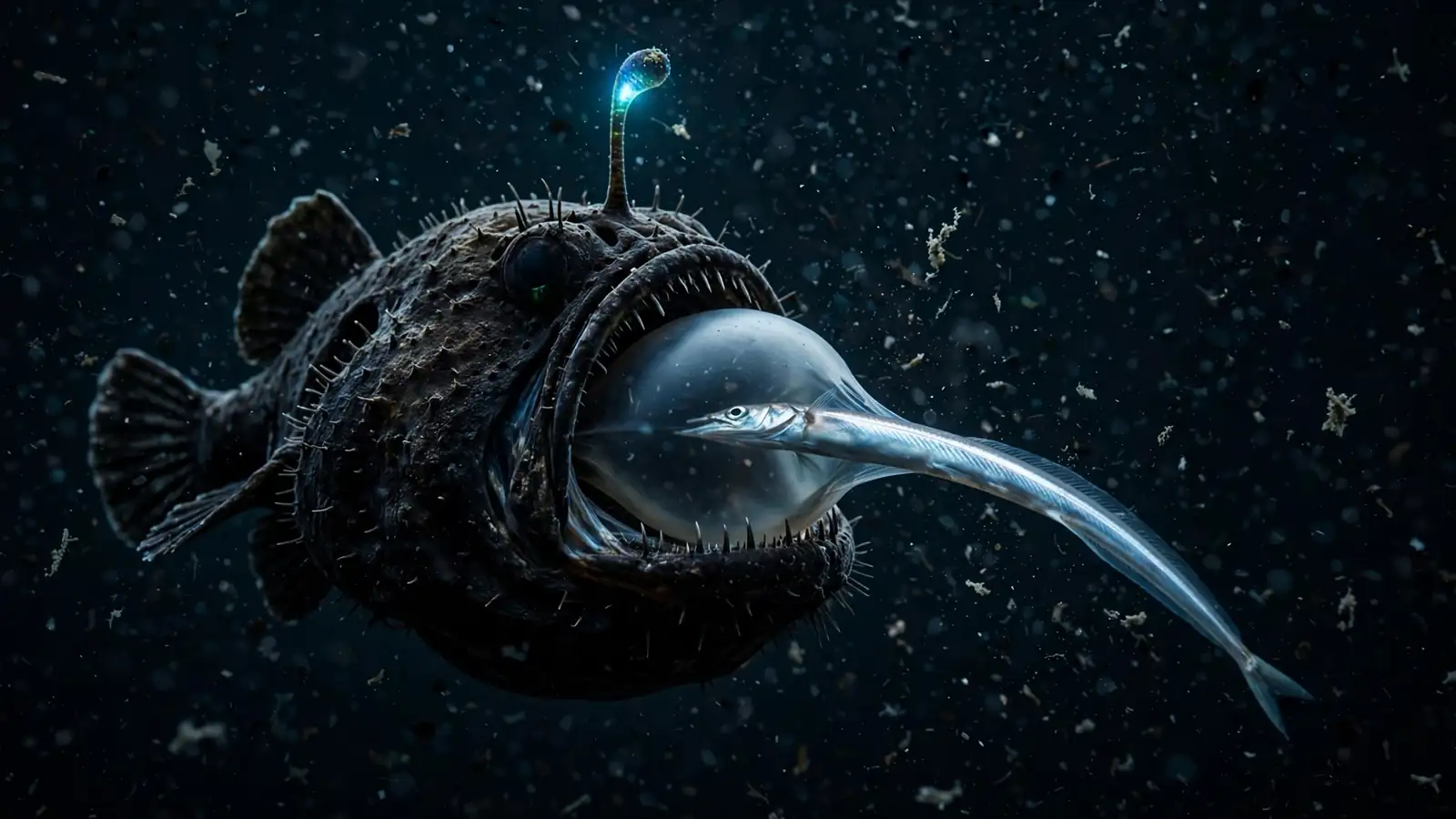
The diet is whatever the lantern can tempt: other fish, squid and crustaceans, drawn close by the bobbing light until they are inside the strike zone. Then the huge mouth opens in a fraction of a second, creating a rush of suction that pulls the prey in past the hinged, inward-angled teeth. There is no chewing and no escape — the trap only opens one way.
Because meals are rare, it eats like it may never eat again. The stomach stretches astonishingly: one humpback weighing 8.8 grams was found with 12.3 grams of snipe eels inside — a meal heavier than the fish itself — and another, just 6.6 centimetres long, held a viperfish of about 24 centimetres. When your larder is an empty black ocean, you take the biggest meal that swims within reach of the light.
Reproduction: The Males Who Fuse
In an ocean of darkness, finding a mate is the hardest problem it faces — and evolution’s answer is the strangest love story in nature. The tiny male, equipped with oversized eyes and nostrils, spends his short free life hunting not for food but for a female, following her scent and the glow of her species-specific lure. Early scientists who found males attached to females assumed the little fish were parasites. They were husbands.
In about 23 deep-sea species, the male bites the female and never lets go. His lips fuse to her skin, their blood vessels join, and over time he loses his eyes, his digestive system and almost everything except his reproductive organs — becoming a permanent attachment that draws all its food from her bloodstream. One female may carry several fused males, up to six have been recorded. It works because these species have dismantled much of the immune machinery that would normally reject foreign tissue — a trade no other vertebrate is known to have made.
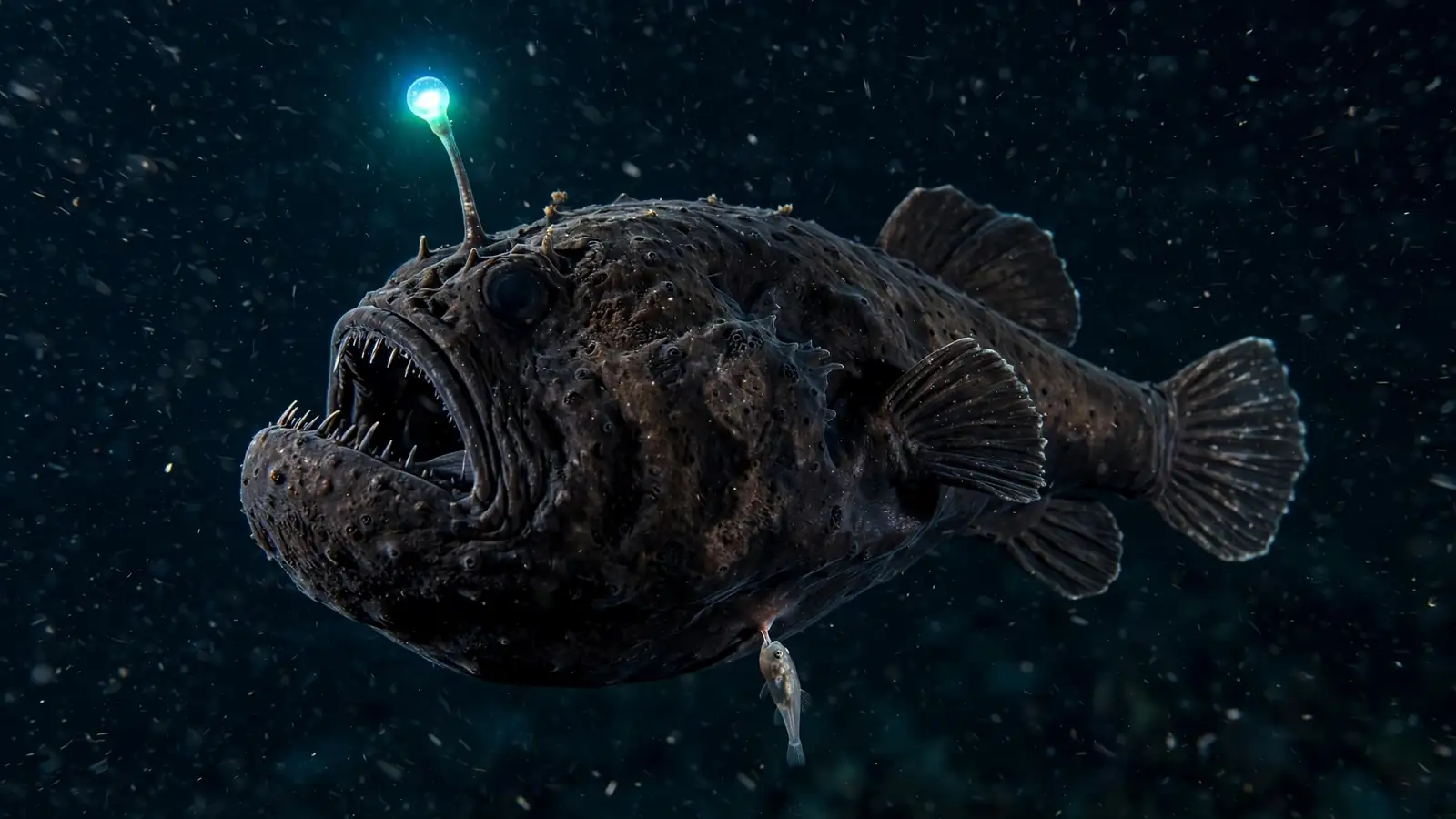
Most, to be clear, do not go this far: in many species males attach only temporarily, and in some — including the humpback — males stay free-living their whole lives. However they mate, the eggs are released into the water, in the deep-sea kinds held in a floating gelatinous raft. The larvae grow up near the surface, in the top 100 metres, and only descend into the dark as they mature — every lantern begins its life in the light.
Threats, Science and a Visitor to the Surface
The deep-sea kinds are among the least-studied fish on Earth: most species are known from a handful of dead specimens hauled up in nets, and many have never been assessed for conservation status at all. They are not fished directly — only their shallow monkfish cousins are — but deep trawling reaches further down every decade, and the slow rain of food from the surface that sustains them is sensitive to a changing climate. Their protection, for now, is the depth itself.
That depth is also why a single fish made world headlines in early 2025, when a humpback was filmed alive near the surface in daylight off the island of Tenerife — a creature of the midnight zone, swimming in blue sunlit water. It died soon afterwards, and its body went to a museum for study. The sighting was a reminder of how rarely we see these animals alive: almost everything in this guide was learned from specimens, patience and the cameras of deep-sea submersibles.
Fun Facts
- Its glow is borrowed: the light comes from bacteria the fish farms in its lure, picked up from the seawater when the fish is young.
- A 6.6 cm humpback was once found with a 24 cm viperfish folded inside its stomach.
- The first scientists to discover the males mistook the tiny husbands, attached to the females, for parasites.
- The deep-sea kinds are the most species-rich vertebrate group in the bathypelagic zone, with roughly three times as many species as the next group.
- A single female may carry up to six fused males at once, each fed entirely by her bloodstream.
- Not every lure glows: shallow-water frogfish fish with lures shaped like worms and shrimps instead.
Frequently Asked Questions
What Is an Anglerfish?
It is any fish in the order Lophiiformes, more than 200 species defined by a built-in fishing rod: a modified dorsal-fin spine (the illicium) tipped with a bait-like lure (the esca). The most famous are the deep-sea ceratioids, about 168 species that live in dark midwater and glow.
Why Does the Anglerfish Glow?
The glow comes from symbiotic bacteria living inside the lure — the fish itself cannot make light. The blue-green shine attracts curious prey toward the waiting jaws in total darkness, and may also help males find females of the right species. The young collect their bacteria from the surrounding seawater.
How Big Do Anglerfish Get?
It depends on the species and the sex. The famous humpback female reaches only about 18 cm, while the largest deep-sea species, Krøyer’s deep-sea angler, grows to about 1.2 metres. Males of deep-sea species are dwarfs of just 1 to 3 centimetres.
Do Male Anglerfish Really Fuse to Females?
Yes — in about 23 deep-sea species, a male bites a female and fuses permanently, sharing her bloodstream and losing his digestive system, eyes and independence. In many other species males attach only temporarily or never, and some, like the humpback, stay free-living.
How Deep Do Anglerfish Live?
The deep-sea kinds typically live between about 200 and 2,000 metres down, and the humpback has been recorded from 100 to 4,500 metres. Not all are deep, though: monkfish live on continental shelves and frogfish hunt in shallow reefs.
Are Anglerfish Dangerous to Humans?
No. The deep-sea kinds live far below any depth a swimmer or diver could reach, are harmless to people and show no interest in them. Even the famous surface visitor of 2025 was a dying fish far from home, not a hunter.
Similar Species Worth Exploring
Keep Exploring
From the deep, climb back toward the light with the upright seahorse, meet the inflatable pufferfish, or survey the whole family tree in our types of fish guide — then sink back down to the glow of the unforgettable anglerfish.