Box Jellyfish
Box Jellyfish: 24 eyes, no brain, and the sea’s most feared sting
The box jellyfish is the animal that closes tropical beaches: a cube-bodied hunter with bundles of stinging tentacles at its four corners and venom strong enough to stop a human heart. Yet it is no mindless drifter. It swims with purpose, dodges obstacles, and watches the world through 24 eyes, including camera-like eyes with lenses, all without a brain. Beautiful, nearly invisible and genuinely dangerous, it demands respect and rewards curiosity.
By Emily Carter · Reviewed by our vet team · Updated 10 November 2026 · 9 min read
24 eyes, no brainThe most venomous jellyfishVinegar is the first aid
At a Glance
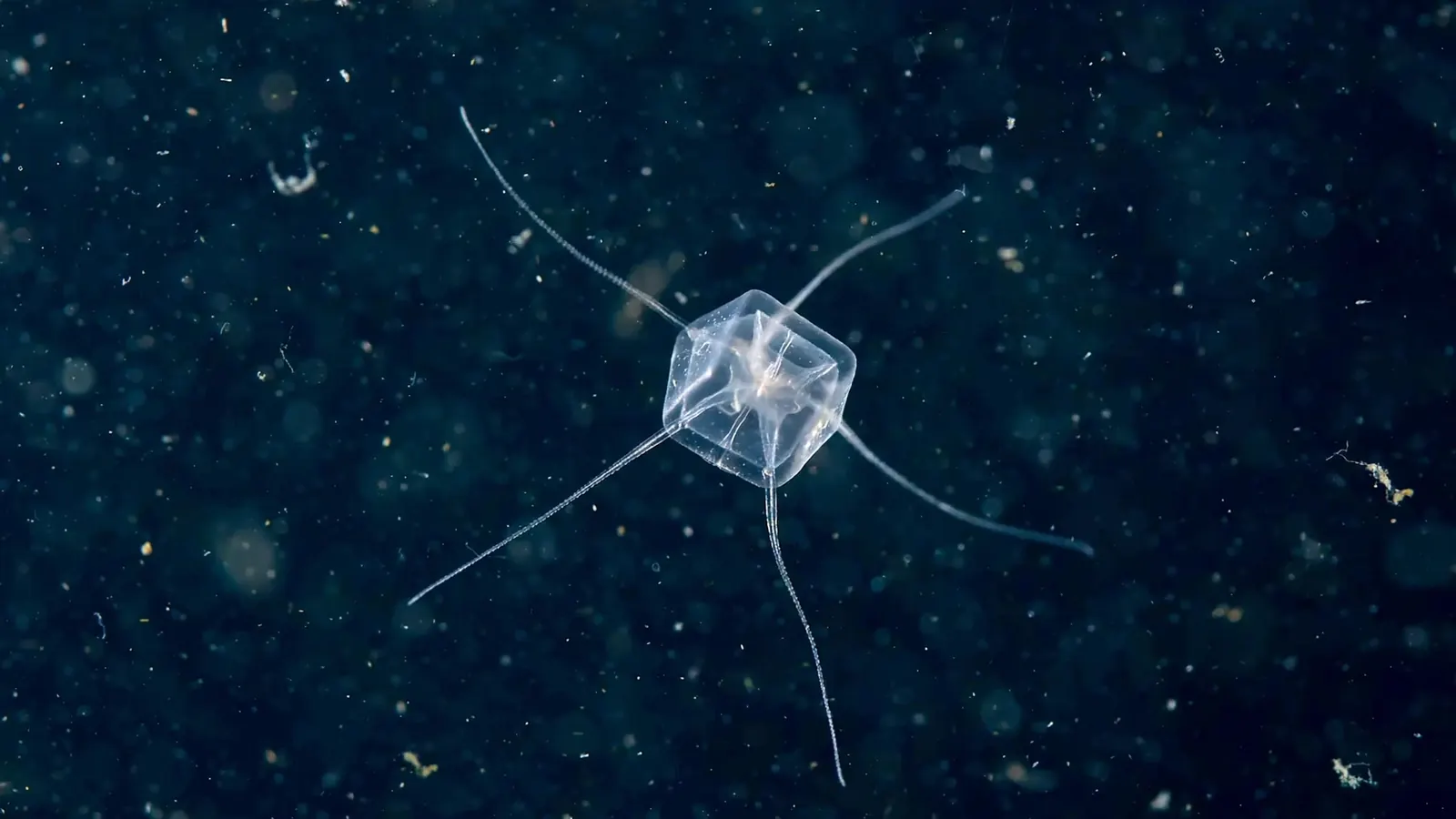
The box jellyfish belongs to the class Cubozoa, a small group of about fifty species set apart from other jellyfish by the cube-shaped bell that gives them their name. At each corner of the cube hangs a fleshy stalk, the pedalium, carrying the tentacles, and between them, suspended under the bell, the eye clusters that make these the most visually sophisticated jellyfish alive. Two of the group, the great Chironex and the tiny Irukandji jellies, are infamous. The rest are simply extraordinary.
Box Jellyfish Species: From Chironex to the Tiny Irukandji
The most famous member is Chironex fleckeri, the sea wasp of northern Australia: a bell up to about 30 centimetres across, with up to 60 flat tentacles reaching 3 metres, each carrying millions of stinging cells. It is the largest and most dangerous of the group. At the other extreme sit the Irukandji jellies, a set of small species whose bells measure around a centimetre, with just one tentacle at each corner, yet whose sting triggers one of the most feared syndromes in medicine.
Between the giants and the thumbnails, the fifty-plus species fill warm seas worldwide: the habu kurage of Japan, sea wasps of the Caribbean and Atlantic, and mangrove jellies that patrol estuary roots. The full species list and classification are set out in the group’s class record, from Chironex to the Irukandji group, and the wider family is gathered in our guide to the types of jellyfish. One animal often confused with them, the Portuguese man o’ war, is not a jellyfish at all, as the FAQ below explains.
Eyes Without a Brain: The Vision of the Cubozoans
Each one carries 24 eyes, grouped in four clusters called rhopalia that hang in pits beneath the bell. Every cluster holds six eyes of four kinds, including two true lens eyes, complete with cornea, lens and retina, built on the same plan as our own. The upper lens eye always points up through the bell, whatever the jelly’s tilt, and in mangrove species it is used to navigate by the tree canopy overhead, a visual compass for staying in the home shallows.
And yet there is no brain: the rhopalia connect to a ring of nerves, and experiments show the animals learning, avoiding dark obstacles and steering for light gaps. They do not drift into danger, they swim around it, at speeds of several knots. This is why they are so hard to escape in the water, and why the advice is always to keep out of theirs.
Box Jellyfish Sting and Venom: What the Tentacles Do
A single tentacle is a ribbon studded with millions of nematocysts, spring-loaded stinging capsules that fire on contact with skin or prey. The venom of Chironex is among the most potent known, attacking skin, nerves and, in severe cases, the heart; a major sting brings immediate, intense pain and whip-like welts, and the worst can cause collapse within minutes. The Irukandji sting is different: often barely felt at first, then, 20 to 40 minutes later, a syndrome of severe back and muscle pain, cramps, sweating, anxiety and soaring blood pressure that needs hospital care.
For the jellyfish, of course, the venom is a fishing tool: it kills fish and prawns instantly, so a struggling catch cannot tear the delicate tentacles. Perspective helps too: the moon jellyfish at the mild end of the family barely registers on human skin. The box jellies are the sharp exception in a mostly gentle group, and nearly all serious stings involve Chironex or an Irukandji species.
First Aid: Vinegar, and What Actually Helps
On Australian beaches, the first aid for a tropical cubozoan sting is drilled and specific: get the person from the water, call emergency services, and flood the sting with vinegar for at least 30 seconds. Vinegar does not treat venom already injected; it permanently disables the undischarged stinging cells still sitting on the skin, stopping the sting from getting worse while help comes. Then tentacles are picked off, an ice pack eases the pain, and CPR, if needed, comes before everything else.

That vinegar rule remains the standard advice on Australian beaches today. Research continues to refine the details, including laboratory work on how vinegar affects cells that have already fired, but the field guidance is unchanged, because in real stings the priority is stopping the millions of unfired cells. For Chironex, hospitals also have a specific antivenom. The folk remedies, urine, fresh water, rubbing, are all worse than useless: they can fire more stinging cells. Vinegar, help, and speed are the whole recipe.
Where Do They Live? Habitat and Season
They live in warm coastal waters of the Indo-Pacific and beyond: northern Australia, Southeast Asia, Japan, the Caribbean and the tropical Atlantic all have their species. Chironex favours calm, shallow water over sand near estuary mouths and mangroves, hunting in the same shallows people swim in, which is exactly the problem. In northern Australia they arrive with the wet season, roughly October to May, the “stinger season” when beaches fly warnings and swimming enclosures go in.

They are also creatures of rhythm: many species rise and hunt by day, resting near the bottom at night, and tides and winds push them shoreward in pulses. The defences are practical rather than heroic: swim inside stinger-net enclosures, wear a stinger suit in season, and treat a clear, calm, beautiful tropical beach in summer with the respect its most famous resident has earned.
Life Cycle: The Polyp That Turns Into a Jellyfish Whole
Each begins as a larva that settles in an estuary and becomes a tiny polyp, a stalked, tentacled bud a few millimetres tall, clinging to shells, stones and mangrove roots. Polyps can bud off more polyps and wait out bad seasons. Then comes the cubozoan miracle: instead of budding off small medusae like other jellyfish, the polyp metamorphoses completely, its whole body reorganising into a single young medusa that swims away. The polyp leaves nothing behind.
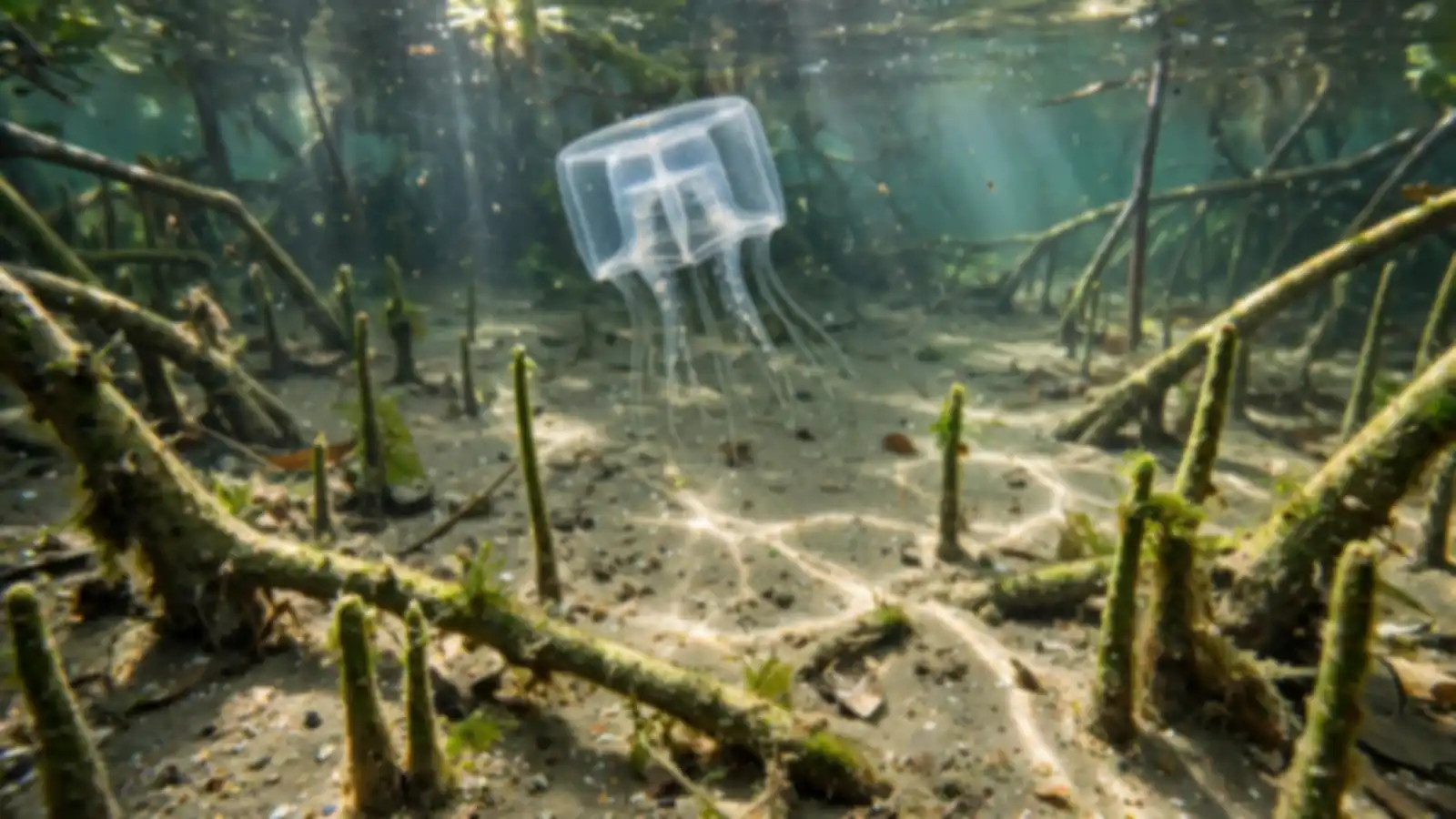
The young medusa grows fast on prawns and small fish, reaching full size within a season. Most species live less than a year as medusae, timed so the adults hunt the warm months and the polyps, hidden in the estuaries, carry the species through the rest. It is a life cycle built like the animal itself: quiet, hidden, and suddenly very hard to miss.
Fun Facts
- Its upper lens eye always points upward through the bell, and mangrove species use the view of the tree canopy to navigate home.
- Chironex tentacles can carry millions of stinging cells, and a few metres of tentacle contact is considered a major sting.
- Irukandji jellies are so small, about a centimetre across, that they pass through the nets of swimming enclosures; stinger suits are the real protection.
- The animal’s polyp transforms its entire body into one medusa, the only jellyfish group that develops this way.
- They swim actively at several knots and can turn and dodge obstacles, behaviour no other jellyfish group matches.
- An antivenom for Chironex stings has existed since 1970, and prompt vinegar plus antivenom has made deaths in Australia rare.
Frequently Asked Questions
How Dangerous Is a Box Jellyfish Sting?
A cubozoan sting ranges from painful to life-threatening depending on the species and the amount of tentacle contact. Chironex fleckeri, the most dangerous, can cause intense pain, whip-like welts and, in the worst cases, heart failure within minutes. Irukandji stings are initially mild but can trigger a severe delayed syndrome. Most stings are far less serious, and prompt vinegar first aid, emergency care and antivenom have made deaths rare in Australia.
What Should You Do for a Box Jellyfish Sting?
For a tropical cubozoan sting: remove the person from the water, call emergency services, and flood the sting generously with vinegar for at least 30 seconds to disable unfired stinging cells. Pick off tentacles, apply an ice pack for pain, and start CPR if the person collapses. Do not use fresh water, urine or rubbing, which can fire more stinging cells. Seek hospital care for any major sting.
How Many Eyes Does a Box Jellyfish Have?
A specimen has 24 eyes, arranged in four clusters called rhopalia under the bell. Each cluster has six eyes of four types, including two true lens eyes with corneas, lenses and retinas similar in design to vertebrate eyes. Despite this sophisticated vision, the animal has no brain; its eyes feed into a simple nerve ring that steers its swimming.
What Is the Difference Between a Box Jellyfish and a Portuguese Man O’ War?
A species is a true jellyfish, a single animal with a cube-shaped bell that swims actively. A Portuguese man o’ war is not a jellyfish at all but a siphonophore, a floating colony of specialised polyps under a gas-filled sail, drifting wherever wind and current take it. The distinction matters for first aid too: vinegar is the standard for tropical cubozoan stings in Australia, while man o’ war stings are treated differently, with seawater rinsing and hot water for pain.
Where Do Box Jellyfish Live?
They live in warm coastal seas, especially the Indo-Pacific: northern Australia, Southeast Asia, India and Japan, with relatives in the Caribbean and tropical Atlantic. They favour calm, shallow water over sand, often near estuaries and mangroves, and in Australia they are mainly a wet-season presence from about October to May. Polyps live hidden in estuaries year-round.
How Big Do Box Jellyfish Get?
Sizes vary hugely among species. Chironex fleckeri, the largest, has a bell up to about 30 centimetres across and tentacles reaching 3 metres. Many species are far smaller, and the Irukandji jellies are only about a centimetre across the bell with tentacles that can still stretch a metre. Bell size is a poor guide to danger: the smallest species carry some of the most feared venom.
Can You See a Box Jellyfish in the Water?
Barely. A specimen is almost perfectly transparent, and even a large Chironex can be invisible until you are upon it, which is why stings happen on clear, calm days. The animals themselves can see you, and actively avoid obstacles, but they cannot be relied on to dodge a swimmer. Stinger nets, protective suits and heeding beach warnings are the practical answers in season.
What Is the Most Venomous Box Jellyfish?
Chironex fleckeri, the sea wasp of northern Australia. It is the largest and most dangerous of the group: a bell up to about 30 centimetres across, with up to 60 flat tentacles reaching 3 metres, each carrying millions of stinging cells.
What Is Irukandji Syndrome?
Irukandji syndrome is the delayed reaction to the sting of a tiny Irukandji jelly — a bell around a centimetre wide, with one tentacle at each corner. The sting itself is mild, but 5 to 40 minutes later come severe back pain, muscle cramps, nausea, sweating and a racing heart, with blood pressure climbing dangerously. It is one of the most feared syndromes in medicine, and a suspected Irukandji sting needs hospital care.
Similar Species Worth Exploring
Keep Exploring
Keep exploring the gentler side of the family with the moon jellyfish, meet the cold-water record-breaker among the types of jellyfish, and remember the golden rule of the tropics: swim in the net, and respect the box jellyfish.