Gray Seal
Gray Seal: the horse-headed diver of the North Atlantic
The gray seal is the big, long-faced seal of North Atlantic shores — a 400-kilogram diver that can stay under for an hour, call to its pup in a voice eerily like a crying child, and fast for weeks on a crowded autumn beach. Hunted hard for centuries, it has come back in force on both sides of the ocean. Here is its size, diet and double life.
By Emily Carter · Reviewed by our vet team · Updated 10 November 2026 · 8 min read
Males up to 3 mDives to 475 mPups gain 1.4 kg a day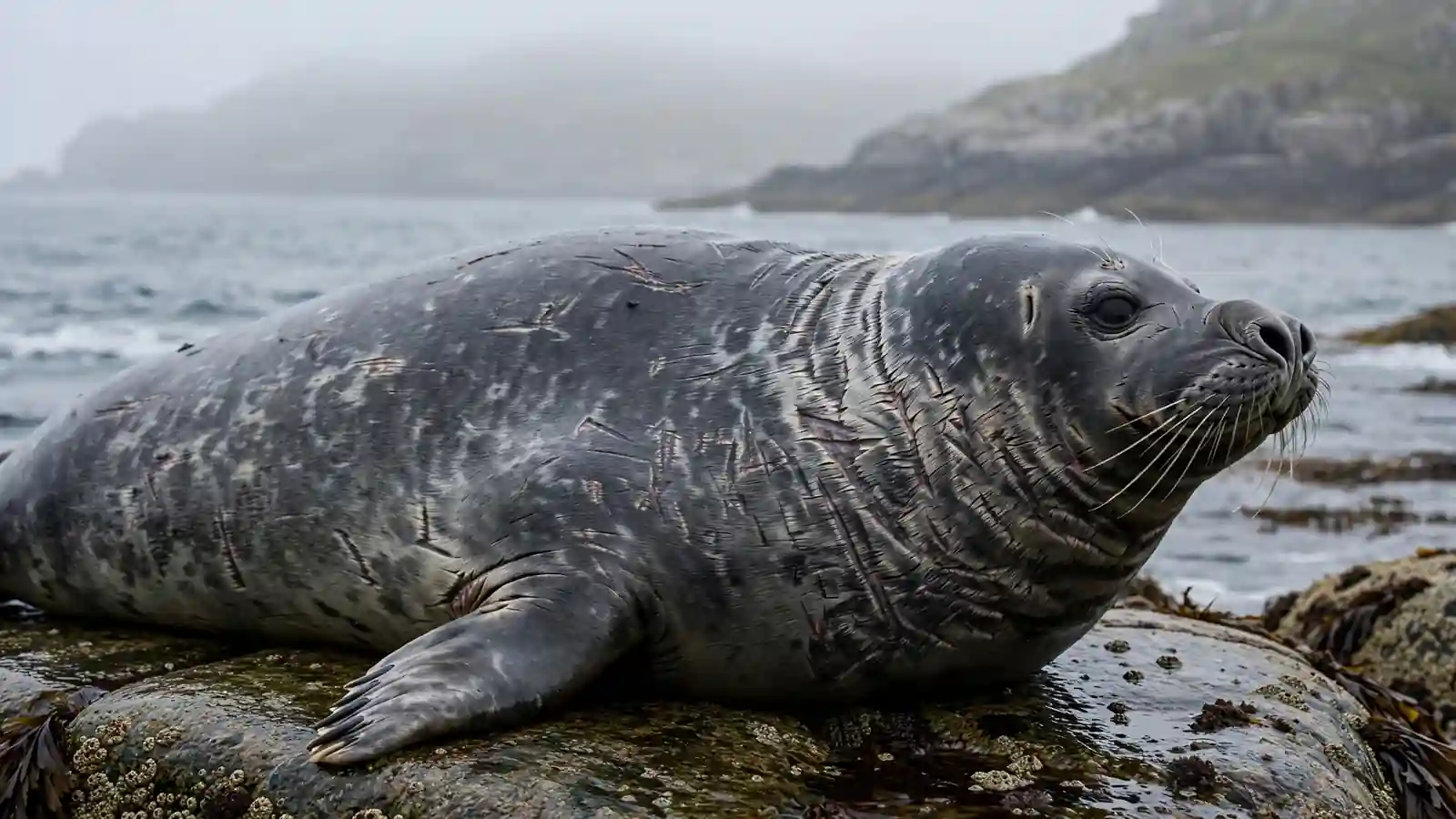
At a Glance
Two seals share most North Atlantic shores, and this is unmistakably the heavyweight: longer in the head, heavier in the shoulder and far more numerous than it was a lifetime ago. It is also a true seal — no ear flaps, no walking on land — which makes its power in the water all the more remarkable.
Gray Seal Size and Weight
A big male gray seal can reach 3 metres (10 feet) long and weigh about 400 kilograms (880 pounds) — think of a full-grown grizzly’s worth of seal. Females are smaller but still substantial, at roughly 2.3 metres (7.5 feet) and up to about 250 kilograms (550 pounds). Many adults fall short of those maxima, but even an average animal dwarfs the harbour seal it shares its beaches with.
The bulk is not evenly spread. A breeding bull carries massive, scarred shoulders and a thick neck built up over years of fighting, while the long head — the species’ signature — sits on top like an afterthought.
Pups arrive at about 16 kilograms (35 pounds) and then grow at a speed few mammals match, as the reproduction section shows.
Appearance and Anatomy
That head gives the species away: long and straight in profile, almost horse-like, with a broad muzzle and nostrils set wide apart on top. A bull’s nose is longer still, strongly arched — a Roman profile honoured in the scientific name, which translates roughly as ‘hook-nosed pig of the sea’, as the full species account explains.
Coats split by sex. Females wear silver-grey fur scattered with dark spots and keep a narrower, shorter nose; males are darker overall — dark grey or brown with paler patches — and carry their battle scars openly across the neck and chest.
As a true seal it has no external ear flaps and only short flippers, so on land it hauls itself along caterpillar-style, humping and shuffling. The transformation in water is total: rear flippers become a propeller, the body a torpedo, and the clumsy shore animal turns into one of the Atlantic’s most capable divers.
Habitat and Range
Three populations divide the North Atlantic. The western stock ranges down the Canadian Maritimes to New England — around 450,000 animals in Canadian and United States waters combined, anchored by the great colony on Sable Island. The eastern stock spreads from Britain and Iceland to Norway, the Faroes and Russia’s coast, and a third, smaller population lives enclosed in the Baltic Sea.
Within that range they are flexible shore-dwellers: rocky coasts and islands, sandbars, quiet beaches and, in the north, ice shelves and bergs. They haul out alongside the smaller harbor seal so routinely that telling the two apart — long straight head against round one — becomes a birder-style party trick.
Outside the breeding and moulting seasons they scatter widely. Young animals especially are wanderers, dispersing more than 1,000 kilometres from their birth beach before settling into adult life.
Diet and Feeding
Sand eels are the staple across much of the range, backed by cod, haddock, whiting, hake, pollock and flatfish, with squid, octopus and crustaceans on the side and the occasional seabird taken by bold individuals. At least 29 kinds of fish have been recorded in the diet, and an adult eats roughly four to six percent of its body weight a day.
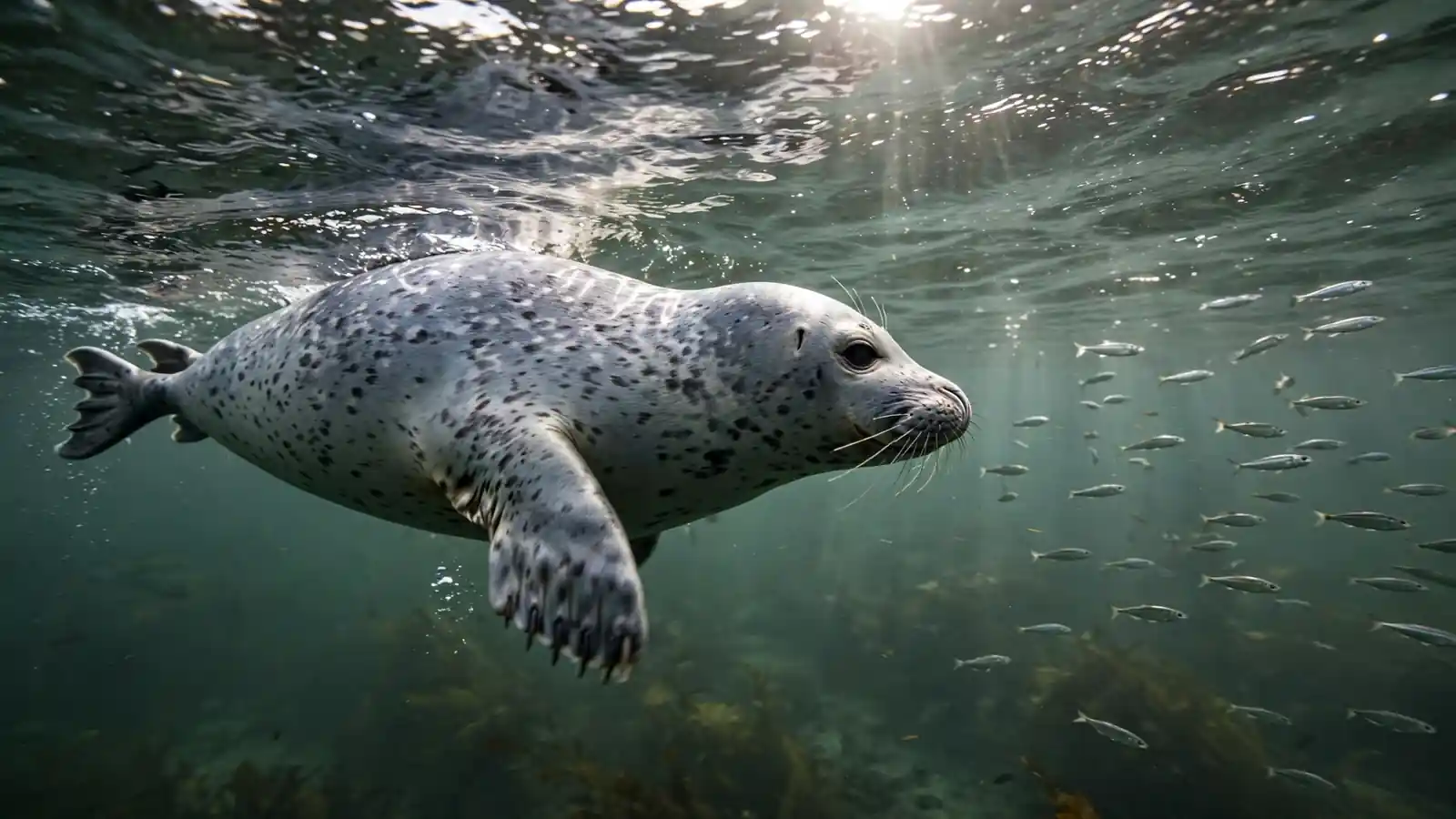
The hunting machinery is elite. A gray seal can dive to about 475 metres (1,560 feet) and stay down for as long as an hour, using excellent vision and hearing — and a whiskered muzzle that feels fish moving in black water. Groups often hunt together, herding shoals and cutting off escape routes.
Eating stops entirely at the two great gatherings of the year: through the breeding season and again through the moult, adults live off their blubber while the colony does its noisy, fasting work ashore.
Behavior and Social Life
The social calendar has two peaks. For breeding and again for the annual moult, they gather in dense, quarrelsome colonies; the rest of the year the same animals live alone or in loose small groups, spread across whole coastlines.
At sea they are mostly invisible neighbours — a head surfacing between waves, a long dive, a shape shadowing a fishing boat. On land a hauled-out animal spends its hours sleeping off the last hunt, shifting only to scratch, stretch or shuffle away from the tide.
Communication and Sound
The sound that stops visitors on a breeding beach is the pup’s cry — a wavering wail so like a human baby’s that rangers field worried phone calls about it. It has a serious job: on a beach of thousands, that voice is how a returning mother finds her own white-coated pup.
Adults keep a lower profile vocally — moans, hisses and claw-raking threats in the colony, and underwater, soft trills and knocks during the breeding season. Much of their real conversation is chemical and tactile: scent to identify, whiskers to investigate.
Reproduction and Pups
Timing depends on the ocean: western Atlantic females pup from December to February, eastern Atlantic females from September to November, and Baltic females in March. After a pregnancy of about eleven months, a female hauls out and gives birth to a single pup within a day or so of landing.

What follows is one of the fastest childhoods in the mammal world. The pup, born at about 16 kilograms in a creamy white coat, nurses on extremely rich milk and gains around 1.4 kilograms (3 pounds) a day — nearly quadrupling its weight in about three weeks — while its mother eats nothing at all. Then, abruptly, she mates, returns to the sea, and the weaned pup is on its own, living off its new blubber while it moults and finally learns to feed itself.
Bulls run the beach meanwhile, fasting for up to six weeks and fighting for position; a successful male may mate with up to ten females in a season, though the fighting, scar for scar, is usually less savage than among sea lions.
Predators and Threats
Killer whales and large sharks take some, mostly the young and the careless. The persistent threats are entanglement in fishing gear and debris, chemical contaminants concentrating in blubber, oil spills that soak fur and destroy insulation, vessel strikes in busy waters, and — where tempers fray over fish — illegal killing and harassment.
The Baltic population carries the cautionary tale: hunting and a mid-twentieth-century pollution spike cut it down hard, and its recovery has been slower and more fragile than the Atlantic stocks’, despite strong legal protection.
Conservation and Human Interaction
For centuries this was a hunted animal — for oil, skins and, into living memory, under bounty schemes in several countries that blamed it for fish declines. Protection flipped the story: with hunting ended across most of its range, the gray seal has rebounded into one of the North Atlantic’s most visible marine mammals, a recovery charted in the federal species profile for the western stock.
Its very success now writes the agenda — competition with fisheries, crowded protected beaches, colonies returning to coasts that forgot them. The working settlement is the modern one: protected status, watched populations, and a respectful distance on the beach, especially anywhere a white pup is waiting for its mother.
Fun Facts
- Its scientific name translates roughly as ‘hook-nosed pig of the sea’.
- A pup can nearly quadruple its birth weight in just three weeks of nursing.
- The oldest recorded wild female lived to be 46 years old.
- Breeding bulls can fast for up to six weeks straight on the rookery beach.
- On land it hauls itself along caterpillar-style — true seals cannot walk like sea lions.
- A single dive can reach about 475 metres and last up to an hour on one breath.
Frequently Asked Questions
How Big Is a Gray Seal?
Males reach up to 3 metres (10 feet) long and about 400 kilograms (880 pounds); females are about 2.3 metres and up to 250 kilograms. Averages run smaller, but it is still by far the larger of the two seals sharing North Atlantic shores.
What Do Gray Seals Eat?
Mostly fish — sand eels above all, plus cod, haddock, whiting, hake and flatfish — with squid, octopus and crustaceans, and very occasionally a seabird. An adult eats about four to six percent of its body weight each day.
Where Do Gray Seals Live?
Across the coastal North Atlantic in three populations: Canada and New England in the west; Britain, Iceland, Norway and Russia in the east; and a smaller enclosed population in the Baltic Sea. They haul out on rocky coasts, islands, sandbars and ice.
How Long Do Gray Seals Live?
Typically 25 to 35 years. Females often outlive males, and the oldest recorded wild female reached 46 years old — remarkable for an animal that spends its life in cold, crowded, competitive seas.
Are Gray Seals Dangerous?
They are large wild predators with strong jaws, and bulls are aggressive in the breeding season. They are also fully protected in many waters. Admire them from a distance, and never approach a white-coated pup — its mother is close by.
What Is a Baby Gray Seal Called?
A pup. Pups are born in a creamy white coat called lanugo, nurse for about three weeks while gaining around 1.4 kilograms a day as their mother fasts, then are weaned suddenly and live off their blubber while they moult.
How Deep Can a Gray Seal Dive?
To about 475 metres (1,560 feet), staying down for as long as an hour on a single breath. Most feeding dives are shallower, but the deep-diving ability lets it hunt fish well beyond the reach of the harbour seals it lives beside.
Similar Species Worth Exploring
Keep Exploring
The gray seal shares most of its shores with the smaller harbor seal and its story with the ice-breeding harp seal — compare them all in our guide to the types of seals and sea lions.