Deep Sea Jellyfish: Atolla, Helmet and the Dark Zone
Deep Sea Jellyfish: Atolla, Helmet and the Dark Zone
Deep sea jellyfish light up the darkest water on Earth, flashing blue alarms and glowing red in a world where red light does not exist. They are not one animal but a whole cast of drifters, each with its own way of surviving a kilometre or more beneath the surface.
By Emily Carter · Reviewed by our vet team · Updated 10 November 2026 · 9 min read
The alarm jelly that flashes blueRed in a world without red lightArms 10 metres long
At a Glance
Deep sea jellyfish are not a single species, and that is the first thing to get straight. The name covers every jellyfish that lives in the deep ocean, from the twilight zone at 200 metres down to the midnight zone at 4,000 metres and beyond. The animals in this guide — the Atolla alarm jelly, the helmet jelly and the giant phantom jelly — are three very different answers to the same problem: how to live, feed and avoid being eaten in water so dark that sunlight never arrives.
Deep Sea Jellyfish: A Guide to the Dark Zone
The deep sea starts where the light runs out. Below about 200 metres, in the twilight zone, sunlight is too weak for photosynthesis, and below 1,000 metres, in the midnight zone, there is no sunlight at all. The jellyfish that live here have given up on the sun entirely. They hunt by touch and by light of their own making, and they are built for a world of cold, pressure and almost no food.
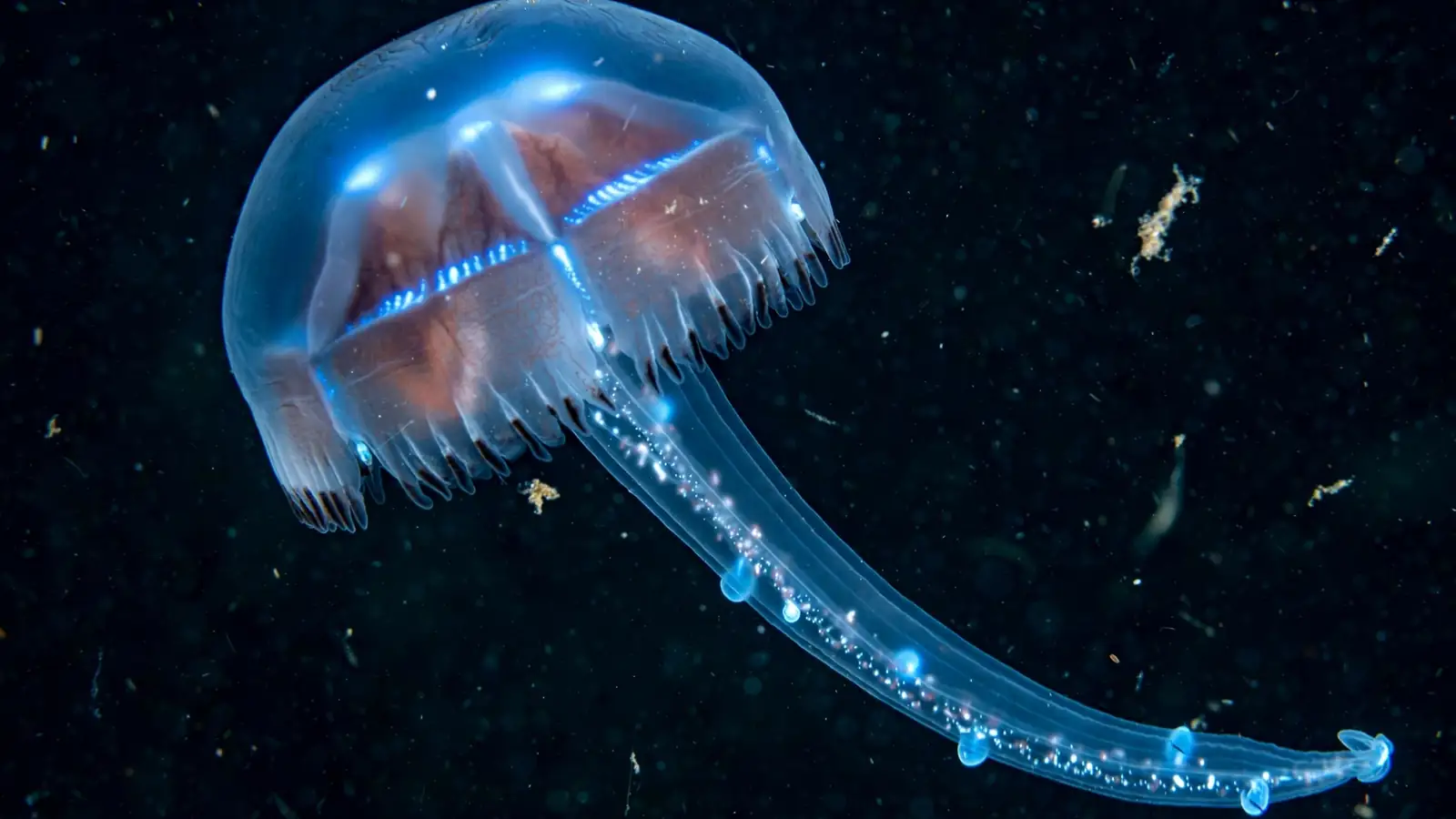
Three animals carry this guide. The Atolla jellyfish, Atolla wyvillei, is the alarm jelly, famous for a flashing blue display that may be the most dramatic light show in the deep sea. The helmet jellyfish, Periphylla periphylla, is a deep red crown that haunts the twilight zone and the Norwegian fjords. The giant phantom jellyfish, Stygiomedusa gigantea, is a pale giant with a bell over a metre across and arms up to 10 metres long — one of the largest invertebrates in the ocean, and a world away from the lion’s mane jellyfish of the sunlit shallows.
What unites them is not family but lifestyle. All three are drifters in the dark, all three make their own light, and all three are red, blue or pale in ways that make perfect sense once you understand how light behaves at depth. This guide takes them one at a time, then explains the two rules — glow and red — that govern them all.
Atolla Jellyfish: The Burglar Alarm of the Deep
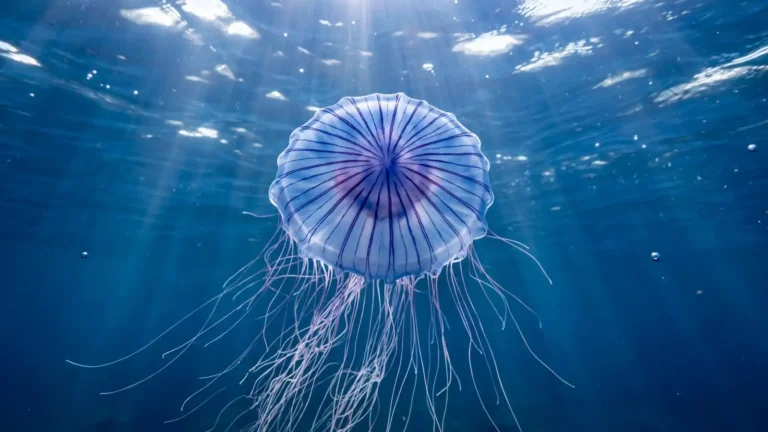
The Atolla jellyfish lives between 1,000 and 4,000 metres down, in the midnight zone, and it is one of the most recognisable animals in the deep sea. Its bell is shaped like a crown, with a deep groove around the middle and a single long tentacle trailing behind it, sometimes several metres long. The bell is usually a deep red, though in the dark of the midnight zone its colour is invisible.

What makes the Atolla famous is its alarm. When something grabs it, the jellyfish produces a rotating ring of blue light that ripples around its bell like a burglar alarm going off. The display is thought to work in two ways at once: it startles the attacker, and it advertises the attack to bigger predators, which may come and eat the attacker instead. It is a scream for help written in light, and it is one of the brightest bioluminescent displays ever measured in a jellyfish.
The single long tentacle is a fishing line. The Atolla drifts with the tentacle trailing, and anything that touches it is drawn up to the mouth. The animal also eats small crustaceans and other jellyfish, and it is itself eaten by fish and larger jellies. In a zone where food is scarce, the alarm is a gamble — light draws attention, and attention in the deep sea is not always friendly.
Helmet Jellyfish: The Red Crown of the Twilight Zone
The helmet jellyfish, Periphylla periphylla, is a deep red jellyfish with a tall, domed bell and 12 tentacles, and it is one of the most common large jellyfish of the deep sea. It lives from about 200 metres down to the abyss, in the twilight and midnight zones, and it is famously abundant in the Norwegian fjords, where the dark, deep water lets it rise much closer to the surface than it could in the open ocean.

The helmet jelly’s red colour is a disguise, not a decoration. Red light does not penetrate deep water, so at depth a red animal reflects almost no light at all — it looks black, and black is invisible in the dark. The helmet jelly is red for the same reason so many deep-sea animals are red: in a world without red light, red is the perfect camouflage.
Unlike the Atolla, the helmet jelly does not flash an alarm. It hunts quietly, drifting with its tentacles spread and catching small crustaceans, fish larvae and other jellyfish. It is a slow, patient animal, and its 12 tentacles give it a wide net. In the fjords it can gather in huge numbers, turning the deep water into a slow-moving red forest of bells. The helmet jellyfish creature feature from the Woods Hole Oceanographic Institution describes the animal’s deep red crown and its life in the twilight zone.
Giant Phantom Jellyfish: 10 m of Arms
The giant phantom jellyfish, Stygiomedusa gigantea, is one of the largest invertebrates in the ocean and one of the least seen. Its bell is over a metre across, and its four ribbon-like oral arms can stretch up to 10 metres long, trailing behind it like pale curtains in the dark. It has no stinging tentacles at all — the arms are for gathering food, not for stinging.

The phantom is rare in the records because it lives so deep and is so fragile. For decades it was known mostly from a handful of sightings, and each new one made the news. Submersibles have now filmed it in the Southern Ocean and the deep Pacific, drifting slowly through the midnight zone with its arms spread wide, catching plankton and small animals that drift into the ribbons.
Its size is a puzzle. In a zone where food is scarce, growing to more than 10 metres long seems like a bad bargain — until you realise that the arms are the hunting gear. A wider net catches more food, and the phantom’s net is one of the widest in the deep sea. The animal drifts, the arms drift with it, and the food comes to the net rather than the other way around.
Why Deep Sea Jellyfish Glow — and Why They Are Red
Deep sea jellyfish make light because light is the only signal that works in the dark. Bioluminescence — light made by a chemical reaction inside the animal — is used to startle predators, to lure prey, and to communicate. The Atolla’s flashing ring is the most dramatic example, but many deep-sea jellies glow when touched, and some produce a steady light that may act as a lure, drawing small animals close enough to catch.

The glow is made by the same kind of chemistry that lights a firefly, using a molecule called luciferin and an enzyme called luciferase. The light is almost always blue or green, because blue-green light travels furthest through seawater. A red glow would be swallowed by the water within a few metres, so the deep sea speaks in blue.
Red is the other half of the story. Red light from the sun is absorbed in the first few metres of seawater, so below about 10 metres there is effectively no red light at all. A red animal at 1,000 metres reflects nothing, because there is no red light to reflect — it looks black. That is why the helmet jelly, the Atolla and so many other deep-sea animals are red: in a world without red light, red is invisible.
Deep Sea Jellyfish Diet and Survival
Deep sea jellyfish eat what drifts past. The menu is small crustaceans, fish larvae, other jellyfish and the steady rain of dead material from above, the marine snow that falls through the water column day and night. The Atolla fishes with its single long tentacle, the helmet jelly spreads 12 tentacles like a net, and the giant phantom trails its ribbon arms for up to 10 metres behind it.

Food is scarce at depth, so the deep-sea jellies are built to wait. They drift rather than swim, saving energy, and they can go long periods between meals. Some can shrink when food is short, living off their own tissues until the next meal arrives. It is a life of patience, and the animals that survive it are the ones that spend the least and catch the most.
They are also food themselves. Fish, turtles and larger jellyfish eat deep-sea jellies, and the Atolla’s alarm may be as much about calling in a bigger predator to eat its attacker as about scaring the attacker away. The deep sea has other glowing drifters too, including the giant siphonophore, a colonial animal that can stretch longer than a blue whale. In the midnight zone, everything is both hunter and hunted, and the jellyfish that glow brightest are the ones with the most to lose.
Fun Facts
- The Atolla jellyfish flashes a rotating blue burglar alarm when attacked.
- The giant phantom jellyfish has arms up to 10 metres long and no stinging tentacles.
- Red animals look black at depth, because red light never reaches them.
- The helmet jellyfish is so common in Norwegian fjords that it fills the deep water there.
- Deep sea jellyfish make blue-green light, because blue travels furthest through seawater.
- The Atolla lives 1,000 to 4,000 metres down, in the midnight zone.
Frequently Asked Questions
What is a deep sea jellyfish?
Deep sea jellyfish is a description, not a single species — it covers every jellyfish that lives in the deep ocean, from the twilight zone at 200 metres down to the midnight zone at 4,000 metres and beyond. The best-known examples are the Atolla alarm jelly, the helmet jelly and the giant phantom jelly.
How deep do deep sea jellyfish live?
The Atolla lives 1,000 to 4,000 metres down, the helmet jelly from about 200 metres to the abyss, and the giant phantom jelly in the midnight zone. In the Norwegian fjords, helmet jellies rise much closer to the surface because the deep, dark water suits them.
What is the Atolla alarm jellyfish?
The Atolla jellyfish (Atolla wyvillei) is a crown-shaped deep-sea jellyfish that produces a rotating ring of blue light when attacked — a burglar alarm that startles the attacker and may attract a bigger predator to eat it. It lives 1,000 to 4,000 metres down and fishes with a single long tentacle.
What is a helmet jellyfish?
The helmet jellyfish (Periphylla periphylla) is a deep red jellyfish with a tall domed bell and 12 tentacles. It lives from about 200 metres down to the abyss and is famously abundant in Norwegian fjords. Its red colour makes it effectively invisible at depth, because red light does not penetrate deep water.
Why are deep sea jellyfish red?
Many deep sea jellyfish are red because red light is absorbed in the first few metres of seawater, so at depth there is no red light to reflect. A red animal reflects almost nothing and looks black — and black is invisible in the dark. Red is camouflage in a world without red light.
How do deep sea jellyfish make light?
They make light by bioluminescence, a chemical reaction using a molecule called luciferin and an enzyme called luciferase. The light is almost always blue or green, because blue-green light travels furthest through seawater. It is used to startle predators, lure prey and communicate.
What is the giant phantom jellyfish?
The giant phantom jellyfish (Stygiomedusa gigantea) is one of the largest invertebrates in the ocean, with a bell over a metre across and four ribbon-like oral arms up to 10 metres long. It has no stinging tentacles — the arms gather plankton and small animals as it drifts through the midnight zone.
Similar Species Worth Exploring
Keep Exploring
From the alarm jelly’s blue flash to the phantom’s 10-metre ribbons, the dark zone is full of drifters that make their own light — keep exploring the deep sea jellyfish.