Northern Gannet
Northern Gannet: The 100 km/h Plunge Diver
The northern gannet is the North Atlantic’s largest seabird, a white torpedo that folds its wings and dives from 30 metres, hitting the water at 100 km/h — and surviving it.
By Emily Carter · Reviewed by our vet team · Updated 10 November 2026 · 9 min read
Dives at 100 km/hWingspan 170–180 cmBass Rock colonies
At a Glance
The northern gannet is the largest seabird in the North Atlantic, a white-and-black hunter that plunge-dives from 30 metres and hits the water at 100 km/h. It nests in huge cliff colonies and eats the mackerel and herring of the cold northern seas.
Northern Gannet Plunge Diving: 100 km/h Into the Sea
Its dive is one of the great sights of the North Atlantic. From 30–40 metres up, the bird folds its wings back, turns into a white arrow, and drops — hitting the water at up to 100 km/h, fast enough to stun the fish below before it even touches them. The figures are maxima, not averages: up to 100 km/h, from up to 30–40 metres, on a good day with a clear sighting.

The dive is a hunt, not a stunt. The gannet spots a shoal from the air, climbs, folds and falls, and the impact does the first part of the work — the shockwave stuns the fish, and the bird grabs them underwater before they recover. A gannet that dives well eats well, and a colony of thousands diving together can strip a shoal in minutes.
Northern Gannet Size: The North Atlantic’s Largest Seabird
It is the largest seabird in the North Atlantic: 87–100 cm long, with a wingspan of 170–180 cm and a weight of 2.3–3.6 kg. It is a big bird by any measure — bigger than a herring gull, bigger than a cormorant, and the largest of the gannets — and it looks it, a white bird with black wingtips and a yellow-tinged head, built like a torpedo.

The size is part of the dive. A heavier bird hits harder, and the gannet’s 3 kg of muscle and bone is what lets it survive a 100 km/h impact that would break a smaller bird. The wings are long and narrow, built for soaring over the sea rather than flapping, and the body is streamlined for the fall. Everything about the gannet is built for the dive — including its size.
How They Survive the Impact: Air Sacs and No Nostrils
Hitting water at 100 km/h should break a bird’s neck — and the gannet survives it with anatomy, not luck. Air sacs under the skin cushion the impact, acting like bubble wrap between the body and the water. There are no external nostrils to flood: the gannet breathes through its mouth, so the impact cannot force water up its nose. And the skull and neck are reinforced, built to take the shock.
The whole bird is a crash helmet with wings. The air sacs absorb the blow, the closed nostrils keep the water out, and the reinforced bones hold the shape. It is not invulnerable — young gannets misjudge dives and die — but an adult gannet can dive all day, hundreds of times, and come up every time. For the full account of the dive and the anatomy behind it, see this gannet guide, which covers how they dive, how they survive it, and where to find them.
Where They Nest: Cliff Colonies
Northern gannets nest in cliff colonies in Canada, Iceland and the British Isles — huge, noisy, white cities on the edge of the sea. Bass Rock, off the Scottish coast, is the most famous: a single rock holding tens of thousands of nests, white with birds and loud with their calls, visible from miles away.

The colony is a nursery and a fortress in one. The cliffs keep ground predators away, the sea below brings the food, and the density of nests means every bird has neighbours to watch and learn from. Gannets pair for life, they return to the same nest site year after year, and the colony grows by the same fidelity — birds that were born on Bass Rock come back to Bass Rock to breed.
What They Eat: Mackerel, Herring and Sandeels
Northern gannets eat mackerel, herring and sandeels — the schooling fish of the cold North Atlantic. They catch them by plunge-diving, stunning the shoal with the impact and grabbing the fish underwater, and they can dive deep and stay down, chasing the fish below the surface.

The diet follows the shoals, and the shoals move with the seasons. In summer the gannets work the coastal waters near their colonies; in winter they range further south, following the mackerel and herring to warmer water. A gannet eats a lot — a breeding bird can take hundreds of grams of fish a day — and the colony’s appetite is one of the great pressures on the North Atlantic’s fish stocks.
Bigger Than a Cormorant: The Rival on the Cliffs
It and the great cormorant share the same cliffs and the same seas, and they are easy to tell apart once you know the marks. The gannet is the larger bird — 87–100 cm against the cormorant’s 80–100 cm — and it is white with black wingtips and a yellow-tinged head, where the cormorant is dark, almost black, with a white thigh patch in breeding season.

The hunting styles differ even more than the looks. The gannet plunge-dives from 30 metres at 100 km/h; the cormorant swims underwater, chasing fish with its feet and its wings half-open. The gannet is the bird of the air and the fall; the cormorant is the bird of the water and the chase. Same cliffs, same sea, two completely different ways of making a living.
Conservation: Least Concern, Avian Flu Watch
It is listed as Least Concern, and its population is large — hundreds of thousands of breeding pairs across the North Atlantic, with Bass Rock alone holding tens of thousands of nests. It is not a rare bird, and it is not in obvious decline.
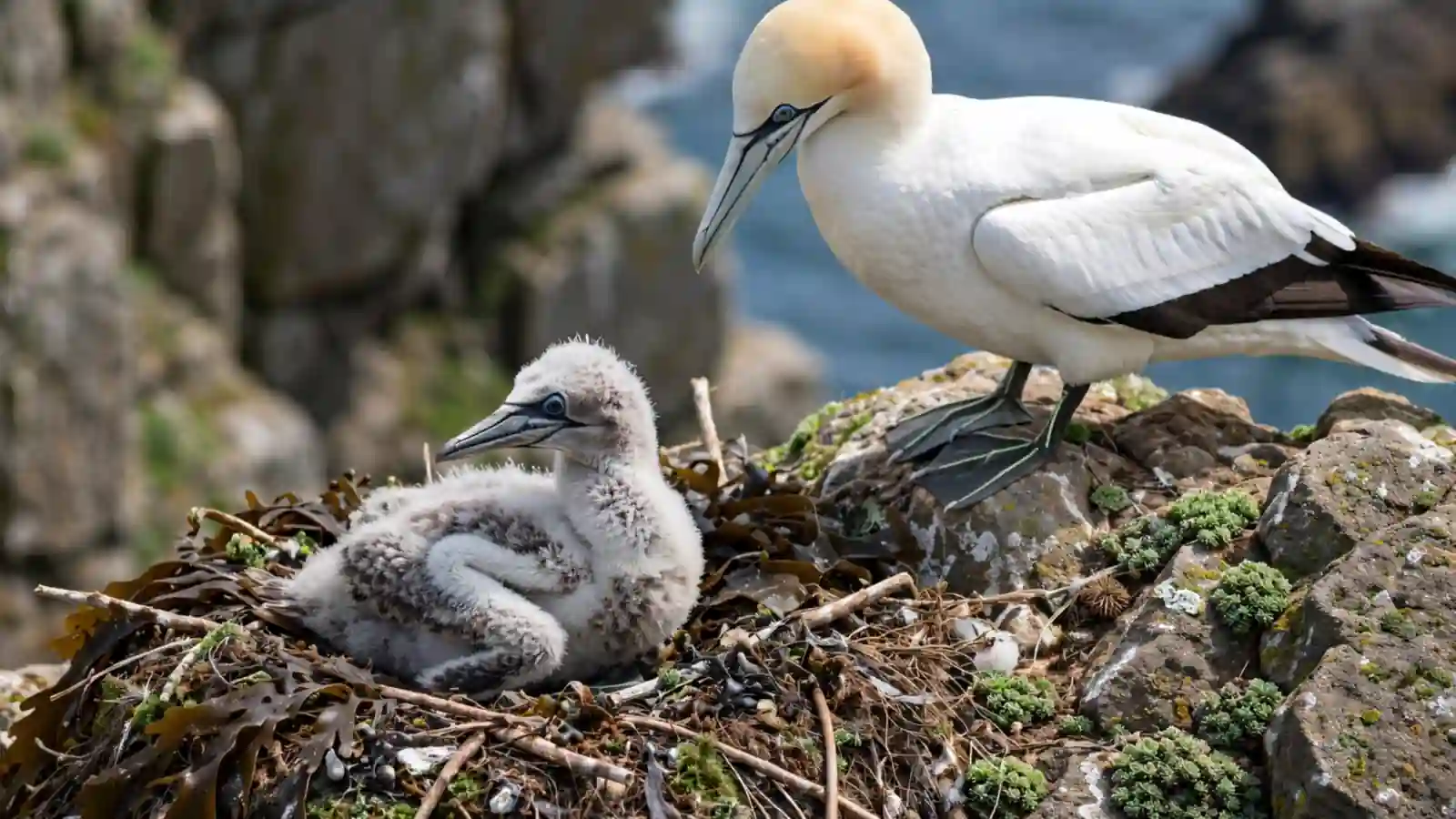
The watch item is avian flu. Highly pathogenic avian influenza has hit gannet colonies hard in recent years, killing adults and chicks in numbers that would have been unthinkable a decade ago, and the colonies are still recovering. The status is Least Concern, but the flu is the threat that conservationists watch — and the reason the great white colonies are counted more carefully than ever.
Fun Facts
- It dives from 30–40 metres and hits the water at up to 100 km/h.
- It has no external nostrils — it breathes through its mouth, so the dive cannot flood its nose.
- Air sacs under its skin cushion the impact, like bubble wrap.
- It is the largest seabird in the North Atlantic, at 87–100 cm.
- Bass Rock holds tens of thousands of nests on a single rock.
- Gannets pair for life and return to the same nest site year after year.
Frequently Asked Questions
What Is a Northern Gannet?
A northern gannet is a large seabird, Morus bassanus, of the North Atlantic — the largest seabird in the region, at 87–100 cm with a wingspan of 170–180 cm. It is white with black wingtips and a yellow-tinged head, and it is famous for plunge-diving from 30 metres at up to 100 km/h.
How Fast Do Northern Gannets Dive?
Up to 100 km/h, from heights of up to 30–40 metres. The figures are maxima, not averages: the bird folds its wings, drops like an arrow, and the impact stuns the fish below before it even touches them.
How Big Is a Northern Gannet?
87–100 cm long, with a wingspan of 170–180 cm and a weight of 2.3–3.6 kg. It is the largest seabird in the North Atlantic — bigger than a herring gull and bigger than a great cormorant.
Where Do Northern Gannets Nest?
In cliff colonies in Canada, Iceland and the British Isles. Bass Rock, off the Scottish coast, is the most famous — a single rock holding tens of thousands of nests. Gannets pair for life and return to the same nest site year after year.
What Do Northern Gannets Eat?
Mackerel, herring and sandeels — the schooling fish of the cold North Atlantic. They catch them by plunge-diving, stunning the shoal with the impact and grabbing the fish underwater. A breeding bird can take hundreds of grams of fish a day.
How Do Northern Gannets Survive Hitting the Water?
With air sacs under the skin that cushion the impact, no external nostrils to flood (they breathe through the mouth), and a reinforced skull and neck. The whole bird is built for the fall — and an adult can dive hundreds of times a day without injury.
Are Northern Gannets Endangered?
No — the northern gannet is listed as Least Concern, with hundreds of thousands of breeding pairs. The watch item is avian flu, which has hit colonies hard in recent years and is the threat conservationists monitor most closely.
Similar Species Worth Exploring
Keep Exploring
Meet the great cormorant, the gannet’s dark rival on the cliffs, then the Manx shearwater, the shearwater that owns Skomer, and browse the whole family in our types of seabirds hub — then come back to the 100 km/h plunge diver, the northern gannet.