Krill
Krill: the tiny crustaceans that feed the ocean
Krill are small, translucent, shrimp-like crustaceans with an outsized job: converting microscopic algae into food for the largest animals that have ever lived. A single species in the Southern Ocean outweighs humanity. This guide explains what they are, how big they grow, what eats them, the northern species of the Atlantic, and why the fishery chasing their oil has become one of the ocean’s biggest arguments.
By Emily Carter · Reviewed by our vet team · Updated 10 November 2026 · 8 min read
85 known speciesAntarctic biomass ~379 million tonnesMost adults only 1–2 cm long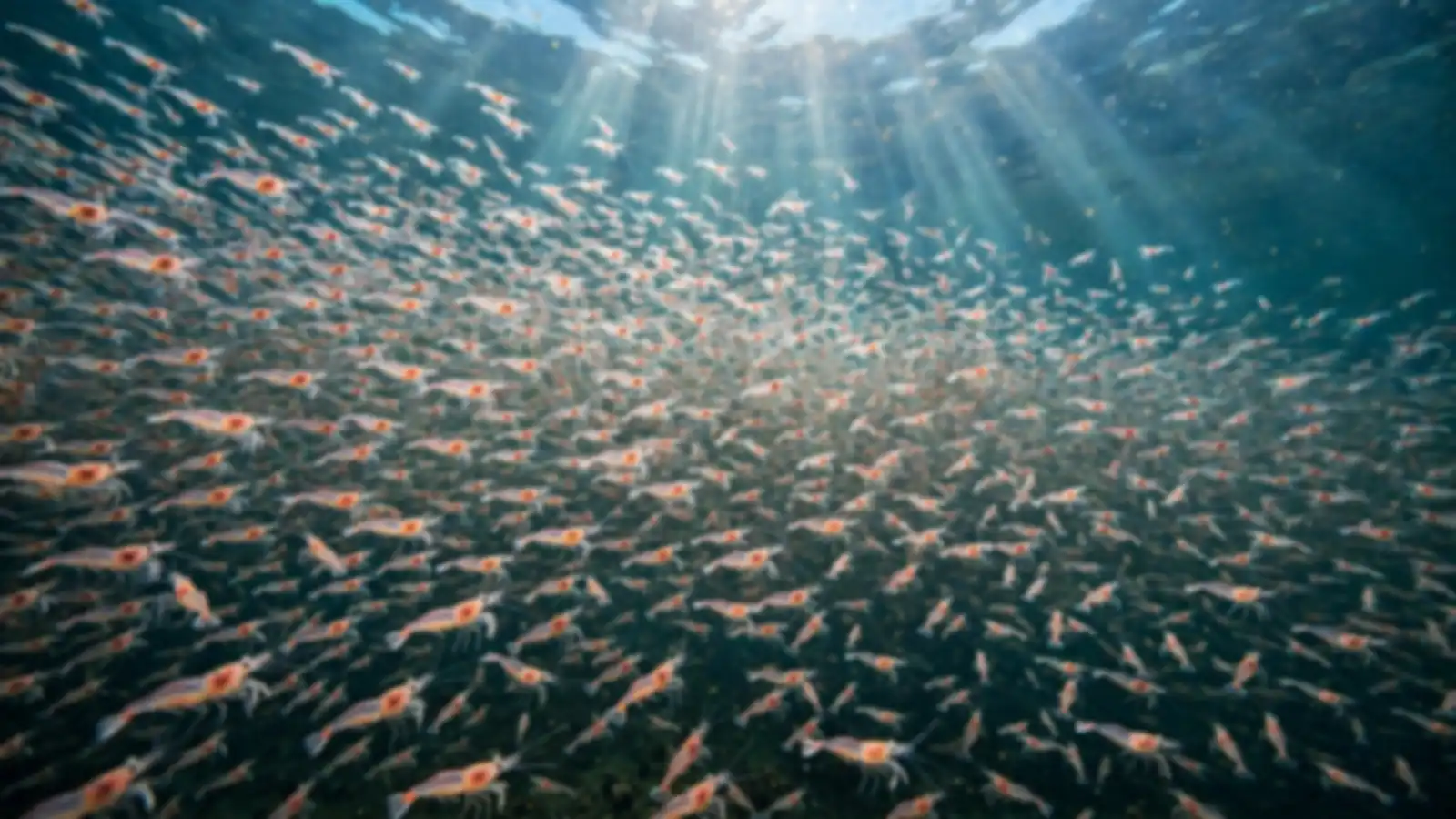
At a Glance
Krill are the one animal group the ocean cannot do without. These finger-length crustaceans graze the plankton blooms of cold seas and are eaten, in almost inconceivable quantities, by everything from penguins to the blue whale. Remove them and the great wildlife spectacles of the polar oceans simply stop.
This is a group guide to all 85 species, with a special section on the superstar — the Antarctic species, which also earns its own dedicated profile in this programme — and on its Atlantic cousin the northern one, folded into this page. It ends with the modern dilemma: they are now targeted by an industrial fishery, and the whole food web is watching.
What Are Krill?
They form the order Euphausiacea: 85 species of small crustaceans, most in the family Euphausiidae. The body is shrimp-like but with giveaway features — the feathery gills hang outside the shell where you can see them fluttering, the carapace is largely transparent, and a row of light organs called photophores runs along the underside, flashing blue-green in the dark. Nearly all of them glow; scientists still debate whether the lights serve camouflage, communication or both.

They live in every ocean, usually in swarms so dense they discolour the surface — sailors described a living ‘soup’ long before science caught up. By day many species sink hundreds of metres to hide in the dark; by night they rise to feed near the surface, a daily migration of billions of tonnes of animal life. It happens in every ocean basin on Earth, every single night, and it has done so for millions of years — the largest daily movement of life on the planet, performed by animals most people never see.
They are not true shrimp, though the resemblance misleads everyone. Shrimp carry their gills hidden under the shell; they wear theirs outside, feathery and visible. The one exception to the family glow is the primitive Bentheuphausia amblyops, a deep-water species with no photophores at all — the living reminder that even this body plan had a first draft. Everything else in the order lights up.
How Big Do They Get?
Smaller than you would guess, given their importance. Most adults measure just one to two centimetres; even the Antarctic giant of the group tops out around six centimetres, and only the deep-water Thysanopoda cornuta reaches 15. Against that, their numbers are astronomical — a single swarm can hold billions of individuals.
Feeding is a filtering marvel. The front legs form a fine basket of combs and bristles; it pumps water through it and rakes out phytoplankton — especially glass-shelled diatoms — with exquisite efficiency. Some species also hunt small zooplankton. In winter, the Antarctic species scrapes algae from the underside of sea ice, and can survive months of darkness by literally shrinking between moults.

Growth runs on moults. Like all crustaceans, they shed their shells to expand, and the Antarctic species can keep this up for a lifespan thought to reach five or six years — a remarkable age for an animal at the bottom of everything’s menu. In good summers they grow fast; in the long polar night they wait, shrink and endure, which is why an individual’s size says more about its recent past than its age.
Who Eats Them? Inside the Food Web
Almost everything with a mouth, it sometimes seems. Of the Antarctic population’s roughly 379 million tonnes, more than half is eaten every single year — by baleen whales lunge-feeding through the swarms, by crabeater and leopard seals, by penguins and flying seabirds, by squid and by fish. They are the gearbox of the Southern Ocean: small cogs that transfer the energy of plankton blooms up to every famous animal in the region.

The same pattern, quieter, repeats worldwide. Herring, salmon and countless other fish depend on them; so do the seabird colonies of the North Atlantic. When their years are poor, the failure echoes upward within months — thinner whales, empty penguin nests, seabirds that never breed. The full cast of those colonies fills our guide to the types of seabirds. The dependency also runs in time: a single bad season shows up as missing chicks and skipped breeding long before it shows up in any catch statistic.

The service runs deeper than food. They package surface plankton into faecal pellets that sink, carrying carbon down toward the deep ocean; their moults and carcasses do the same. Whales then return iron and nutrients to the surface in their own waste, fertilising new plankton blooms. Scientists describe the whole loop as a biological pump — and they are its pistons, moving carbon and energy through the ocean in both directions. Remove them from the loop and the pump slows with them: less carbon buried, fewer blooms fertilised, and a food web that starts to run on empty.
Antarctic Superstar, Northern Cousin
One species dominates the story. The Antarctic species, Euphausia superba, is arguably the most abundant wild animal species on Earth by weight, and the engine of the entire Southern Ocean ecosystem — it gets its own full profile in our dedicated guide. Everything written about their conservation is, at heart, about this species and the swarms of the Scotia Sea.
The Northern Species
The Atlantic has its own counterpart. The northern species, Meganyctiphanes norvegica, swarms from the Mediterranean to the Arctic, rising at night and sinking by day through as much as several hundred metres of water. It feeds the North Atlantic’s fish, whales and seabirds exactly as its southern cousin feeds Antarctica — the same keystone role in a less famous sea.
Geography concentrates the drama. The densest Antarctic swarms gather where currents squeeze past the Antarctic Peninsula and through the Scotia Sea — the same corridor where the region’s penguin colonies, seal haul-outs and whale feeding grounds are stacked. It is no coincidence that the fishery works there too: everyone, industrial or wild, is queuing at the same two-centimetre buffet. That overlap is precisely why the science of counting swarms — from research nets to echo sounders on fishing vessels — matters far beyond the species itself.
For the full scientific overview of the group, the reference page catalogues all eleven genera and the research on their migrations and light organs.
Krill Oil and the Fishery
Humans harvest them for aquaculture feed, fishing bait, food — Japan’s okiami is the best known — and above all for their oil, the omega-3 supplement industry that has driven the modern fishery. The catch is concentrated in the same Scotia Sea waters where penguins and whales feed, which is why the fishery is managed internationally and why every season is argued over.
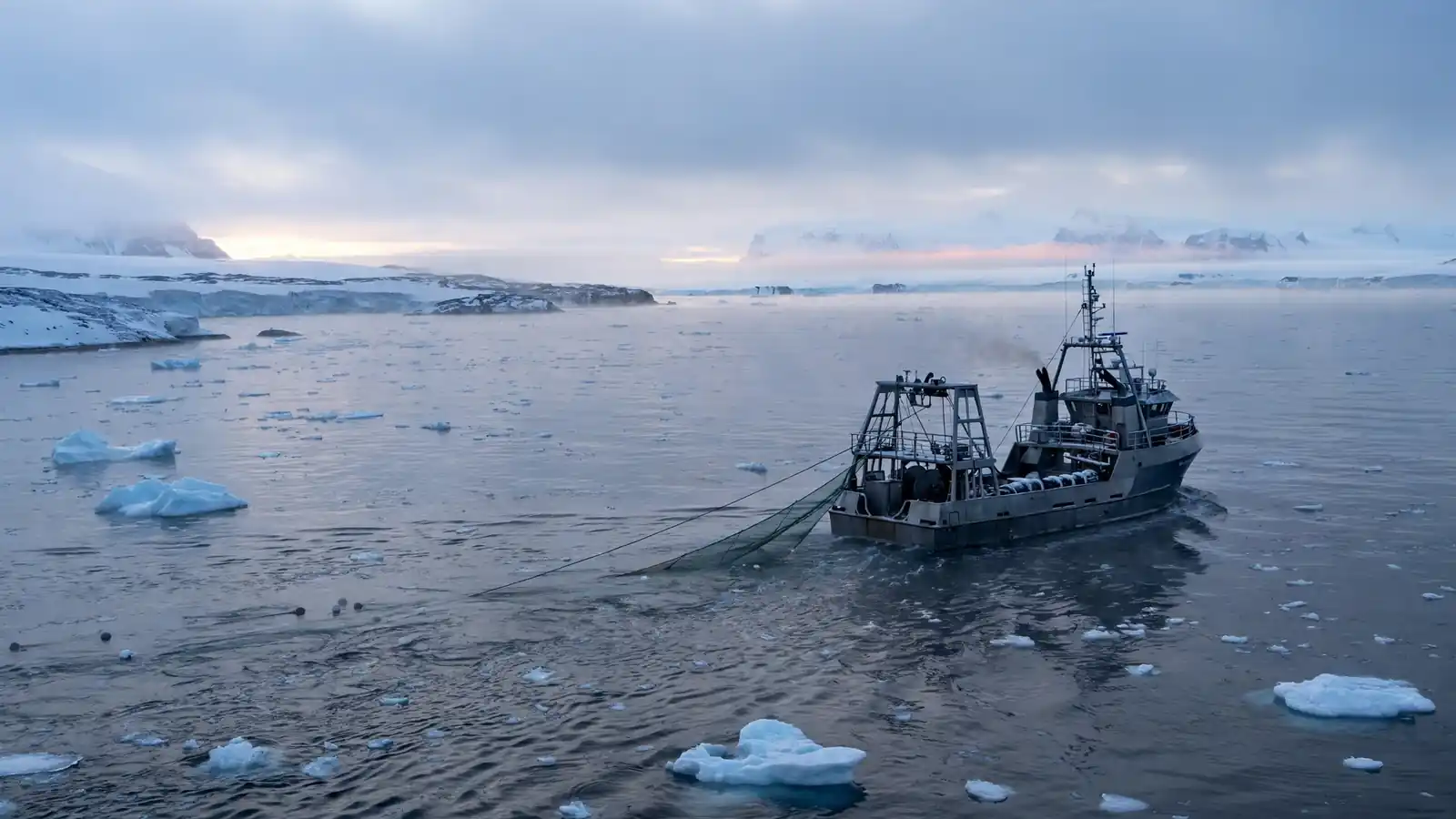
The argument sharpened recently: in 2026 the Antarctic fleet again reached the 620,000-tonne trigger limit that forces the season to close — the second straight year it has done so, after a record catch of roughly 625,000 tonnes in 2025 — and the season shut in August with conservation safeguards under renewed debate. A two-centimetre crustacean now sits at the centre of geopolitics, which tells you everything about how much of the ocean runs on them.
The deeper worry is concentration. The overall catch cap sounds small against 379 million tonnes, but the fleet does not spread across the whole Southern Ocean — it fishes the same peninsula and island waters where penguins are raising chicks and whales are refuelling. Managing the harvest therefore means managing the whole food web’s calendar and map, not just a tonnage: the central challenge for the international commission that governs the fishery in the years ahead. The years ahead will test that idea season by season, in the one stretch of ocean where the watchers, the predators and the fleet all arrive at the same time.
Fun Facts
- They carry light organs that flash blue-green; a startled swarm can light up the water like a firework display.
- Their Antarctic biomass, about 379 million tonnes, is roughly double the weight of all humanity.
- More than half of that biomass is eaten every year — and the population still replaces itself, such is the productivity of the Southern Ocean.
- When food disappears, they can shrink at each moult, effectively growing younger and smaller to survive the winter.
- A large baleen whale can eat several tonnes of them in a single day during the feeding season.
- Their eyes are on stalks and their gills are worn outside the shell — look closely and you can see them fluttering like tiny feathers.
Frequently Asked Questions
Why Is Krill So Important?
They are important because they are the main food link between microscopic plankton and large ocean animals. Baleen whales, seals, penguins, seabirds, squid and many fish depend on them directly. In the Southern Ocean, the Antarctic species alone supports almost the entire food web, so their abundance decides whether the region’s famous wildlife thrives or starves.
What Do Krill Eat?
They eat phytoplankton — especially diatoms — which they filter from the water with a basket of fine, comb-like front legs. Some also catch small zooplankton. In winter, the Antarctic ones graze algae growing on the underside of sea ice and can survive long dark months on stored energy, even shrinking between moults.
Which Animals Eat Krill?
A huge share of ocean life eats them: baleen whales, crabeater and leopard seals, penguins, petrels and other seabirds, squid, and fish from herring to salmon. More than half of the Antarctic population — hundreds of millions of tonnes — is consumed by predators every year, which is why they are called a keystone of the food web.
What Is Krill Used For?
It is used as feed for farmed fish, as fishing bait, as food in some countries (such as okiami in Japan), and increasingly as the raw material for oil supplements. The industrial fishery works mainly in the Southern Ocean and is internationally managed because so many wild predators depend on the same swarms.
What Is Krill Oil?
It is an oil extracted from the Antarctic species, rich in omega-3 fatty acids (EPA and DHA) bound in a form the body absorbs readily, plus the red pigment astaxanthin that gives the oil its colour. It is sold as a dietary supplement. Demand for the oil is the main driver of the modern fishery.
What Are Krill?
They are small shrimp-like crustaceans of the order Euphausiacea, comprising 85 known species. Most adults are only one to two centimetres long, with transparent shells, feathery external gills and light-producing organs. They live in swarms in every ocean and feed by filtering plankton from the water.
Similar Species Worth Exploring
Keep Exploring
Dive deeper with the Antarctic krill profile, or browse the whole family in our guide to the types of crustaceans. The largest animals on Earth run on krill.