Marine Iguana
Marine Iguana: The Only Lizard That Swims in the Sea
The marine iguana is the world’s only seagoing lizard — a black, spiny reptile that dives into the Pacific to graze on algae, sneezes out salt, and can shrink its own skeleton when food runs out. It lives nowhere on Earth except the Galápagos Islands, and every island has its own version of it.
By Emily Carter · Reviewed by our vet team · Updated 10 November 2026 · 10 min read
Only seagoing lizardGalápagos onlyShrinks up to 20%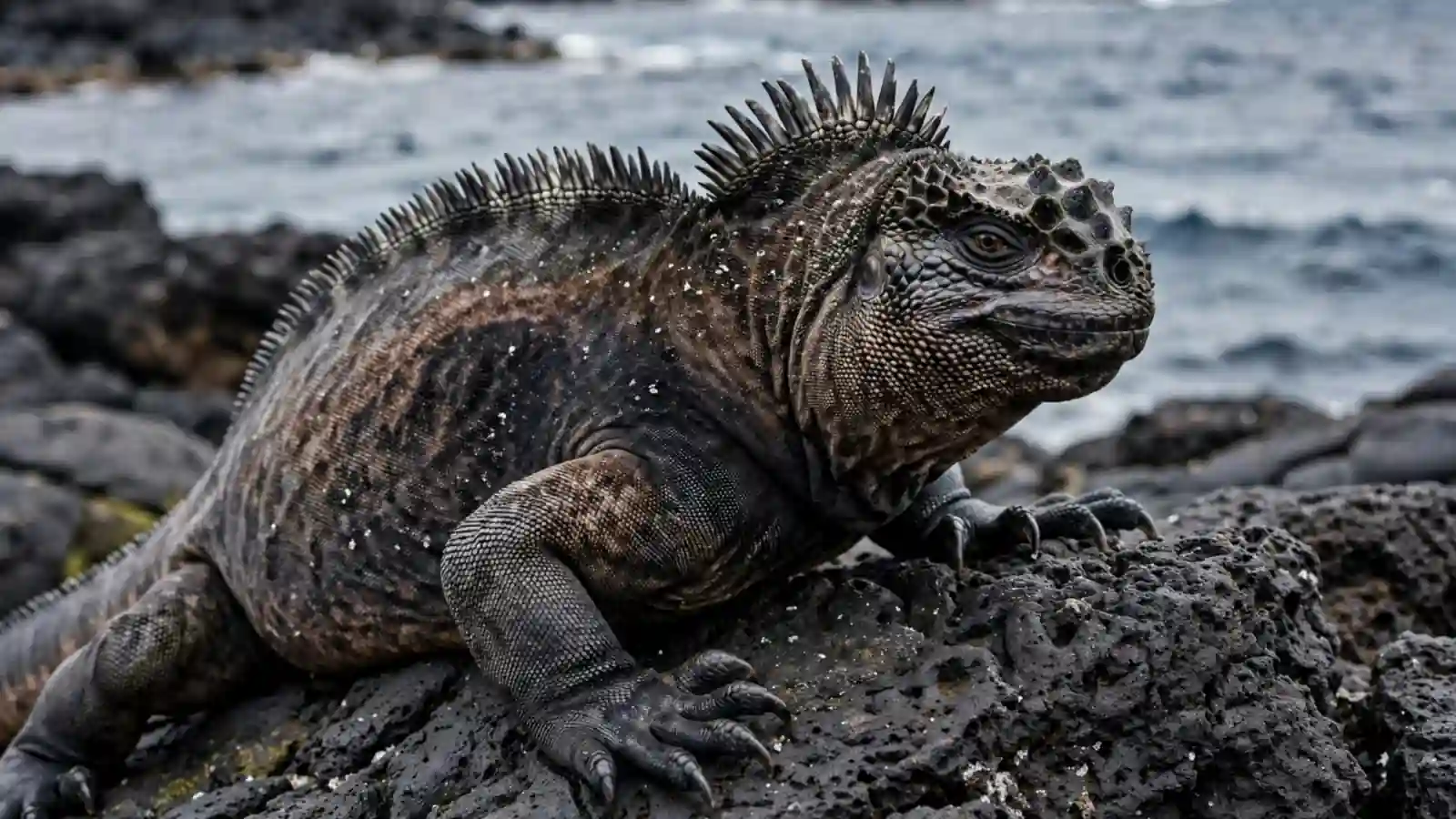
At a Glance
The marine iguana looks like a creature from another age: black as lava, crested like a small dragon, basking in piles on the rocks while the surf breaks around it. Charles Darwin called the animals hideous when he met them in 1835, and then he watched one swim — and realised he was looking at the only lizard in the world that makes its living in the sea.
The Only Seagoing Lizard
No other lizard on Earth does what this one does. Every other iguana lives on land and eats leaves; this one walks into the Pacific, dives down to the algae beds, and comes back to the rocks to warm up in the sun. It is a marine reptile in the full sense: it feeds in the sea, it swims with a flattened tail built for the job, and it has salt glands in its nose that let it drink seawater’s salt load and sneeze the excess away.
The species lives only on the Galápagos Islands, a volcanic archipelago about 1,000 kilometres off the coast of Ecuador, and it is found on nearly every island in the group. Each island’s population has its own size, colour and habits, shaped by the local food and the local sea temperature — and together they add up to one of the strangest success stories in reptile evolution.
Marine iguanas are social in a way few lizards are. They bask in dense piles, sometimes thousands of animals along a single stretch of shore, and they defend tiny territories on the rocks with head-bobs and shoving matches. Males in breeding season flush red and green, turning the black colony into a patchwork of colour — a display that has made them one of the most photographed animals in the Galápagos.
Marine Iguana Size: Island by Island
Marine iguana size depends on where the animal lives. The largest males, on the big western islands of Isabela and Fernandina, reach about 1.3 metres from nose to tail tip and weigh up to 12 kilograms. Females are roughly half that size, around 80 centimetres, and on small islands the whole population runs smaller — the Genovesa iguanas are dwarfs beside their Isabela cousins.
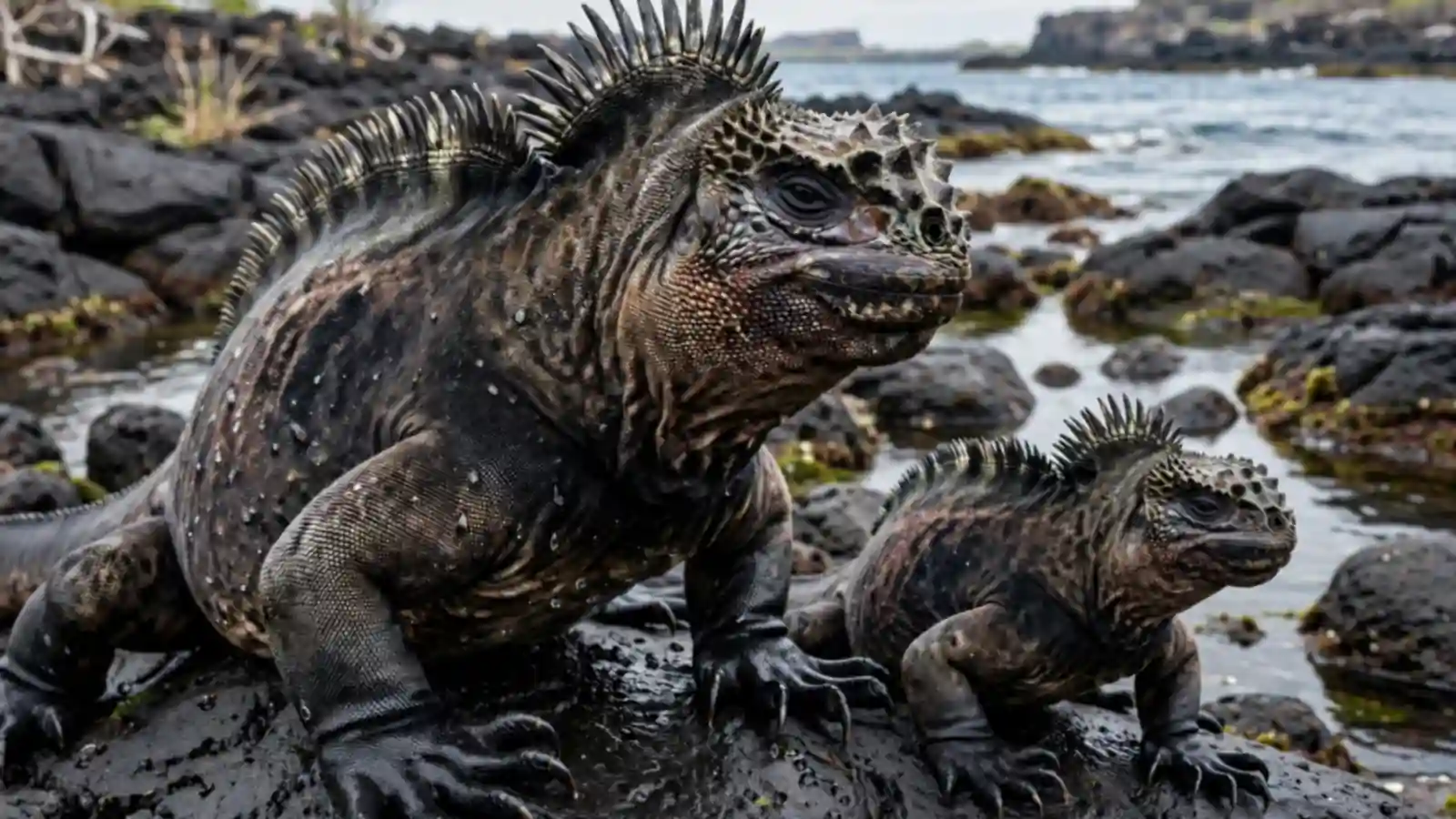
The rule is simple: big islands with rich algae beds grow big iguanas, and small islands grow small ones. Food supply sets the size, and the sea temperature sets the limit, because a cold-blooded animal that feeds in cold water must warm up on the rocks between dives. An iguana that grows too big for its island’s food supply simply does not survive the lean years.
Males are easy to tell from females even at a distance. Males are bigger, with a taller spiny crest down the neck and back, and in the breeding season their flanks flush with red, green and turquoise. Females stay smaller and plainer, dark grey or brown, and young iguanas are darker still, almost black, with a pale stripe down the back that fades as they grow.
What Do Marine Iguanas Eat?
It eats almost nothing but marine algae. At least nine or ten genera of seaweed make up the menu, mostly fine red seaweeds that grow on the rocks in the intertidal zone and just below it. The animal scrapes the algae off with blunt teeth built for the job, and it is so specialised that its gut, its teeth and even its flattened snout are all shaped by this one food.

Feeding happens in two ways. Females and smaller males graze at low tide on the rocks the sea has uncovered, picking algae in the open air. The largest males dive for it, swimming down to the algae beds below the tide line — the only iguanas in the world that feed underwater. A big male can stay down for about ten minutes, and the largest recorded dives reach about 30 metres.
Salt comes with the food, and the iguana deals with it theatrically. Salt glands above the eyes collect the excess salt from the blood and expel it through the nostrils, and the animal sneezes it out in a fine spray — its famous sneeze, which leaves white salt crusts on the snout and the rocks around the basking piles.
How Marine Iguanas Dive
Diving is a cold business for a cold-blooded animal. The water around the Galápagos is cool, and an iguana loses body heat fast once it is under. Only the largest males dive at all, and most dives stay under 5 metres, where the algae is thickest and the trip is short. The animal swims with powerful sweeps of its flattened tail, clings to the rock with long claws, and grazes while its body temperature falls. The diving behaviour is described in detail in the marine iguana animal facts guide.

A dive lasts about ten minutes on average. When the iguana surfaces it hauls out onto the black lava and basks, flattened against the warm rock, until its body temperature is back up — and then it dives again. On a good day a big male may make a dozen dives, and the rhythm of dive and bask sets the pace of the whole colony’s day.
The flattened tail is the key adaptation. Land iguanas have round tails built for balance on branches; the marine iguana’s tail is flattened side to side like a paddle, and it drives the animal through the water with slow, powerful strokes. The claws are long and curved for gripping rock in the surge, and the nostrils sit high on the snout so the animal can breathe with only the tip of its head above water.
The Shrinking Trick
The marine iguana’s strangest trick appears when the food disappears. In El Niño years the warm water kills off the algae beds, and the iguanas begin to starve. Instead of dying, the animals shrink: they reabsorb bone, losing up to about 20 percent of their body length, and when the algae returns they grow again. It is the only known case of an adult vertebrate shrinking its skeleton and then regrowing it.
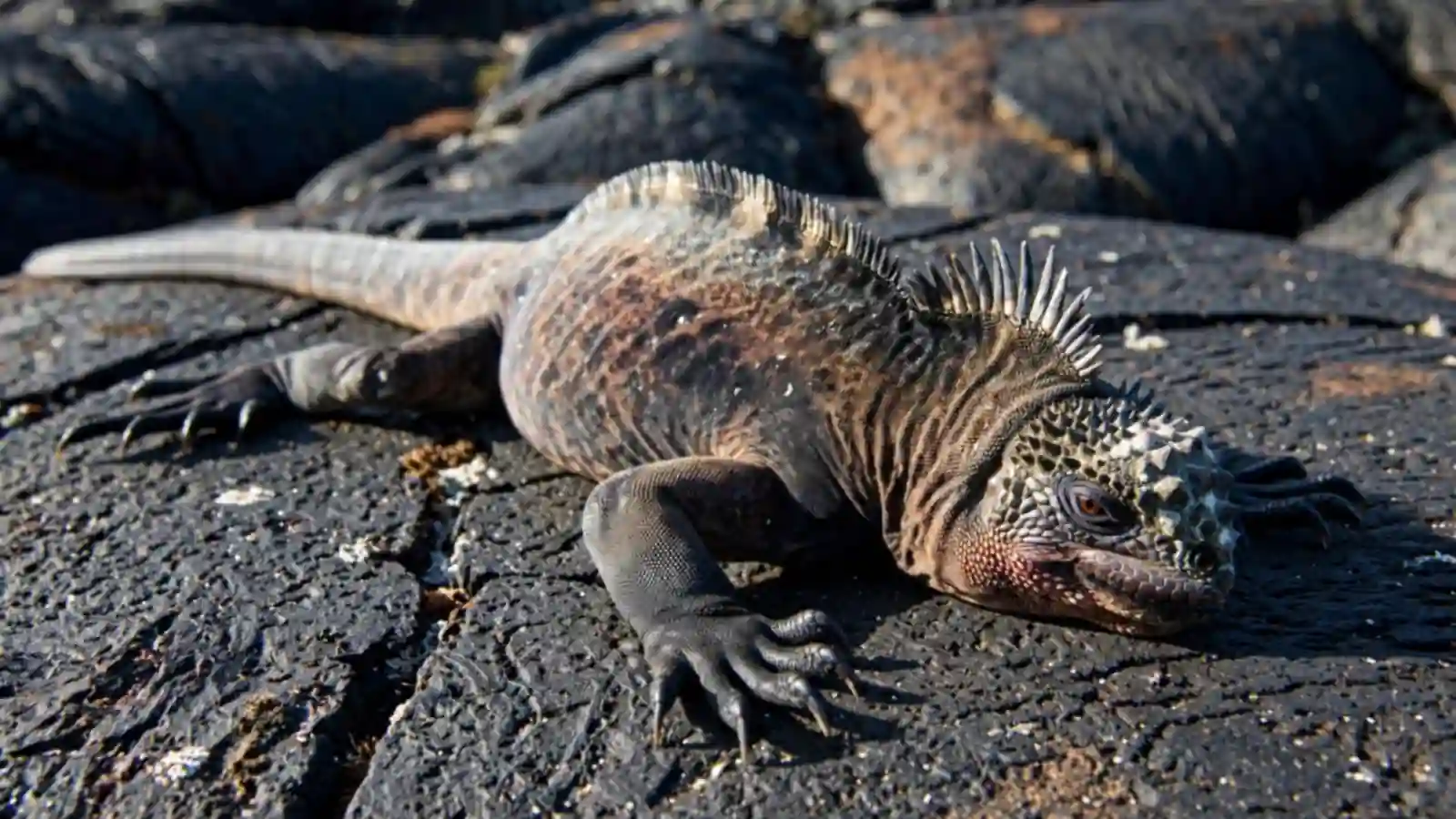
Shrinking is not free. The animals that shrink survive the famine, but they grow back smaller than they were, and the smallest iguanas — the ones with the least to lose — die in the greatest numbers. In bad El Niño years, 30 to 50 percent of a colony can die, and in the worst-hit places mortality has reached 90 percent. The survivors are the ones that shrank early and shrank most.
The trick was only confirmed in the 2000s, when researchers measuring the same marked animals year after year found them shorter after a famine than before it. It rewrites what a skeleton is for: not a fixed frame, but a store of minerals the body can spend when it has to, and rebuild when times improve.
Marine Iguana Subspecies
Ask how many kinds of marine iguana there are and you will get three answers: seven, eight or eleven. The newest answer comes from a 2017 genetic study, which recognised 11 subspecies — eleven population clusters, each tied to its own island or group of islands, each with its own size and colour. That is the count this guide uses, and it is the one the current research supports.
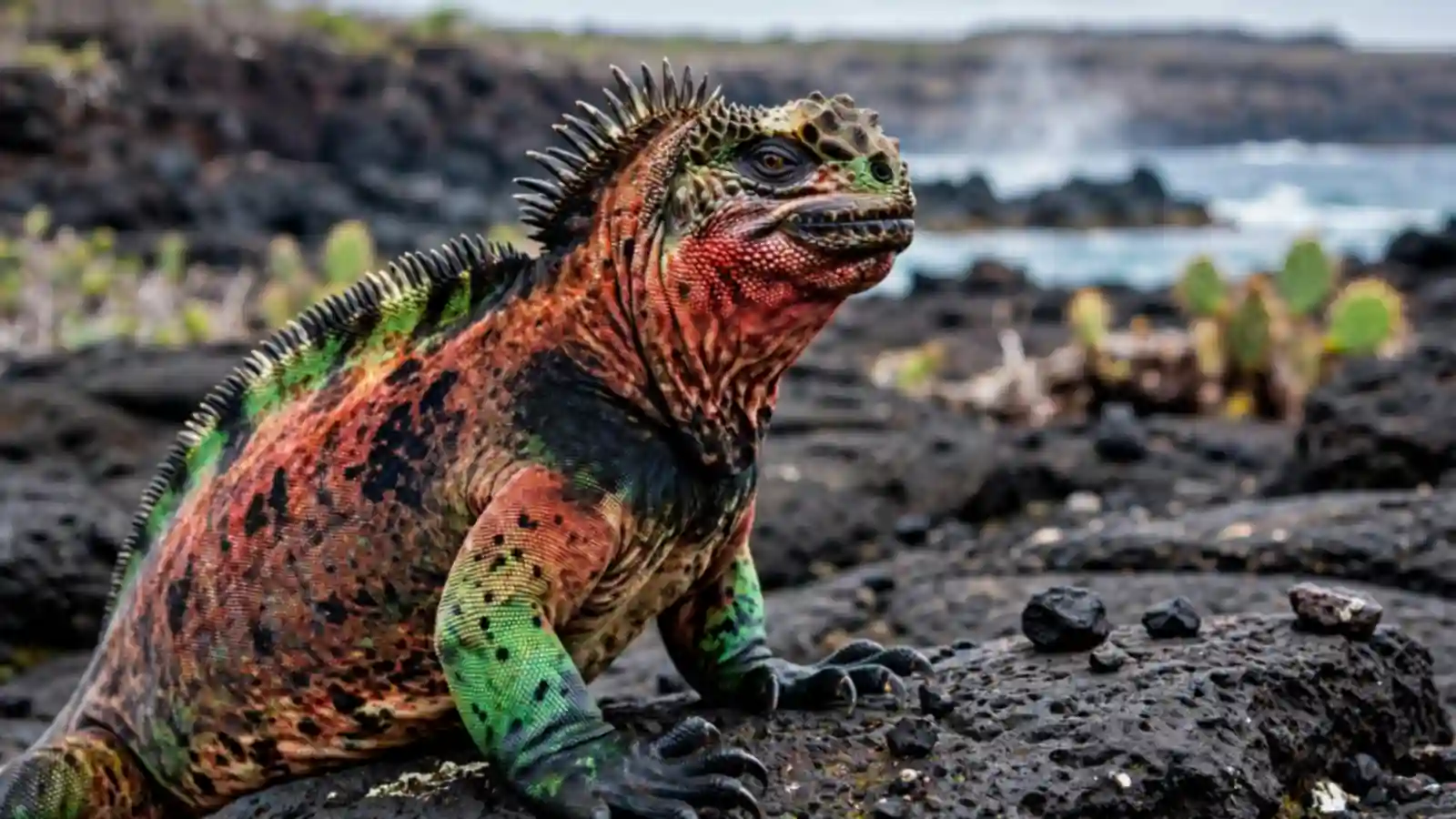
The differences are easy to see once you know them. The Española Island iguanas turn red and green in the breeding season, the brightest of all. The Genovesa animals are small and dark. The Fernandina and Isabela iguanas are the giants. And on northern San Cristóbal lives a subspecies with a name that stops people mid-sentence: Amblyrhynchus cristatus godzilla, named for the movie monster, because the males there are big, dark and spiny enough to earn it.
The subspecies matter for conservation, because they are separate populations. Losing the iguanas of one island would mean losing a subspecies found nowhere else, and the islands are far enough apart that the animals do not swim between them to mix. Protecting the marine iguana means protecting eleven populations, not one.
Are Marine Iguanas Endangered?
The species is listed as Vulnerable, one step below Endangered. The total population is estimated at 200,000 to 300,000 animals, which sounds safe — but the whole species lives on a handful of islands covering a tiny area, and a single bad event on one island can wipe out a subspecies. The status reflects that fragility, not the headcount.

El Niño is the oldest threat. The warm-water famines have always come and gone, and the species survived them for thousands of years — but the famines are becoming more frequent, and the iguanas’ other problems are new. Introduced rats, cats and dogs eat eggs and young iguanas. Oil spills coat the algae beds. And the growing human presence on the islands brings roads, dogs and disturbance to the basking shores.
The protection is strong on paper and mostly strong in practice. The whole archipelago is a national park and a marine reserve, the iguanas are fully protected, and the colonies are watched through every El Niño. What the species needs most is what it has always needed: cold, algae-rich water, quiet basking rocks, and time to grow back after the lean years. The green sea turtle shares these same Galápagos waters and the same dependence on healthy shallow seas.
Fun Facts
- The marine iguana is the only lizard in the world that feeds in the sea.
- It can shrink its own skeleton by up to about 20 percent in a famine — and grow it back when food returns.
- One subspecies is called Amblyrhynchus cristatus godzilla, after the movie monster.
- Marine iguanas sneeze out excess salt through glands in their noses, leaving white crusts on the rocks.
- Charles Darwin called them hideous in 1835 — then watched one swim and changed his mind about how remarkable they are.
- The animals bask in piles of thousands, and males in breeding season flush red, green and turquoise.
Frequently Asked Questions
Where Do Marine Iguanas Live?
Only on the Galápagos Islands, about 1,000 kilometres off the coast of Ecuador. They are found on nearly every island in the archipelago, living on rocky shores, lava flows and beaches — and nowhere else on Earth.
What Do Marine Iguanas Eat?
Almost exclusively marine algae — at least nine or ten genera of seaweed, mostly fine red seaweeds scraped from the rocks. Females and small males graze at low tide; the largest males dive for algae below the waterline.
How Deep Can Marine Iguanas Dive?
Most dives stay under 5 metres, where the algae is thickest. The deepest recorded dives reach about 30 metres, and a typical dive lasts around ten minutes. Only the largest males dive at all — smaller animals feed in the intertidal zone.
Can Marine Iguanas Shrink?
Yes — by up to about 20 percent of their body length. In El Niño famines, when the algae beds die off, the animals reabsorb bone to survive, then regrow when the food returns. It is the only known case of an adult vertebrate shrinking its skeleton and regrowing it.
How Many Marine Iguana Subspecies Are There?
Eleven, according to a 2017 genetic study — eleven population clusters, each tied to its own island or group of islands. Older sources list seven or eight, but the 2017 study is the current basis, and it includes the famously named Amblyrhynchus cristatus godzilla of northern San Cristóbal.
Why Do Marine Iguanas Sneeze?
To get rid of salt. Eating seaweed loads the body with salt, which is collected by glands above the eyes and expelled through the nostrils as a fine spray — the sneeze. The salt dries into white crusts on the snout and the basking rocks.
Are Marine Iguanas Endangered?
They are listed as Vulnerable, one step below Endangered. The population is estimated at 200,000 to 300,000 animals, but the whole species lives on a small group of islands, and El Niño famines, introduced predators and oil spills all threaten it. The status reflects how fragile that island-only range is.
Similar Species Worth Exploring
Keep Exploring
Meet the green sea turtle, the Galápagos’ other famous reptile, then the saltwater crocodile, the giant that hunts where the iguana only grazes, and browse the whole family in our sea turtles and marine reptiles hub — then come back to the black lizard on the lava, the only lizard that swims in the sea, the marine iguana.