Butterfly Ray Facts: Giant Disc, Short Tail and Habitat
Butterfly Ray: Wider Than Long, With a Spine on Its Tail
The butterfly ray is the ray that is wider than it is long — a giant disc with a tail so short it looks like an afterthought, gliding over sand and mud in shallow coastal waters around the world.
By Emily Carter · Reviewed by our vet team · Updated 10 November 2026 · 7 min read
Disc wider than longUp to 2.2 m wide14 species

At a Glance
The butterfly ray is named for its shape: a disc so wide and so short that it looks like a butterfly’s wings, with a tail so short it barely counts as a tail at all. It is a group, not a single species — 14 species in the genus Gymnura, found in warm coastal waters worldwide — and the biggest of them, the spiny ray, has a disc 2.2 metres across. This guide covers the shape, the short tail, the four best-known species, and why their conservation statuses are all different.
Butterfly Ray Size: Wider Than Long
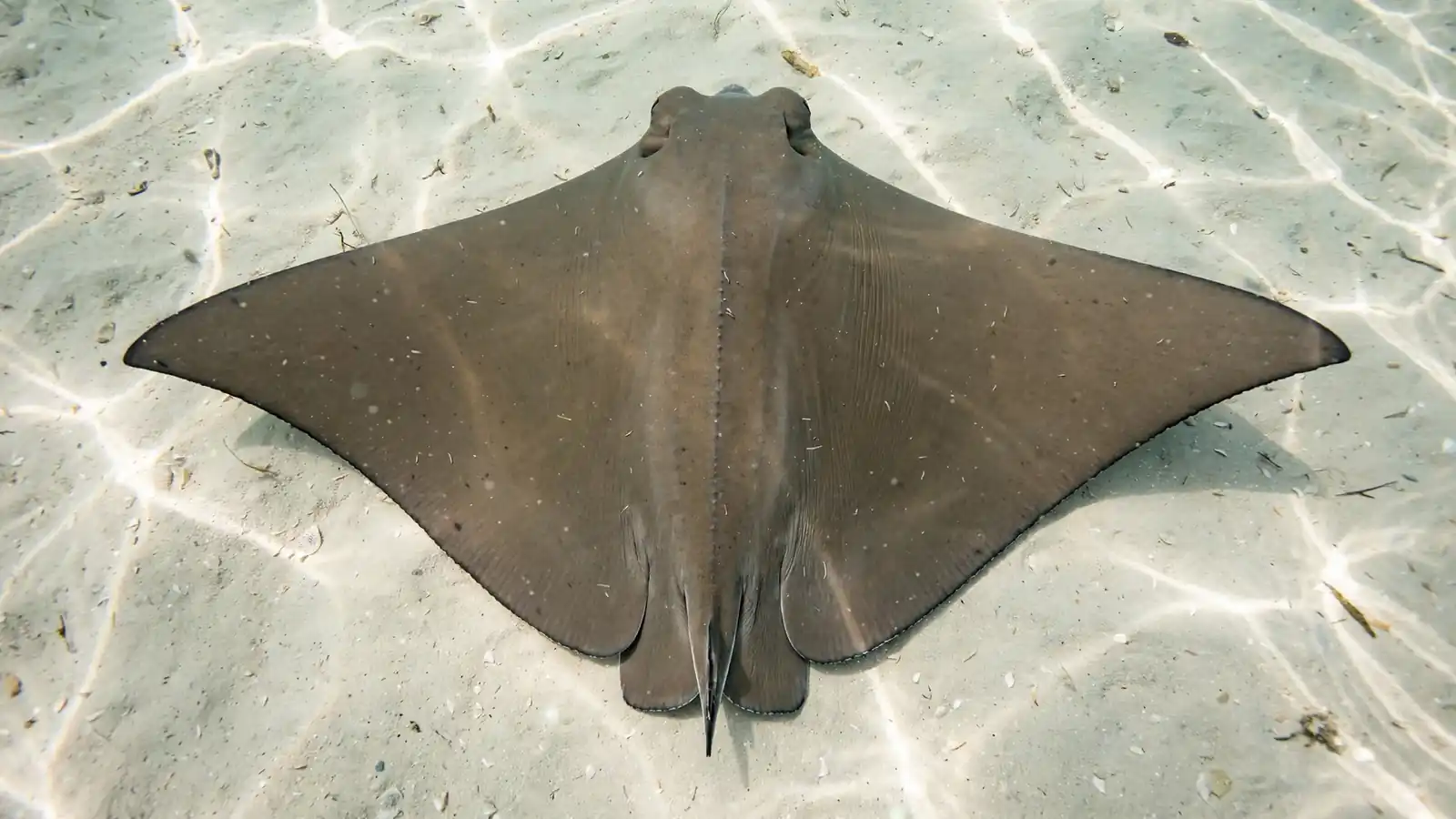
It is wider than it is long — the disc is at least one and a half times as wide as it is long, and in the biggest species the difference is even greater. The spiny ray, Gymnura altavela, has a disc up to 2.2 metres across, while most species measure 90 cm to 1.5 metres. For the full species record, see the spiny ray profile.
Claims of 4-metre butterfly rays appear in some guides, but they are unsubstantiated — no verified animal of that size exists, and this guide does not print them. The 2.2-metre disc of the spiny ray is the verified maximum, and it is already enormous: a disc wider than a person is tall.
What Makes a Butterfly Ray? The Giant Disc and Short Tail

It is defined by two things: a giant disc and a very short tail. The disc is the whole animal — broad, flat and rounded, with the head and the pectoral fins merged into a single wide wing — and the tail is a stub by comparison, barely longer than the disc is wide in some species.
The short tail is the mark that separates butterfly rays from stingrays. A stingray’s tail is a long whip; its tail is short, thick and carries a single spine at its base. The disc does the work — the ray flies through the water on it, undulating the wings in a slow, graceful flap — and the tail is little more than a rudder.
Where Butterfly Rays Live: Sandy Shores Worldwide
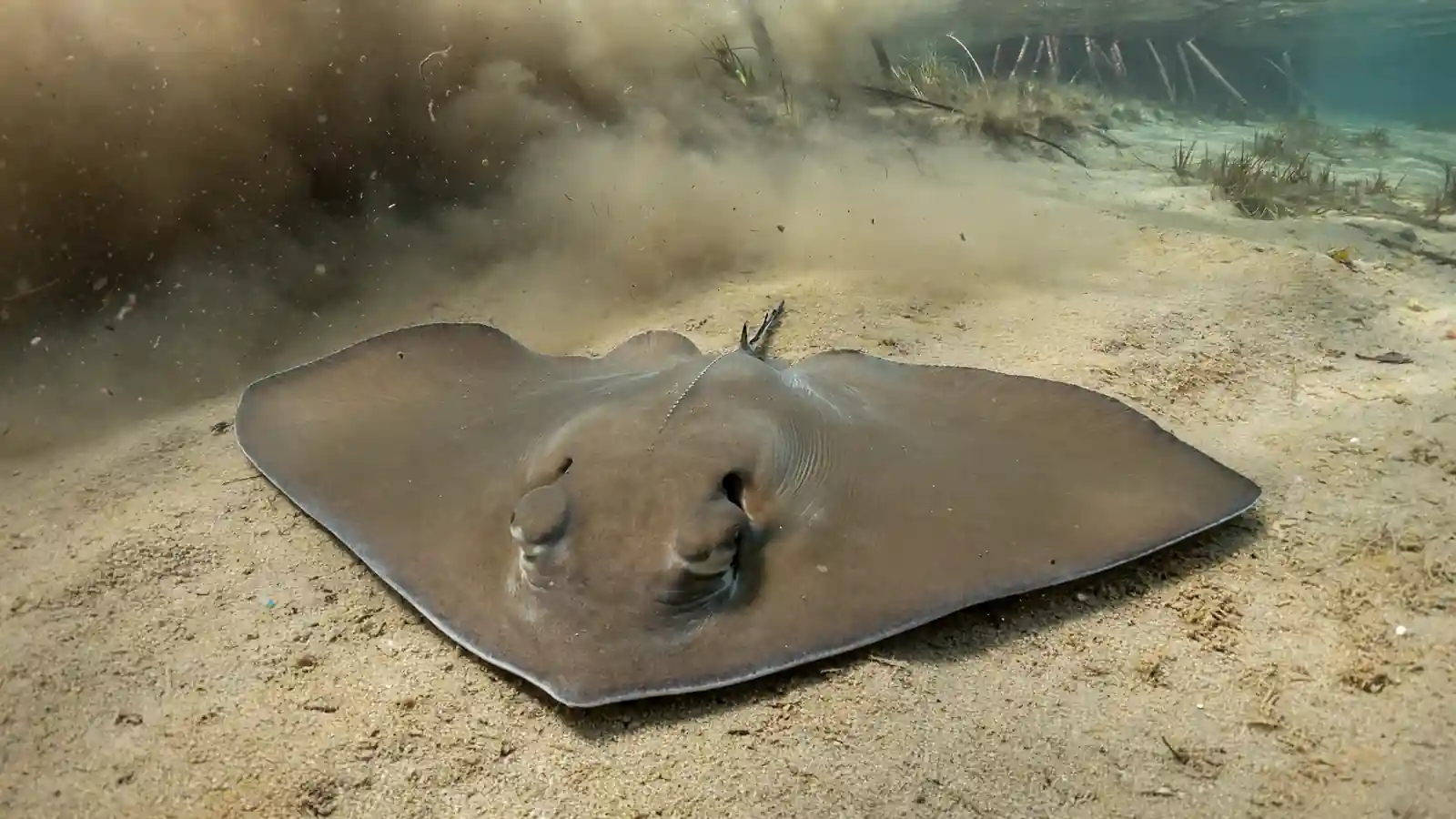
Butterfly rays live in shallow coastal waters around the world — sandy and muddy bottoms, estuaries and river mouths, usually in water less than 50 metres deep. They are warm-water animals, found in tropical and subtropical seas, and they favour the soft bottoms where their prey is buried.
They are bottom animals through and through. It spends its days resting on the sand, half-buried and invisible, and its nights hunting across the flat. The wide disc is a hiding place as well as a wing: pressed flat against the sand, it makes the ray disappear.
What Do Butterfly Rays Eat? Buried Shellfish and Crabs

It eats crustaceans, clams, small fish and squid buried in the sand. It finds them with the sensitive pores on its snout, then digs with its fins and sucks the prey up with a mouth set underneath its body.
The hunting style is unhurried and methodical. The ray cruises slowly over the sand, sensing for buried prey, and when it finds a clam or a crab it digs it out with a flick of its wings. A single night’s feeding can take it across a whole sand flat, and by dawn it is buried again, digesting in the sand.
Species: Spiny, Smooth, Australian and Japanese
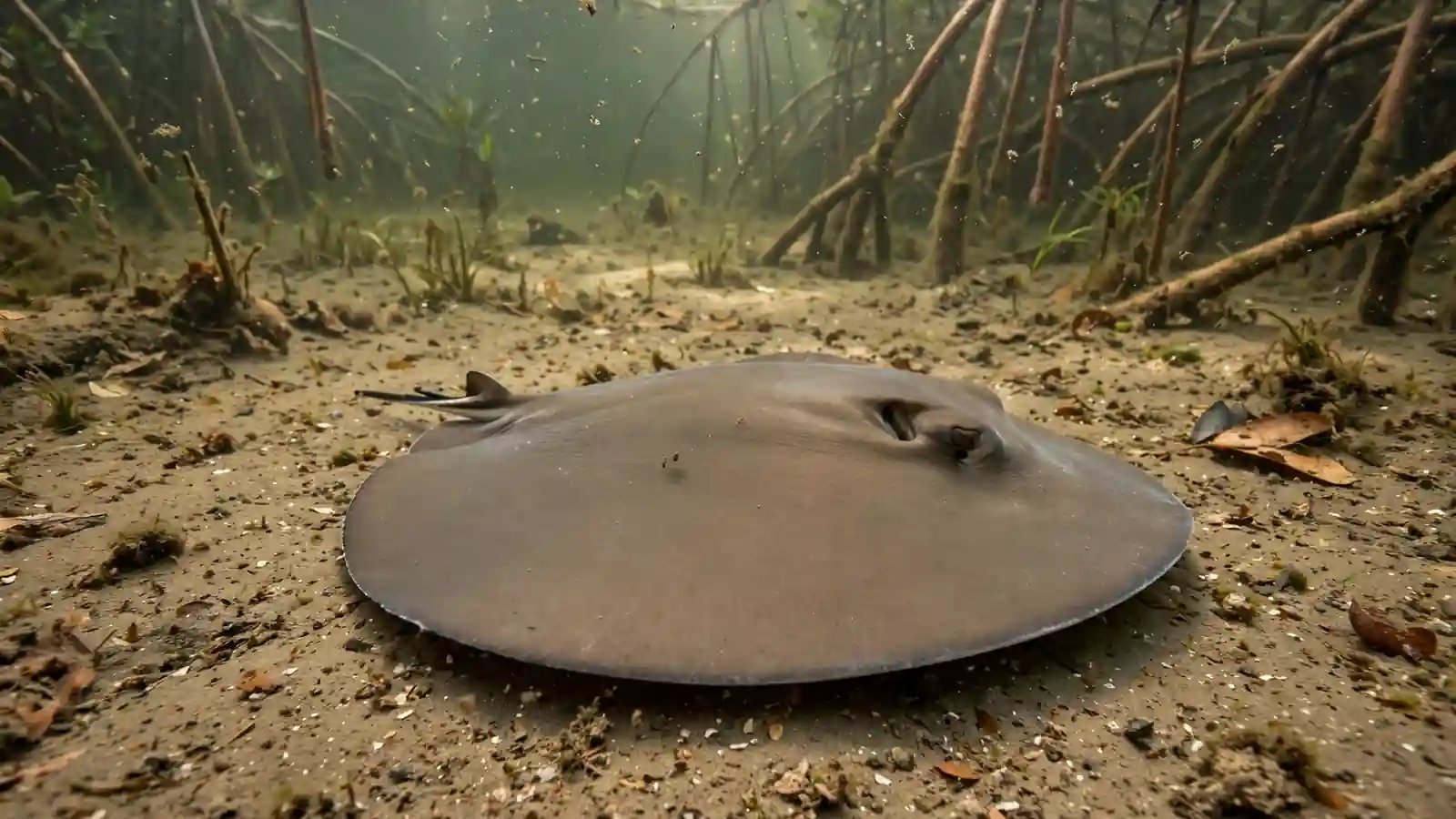
Four species carry the ray story. The spiny ray, Gymnura altavela, is the largest — a 2.2-metre Atlantic ray with a spine at the base of its tail. The smooth ray, Gymnura micrura, is smaller and plainer, found in the western Atlantic. The Australian ray, Gymnura australis, lives around Australia and New Guinea, and the Japanese ray, Gymnura japonica, in the northwest Pacific.
The four are separated by size, by range and by the details of their discs and tails, but they share the butterfly shape: a disc far wider than long, a short tail, and a life spent on the sand. Ten more species fill out the genus, most of them small and little studied, and the family is still being mapped.
Are They Dangerous? The Tail Spine

Butterfly rays carry a spine at the base of the tail, and the spine is venomous — but the ray uses it only in defence, lashing its tail upward when something presses down on it. A ray that is given warning will always flee rather than fight, and stings are rare.
The sting is painful but rarely dangerous, and it is easily avoided: shuffle your feet as you wade, and give any ray you see plenty of space. It is a gentle animal that wants to be left alone, and its spine is a last resort, not a weapon of choice.
Conservation: Statuses That Vary by Species
Butterfly rays do not share a single conservation status — it varies by species. The spiny ray is listed as Vulnerable globally, with Critically Endangered populations in the Mediterranean and the eastern Atlantic, while the Japanese ray is listed as Data Deficient. The other species fall somewhere in between, and several have never been properly assessed at all.
What the butterfly rays need most is what every sand-flat ray needs — healthy coasts, limits on inshore catch, and the shallows left intact. They are still a common sight on sandy shores around the world, which makes their decline easy to miss. A ray that is everywhere today can be gone tomorrow, and the butterfly rays are the proof.
Fun Facts
- Its disc is at least one and a half times as wide as it is long.
- The spiny ray has a disc up to 2.2 metres across.
- There are 14 species in the genus Gymnura.
- Its tail is so short it barely counts as a tail — with a single spine at its base.
- The spiny ray is Vulnerable globally and Critically Endangered in the Mediterranean.
- The Japanese ray is listed as Data Deficient — almost nothing is known about it.
Frequently Asked Questions
What Is a Butterfly Ray?
It is a ray of the genus Gymnura, with a disc far wider than long and a very short tail. There are 14 species, found in warm coastal waters worldwide.
How Big Do Butterfly Rays Get?
The spiny ray has a disc up to 2.2 metres across. Most ray species measure 90 cm to 1.5 metres across the disc.
Where Do Butterfly Rays Live?
Butterfly rays live in shallow coastal waters worldwide — sandy and muddy bottoms, estuaries and river mouths, usually in less than 50 metres of water.
What Do Butterfly Rays Eat?
The butterfly ray eats crustaceans, clams, small fish and squid buried in the sand, digging them out with its fins and sucking them up.
Are Butterfly Rays Dangerous to Humans?
Butterfly rays carry a venomous spine at the base of the tail, used only in defence. Stings are rare and easily avoided by shuffling your feet while wading.
How Many Species of Butterfly Ray Are There?
There are 14 species in the genus Gymnura, including the spiny, smooth, Australian and Japanese butterfly rays.
Are Butterfly Rays Endangered?
It varies by species. The spiny ray is Vulnerable globally and Critically Endangered in the Mediterranean and eastern Atlantic; the Japanese ray is Data Deficient.
Similar Species Worth Exploring
Keep Exploring
Still exploring ray country? Watch the Spotted Eagle Ray fly through the water, meet the big diamond of the sand flats, the Southern Stingray, browse the family in the Types of Rays and Skates hub, and then come back to the sand to meet the butterfly ray.