Narwhal
Narwhal: the unicorn of the sea
The narwhal is the closest thing the real world has to a unicorn: a mottled Arctic whale whose male carries a single spiral tusk up to three metres long. Here is its size, diet, habitat, deep winter dives and the strange truth about that famous horn.
By Emily Carter · Reviewed by our vet team · Updated 4 November 2026 · 8 min read
Body up to 5.5 mTusk up to 3 mLifespan 50+ years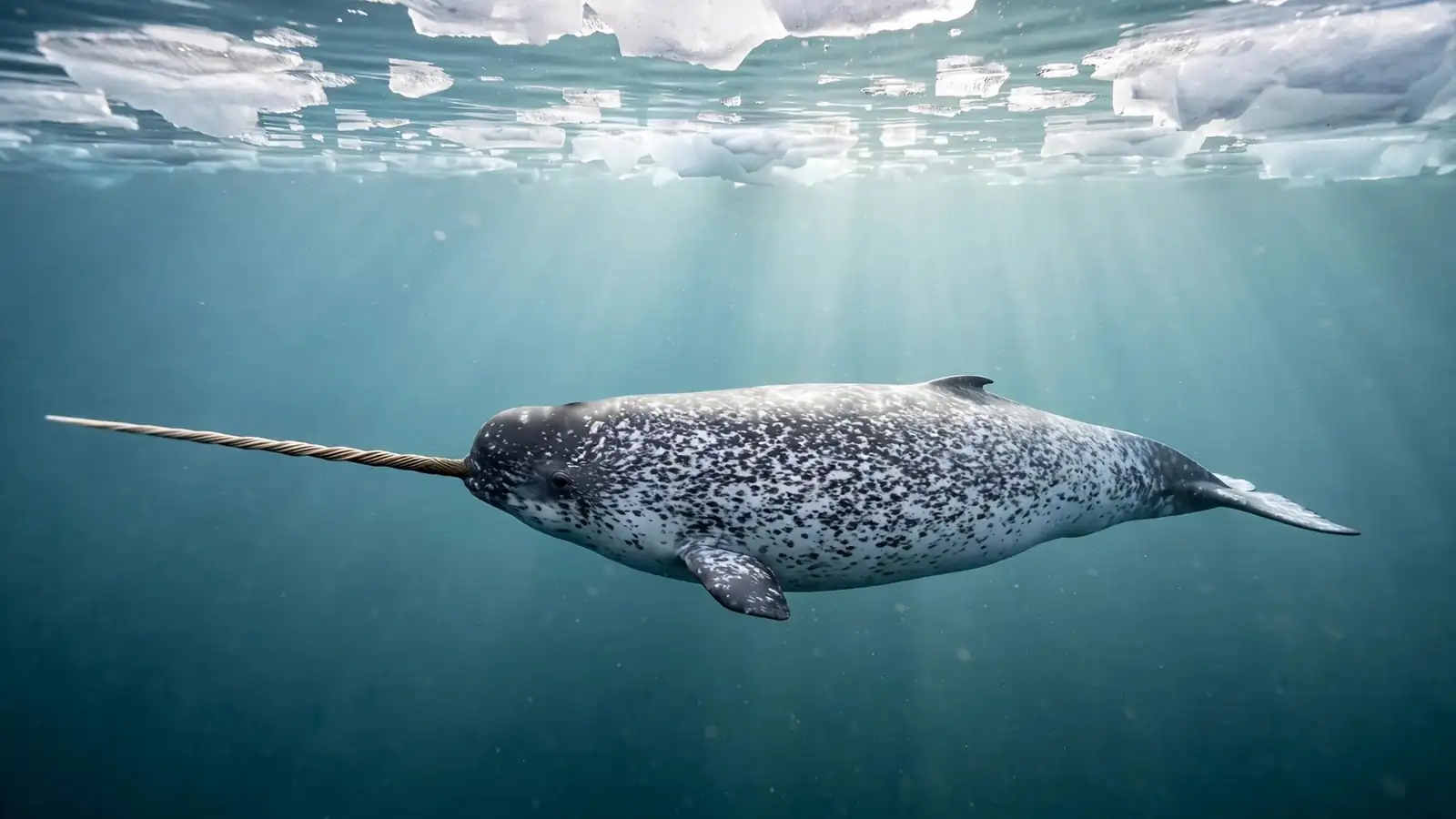
At a Glance
The narwhal carries a long spiralled tusk that no other animal has, yet it is no monster of myth: it is a shy, deep-diving Arctic whale that spends much of its life under sea ice, hunting flatfish in the dark water below the ice.
Narwhal Size and Weight
Its body measures about 3.5 to 5.5 metres (11 to 18 feet) long, not counting the tusk, with adult males at the larger end. Most adults weigh between 800 and 1,600 kilograms (1,760 to 3,530 pounds), males again heavier than females. The tusk adds a further 1.5 to 3 metres (5 to 10 feet) on a grown male, so a big bull measured from tusk tip to tail can stretch well past seven metres.
In human terms, a large male narwhal is roughly as long as a small car and about as heavy as one too. Nearly all of that bulk is arranged for cold water: a thick layer of blubber beneath smooth skin keeps heat in, and a compact, finless back slips easily along the underside of the ice.
Size is a survival tool here. A well-insulated body loses little heat to near-freezing water, and it stores enough energy to carry the whale through long winter dives beneath the ice, where its food waits in total darkness.
Appearance and Anatomy
Its colouring changes across its life. Calves are born a plain grey, youngsters darken and then turn mottled with dark patches, and very old animals can be almost white. Adults wear a speckled pattern of black, grey and white across the back and flanks over a paler belly, and every individual’s pattern is slightly different.
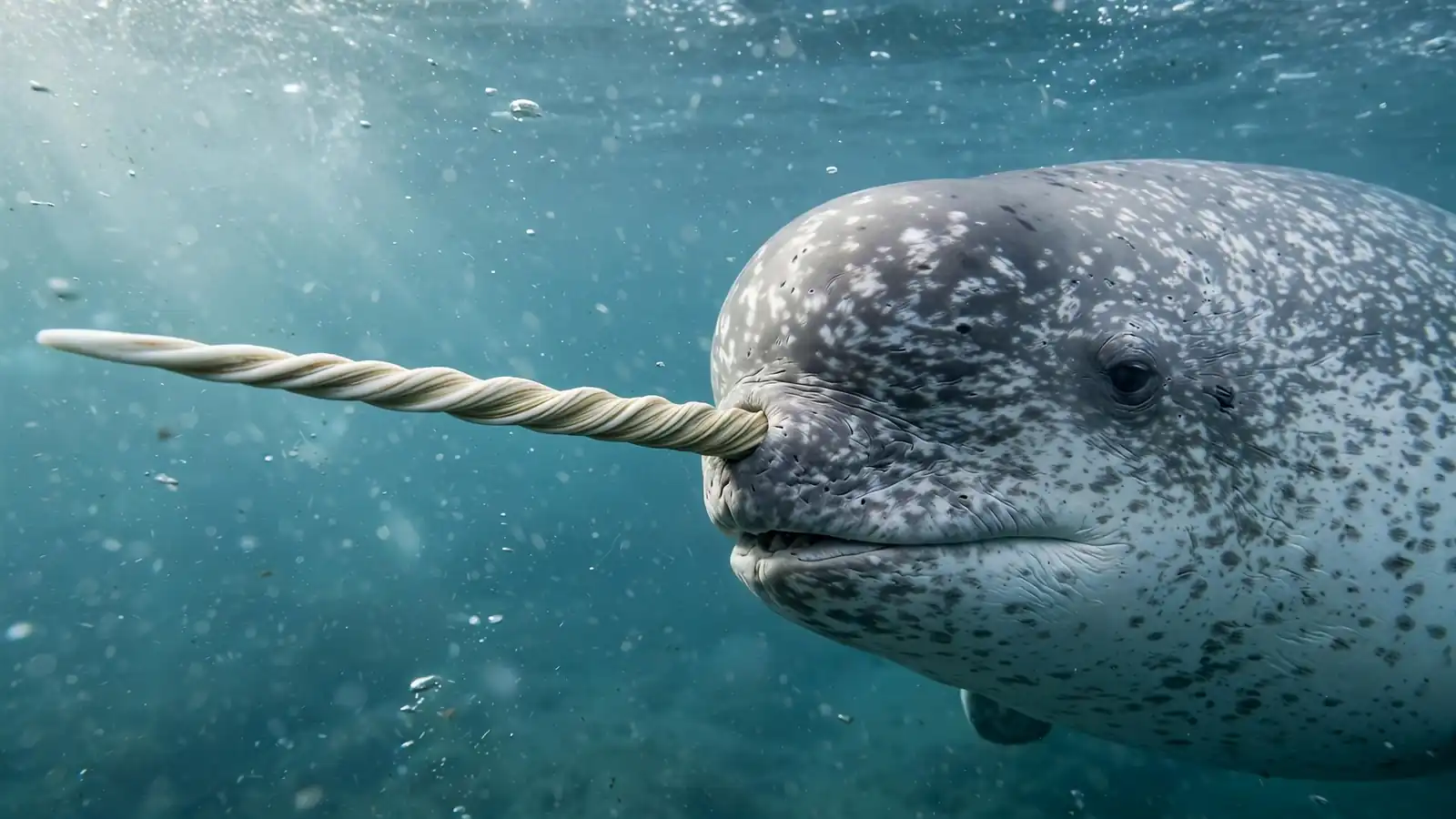
The famous tusk is not a horn at all. It is the whale’s left upper canine tooth, which pushes out through the lip and grows in a counterclockwise spiral for the whole of the animal’s life. Almost all tusked narwhals are male; only about 15 percent of females grow a tusk, and very rarely a whale grows two. Inside the mouth there are no functional teeth at all.
The rest of the design suits life under ice. There is no dorsal fin, only a low ridge along the back, so nothing catches when the whale swims close beneath the ice sheet. Even the tail flukes are unusual: their trailing edges curve the opposite way to those of most whales, convex rather than scooped, which may help with precise manoeuvring in tight water.
Habitat and Range
Narwhals live only in the far north, in the Arctic waters of Canada, Greenland and Russia, and occasionally as far east as Svalbard. They favour deep offshore waters, fjords and bays that freeze over in winter, and they are among the most ice-dependent of all whales.
Their year follows the ice. In summer they gather in relatively ice-free coastal bays and fjords to feed, socialise and raise calves. As the sea freezes they move offshore into deep water and spend the winter beneath heavy pack ice, breathing through the narrow cracks and leads that split it.
The world population is spread across roughly a dozen recognised groups, each loyal to its own bays and wintering grounds, and altogether narwhals number well over 100,000 animals.
Diet and Feeding
It is a specialist hunter of the deep. In winter it feeds mainly on Greenland halibut, a flatfish that lives on the seabed hundreds of metres down, along with Arctic and polar cod, squid and shrimp. Summer feeding is lighter and more varied, with more cod and squid taken in shallower water.
With no teeth in its mouth, it cannot chew or grip in the usual way. Instead it is thought to suck prey in with a sudden intake of water and swallow it whole. Narwhals have also been filmed tapping fish with the side of the tusk, a quick flick that may stun prey for a split second, though the tusk’s main jobs seem to lie elsewhere.
To reach its winter food, it makes some of the deepest dives of any whale its size, plunging beyond 1,500 metres and sometimes past 2,000 metres, and staying down for up to about 25 minutes at a time.
Behavior and Social Life
Narwhals are social animals that travel in pods, usually of two to ten whales, often sorted loosely by age and sex. In summer, separate pods sometimes merge into gatherings of hundreds where the water is open and the feeding is good.

Its most famous behaviour involves the tusk. Males sometimes cross tusks above the surface in a slow, duel-like display known as tusking, rubbing them together while companions watch. It looks like fencing, but it is thought to be a social ritual, a way of showing off size and status rather than a true fight.
Otherwise the pod keeps a quiet routine: slow travelling at the surface, deep feeding dives in season, and long rests floating almost motionless, when their speckled backs are hardest to spot against broken ice.
Communication and Sound
Like other toothed whales, narwhals hunt and navigate with echolocation, producing rapid clicks that bounce back from fish, ice and the seabed. They also whistle and make pulsed calls to keep the pod together, and groups in different areas seem to favour slightly different sounds.
The tusk may add a sense no other whale has. It is threaded with around ten million tiny nerve connections running to its surface, which suggests it can detect changes in the water such as temperature and saltiness. A male sweeping his tusk through the sea may, in a sense, be tasting his surroundings.
Reproduction and Babies
Narwhals mate in spring, and after a pregnancy of about 14 to 15 months a female gives birth to a single calf in summer. A newborn is already about 1.5 metres (5 feet) long and weighs around 80 kilograms (176 pounds), and it is born without any sign of a tusk.
The calf stays close, nursing on rich milk for a year or more while it learns the pod’s routes between the summer bays and the winter ice. Females usually produce a calf only once every three years or so, one reason the species recovers slowly from any losses.
A male’s tusk usually breaks through at around two to three years of age and keeps growing for the rest of his life, so the very longest tusks belong to the oldest bulls.
Predators and Threats
The narwhal’s main natural enemy is the killer whale. Pods of orcas hunting in summer bays can trap narwhals in shallow water, and polar bears occasionally take a whale caught at a closing ice hole. Greenland sharks may scavenge, or take weaker animals.
The deeper threat is the changing ice itself. Narwhals are built around a calendar of freezing and thawing: a sudden late freeze can trap whole groups under new ice with too few breathing holes, an event called an ice entrapment, while shrinking ice cover opens their refuges to more killer whales and more ships.
Conservation and Human Interaction
Narwhals are currently listed as Least Concern, with a world population estimated at well over 100,000 animals. They have been hunted for centuries by Arctic Indigenous communities, who use the meat, skin and ivory, and regulated hunting continues today in Canada and Greenland. Current population estimates are summarised in official species assessments.
The tusk’s ivory once made this whale famous far beyond the Arctic: in medieval Europe, narwhal tusks were sold as unicorn horns at many times their weight in gold, which is exactly how the unicorn legend came to be attached to a real Arctic whale.
The pressures ahead are noise, shipping and a warming Arctic. More open water means more vessels, more underwater noise in the channels narwhals travel, and easier access for their predators. Protecting the quiet, icy calendar this species lives by is the heart of its conservation. For the full biology in one place, a complete university species account covers its classification, range and life history.
Fun Facts
- Its scientific name, Monodon monoceros, roughly means ‘one tooth, one horn’.
- A group of narwhals is sometimes called a blessing.
- Narwhal tusks spiral counterclockwise, and they grow from the left side of the jaw in almost every case.
- It has no teeth inside its mouth at all; its only erupting tooth is the tusk.
- Old narwhals can be almost pure white, while calves are born plain grey.
- Narwhals can dive deeper than 1,500 metres, among the deepest dives of any whale their size.
- In medieval Europe, narwhal tusks were traded as the horns of unicorns.
Frequently Asked Questions
How Big Is a Narwhal?
A narwhal’s body grows to about 3.5 to 5.5 metres (11 to 18 feet) long and weighs 800 to 1,600 kilograms. On top of that, an adult male’s spiral tusk can add another 1.5 to 3 metres, so a large male measures over seven metres from tusk tip to tail.
What Do Narwhals Eat?
Narwhals eat Greenland halibut, Arctic and polar cod, squid and shrimp. They feed most heavily in winter, diving deep under the ice to catch flatfish on the seabed, and they swallow their prey whole because they have no teeth in their mouths.
Where Do Narwhals Live?
Narwhals live only in the cold Arctic waters around Canada, Greenland and Russia. They spend summers in ice-free coastal bays and fjords, then move offshore in winter to deep water covered by pack ice.
How Long Do Narwhals Live?
Narwhals live for at least 50 years, and studies of growth layers in the teeth and eye lenses suggest the oldest may reach 80 to 90 years. Females tend to outlive males.
Are Narwhals Dangerous to Humans?
No. Narwhals are shy, quiet whales that avoid people, and despite the dramatic tusk they have never been known to attack a human. The tusk is a tooth used mainly for display and sensing, not a weapon.
What Is a Baby Narwhal Called?
A baby narwhal is called a calf. It is born in summer after about 14 to 15 months in the womb, measures roughly 1.5 metres long and weighs about 80 kilograms, and it is plain grey, mottling as it grows.
Similar Species Worth Exploring
Keep Exploring
Still curious about the whales of the far north and beyond? Start with our hub of types of whales, then meet the beluga whale, the narwhal’s closest cousin, and the killer whale, the Arctic hunter every narwhal watches for. Every marine guide here follows the same layout, so the facts are always in the same place.