Bluefin Tuna
Bluefin tuna: the warm-bodied giant of the open ocean
The bluefin tuna is a fish that breaks the rules of being a fish: warm-bodied, broader than a doorway at full size, and able to dive deeper than sunlight, sense or most submarines comfortably go. This guide meets all three bluefin species, measures the giants honestly, counts the cost of their fame, and follows the hard-won recovery now under way.
By Emily Carter · Reviewed by our vet team · Updated 10 November 2026 · 8 min read
Three species, one legendTo ~680 kg (1,500 lb)Warm-bodied, unlike other fish
At a Glance
A bluefin tuna at full size is less a fish than a weather event with fins: 600 kilograms of warm muscle crossing oceans, diving into black water, and husbanding its own body heat against the cold like a mammal that never left the sea. Three species share the name and the fame, and the fame, in the form of the world’s appetite, very nearly finished all three of them.
Three Bluefin Tuna Species
The name covers three giants. The Atlantic bluefin, Thunnus thynnus, is the largest and the most famous, ranging the Atlantic and the Mediterranean. The Pacific bluefin, Thunnus orientalis, works the North Pacific from Japan to California. The Southern bluefin, Thunnus maccoyii, circles the cold southern oceans below Australia, South Africa and South America. All three share the deep, torpedo body, the metallic blue back and silver belly, and the same improbable warmth, and all three were once lumped together as a single species.

Tell them apart and geography does most of the work, for the three patrol separate oceans and rarely meet. Under the skin they are near-identical machines, which is why science long debated whether they were species or subspecies. What separated their fates was not anatomy but appetite: the markets of the world reached each ocean in turn, and each bluefin met them in the same order of size.
Bluefin Tuna Size: How Big Do They Get?
Start with the verified ceiling. An Atlantic bluefin can reach about 3 metres, and the heaviest fish ever authenticated, the rod-and-line record taken off Nova Scotia in 1979, weighed 1,496 pounds, 679 kilograms. A typical adult is smaller and still absurd: about 2 metres and 250 kilograms, heavier than a grand piano, broader through the shoulders than the fisherman holding the gaff. Pacific bluefin top out lower, in the region of 3 metres claimed and 500-plus kilograms for the greatest, and Southern bluefin are the runts of the trio at around 2.5 metres and 260 kilograms, runt being a relative term.

Growth follows the slow-giant pattern: fast early years, maturity somewhere between four and eight-plus years depending on species and stock, then decades of steady addition. It is the life plan of an elephant or a whale executed by a fish, and it carries the same consequence, that a population of giants is the work of generations and can be undone in a few seasons of nets.
Warm Blood in a Cold Ocean
Nearly every fish is the temperature of its water. The bluefin is not. Through its swimming muscles and around its gut runs a counter-current lattice of blood vessels, a rete mirabile, that traps the heat of exertion and holds the working tissues far above the temperature of the sea, in cold water by margins reported up to about 20 degrees. The result is a fish that keeps its power in near-freezing seas, digests fast, and ranges from the tropics to the edge of the subpolar gyres without slowing down. Only a handful of animals, the opah fully and a few sharks in part, share the trick.

The warmth is not free. A bluefin burns fuel at a rate no cold fish would tolerate, and must feed heavily and often, which is why the giants shadow bait schools and squid grounds across entire ocean basins. Warm blood bought the bluefin the cold half of the world; the price is an appetite that never really clocks off.
Speed, Dives and the Vertical Life
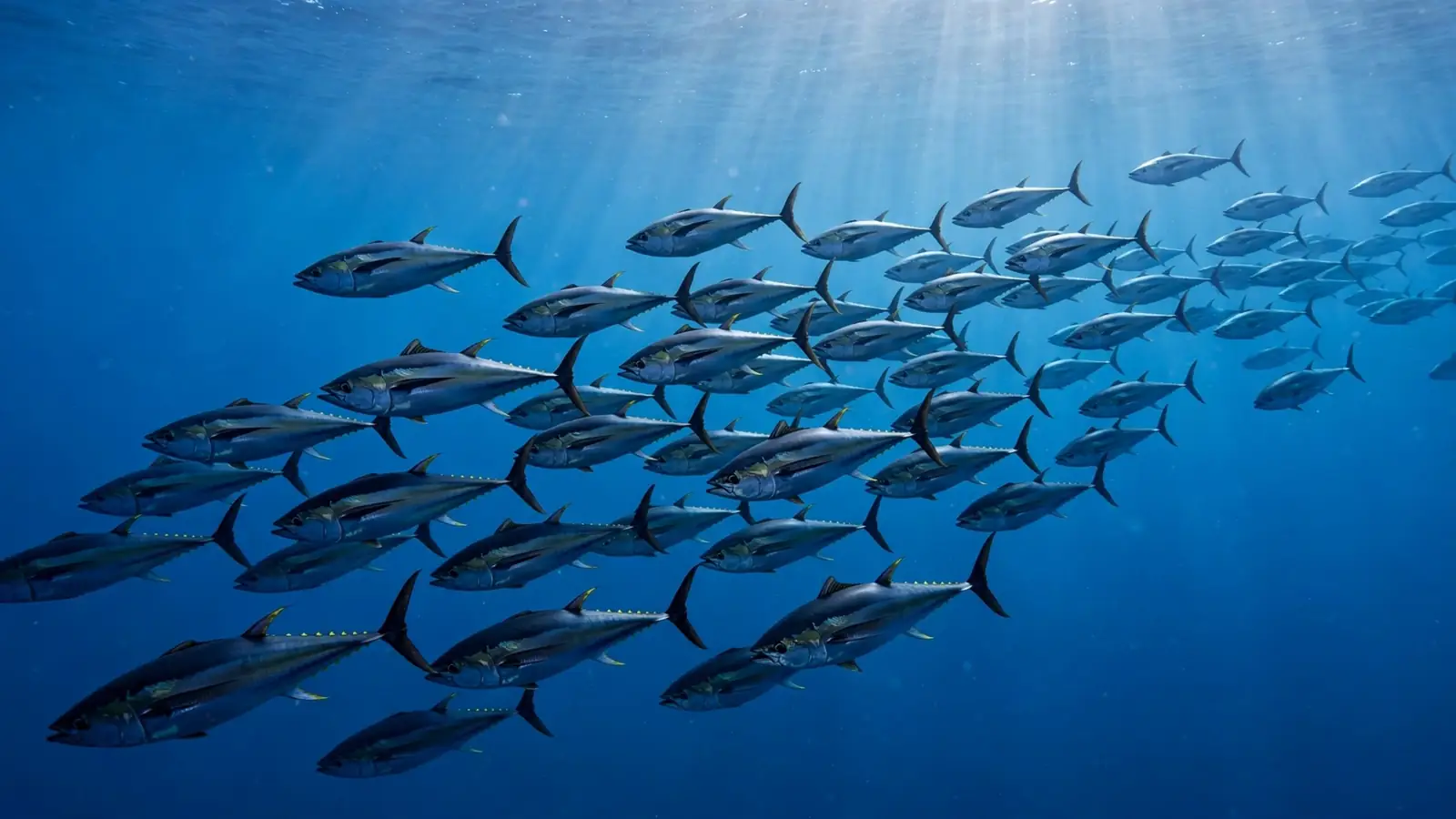
The bluefin’s top speed is quoted at around 43 miles per hour, 70 kilometres per hour, in bursts, and the honest treatment is the one given to all fish speed records: impressive, plausible given the machinery, and softer at the edges than the legend. The machinery itself is beyond argument: a rigid, crescent-moon tail beating stiffly like a shark’s, fins that fold into slots to erase drag, and warm muscle that never loses power to the cold. Cruising is where the fish truly lives, though, at a tireless few kilometres per hour across entire oceans; tagged Atlantic bluefin have crossed from America to Europe in a matter of weeks.

The vertical range matches the horizontal. Tagged fish dive below 1,000 metres, into water at 4 degrees and total darkness, then rocket back to the surface within the hour, a commute between two worlds run several times a day. The Atlantic bluefin species account compiles the records behind the legend, depths, distances and all.
The Price of Fame
The bluefin’s flesh, above all the fatty belly, toro, became the supreme prize of the sushi world in the later twentieth century, and the fish’s rarity did the rest. Prices climbed until the market developed its own theatre: at Tokyo’s New Year auction in 2019, a 278-kilogram Pacific bluefin sold for 3.1 million dollars, a record set deliberately in front of the cameras, many times the rate the same fish would fetch on an ordinary Tuesday. Beneath the theatre, the everyday trade in wild and ranched bluefin, giants caught young and fattened in pens, ran on at industrial scale.

The fame had a geography: the giants were once so little valued in the West that Atlantic bluefin were rendered for oil and pet food within living memory, while the same fish became, in Japan, the most prestigious mouthful in the world. Few animals have been simultaneously worthless and priceless, and the swing between the two values is the whole modern history of the species in miniature.
The Recovery: Quotas and a Second Chance
The crash, when it came, was proportional to the fame: by the early 2000s the Atlantic bluefin in particular had been fished down to a remnant, and the species was listed as Endangered. What followed is one of conservation’s better stories. Quotas were cut and then, crucially, enforced; illegal catch was squeezed; the eastern Atlantic and Mediterranean stock rebuilt year on year until, in 2021, the Atlantic bluefin’s global status was formally improved from Endangered to Least Concern, a downlisting almost unheard of for a fish of its value.
The other two species stand at earlier chapters of the same book: the Pacific bluefin’s status has improved from Vulnerable to Near Threatened as management tightened, while the Southern bluefin, the most depleted of all, remains endangered even under its own strict international regime. The Atlantic lesson is the hopeful one, and it generalises beyond tuna: a giant that lives forty years can come back, if the world can agree to wait forty years with it.
Fun Facts
- A bluefin’s swimming muscles run far warmer than the sea, thanks to a lattice of blood vessels that traps the heat of exercise.
- The record rod-caught Atlantic bluefin weighed 1,496 pounds (679 kg) and was taken off Nova Scotia in 1979.
- In 2019 a single Pacific bluefin sold at Tokyo’s New Year auction for $3.1 million, a publicity price far above the everyday market.
- Bluefin have been tracked crossing the entire Atlantic in a matter of weeks, and diving below 1,000 metres.
- The Atlantic bluefin’s comeback was strong enough for its global conservation status to improve from Endangered to Least Concern in 2021.
- At speed, a bluefin’s fins fold away into slots in the body, and the great tail beats with a stiff, scything motion.
Frequently Asked Questions
Why Is Bluefin Tuna So Expensive?
Three forces multiply. The flesh, especially the fatty belly cut called toro, is prized for sushi and sashimi at a level no other fish matches. The giants became genuinely scarce after decades of heavy fishing, so rarity compounded desire. And the market has theatre in it: the record $3.1 million paid for one fish at Tokyo’s 2019 New Year auction was a publicity price, many times the everyday rate, bid in front of the world’s cameras.
How Big Do Bluefin Tuna Get?
The Atlantic species is the giant: up to about 3 metres long and, at the verified top end, around 680 kilograms, roughly 1,500 pounds. The largest ever taken on rod and line, off Nova Scotia in 1979, weighed 1,496 pounds (679 kg). Pacific bluefin run somewhat smaller and Southern bluefin smaller still, though all three are enormous by tuna standards; a typical adult Atlantic fish is nearer 2 metres and 250 kilograms.
How Fast Can a Bluefin Tuna Swim?
Fast in bursts and tireless at cruise. Bluefin are commonly credited with bursts around 43 miles per hour (70 km/h), delivered by a stiff, scything tail and warm swimming muscles, though as with all fish top speeds the highest figures outrun the measurements. The better-documented marvel is endurance: tagged bluefin cross whole oceans and dive below 1,000 metres, a vertical and horizontal range few fish on Earth can match.
Bluefin vs Yellowfin Tuna: What Is the Difference?
Size and proportions separate the cousins. A bluefin is deeper-bodied and far heavier, with short pectoral fins that barely reach the second dorsal; a yellowfin is slimmer, wears long, bright yellow finlets and, in adults, sickle-like second dorsal and anal fins. Yellowfin stay in warm tropical water, while bluefin push into cold temperate seas on the strength of their warm bodies. The gap in fame, and price, follows from the gap in size and rarity.
How Long Do Bluefin Tuna Live?
Up to about 40 years in the Atlantic species, with the Pacific and Southern close behind; ageing from ear stones and vertebrae keeps pushing the estimates up. They are not fully grown children at spawning age either: Atlantic fish mature somewhere between about four and eight-plus years depending on the stock. It is a whale’s life plan executed by a fish, which is exactly why the species took so long to recover once depleted.
Similar Species Worth Exploring
Keep Exploring
Keep exploring the great travellers: meet the striped sprinter in our wahoo guide, or browse the whole shoal in the types of fish. Then come back to the warm-bodied giant that crosses oceans to spawn where it was born: the bluefin tuna.