Day Octopus
Day Octopus: The Daylight Hunter With the Passing Cloud
The day octopus hunts by daylight and rolls a passing cloud of colour across its body. It is the reef octopus that works the day shift — and it can change its pattern a thousand times in seven hours.
By Emily Carter · Reviewed by our vet team · Updated 10 November 2026 · 9 min read
Hunts by dayPassing cloud display1,000 patterns in 7 hours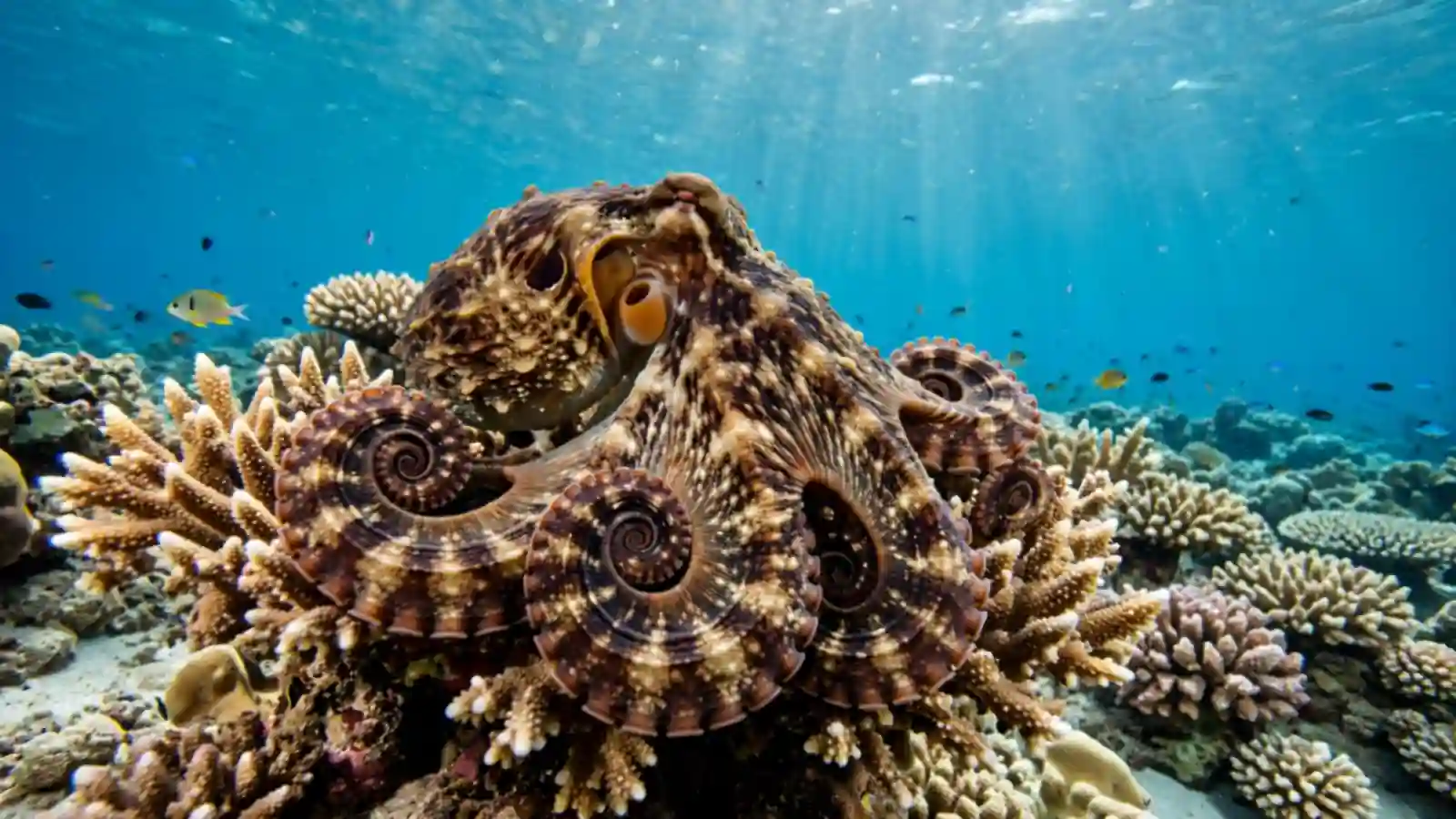
At a Glance
The day octopus is the daytime octopus of Indo-Pacific reefs, Octopus cyanea, also called the big blue octopus or carpet octopus. Its mantle reaches 16 cm, its arms 80 cm, and it changes its pattern a thousand times in seven hours.
Day Octopus Size: A 6.5-Kilogram Reef Hunter
It grows a mantle of 16 cm, arms to 80 cm and a weight of up to 6.5 kg — a large reef octopus, big enough to take a crab and strong enough to pull a mollusc from its shell. The mantle figure is the standard one: 16 cm, with one source giving 22 cm, and this guide uses 16 cm.
The size makes the octopus the dominant octopus of its reef. It is bigger than the coconut octopus and the California two spot octopus, and it hunts in the open, by day, where smaller octopuses hide. A 6.5 kg octopus on a coral reef is a serious predator, and the reef’s crabs know it.
The Passing Cloud: Colour Rolling Across the Body
It shows the “passing cloud” display — a dark cloud-like wave of colour that rolls across its body, from head to arms, like a shadow passing over the reef. It is the most famous display of any octopus, and it is unique to it: no other species rolls colour across its body this way.
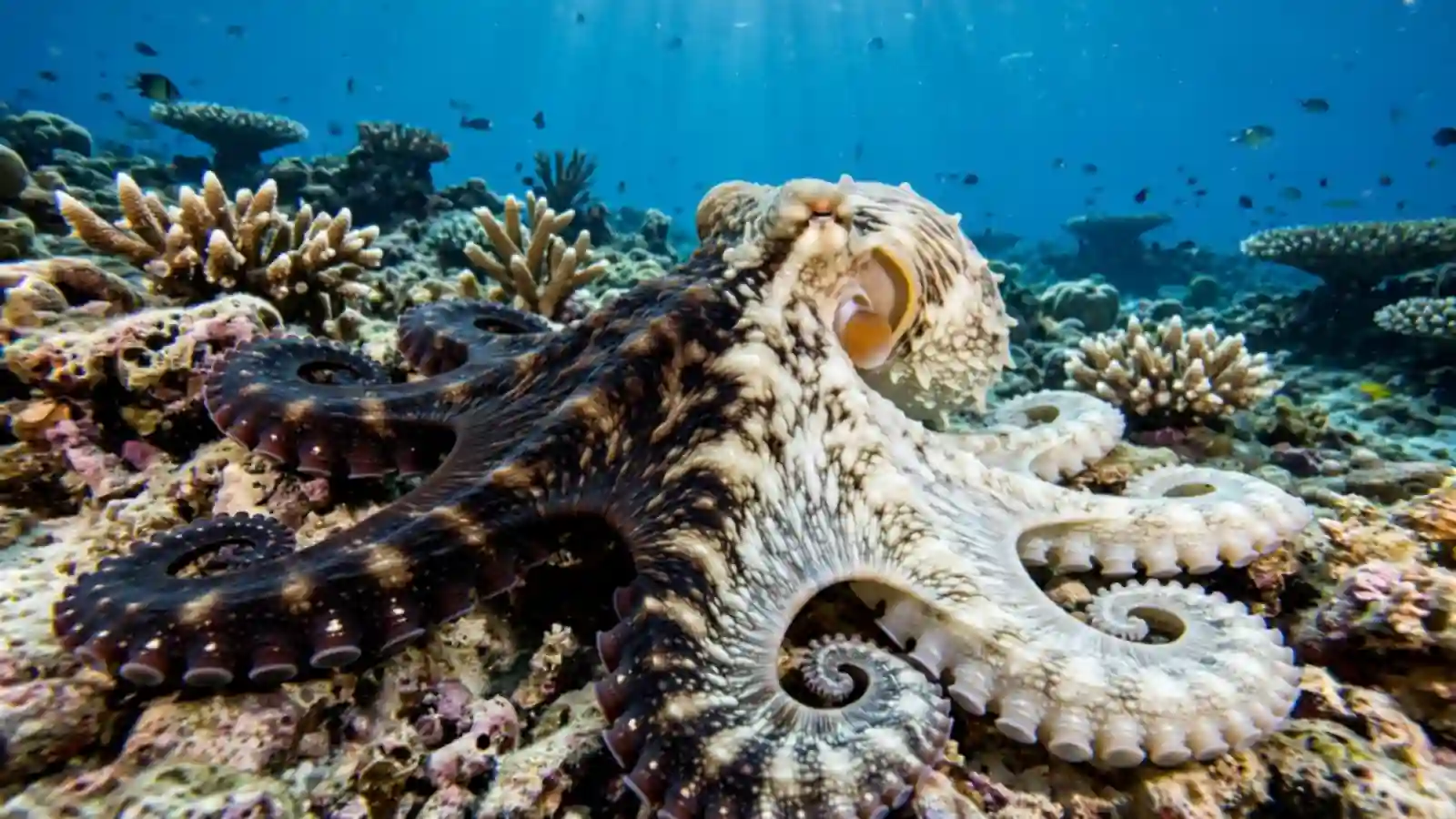
The display is part of a camouflage system that Roger Hanlon measured at 1,000 pattern changes in seven hours — the fastest pattern-changing of any octopus studied. The chromatophores open and close in waves, the iridophores add shine, and the papillae raise the skin into ridges, so the animal can become rock, sand or coral in a second. For the full description, see this octopus profile, which covers the 16 cm mantle, the false eye-spots and the 1,000 pattern changes in detail.
Where Day Octopuses Live: Indo-Pacific Reefs
Day octopuses live on Indo-Pacific coral reefs and rocky shores, in shallow water to about 20 m. They are reef animals, at home in the coral gardens and rocky ledges of the tropical Pacific and Indian Oceans, from Hawaii to East Africa, and they are the octopus most divers meet on a daytime reef dive.
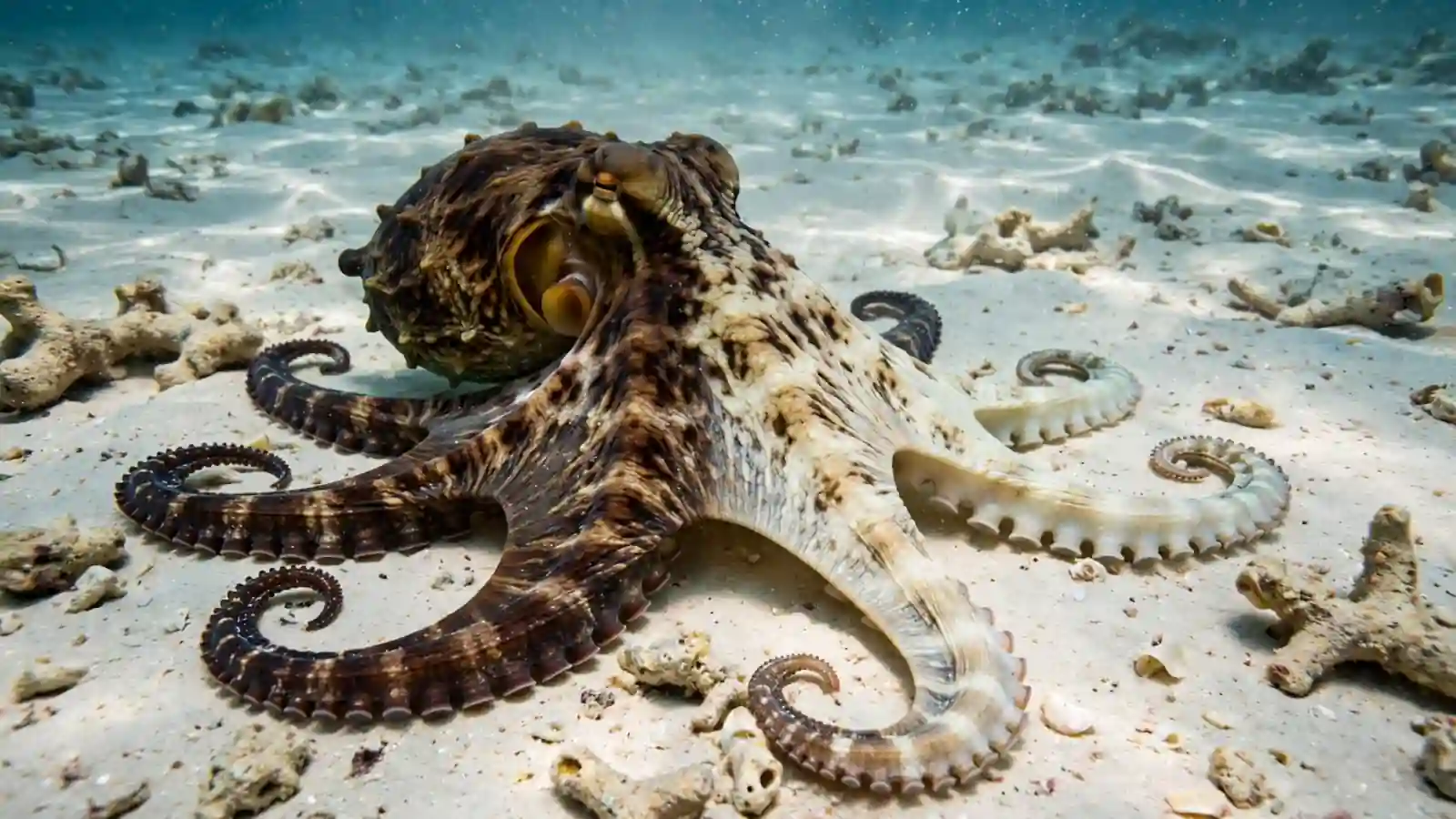
The habitat is the reason for the daytime hunting: the reef is busiest by day, and it has the reef to itself while the nocturnal octopuses sleep in their dens. It changes colour to match the sand and the coral as it moves through its home range, and it returns to the same lair night after night.
What Do Day Octopuses Eat? Crabs, Shrimps and Molluscs
It eats crabs, shrimps, molluscs and small fish, hunting by day, mostly at dawn and dusk. It prowls the reef with its arms spread, feeling into crevices for crabs, and it is strong enough to pull a mollusc from its shell or a crab from its hole.
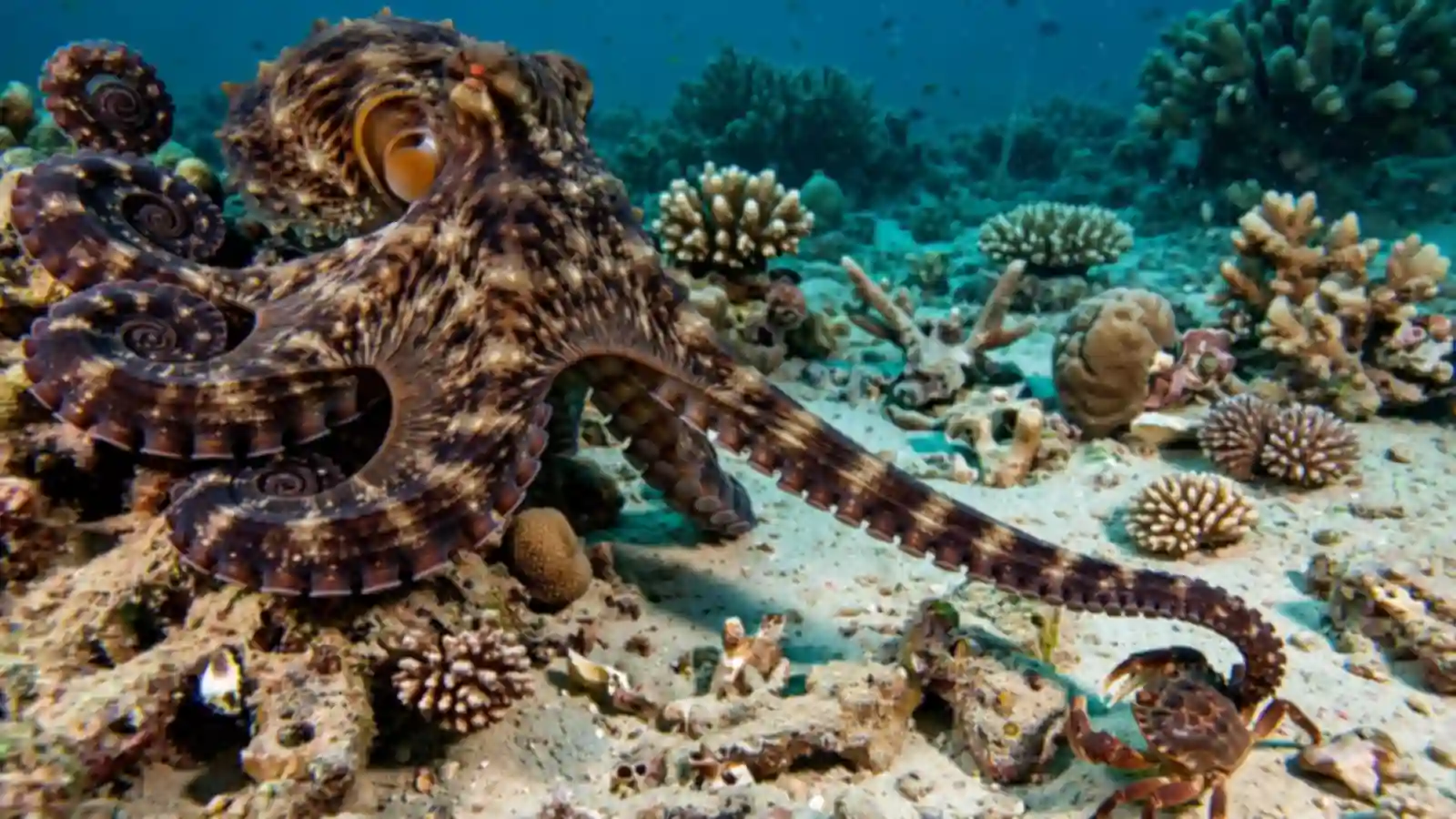
The hunting is cooperative as well as solitary: day octopuses have been seen hunting alongside fish, with the fish flushing prey out of the reef and the octopus catching what the fish miss. It is a daytime hunter in a reef full of daytime prey, and it takes full advantage of the shift.
Day Octopus Behaviour: Hunting at Dawn and Dusk
It hunts by day, mostly at dawn and dusk, when the reef is changing shifts. It leaves its lair in the morning, prowls the reef for crabs and molluscs, and returns before dark — the opposite schedule to the common octopus, which hunts at night.

The dawn and dusk hunts are the busiest times on the reef, and it is built for them: its eyes are adapted to bright light, its camouflage works best in daylight, and its passing-cloud display is a daytime signal. At dawn on a rocky shore, it is already at work, and the reef’s crabs are already hiding.
The Shell Midden: Finding an Octopus Lair
It leaves a shell midden outside its lair — a pile of empty shells, the remains of its meals, that marks an occupied den. Find the midden and you have found the octopus: the pile of crab carapaces and mollusc shells outside a crevice is the sign of an octopus at home.
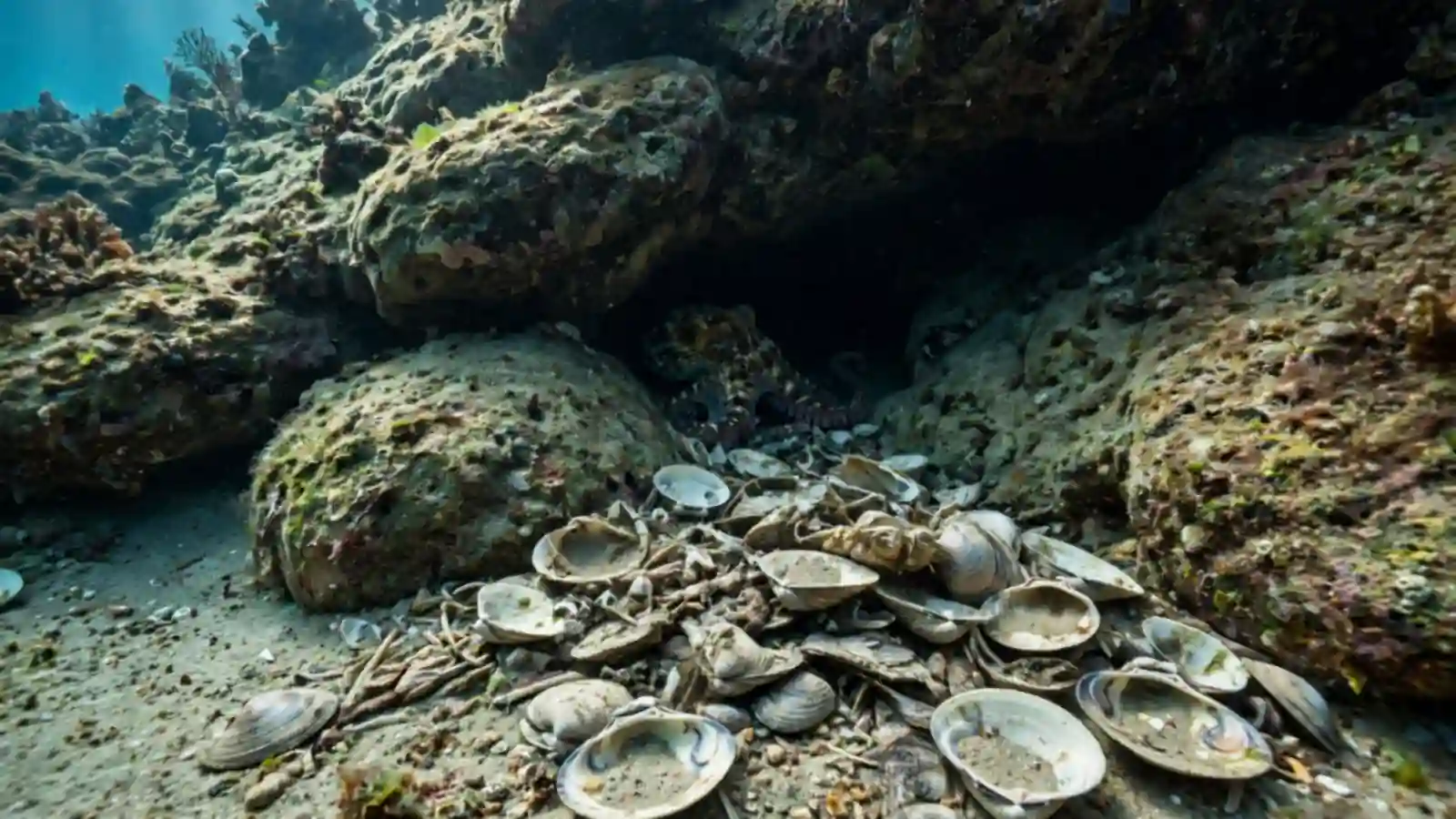
The midden is more than a rubbish heap; it is a record of the octopus’s hunting. The shells in it show what the animal has eaten, how big it is and how long it has lived there — and the midden grows as the octopus feeds, so a large pile means a well-fed octopus that has held its lair for a long time.
Conservation: A Least Concern Octopus
It is listed as Least Concern by the IUCN. It is widespread across the Indo-Pacific, it is abundant on coral reefs, and although it is fished in places, the population is not considered threatened.

The older Aquarium of the Pacific listing says Data Deficient, but that is outdated — the current IUCN assessment is Least Concern, and this guide uses the current status. The dark oval false eye-spots, without iridescent rings, are the field mark that lets divers identify the species for reef counts, and the counts are healthy.
Fun Facts
- It changes its pattern 1,000 times in seven hours, observed by Roger Hanlon.
- Its “passing cloud” display rolls a dark wave of colour across its body.
- It hunts by day, mostly at dawn and dusk — the opposite schedule to the common octopus.
- It leaves a shell midden outside its lair — a pile of empty shells that marks an occupied den.
- Its mantle reaches 16 cm, its arms 80 cm, and it weighs up to 6.5 kg.
- It is also called the big blue octopus, the carpet octopus, and in Hawaiian, he’e mauli.
Frequently Asked Questions
How Big Do Day Octopuses Get?
The mantle reaches 16 cm, the arms 80 cm, and the weight up to 6.5 kg. One source gives a 22 cm mantle, but 16 cm is the standard figure, and this guide uses it.
Why Are They Called Day Octopuses?
Because they hunt by day, mostly at dawn and dusk — the opposite schedule to most octopuses, which hunt at night. It leaves its lair in the morning, prowls the reef for crabs and molluscs, and returns before dark.
Where Do Day Octopuses Live?
On Indo-Pacific coral reefs and rocky shores, in shallow water to about 20 m — from Hawaii to East Africa. They are reef animals that return to the same lair night after night, and they are the octopus most divers meet on a daytime reef dive.
What Do Day Octopuses Eat?
Crabs, shrimps, molluscs and small fish. They hunt by day, prowling the reef with their arms spread and feeling into crevices for crabs, and they have been seen hunting alongside fish, with the fish flushing prey out for the octopus to catch.
What Is the Passing Cloud Display?
A dark cloud-like wave of colour that rolls across its body, from head to arms, like a shadow passing over the reef. It is unique to it, and it is part of a camouflage system that changes pattern 1,000 times in seven hours.
How Long Do Day Octopuses Live?
About one year. Like most octopuses, the day octopus breeds once and dies: the female guards her eggs in the lair without eating until they hatch, and the male dies soon after mating.
What Is the Difference Between a Day Octopus and a Common Octopus?
They are separate species. The day octopus, Octopus cyanea, lives on Indo-Pacific reefs, hunts by day and shows the “passing cloud” display. The common octopus, Octopus vulgaris, lives in the Mediterranean and eastern Atlantic and hunts mostly at night. Do not mix the two species’ facts.
Similar Species Worth Exploring
Keep Exploring
Meet the common octopus, its nighttime counterpart in the Mediterranean, then the coconut octopus, the tool user of the same Indo-Pacific reefs, and browse the whole family in our types of cephalopods hub — then come back to the daylight hunter with the passing cloud, the day octopus.