Upside Down Jellyfish Facts: Sting, Algae and Secrets
Upside Down Jellyfish Facts: Sting, Algae and Secrets
The upside down jellyfish spends its life the wrong way up, bell pressed to the seafloor and frilly arms waving at the sun. It is a jellyfish that behaves more like a plant, farming algae in its tissues for food — and it can sting you without ever touching you.
By Emily Carter · Reviewed by our vet team · Updated 10 November 2026 · 8 min read
The jellyfish that sits upside downFarms algae in its armsStings without touching you
At a Glance
The upside down jellyfish is easy to spot once you know the trick: look down, not up. While most jellyfish drift through open water, this one rests on the bottom of a shallow lagoon, its smooth bell pressed to the sand like a suction cup and its frilly oral arms held up toward the light. The animal is a Cassiopea, chiefly Cassiopea xamachana in the Caribbean and Cassiopea andromeda in the Indo-Pacific, and the upside-down posture is not an accident. The arms carry millions of microscopic algae, and the jellyfish holds them up to the sun the way a gardener turns leaves to the light.
Upside Down Jellyfish Size: A 30 cm Saucer
It grows a bell 25 to 30 centimetres across, about the size of a dinner plate, with the frilly oral arms adding a little more to its spread. The bell itself is smooth and saucer-shaped, thicker in the middle and thinner at the rim, and it sits flat on the bottom rather than pulsing through the water. Young animals are much smaller, starting as tiny polyps on the seafloor before growing into the familiar saucer form.
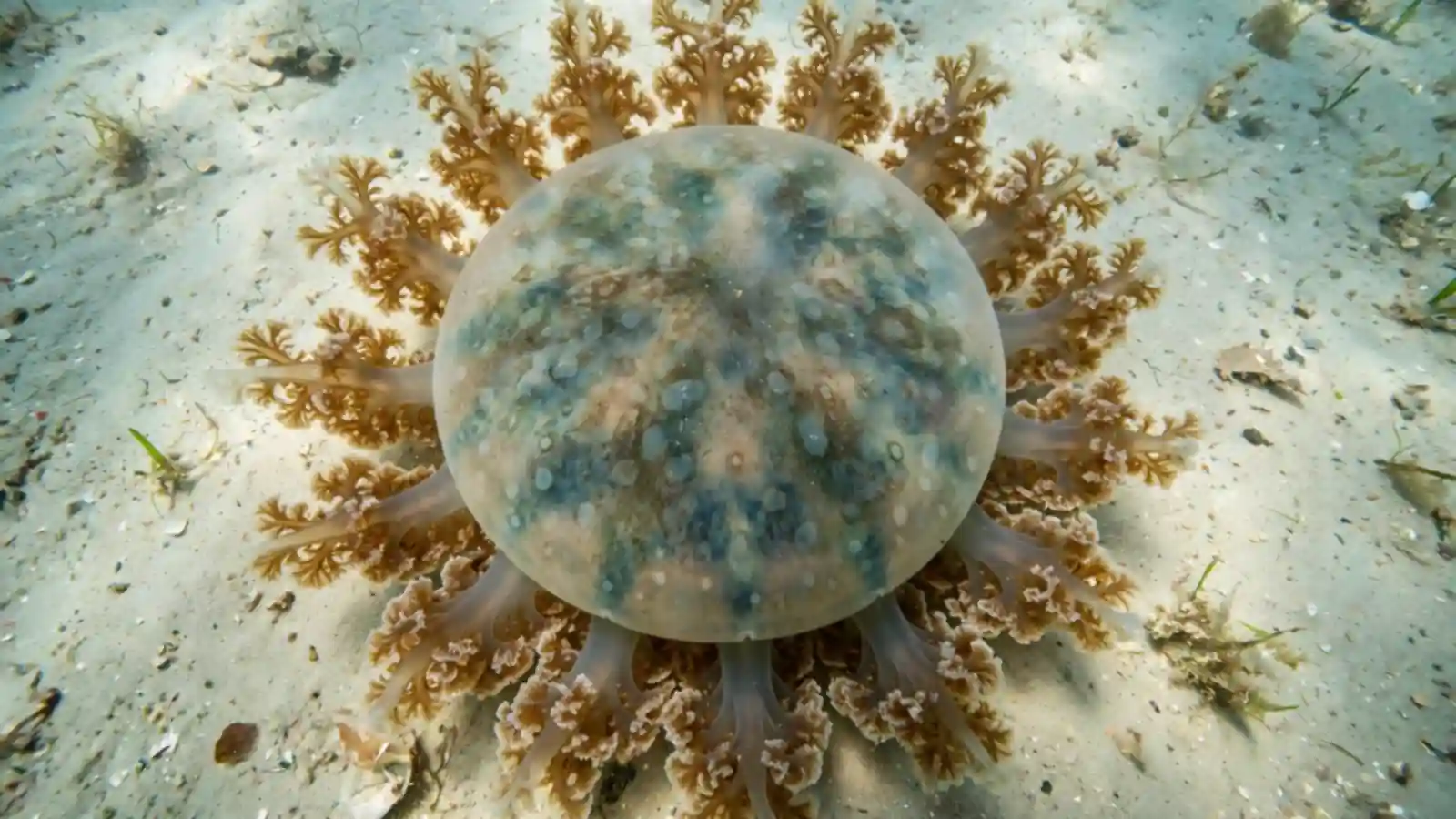
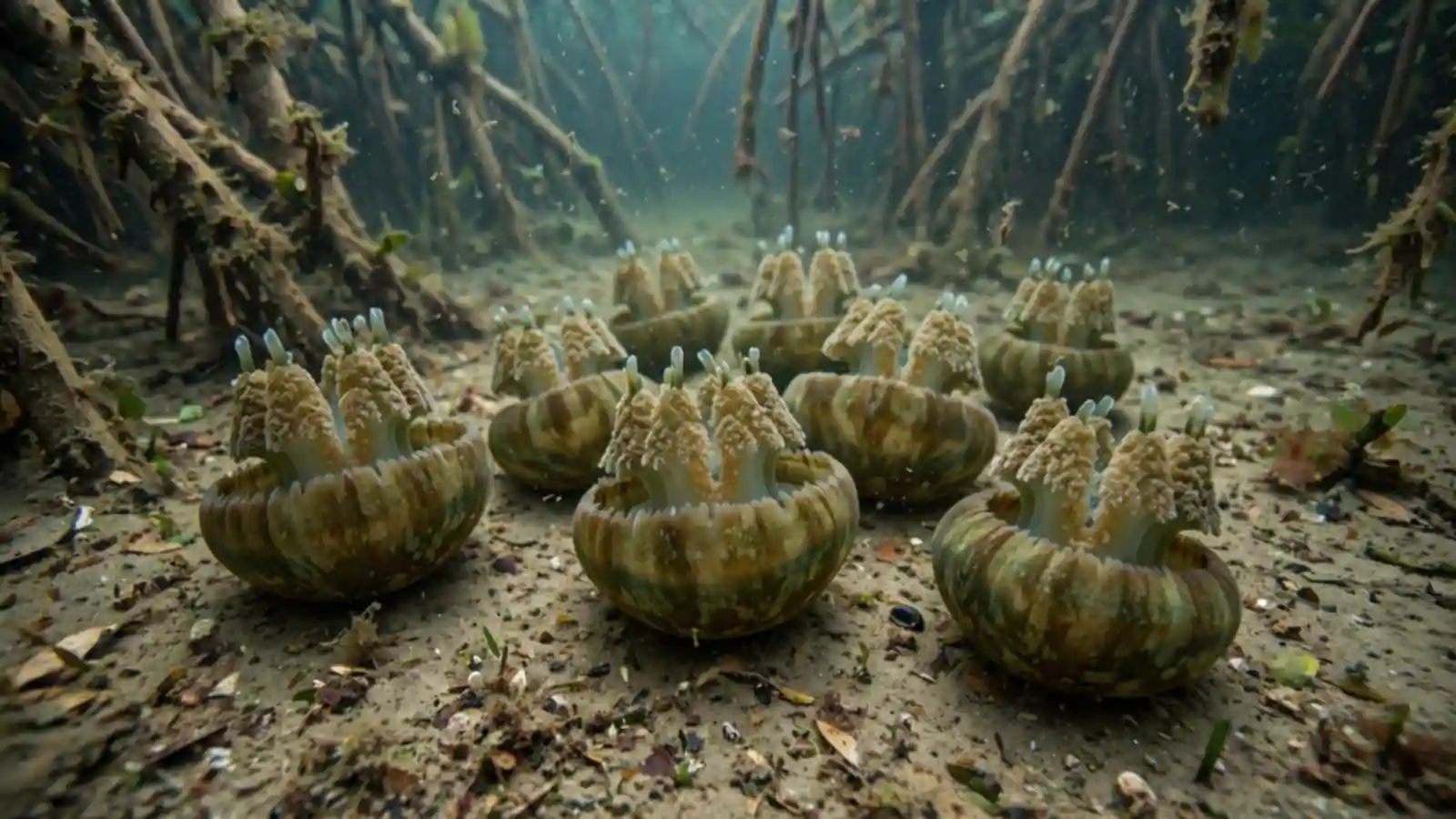
The colour gives the animal away before the shape does. The bell is usually a pale cream or greenish-brown, tinted by the algae living in its tissues, and the frilly arms can be green, brown or faintly blue. In a mangrove lagoon the colour blends with the sand and the dappled light, so a whole group of them can sit almost unnoticed on the bottom until one of them pulses.
Compared with its drifting cousins, it is a heavyweight. A moon jellyfish of similar width is a thin, watery disc built for drifting; the Cassiopea bell is a solid saucer built for sitting still, and it spends almost its whole adult life in one place.
Why Upside Down Jellyfish Live Upside Down
It lives upside down for one reason: sunlight. Its oral arms are packed with zooxanthellae, single-celled algae that photosynthesise, and the algae need light to make food. By resting bell-down on the seafloor and holding its arms upward, the jellyfish turns its whole body into a solar panel, giving the algae the brightest position available in the shallow lagoon.
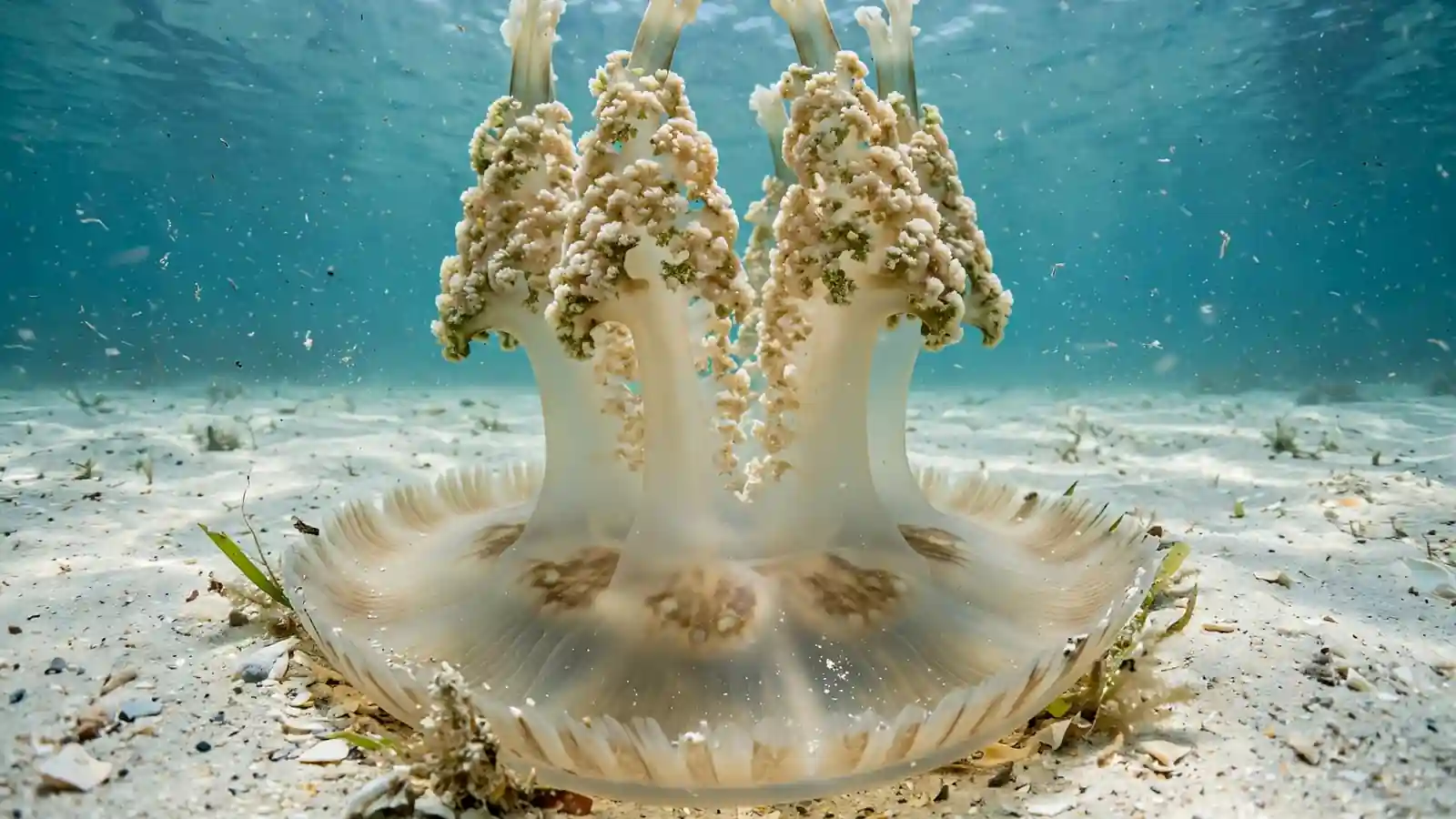
The posture also suits the animal’s lazy lifestyle. It barely swims at all. If it is lifted off the bottom it pulses weakly for a few seconds and then settles straight back down, bell first, arms up. The bell works like a suction cup against the sand, holding the animal in place while the arms do the work of feeding and catching plankton.
There is a trade-off. Sitting on the bottom puts the jellyfish in reach of anything that walks or crawls across the lagoon floor, and it cannot flee the way a drifting jellyfish can. The animal’s answer is chemical rather than physical: the stinging mucus it releases, the cassiosomes, keeps most grazers at a distance without the jellyfish ever having to move.
Zooxanthellae: Farming Algae for Food
It is a farmer. Its tissues host millions of zooxanthellae, the same kind of symbiotic algae that live inside reef-building corals, and the algae hand over most of the sugars they make from sunlight. Researchers estimate that photosynthesis supplies the majority of the jellyfish’s nutrition, which is why the animal can afford to sit still all day instead of hunting.
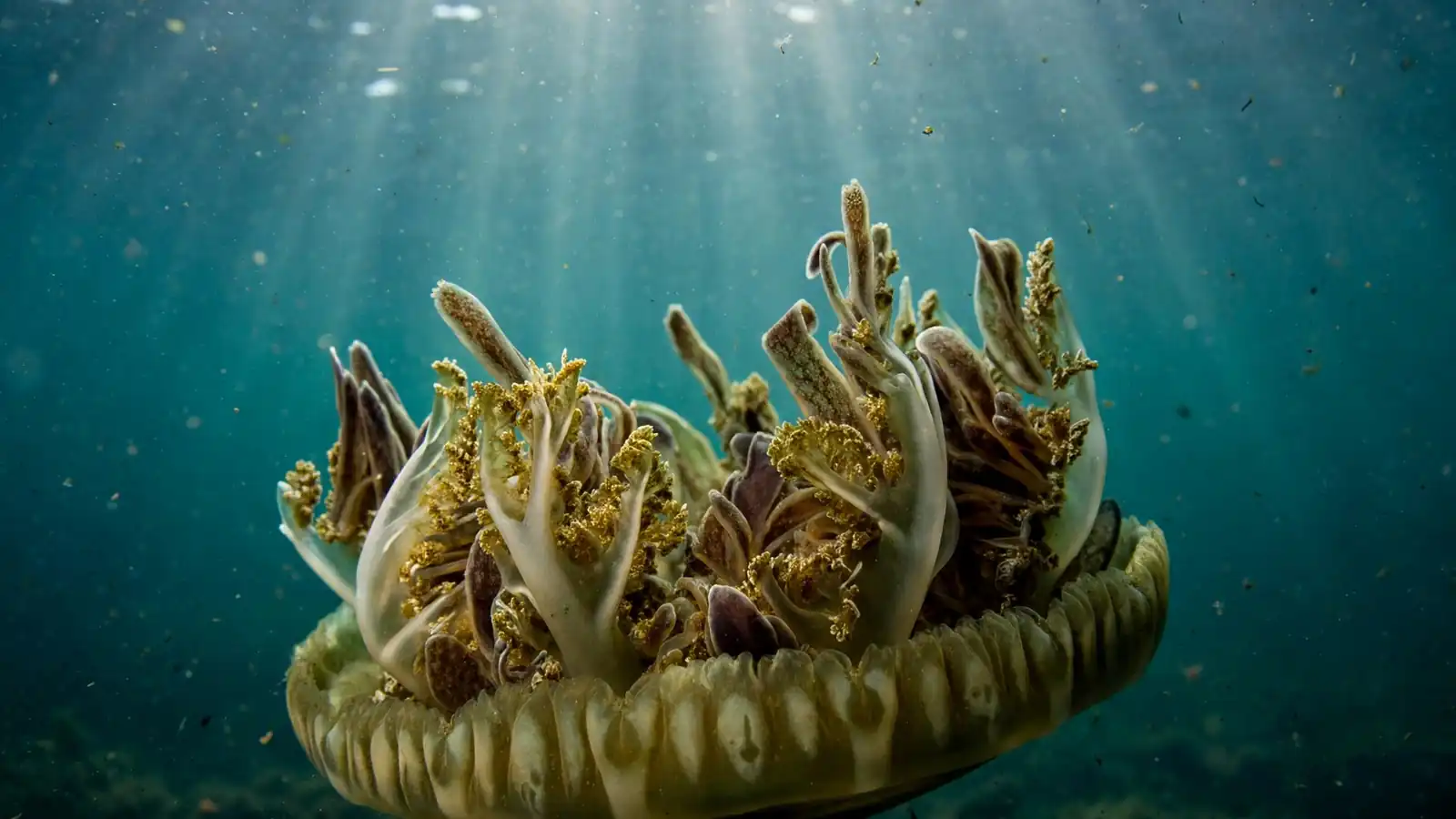
The partnership runs both ways. The algae get a safe home inside the jellyfish’s arms, a steady supply of the nitrogen and carbon dioxide the animal produces, and a ride to the sunniest spot on the lagoon floor. The jellyfish gets food delivered without moving. When the water turns cloudy or the light fades, the animal falls back on its second food source, catching plankton with its frilly arms.
The green-brown tint of the arms is the algae showing through the tissue. A jellyfish kept in the dark loses its colour and shrinks, because the algae stop producing and the animal has to live on plankton alone. In bright, clear water the colour deepens and the animal grows faster — a visible sign of how much of its life runs on sunlight.
Cassiosomes: The Sting That Travels
It has a sting that breaks the usual rules. In 2020 researchers discovered that it releases tiny free-swimming balls of stinging cells, called cassiosomes, into the water around it. The cassiosomes drift on the current like microscopic grenades, and when something brushes against one it fires its stinging cells — so the jellyfish can sting you without ever touching you.
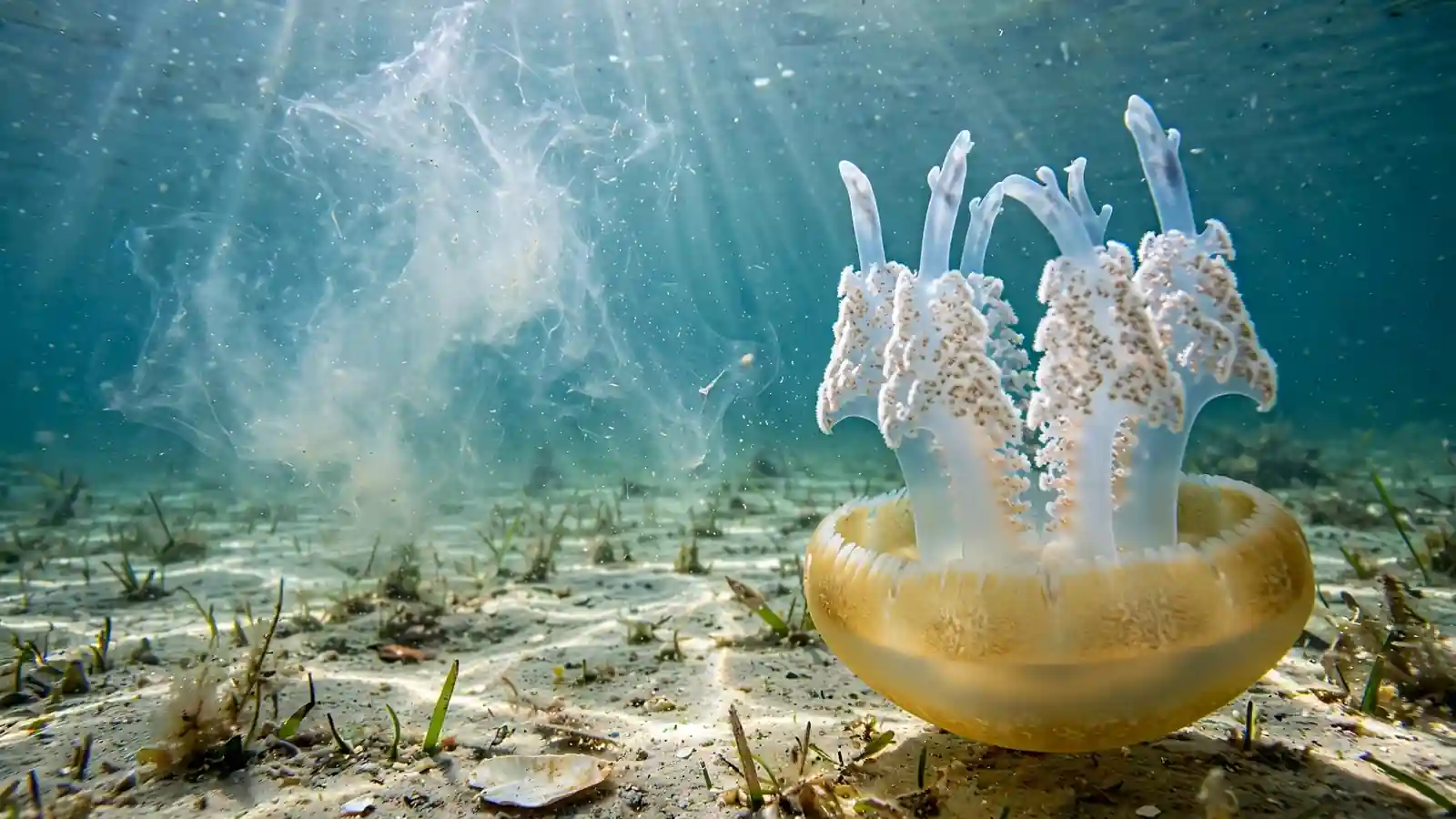
Swimmers in lagoons full of them sometimes feel a faint itch or rash even when they never saw an animal, and the cause is usually this “stinging water”. The sting is mild to humans, more an irritation than a danger, but it is real, and it is why wading through a dense bed of Cassiopea is a bad idea even though the animals look harmless sitting on the bottom.
The cassiosomes are also a hunting tool. Plankton and small animals that drift into the mucus cloud are stung and then gathered by the oral arms, so the jellyfish feeds at a distance as well as up close. The upside-down jellyfish facts page describes the animals’ gentle appearance and their surprising sting, and it is a good reminder that the quietest jellyfish in the lagoon is not the most harmless.
What Do Jellyfish Eat?
It eats two ways at once. Most of its food comes from its algae, which turn sunlight into sugars and pass them to the host. The rest comes from plankton — tiny animals and larvae that drift into the frilly oral arms, where they are caught in mucus, stung by the cassiosomes, and moved toward the mouth in the centre of the arms.

The oral arms are the animal’s kitchen. They are broad, frilly and covered in small mouths, and they do the work that a normal jellyfish’s bell and tentacles do. Food caught on the arms is passed along grooves to the central mouth, while the algae in the same arms keep making sugar in the background. It is a slow, steady way of eating that matches the animal’s slow, steady life.
Because so much of its food arrives as sunlight, it needs far less plankton than a drifting jellyfish of the same size. That is part of why it can live in calm, nutrient-poor lagoons where a hunting jellyfish would go hungry — the sun does the hunting for it.
Habitat, Lifespan and Reproduction
It lives in shallow, calm water on muddy or sandy bottoms, most famously in mangrove lagoons across the Caribbean and the Indo-Pacific. The water is usually warm, clear and only a metre or two deep, with mangrove roots overhead and seagrass nearby. The animals gather in groups on the lagoon floor, sometimes in their hundreds, each one bell-down and arms up in the sun.
One species has travelled far beyond its home range. Cassiopea andromeda, the Mediterranean jellyfish, entered the Mediterranean through the Suez Canal and is now a well-known Lessepsian invader, turning up in harbours and lagoons from Turkey to Italy. It is the same animal with the same upside-down habit, now living in a sea it never evolved in.
It lives for about a year. It reproduces sexually, releasing eggs and sperm into the water, and the larvae settle on the bottom as tiny polyps. The polyps can bud off young jellyfish, called ephyrae, which grow into the saucer-shaped adults. The whole cycle runs on the lagoon floor, out of sight of most swimmers — a very different life from the deep sea jellyfish of the midnight zone, and one reason so many people meet the adult for the first time and never see the tiny stages that came before it.
Fun Facts
- It can sting you without touching you, using free-swimming cassiosomes.
- Most of its food comes from sunlight, through algae farming in its arms.
- The bell works like a suction cup, holding the animal to the lagoon floor.
- Cassiopea andromeda entered the Mediterranean through the Suez Canal and now lives there.
- A group of jellyfish is called a smack — and they gather in smacks on the bottom.
- If lifted off the bottom, it pulses weakly and settles straight back down, bell first.
Frequently Asked Questions
Why do upside down jellyfish live upside down?
They live upside down so their frilly oral arms, which are packed with photosynthetic algae called zooxanthellae, face the sun. The algae make most of the jellyfish’s food from sunlight, so the animal holds its arms up to the light and rests its bell on the seafloor.
Do upside down jellyfish sting?
Yes, mildly. They release tiny free-swimming balls of stinging cells called cassiosomes into the water, which can sting on contact — so you can be stung without ever touching the animal. The sting is an irritation for most people, not a danger, but wading through a dense bed is best avoided.
What are cassiosomes?
Cassiosomes are tiny balls of stinging cells that upside down jellyfish release in mucus into the surrounding water. Discovered in 2020, they drift on the current and fire their stinging cells when something brushes against them, letting the jellyfish sting and catch prey at a distance.
What do upside down jellyfish eat?
Most of their food comes from their symbiotic algae, which turn sunlight into sugars. They also catch plankton with their frilly oral arms, where the prey is trapped in mucus, stung by cassiosomes, and moved to the mouth in the centre of the arms.
Where do upside down jellyfish live?
In shallow, calm water on muddy or sandy bottoms, most famously in mangrove lagoons in the Caribbean and the Indo-Pacific. Cassiopea andromeda has also spread into the Mediterranean through the Suez Canal.
How big do upside down jellyfish get?
The bell grows 25 to 30 centimetres across, about the size of a dinner plate. Young animals are much smaller, starting as tiny polyps on the seafloor before growing into the saucer-shaped adult form.
Can you touch an upside down jellyfish?
You should not. The sting is mild, but the animal releases cassiosomes that can irritate skin, and handling stresses it. Watch them from above the water or at a distance, and give the lagoon floor a wide berth where they gather.
Similar Species Worth Exploring
Keep Exploring
From a jellyfish that farms sunlight on the lagoon floor to the glowing hunters of the deep sea, the jellyfish family keeps surprising — keep exploring the upside down jellyfish.