Coconut Octopus
Coconut Octopus: The Tool-Using Octopus That Carries Shells
The coconut octopus carries coconut shells as portable shelter — the first tool use ever documented in an invertebrate. It is the octopus that plans ahead, walks on stilts and builds a home from whatever the sea floor offers.
By Emily Carter · Reviewed by our vet team · Updated 10 November 2026 · 9 min read
First tool-using invertebrateShells carried 20 mStilt-walks on two arms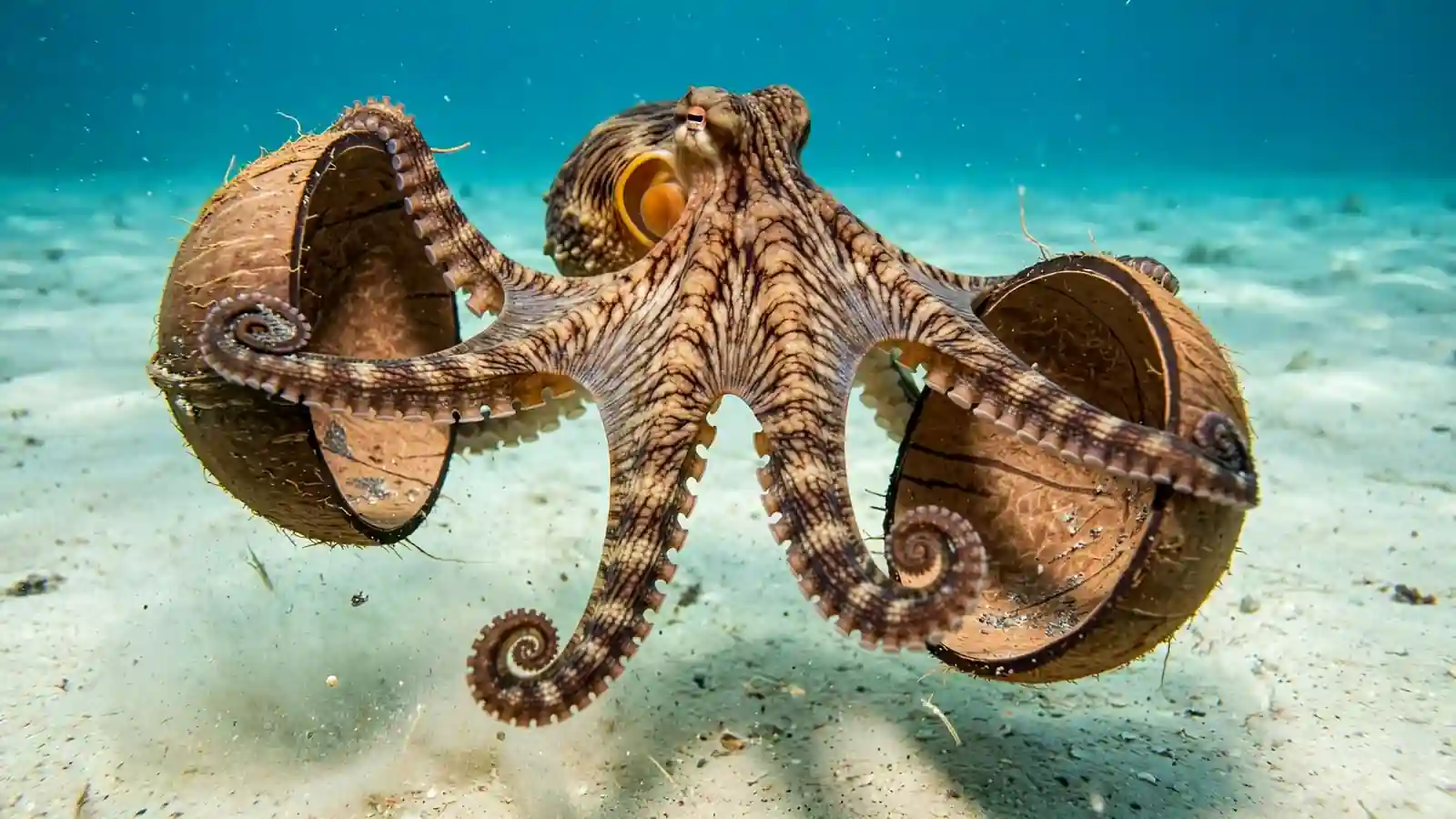
At a Glance
The coconut octopus is a small octopus of the Indo-West Pacific that carries coconut shell halves as portable shelter — the first tool use ever documented in an invertebrate. Its mantle reaches 10 cm, its total length about 30 cm, and it walks on two arms like a pair of stilts.
Coconut Octopus Size: A 30-Centimetre Tool User
It grows a mantle to 10 cm, a total length of about 30 cm and a weight of around 400 g — a small octopus, about the size of a large hand. It is not the size that matters, though; it is what the animal does with the size it has, and a 400-gram octopus that carries its own shelter is doing something no other invertebrate was known to do.
The arms are the working end of the animal: eight arms, each lined with suckers, and two of them reserved for carrying. When the octopus picks up a coconut shell half, it holds it underneath its body with the arms curled around the rim, and the shell becomes a portable roof that goes wherever the octopus goes.
Tool Use: Carrying Coconut Shells as Shelter
It carries coconut shell halves up to 20 m across the sea floor, then assembles them into a shelter — and that is tool use, documented by Finn and colleagues in a 2009 Current Biology study. It was the first tool use ever recorded in an invertebrate, and it changed what scientists thought an octopus could plan.
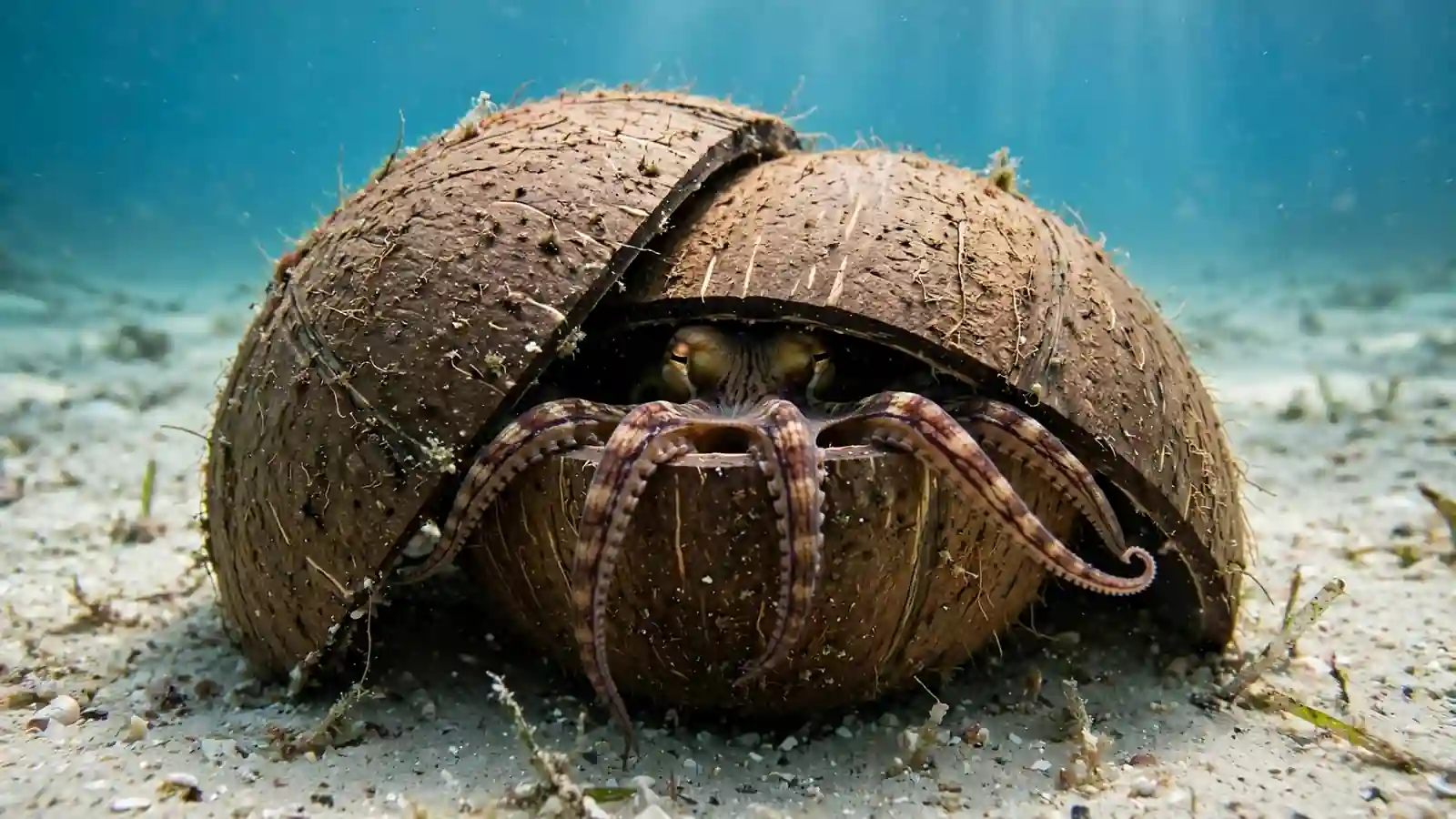
The behaviour is deliberate: the octopus picks up a shell half, carries it — sometimes two halves, one stacked on the other — and when it stops, it pulls the halves together around itself to make a enclosed shelter. It is not using the shell as it finds it; it is transporting a tool for later use, which is the definition of tool use. For the full account, see this octopus profile, which covers the shell-carrying in detail.
Stilt Walking: Moving on Two Arms
It walks on two arms while it carries shells, holding the shell halves underneath its body and stepping forward on the remaining arms like a person on stilts. The gait is ungainly and slow, but it works: the octopus can move across open sand with its shelter held ready, and it can drop into the shell the moment a predator appears.
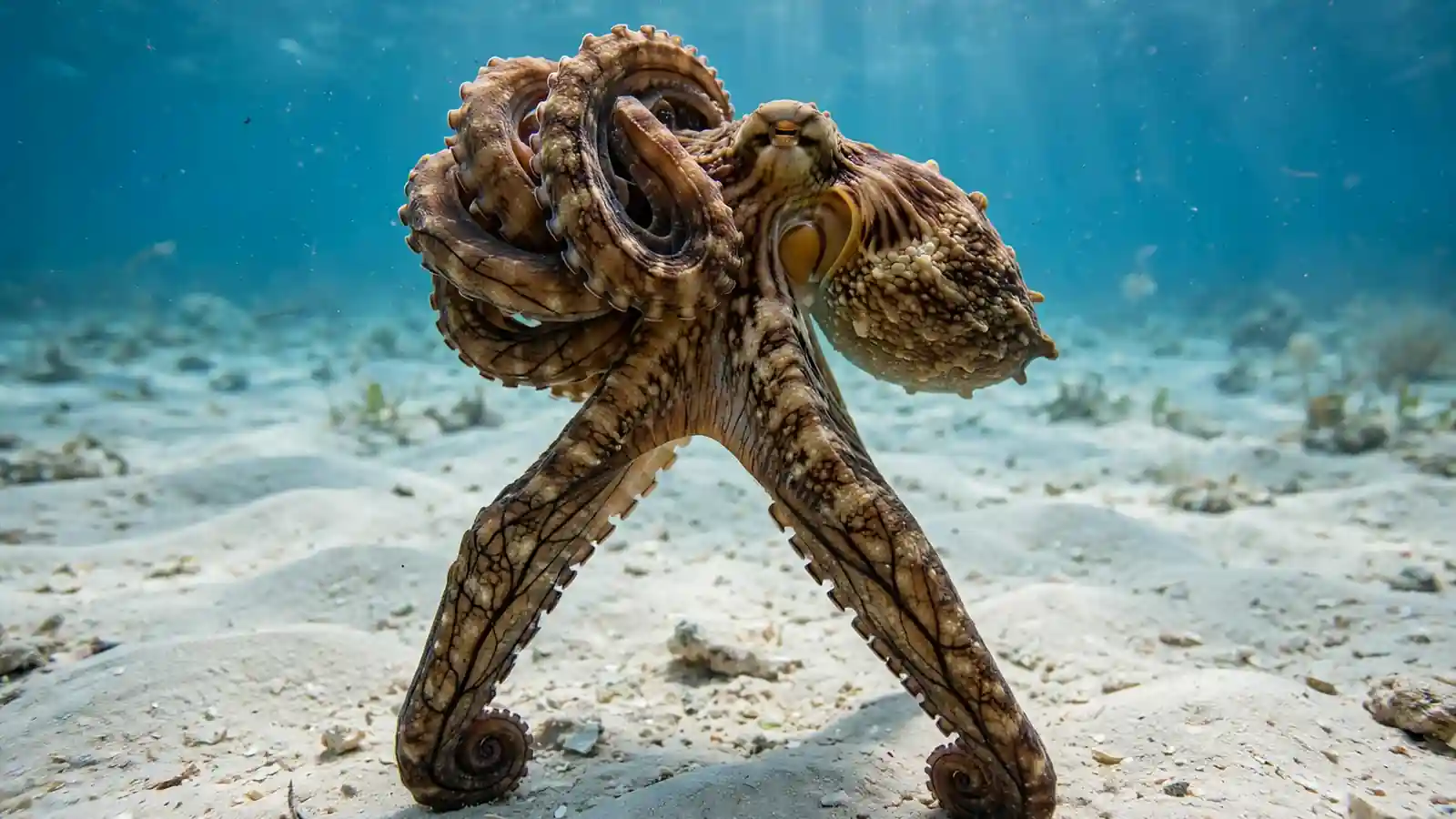
The stilt walk is the giveaway that the animal is carrying something. An octopus without a shell moves like any octopus, crawling and jetting; an octopus with a shell walks upright on two arms, the shell held below it like a carried tray. It is one of the most distinctive walks in the sea.
Where Coconut Octopuses Live: Sandy Indo-Pacific Bottoms
Coconut octopuses live on sandy and muddy bottoms in the Indo-West Pacific, in shallow water down to about 190 m. They are bottom animals: they dig in the sand, hide under shells and hunt in the sediment, and they are most common where the sea floor offers shells and debris to use as shelter.
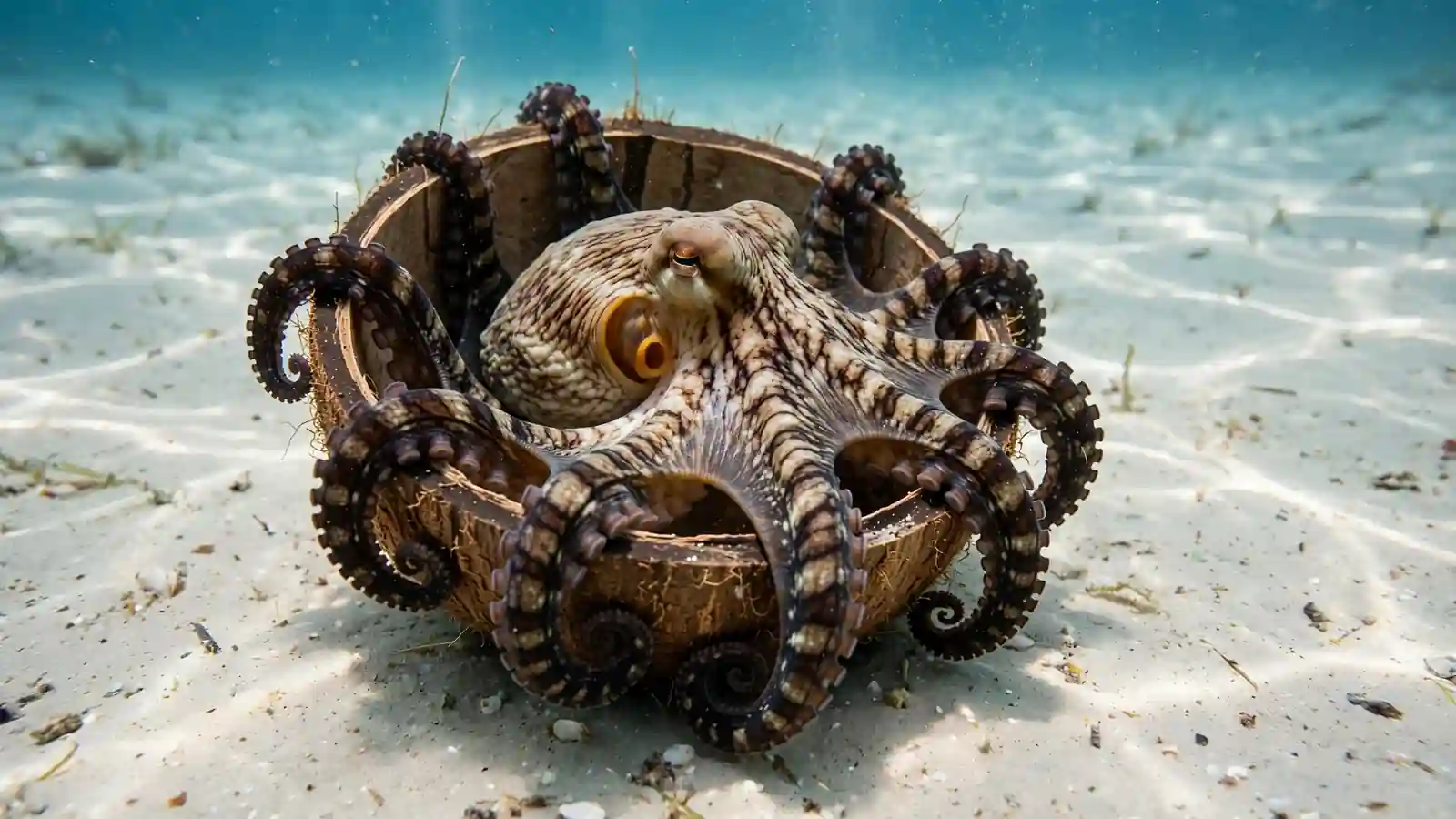
The habitat is the reason for the tool use. A sandy bottom has nowhere to hide, so an octopus that can carry its own hiding place has an advantage — and it has turned that advantage into a way of life. Where shells are scarce it will use clam shells, bottle caps and any other cup-shaped debris it finds.
What Do Coconut Octopuses Eat? Crabs, Shrimps and Clams
It eats crabs, shrimps, clams and small fish, dug from the sand. It hunts by digging: it reaches into the sediment with its arms, feels for buried prey, and pulls it out — a crab from its burrow, a clam from the sand, a shrimp from the mud.

The digging is why the octopus needs its shell. A hunting octopus on open sand is exposed, and the shell is its refuge between hunts. It digs, it catches, it eats, and when a predator approaches it pulls the shell halves around itself and waits — a hunter with a portable fortress.
Coconut Octopus Reproduction: 100,000 Eggs, Then Death
It lays about 100,000 eggs — a huge number for an octopus of its size — and then dies, as most octopuses do after a single brood. The female lays her eggs in a shelter, often inside a shell, and guards them until they hatch, not eating while she tends them.
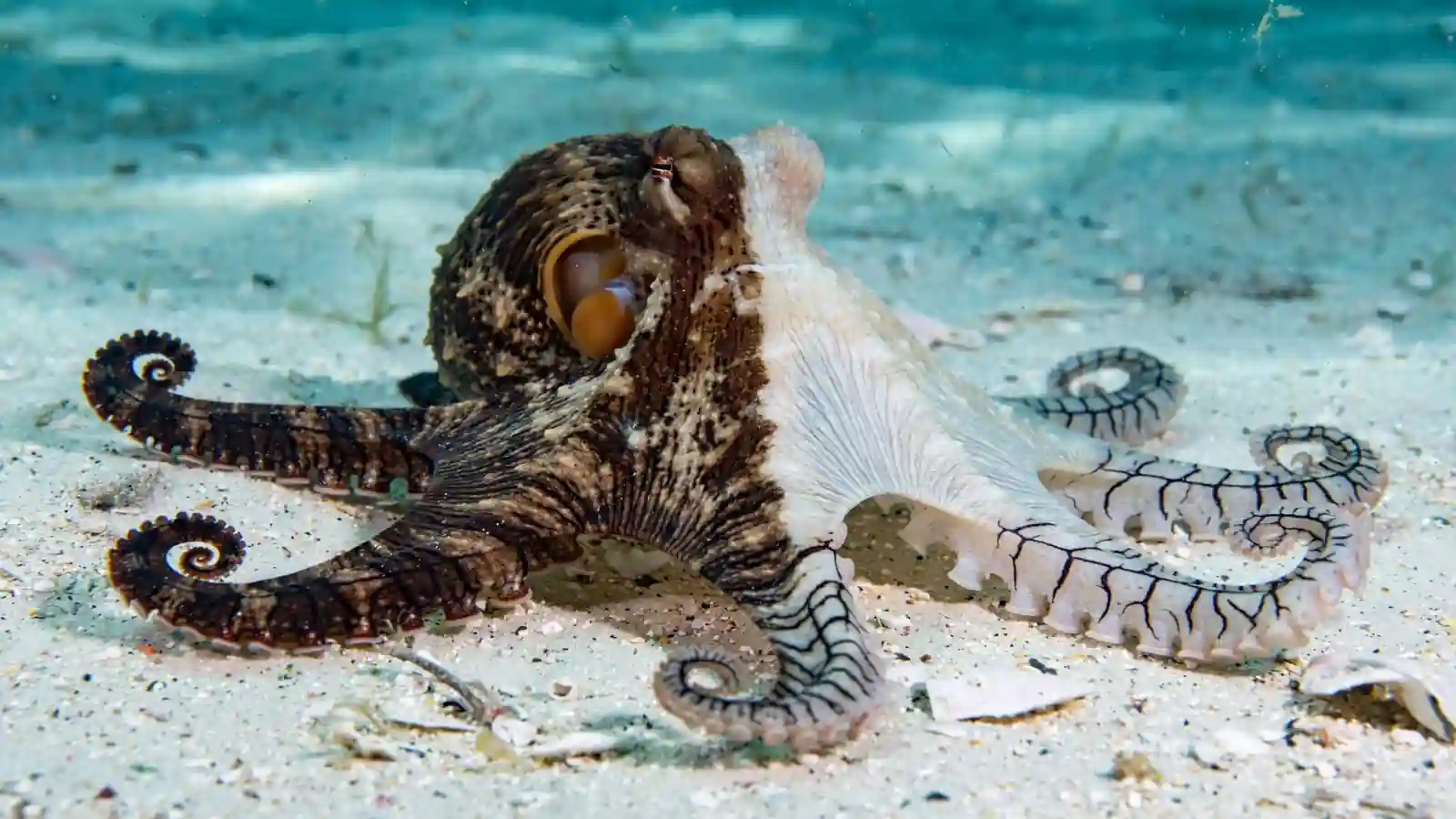
The eggs hatch into tiny planktonic young that drift in the currents before settling to the bottom. The female’s colour shifts as she broods, darkening and paling as she tends the eggs, and by the time the young hatch she is spent. It is a short life — about a year — but the octopus packs a remarkable amount of behaviour into it.
Conservation: A Least Concern Octopus
It is listed as Least Concern by the IUCN (2014 assessment). It is widespread across the Indo-West Pacific, it is not targeted by fisheries, and its sandy-bottom habitat is not under the same pressure as the reefs — so the species is not considered threatened.
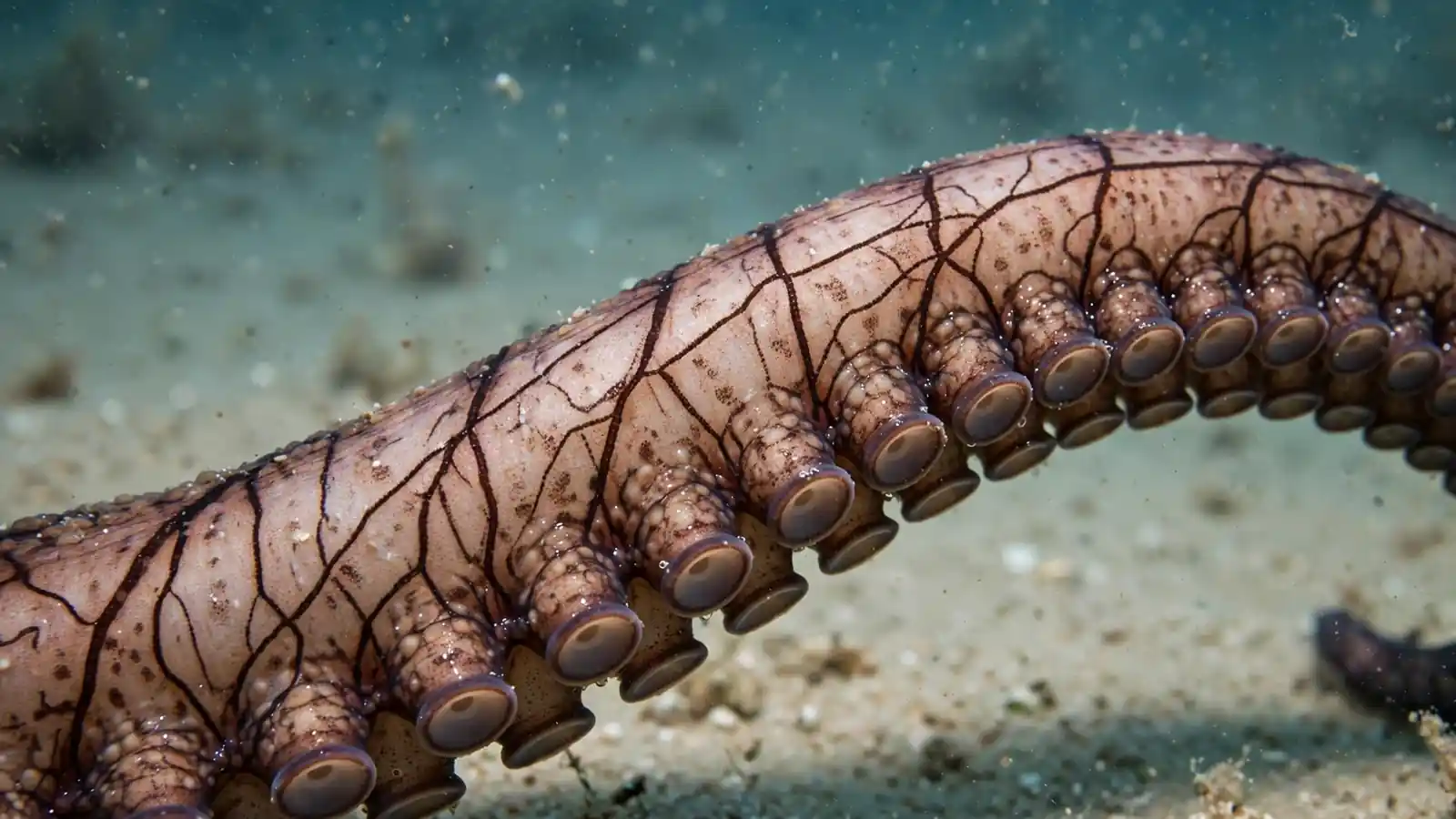
The dark veins on the arms are the field mark that lets divers identify the species for counts, and the veined pattern is also why the animal is sometimes called the veined octopus. It is a common, well-distributed octopus, and its tool use — not its rarity — is what makes it famous.
Fun Facts
- It was the first invertebrate ever documented using tools.
- It carries coconut shell halves up to 20 m to build a shelter.
- It walks on two arms like stilts while it carries a shell.
- It lays about 100,000 eggs, then dies after a single brood.
- It is also called the veined octopus, for the dark veins on its arms.
- Its total length is about 30 cm, and it lives about a year.
Frequently Asked Questions
Do Coconut Octopuses Really Use Tools?
Yes. The coconut octopus carries coconut shell halves up to 20 m and assembles them into a shelter — documented by Finn and colleagues in a 2009 Current Biology study. It was the first tool use ever recorded in an invertebrate.
How Big Do Coconut Octopuses Get?
The mantle reaches 10 cm, the total length about 30 cm, and the weight around 400 g. It is a small octopus, about the size of a large hand, and its arms do the heavy work of carrying shells.
Where Do Coconut Octopuses Live?
On sandy and muddy bottoms in the Indo-West Pacific, in shallow water down to about 190 m. They are bottom animals that dig in the sand and hide under shells, and they are most common where the sea floor offers shells and debris.
What Do Coconut Octopuses Eat?
Crabs, shrimps, clams and small fish, dug from the sand. The octopus reaches into the sediment with its arms, feels for buried prey and pulls it out, then retreats to its shell between hunts.
How Do Coconut Octopuses Walk on Stilts?
By holding a shell underneath its body and stepping forward on two arms, like a person on stilts. The gait is slow and ungainly, but it lets the octopus move across open sand with its shelter held ready to drop into.
How Many Eggs Do Coconut Octopuses Lay?
About 100,000 eggs. The female lays them in a shelter, often inside a shell, guards them until they hatch without eating, and then dies — as most octopuses do after a single brood.
Why Are They Called Coconut Octopuses?
Because they carry coconut shell halves as portable shelter. The name comes from the tool use: the octopus picks up discarded coconut shells, carries them across the sand and assembles them into a home.
Similar Species Worth Exploring
Keep Exploring
Meet the common octopus, the classic camouflage master of the Mediterranean, then the day octopus, the daytime hunter of Indo-Pacific reefs, and browse the whole family in our types of cephalopods hub — then come back to the octopus that carries its own shelter, the coconut octopus.