Lanternfish
Lanternfish: the glowing fish that rises every night in the greatest migration on Earth
The lanternfish is small, silver and almost invisible by day — and then, every night, it rises from the deep in shoals so vast that sonar once mistook them for a false seabed. It carries its own lights, it feeds the whole deep ocean, and by one estimate it may be the most abundant fish family on the planet.
By Emily Carter · Reviewed by our vet team · Updated 10 November 2026 · 9 min read
Rises hundreds of metres every nightGlows with species-specific light patternsUp to 65% of deep-sea fish biomass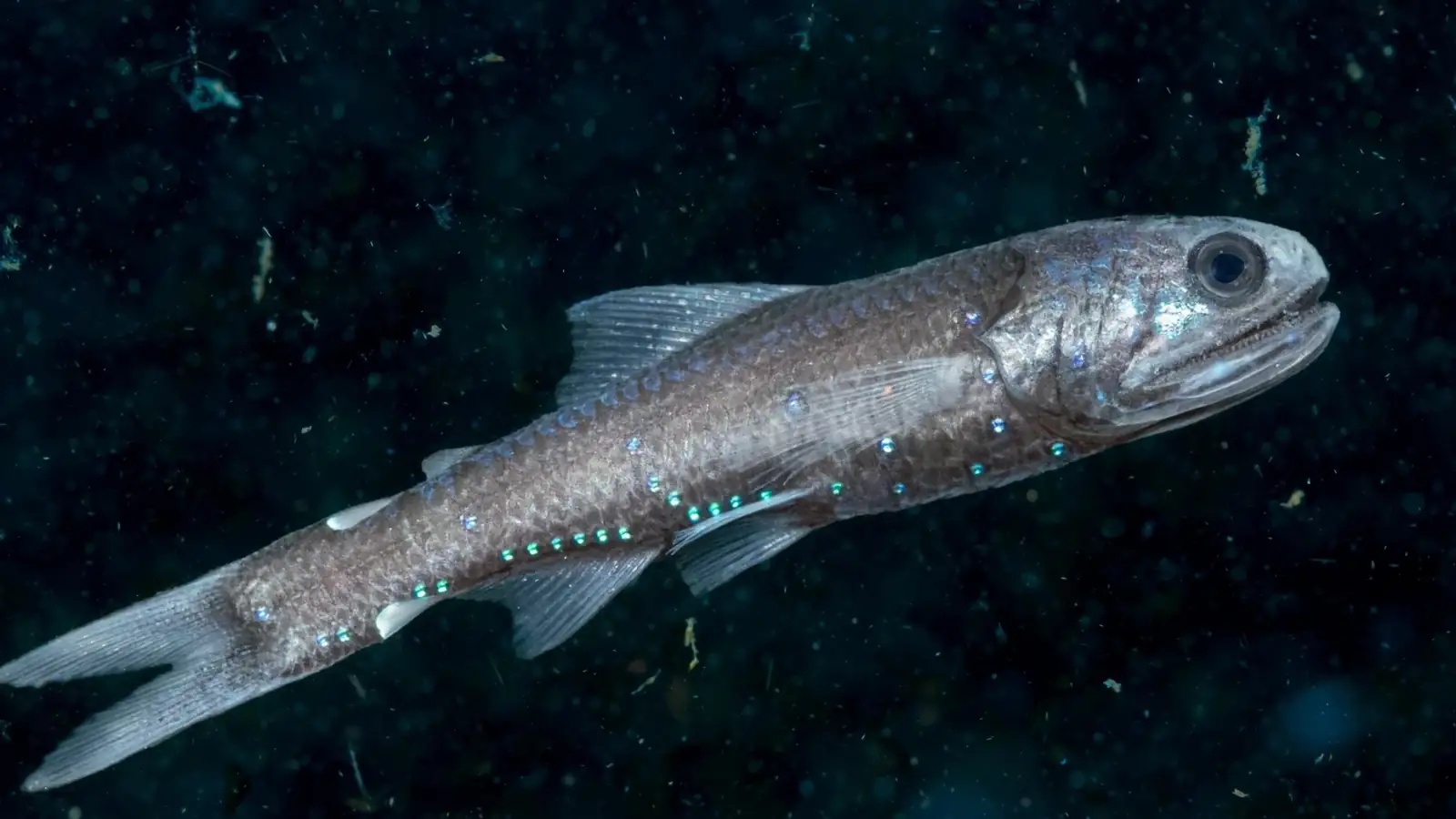
At a Glance
The lanternfish is not one fish but a whole family, the Myctophidae, with around 254 species spread through the world’s oceans. Every one of them is small, silvery and lit from within: rows of light organs, photophores, run along its belly and flanks in patterns so precise that scientists use them to tell the species apart. By day they hide in the deep; by night they rise to feed near the surface, in the largest daily migration of animals on Earth, measured by weight.
What Is a Lanternfish?
It is a small, deep-sea fish with a big eye, a silvery body and a belly studded with photophores — light organs that glow blue-green in the dark. Most species are only 2 to 15 centimetres long, about the size of a finger, and they live in the twilight zone of the open ocean, the mesopelagic, between about 200 and 1,000 metres down. One species is the odd one out: Taaningichthys paurolychnus has no photophores at all, a reminder that even the family’s signature feature has an exception.

The family is spread through every ocean, and it is staggeringly numerous. They are thought to make up as much as 65% of all deep-sea fish biomass, and the global total is estimated at somewhere between 1.8 and 16 gigatonnes — a range so wide it tells its own story about how hard these fish are to count. Whatever the true figure, it is the quiet backbone of the deep ocean’s food web.
Size and Species
They are small by design: a typical adult is 5 to 10 centimetres long, and even the largest species rarely pass 15 centimetres. Small size is the point — a fish this size can live on plankton, hide in the dark, and exist in numbers no big fish could match. There are around 254 described species in the family, divided between two subfamilies, and new ones are still being found in the deep.
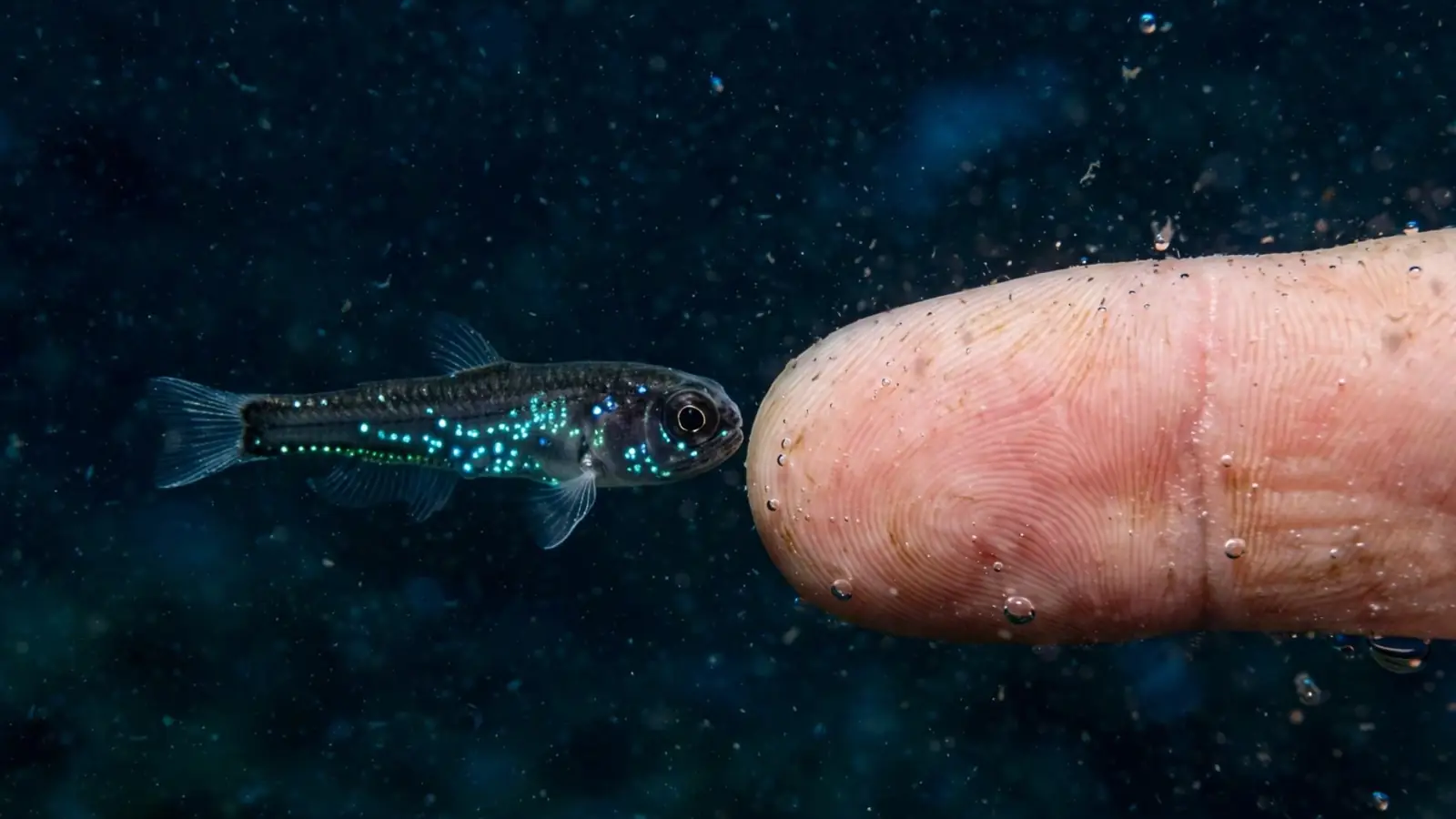
The species are told apart by their lights. Each species carries its photophores in a distinct arrangement — different rows, different spacing, different positions on the head, belly and tail — and those patterns are as reliable as a fingerprint. Two individuals that look identical in daylight can be different species once their lights are mapped, which is why the family’s taxonomy is written in photophores as much as in fins and bones.
Photophores: Lights With a Pattern
Its photophores are small, complex light organs, each with its own lens, reflector and light-producing chemistry, and they are arranged in neat rows along the belly and flanks. The main job of the lights is counterillumination: by glowing downwards as brightly as the faint light coming from above, the fish erases its own silhouette, so a predator looking up from below sees nothing against the glow of the surface.

The lights do more than hide the fish. Different species flash in different patterns, and the lights are thought to help them recognise their own kind in the dark, and to confuse predators with sudden flashes. The glow is cold light, made by chemistry, not heat — the same kind of light a firefly makes, tuned by evolution for the deep sea.
The Daily Migration: Deep by Day, Shallow by Night
Every evening, as the light fades, they rise. By day they hold at depths of 300 to 1,500 metres, safe in the dark; by night they swim up to 10 to 100 metres below the surface, into the rich plankton of the upper ocean, and before dawn they sink back down again. The round trip can be hundreds of metres, and by total weight it is the largest daily migration of animals on Earth.
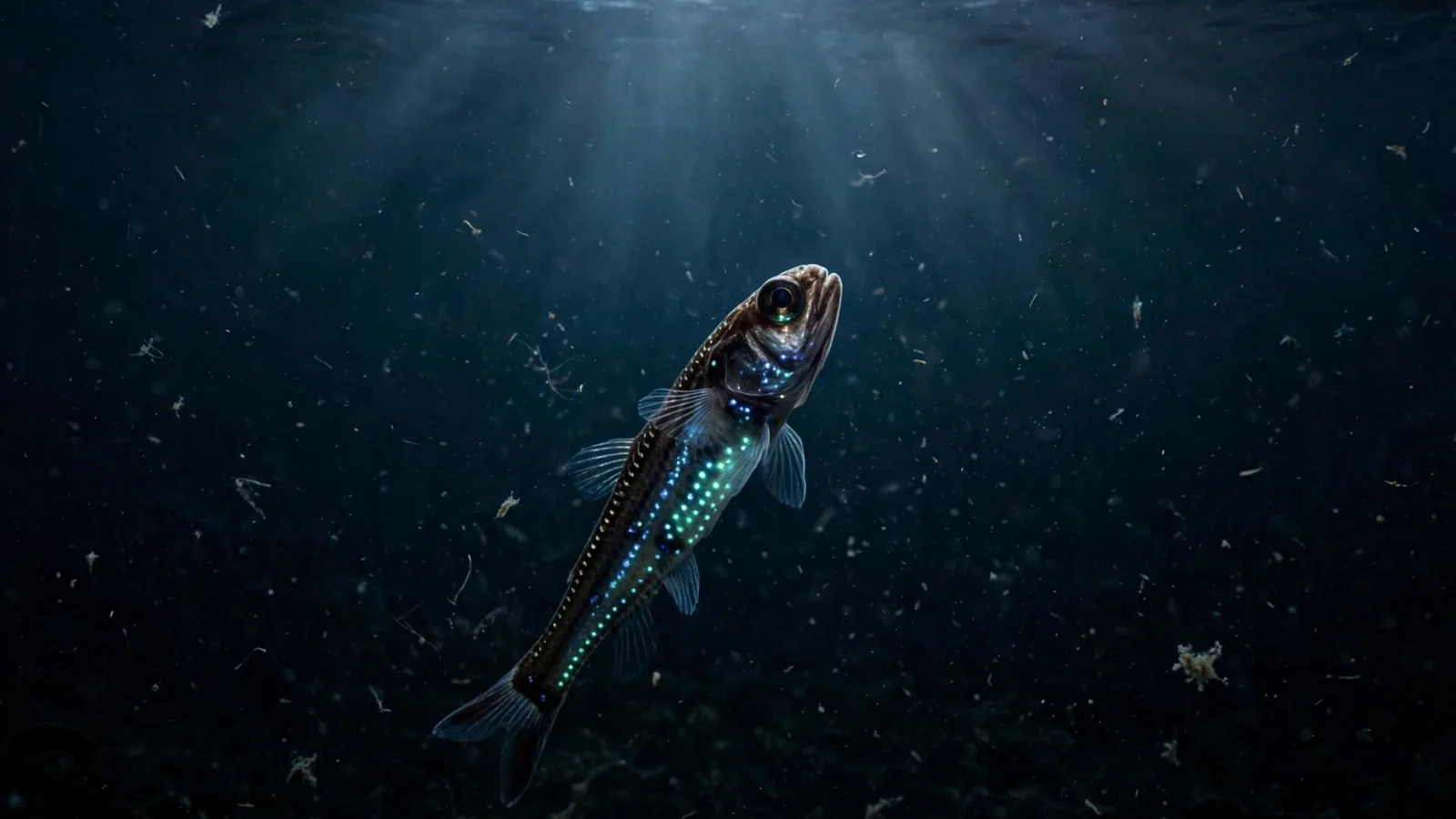
The migration is what first gave them away. Early sonar operators saw a layer in the water that rose at dusk and sank at dawn, and called it the false bottom, thinking it was the seabed moving. It was these fish — and the krill and squid travelling with them — moving as one vast, living layer, feeding at the surface by night and hiding in the deep by day.
Diet and Feeding
They eat zooplankton: copepods, krill, small shrimps and the larvae of other animals, snapped up in the dark with a quick dart and a gulp. They feed mostly at night, in the plankton-rich water near the surface, and their big eyes are built for exactly that — gathering the faintest light to find prey that is barely there. One may eat a large share of its own body weight in a single night’s feeding.
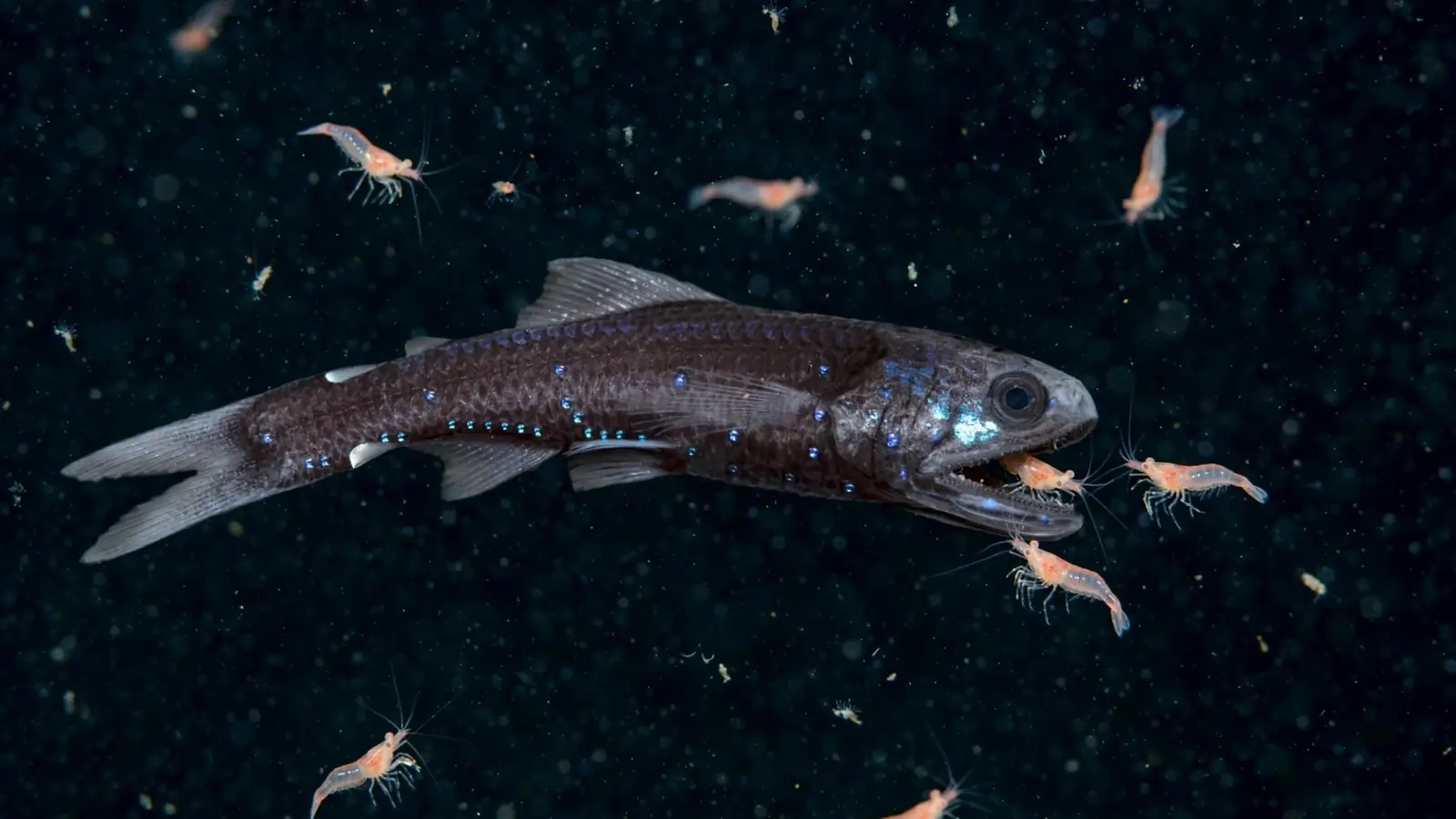
Everything eats them in return. Tuna, swordfish, sharks, seals, whales, seabirds and squid all hunt them, and the nightly rise is what makes that possible: by coming up to feed, they deliver the deep ocean’s food to the surface hunters. Without the migration, the deep sea’s energy would stay locked in the dark, and the surface predators would go hungry.
Biomass: Up to 65% of Deep-Sea Fish
They are the deep ocean’s great store of living matter. The global biomass is estimated at 1.8 to 16 gigatonnes — a huge range, because counting fish in the deep is hard — and they may make up to 65% of all deep-sea fish biomass. In plain terms, most of the fish in the deep sea, by weight, are this family.

That weight does a job for the whole planet. Every night they feed at the surface and every morning they sink back down, excreting at depth — and in doing so they carry carbon from the surface ocean down into the deep, part of the ocean’s biological carbon pump. The fish are small, but the pump is planetary: without the nightly migration, far less carbon would reach the deep sea, and the ocean would hold less of the carbon we put into the air. The family account records the species count, the biomass range and the migration figures behind this guide.
Fun Facts
- Sonar operators once thought their layer was a false seabed, because it rose at dusk and sank at dawn.
- They may make up to 65% of all deep-sea fish biomass, and their global total is estimated at 1.8 to 16 gigatonnes.
- Each species carries its photophores in a distinct pattern, like a fingerprint written in light.
- One species, Taaningichthys paurolychnus, has no photophores at all.
- Their nightly rise is the largest daily migration of animals on Earth, measured by weight.
- By feeding at the surface and excreting at depth, they help pump carbon down into the deep ocean.
Frequently Asked Questions
How Do Lanternfish Produce Light?
They produce light with photophores, small light organs along the belly and flanks that make cold, blue-green light by chemistry — the same kind of light a firefly makes. Each photophore has a lens and a reflector, and the pattern of photophores is different for each species.
How Deep Do Lanternfish Live?
By day, they live at depths of 300 to 1,500 metres in the mesopelagic twilight zone. At night they rise to 10 to 100 metres below the surface to feed, then sink back down before dawn. The round trip can be hundreds of metres.
How Many Species of Lanternfish Are There?
There are around 254 described species in the family Myctophidae. New species are still being found. Species are told apart largely by the arrangement of their photophores, which is distinct for each species.
What Do Lanternfish Eat?
They eat zooplankton: copepods, krill, small shrimps and the larvae of other animals. They feed mostly at night, near the surface, snapping up tiny prey with a quick dart. One may eat a large share of its own body weight in a single night.
Why Do Lanternfish Migrate Every Night?
They migrate every night to feed: the plankton they eat is richest near the surface, but the surface is dangerous by day, so they hide in the deep during daylight and rise only after dark. The migration also lets them avoid daytime predators while still reaching the food.
How Much Do Lanternfish Weigh in Total?
The global biomass is estimated at 1.8 to 16 gigatonnes — a very wide range, because counting fish in the deep sea is hard. They may make up to 65% of all deep-sea fish biomass, making them the most abundant fish family in the deep ocean by weight.
What Eats Lanternfish?
Almost everything that hunts in the open ocean eats them: tuna, swordfish, sharks, seals, whales, seabirds and squid. The nightly rise is what makes that possible, delivering deep-ocean food to surface predators. They are the key link between the deep sea’s plankton and the ocean’s top hunters.
Similar Species Worth Exploring
Keep Exploring
Keep exploring the deep sea through the dragonfish, the glowing hunter of the midnight zone, the viperfish with its record-breaking fangs, and the wider world of the types of deep-sea fish. No fish does more for the ocean, or is seen less, than the lanternfish.