Sally Lightfoot Crab
Sally Lightfoot Crab: The Red Crab That Paints Galapagos Lava Rocks
The Sally Lightfoot crab paints Galapagos lava rocks red and orange, grazes algae, cleans ticks off marine iguanas, and can run in four directions. It starts life black and ends it red — one of the most photographed crabs on Earth.
By Emily Carter · Reviewed by our vet team · Updated 10 November 2026 · 9 min read
Carapace 8–12 cmBlack juvenile, red adultGalapagos shores
At a Glance
The Sally Lightfoot crab is the red-orange shore crab of the Galapagos islands and the Pacific coast of the Americas, famous for the colour change from black juvenile to red adult and for the cleaning symbiosis with marine iguanas. It is also called the red rock crab, and it is one of the most photographed animals in the Galapagos.
Sally Lightfoot Crab Size: 8 to 12 cm of Colour
It grows a carapace 8 to 12 cm across, per the majority of sources — about the width of a hand. The Galapagos Conservation Trust gives smaller figures, 5 cm average and 8 cm maximum, and this guide notes them while printing the majority figure: most Sally Lightfoot crabs you meet on a Galapagos shore are in the 8 to 12 cm range, big enough to see from the path and small enough to vanish into a crack.

Size shows in the colour. The blue belly and red shell of an adult are visible from metres away, and the close-up view shows the smooth, flat carapace and the long legs that let the crab run across lava. It is not a big crab, but it is a bright one, and on black lava it does not need to be big to be seen.
Sally Lightfoot Crab Habitat: Lava Rocks and Spray
It lives on the Pacific coast of the Americas and in the Galapagos, on lava rocks, in tide pools, and in the spray zone where the waves break. It is a shore crab in the fullest sense: it lives where the sea meets the rock, in the thin band that is wet at high tide and dry at low tide, and it is at home on black lava that would burn a bare foot.
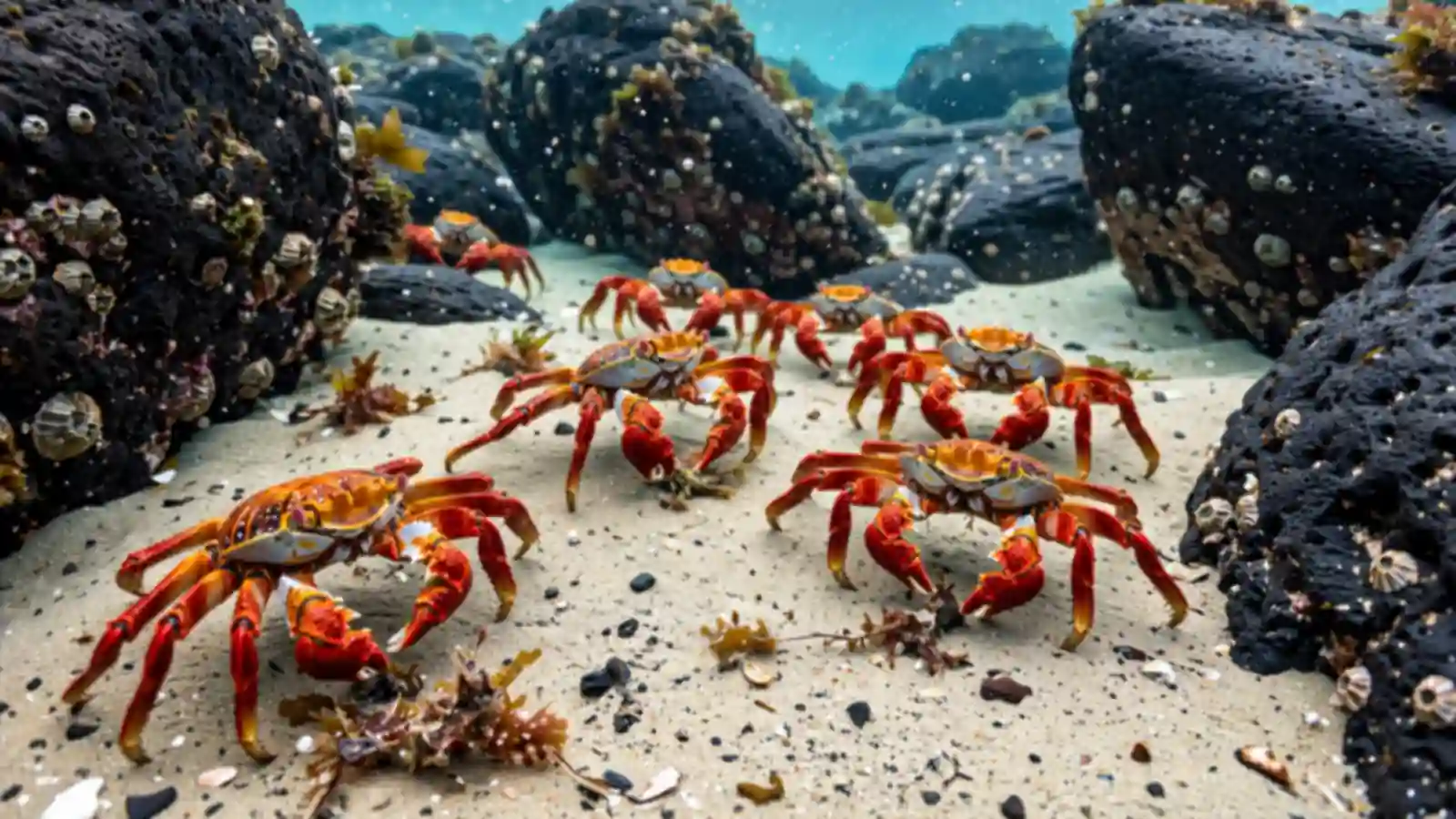
Groups of crabs feed together on the rocks at low tide, grazing algae and picking at detritus — the behaviour covered in this crab species guide from the Galapagos Conservation Trust — and they scatter at the first sign of danger, grazing algae and picking at detritus, and they scatter at the first sign of danger — into cracks, under ledges, anywhere a bird cannot reach. The lava is both home and camouflage for the juveniles, and a stage for the adults, whose red shells stand out against the black rock like paint.
What Do Sally Lightfoot Crabs Eat?
It eats algae and detritus, and it scavenges whatever the sea leaves: sea lion placenta, bird eggs, dead fish. It grazes red algae from the rocks with its claws, picks at detritus in the tide pools, and takes carrion when it finds it. It is an opportunist, and on a Galapagos shore there is always something to eat.
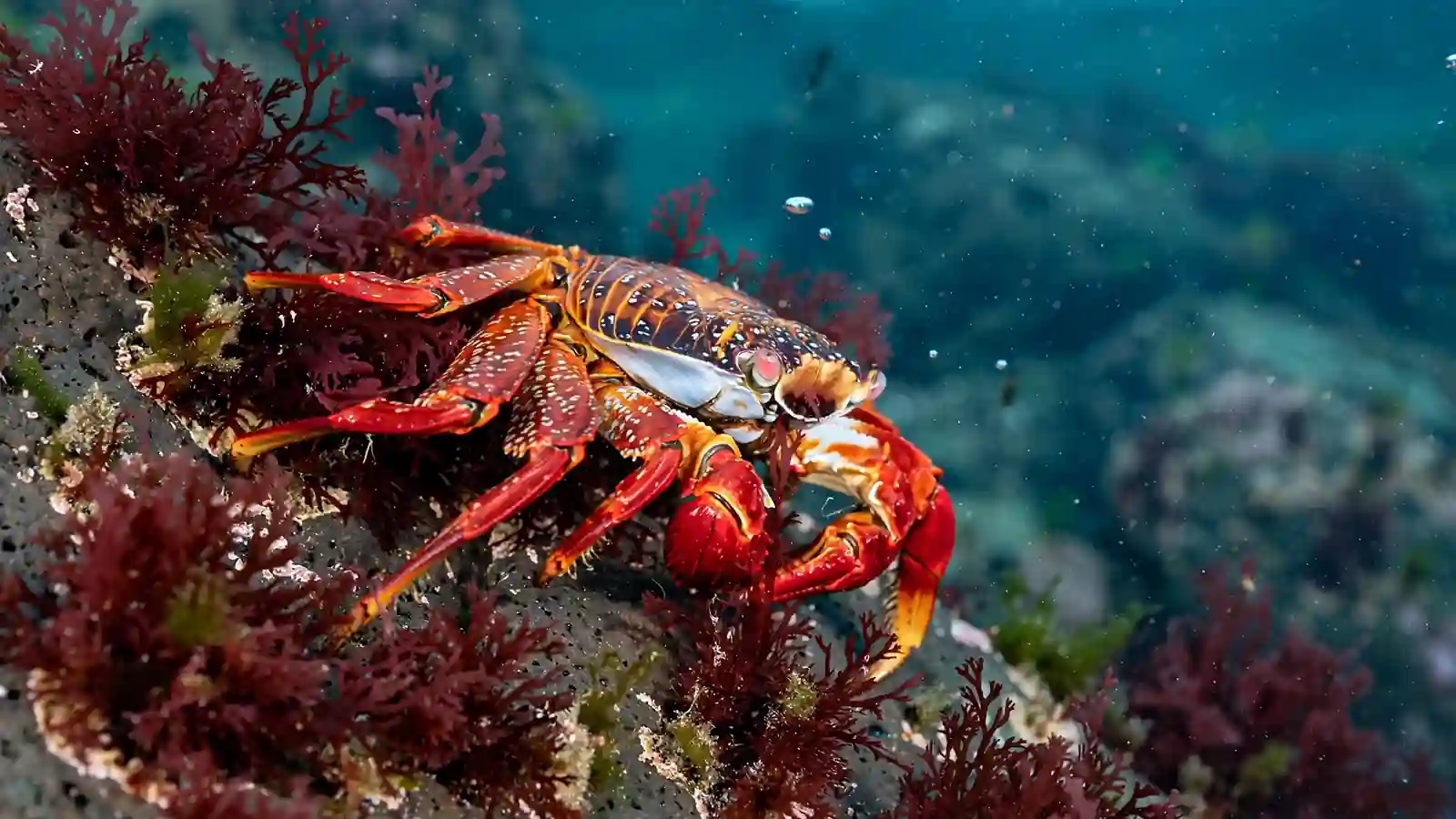
The most famous meal is not algae at all. It picks ticks off marine iguanas — a cleaning symbiosis covered in its own section below — and it is the crab’s willingness to eat anything, including parasites off a reptile, that makes it the shore’s great opportunist.
The Marine Iguana Cleaning Partnership
It cleans marine iguanas: it climbs onto the iguana’s back and picks ticks off its skin, eating the parasites while the iguana sits still and lets it work. It is a cleaning symbiosis — the crab gets food, the iguana gets rid of its ticks — and it happens on the same lava rocks where both animals live.
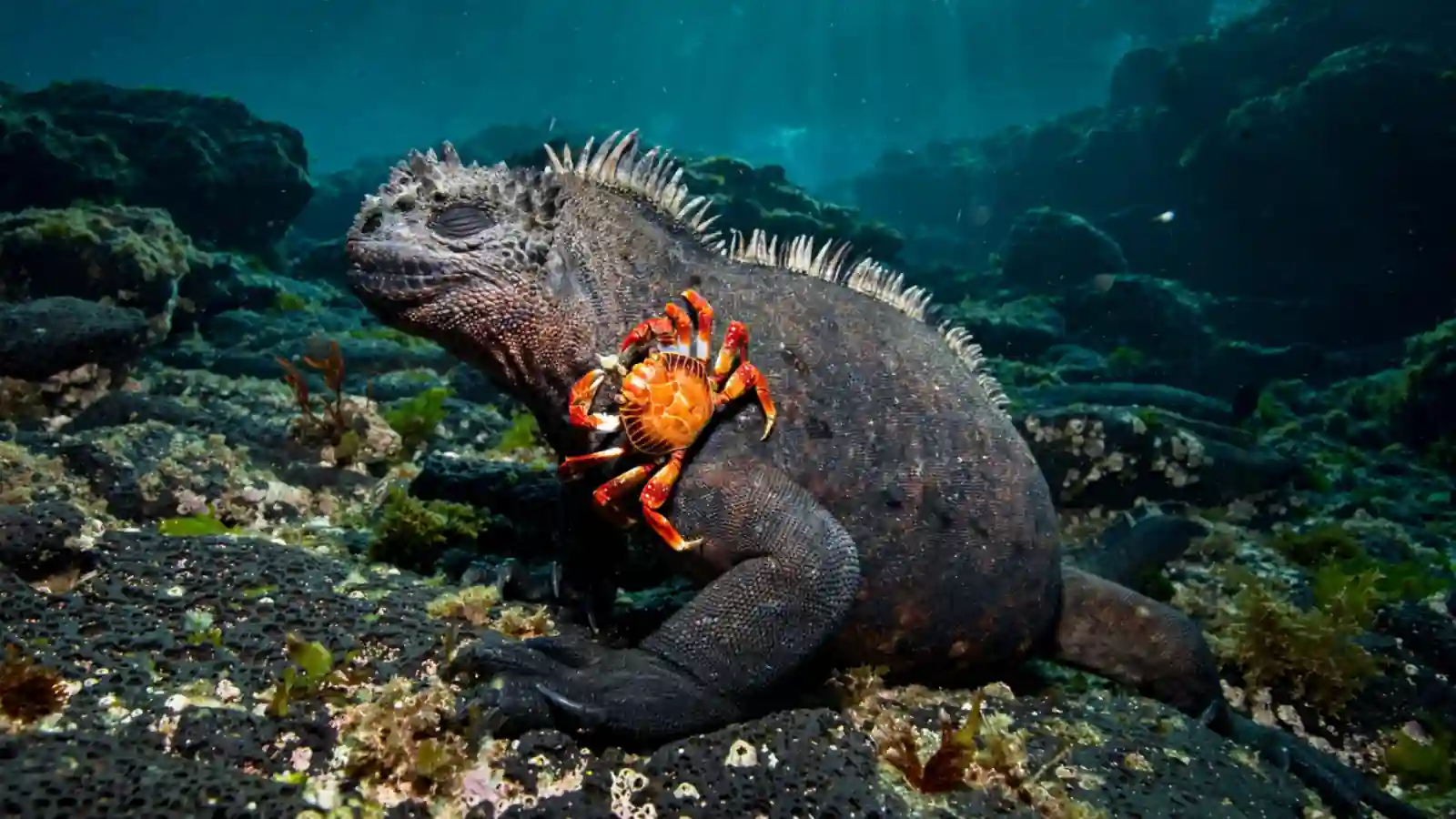
The partnership works because the iguana does not eat the crab. A marine iguana is a herbivore, grazing algae, and the crab is not food to it — it is a cleaner, and the iguana knows it. The crab works over the iguana’s back and head, picking carefully, and the iguana waits, patient as a rock, until the job is done.
Why Sally Lightfoot Crabs Change Colour with Age
It changes colour with age: juveniles are black or dark brown, camouflaged on the black lava, and adults are red-orange with a blue underside. The change is gradual, and it is the crab’s life story written in colour — a young crab hides, and an old crab advertises.
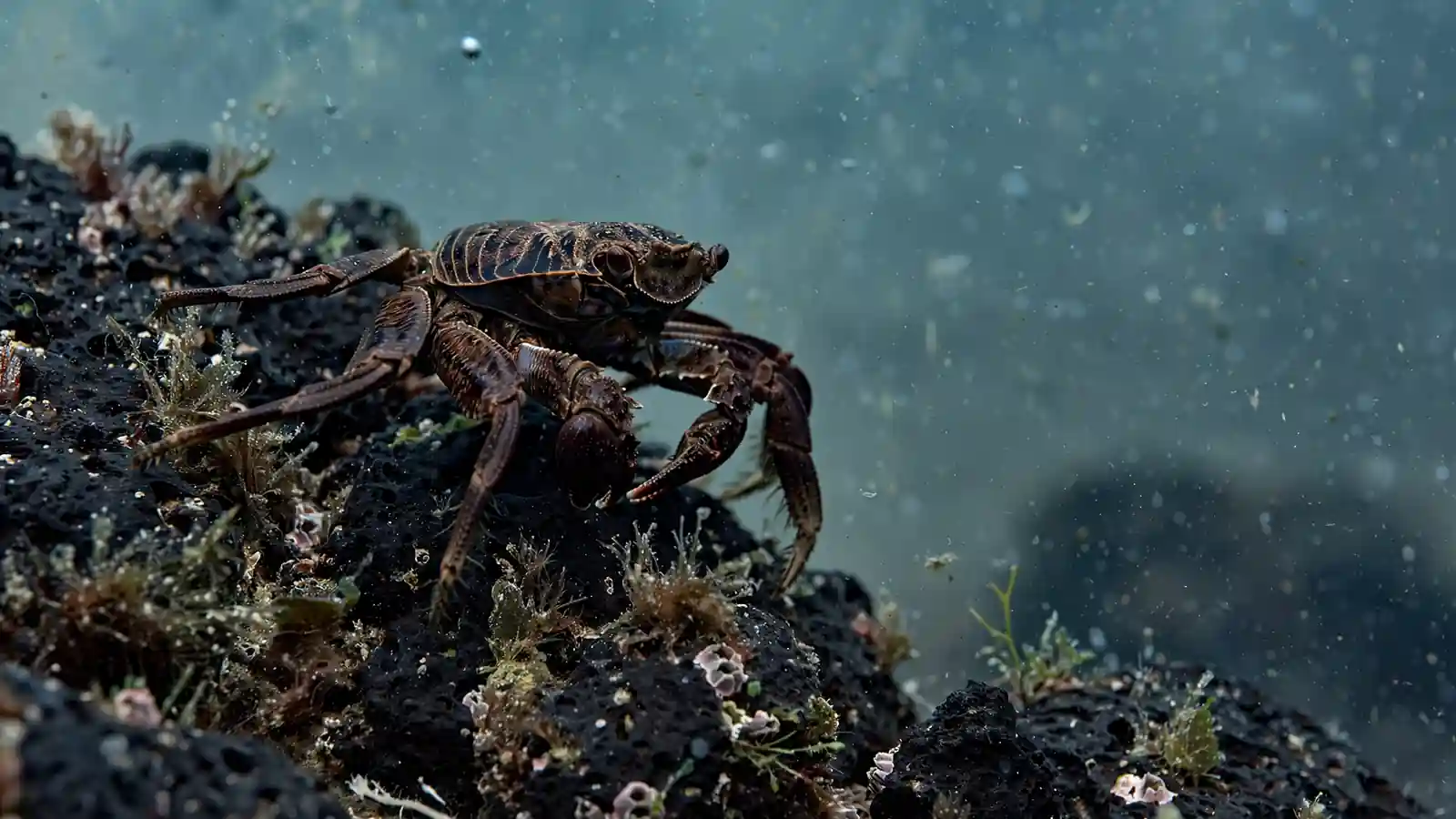
The adult colour is a warning as much as a display. Red and orange in nature often mean “do not eat me”, and it is fast, alert and hard to catch — the colour says so. The blue belly, visible only from below, is the surprise: a flash of blue under the red shell, seen when the crab rears up or is turned over.
Speed and Agility
It is fast and agile: it runs across lava rocks, leaps between boulders above the surf, and can run in four directions — forwards, backwards and sideways, as the question goes. It is the speed that lets it live in the open on black rock, where there is nowhere to hide from a bird except in a crack.

The agility is in the legs. Long, light and quick, they carry the crab across ground no other crab would cross — wet lava, spray-slick rock, boulders with gaps between them. A crab that cannot run is a dead crab, and this species runs better than almost any other crab on the shore.
Conservation: The Galapagos Watch
It is not formally assessed by IUCN — no Red List status is printed for it here. The Galapagos Conservation Trust lists it as Least Concern, and this guide notes that listing while printing the unassessed position: without a formal IUCN assessment, the honest statement is that the species has not been formally assessed, and the Trust’s listing is a regional judgement, not a global one.
The watch matters because the Galapagos is changing. Tourism, introduced species and warming water all press on the shore, and a crab that lives in the spray zone feels every change first. For now it is abundant on its lava rocks — a red flash on black stone, and one of the sights that makes the Galapagos what it is.
Fun Facts
- Juvenile Sally Lightfoot crabs are black or dark brown; adults are red-orange with a blue belly.
- It picks ticks off marine iguanas in a cleaning symbiosis.
- It can run in four directions — forwards, backwards and sideways.
- It eats algae, detritus, sea lion placenta, bird eggs and dead fish.
- The Galapagos Conservation Trust lists it as Least Concern, though IUCN has not formally assessed it.
- It is also called the red rock crab.
Frequently Asked Questions
Where do Sally Lightfoot crabs live?
On the Pacific coast of the Americas and in the Galapagos, on lava rocks, in tide pools, and in the spray zone where the waves break. The Sally Lightfoot crab is a shore crab: it lives where the sea meets the rock, in the thin band wet at high tide and dry at low tide.
What do Sally Lightfoot crabs eat?
Algae and detritus, plus scavenging: sea lion placenta, bird eggs and dead fish. The Sally Lightfoot crab grazes red algae from the rocks, picks at detritus in tide pools, and takes carrion when it finds it. It also picks ticks off marine iguanas.
How big do Sally Lightfoot crabs get?
A carapace 8 to 12 cm across, per the majority of sources. The Galapagos Conservation Trust gives smaller figures — 5 cm average and 8 cm maximum — and this guide notes them while printing the majority figure of 8 to 12 cm.
Why are Sally Lightfoot crabs so colourful?
Because they change colour with age: juveniles are black or dark brown, camouflaged on black lava, and adults are red-orange with a blue underside. The adult colour is a warning as much as a display — red and orange in nature often mean “do not eat me”.
Do Sally Lightfoot crabs clean marine iguanas?
Yes. The Sally Lightfoot crab climbs onto a marine iguana’s back and picks ticks off its skin, eating the parasites while the iguana sits still. It is a cleaning symbiosis: the crab gets food, the iguana gets rid of its ticks.
Are Sally Lightfoot crabs edible?
They are not a food species in the Galapagos, and they are not fished commercially. The Sally Lightfoot crab is small, fast and lives on protected shores — it is watched and photographed far more than it is eaten.
Can Sally Lightfoot crabs really run in four directions?
Yes — forwards, backwards and sideways. The Sally Lightfoot crab is one of the fastest, most agile crabs on the shore, running across wet lava and leaping between boulders above the surf.
Similar Species Worth Exploring
Keep Exploring
Meet the marine iguana, its cleaning partner, then the porcelain crab, the filter-feeding false crab, and browse the whole family in our types of crabs hub — then come back to the red crab that paints Galapagos lava rocks, the Sally Lightfoot crab.