Moray Eel
Moray eel: the two-jawed hunter behind the reef’s scariest face
The moray eel owns the most misunderstood face on the reef: a gaping mouth full of needles that is really just breathing, behind which hides the strangest feeding machinery in the vertebrate world — a second set of jaws in its throat that lunges forward to drag prey down. Add 200 species, a night-hunting partnership with groupers, and not a drop of venom. Here is the real animal.
By Emily Carter · Reviewed by our vet team · Updated 10 November 2026 · 9 min read
Two sets of jawsSome 200 speciesNot venomous at all
At a Glance
The moray eel is not one animal but a whole family of them — around 200 species of scaleless, fin-folded reef hunters, from hand-sized snowflakes to the three-metre giant moray. All share the same brilliant strategy: live in a hole, hunt by scent at night, and swallow prey with a mechanism no other vertebrate possesses. Begin with the variety, because the family is far stranger than its scariest member.
Types of Moray Eels: A Family of 200
Moray eels come in more patterns than any other reef family dares. The green moray of the Atlantic — actually brown-skinned under yellow-tinted mucus — grows thick as a thigh and past 2 metres. The snowflake moray wears a blizzard of black and gold stars and stays near half a metre. The zebra moray is banded like its namesake and specialises in crushing crabs; the honeycomb or leopard moray is draped in spots.

Sizes span an order of magnitude. The giant moray of the Indo-Pacific, at over 3 metres, is among the longest bony fish of the reefs, while the smallest species mature at under 20 centimetres and live their whole lives in a single coral head. Between them sit ribbon-like, pebble-toothed and fang-toothed specialists, each fitted to its crevice and its prey.
What unites them is construction: no scales, no pectoral fins in most, a continuous fin fold along the back and tail, and skin armoured in thick mucus. That mucus is functional — it lets a moray squeeze through abrasive rock without injury — and in the green moray it creates the famous colour: yellow mucus over dark skin reads, underwater, as green. You can browse the family overview for Muraenidae for the full spread of genera and species.
The Second Jaws: How a Moray Really Swallows
Every moray carries a second set of jaws in its throat, and using them is one of the great spectacles hidden inside an animal. The oral jaws do the catching — a fast strike, needle teeth gripping a fish or octopus. Then the pharyngeal jaws, a fully toothed second jaw apparatus sitting in the throat, launch forward into the mouth, bite the prey, and ratchet it backwards down the gullet.
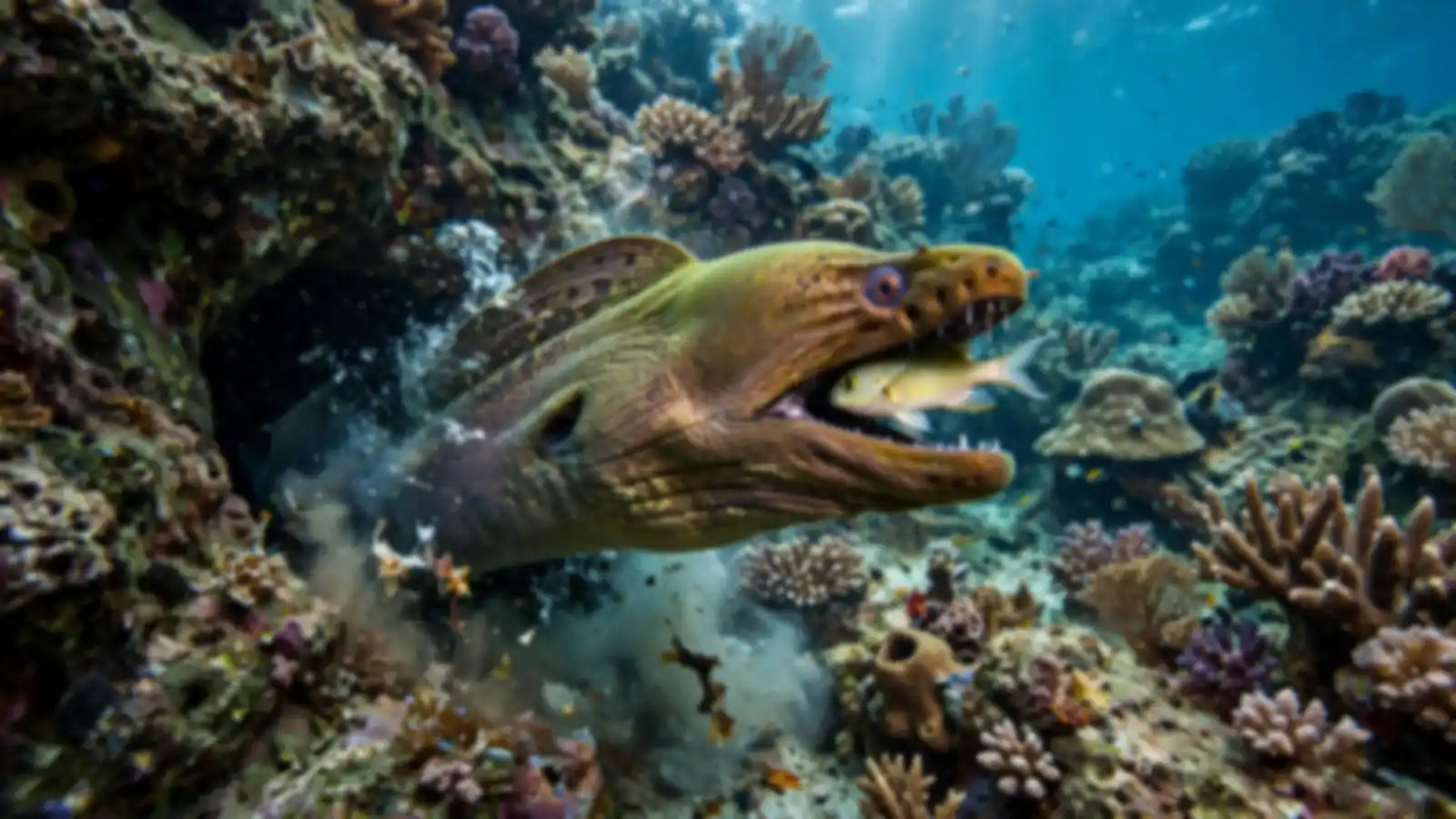
The system was only confirmed in 2007, when high-speed X-ray video caught the throat jaws travelling forward — the first feeding mechanism of its kind known in any vertebrate. It solves a precise problem. A moray hunts in crevices too tight to expand its throat for suction feeding, the method most fish use to inhale prey. So instead of sucking food in, the moray sends a hand down its own throat to fetch it.
Other tricks support the same crevice life. Prey too big to swallow can be tied in a knot: the eel wraps its body around the victim — or braces its tail in a knot for leverage — and tears off manageable pieces. Octopus, crab and fish all end up processed by a fish whose entire design assumes dinner is caught in a corridor.
Are Moray Eels Dangerous? The Honest Answer
A moray eel is dangerous the way a cornered guard dog is dangerous: the equipment is real, the intent is defensive. The teeth are needles angled backwards to hold struggling prey, and a bite tears as the victim pulls away — which is why moray bites are famous among divers and fishers. Almost every recorded bite follows the same story: a hand in a crevice, or food offered by fingers, teaching the eel to associate hands with meals.
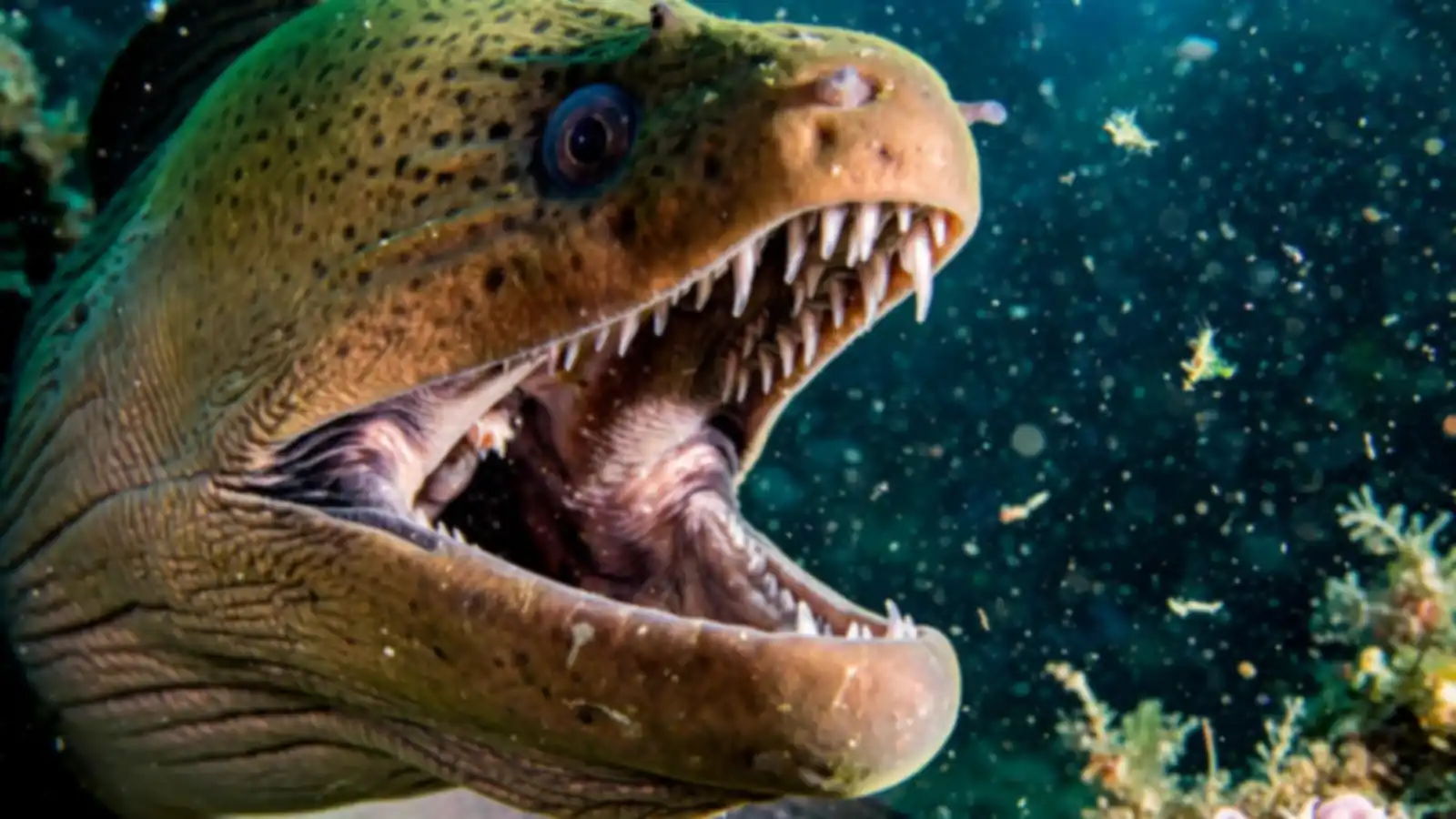
Venom is the durable myth, so let it die here: morays have no venom glands and no way to inject anything. Some species carry mildly toxic compounds in their skin mucus, and bite wounds carry a genuine infection risk from bacteria — clean them thoroughly and seek care. The separate food risk is ciguatera: large morays at the top of reef food webs can accumulate this toxin, a solid reason to admire big morays rather than eat them.
In the water, the etiquette is simple and works everywhere: look into crevices, never reach into them, and never hand-feed. A moray watched at arm’s length is one of the reef’s great characters — curious, long-lived and far more interested in its hole than in you.
Why Do Moray Eels Open Their Mouths?
The gaping moray, jaws wide and teeth bared, is the reef’s most misread photograph. The eel is breathing. Sitting still in a crevice, it cannot rely on swimming to push water over its gills, so it pumps: mouth opening and closing in a slow rhythm, drawing oxygenated water across the gill surfaces. The round gill opening on its side — a neat hole rather than a slit — pulses with the same work.
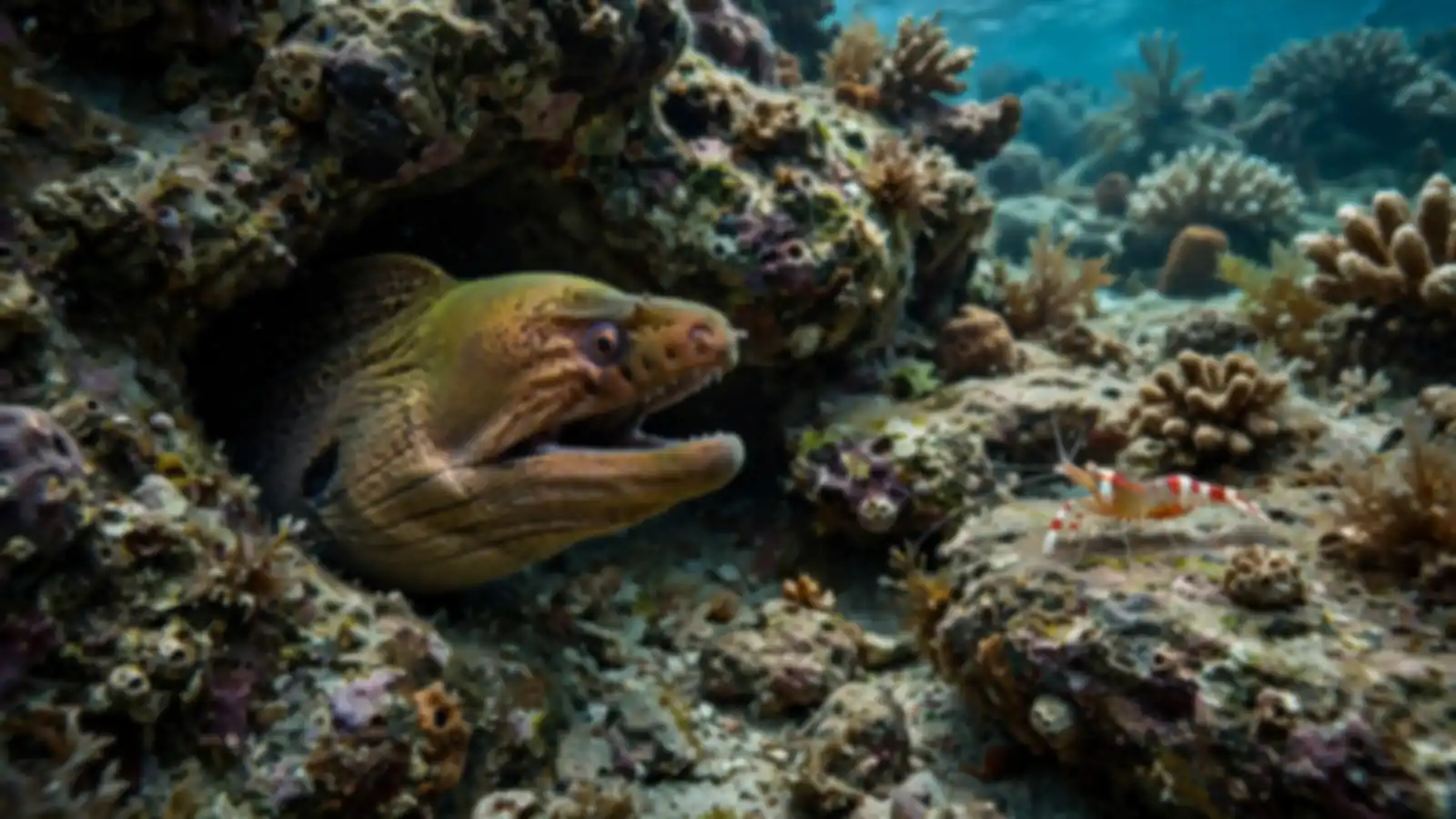
Read correctly, the body language separates cleanly. A resting moray gapes steadily and watches the world go by, often with cleaner shrimp walking unharmed around its teeth. A defensive moray does more: it withdraws deeper, sways its head, and gapes wider and faster — a genuine warning, delivered before any bite. Divers learn to tell the two apart in a single dive.
Poor eyesight completes the picture. Morays see badly and hunt overwhelmingly by smell, which is why a feeding eel may investigate a diver’s glove: it is following scent, not malice. The fearsome face, in short, belongs to a nearly blind animal breathing through the only pump it has — and the teeth are for fish, not for you.
Habitat and Hunting: Night on the Reef
By day, a moray is an address: a head in a hole, territory held for months or years. By night the address empties. Morays leave their dens after dark and hunt across the reef by scent, weaving their full length through the coral, checking every crevice for sleeping fish, octopus and crabs — prey that daytime hunters cannot reach.
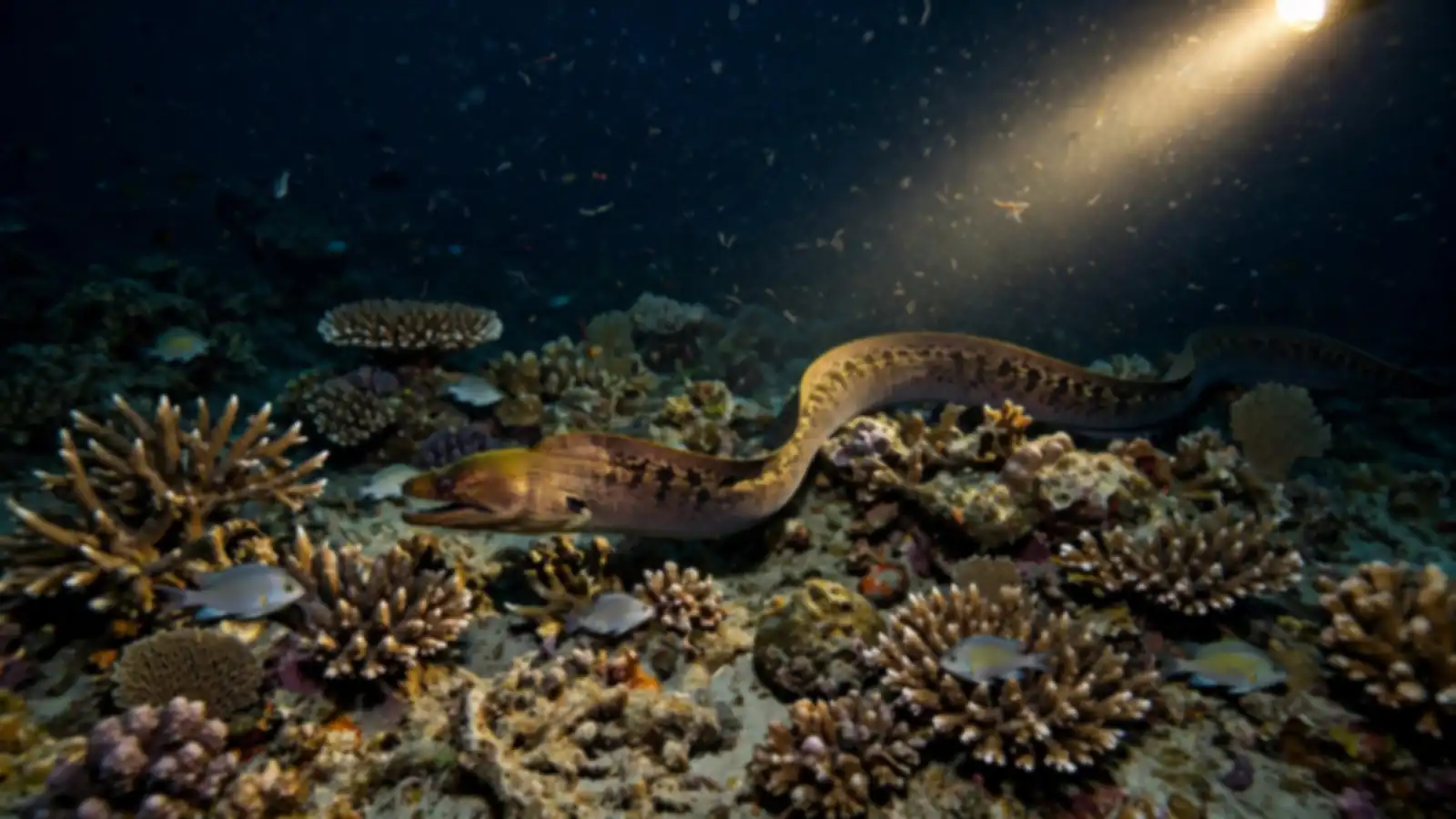
The night shift is a deliberate partition. Day-active predators own the open water; morays own the reef’s interior. A sleeping parrotfish in its mucus cocoon, an octopus in its den — these are moray prey, found by smell in total darkness. The eel’s body is built for the interior too: scaleless, mucus-slick, able to reverse into holes and to squeeze through gaps narrower than itself.
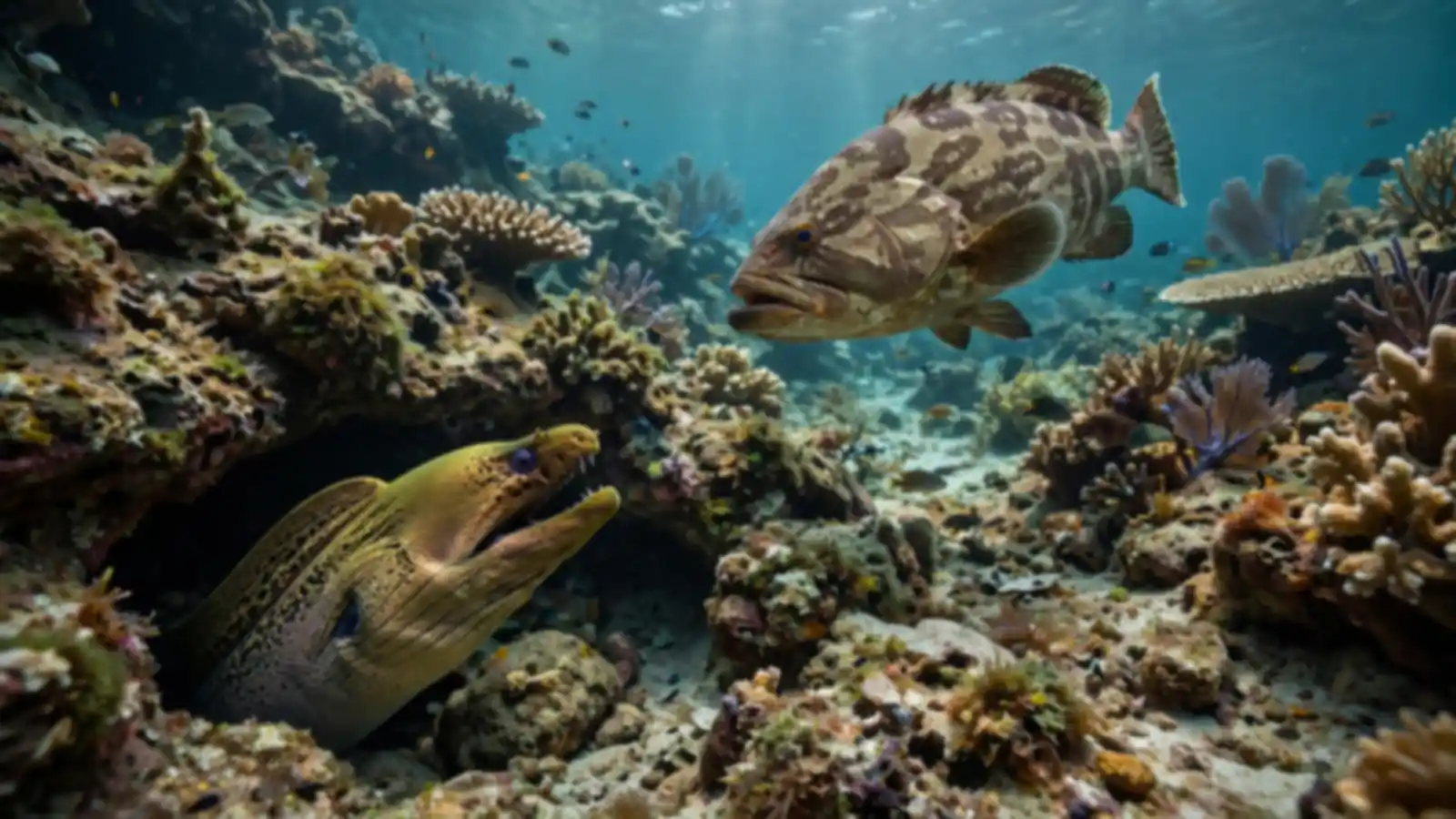
Then there is the partnership. On Red Sea and Indo-Pacific reefs, groupers recruit morays to hunt: a grouper that has cornered prey in the coral shakes its head at a moray’s den, the eel comes out and flushes the prey — which flees either into the grouper’s mouth or the moray’s. It is one of the only known cases of two species hunting cooperatively with signals between them, and each hunter eats better for it.
Moray Eel vs Electric Eel — and the Reef’s Verdict
Clear up the name collision once: the moray eel and the electric eel share a silhouette and nothing else. The electric eel is a freshwater fish of muddy South American rivers, related to catfish and knifefish, and it can genuinely discharge hundreds of volts. A moray is a true eel of the sea — saltwater, reef-bound, and electrically inert. Ask whether a moray can shock you and the answer is a flat no.
The truer comparisons live on the reef. Against its neighbour the wolf eel — which is not an eel at all but a wolffish — the moray is the genuine article: a true eel of the order Anguilliformes, with the family’s ribbon-like larval stage drifting in the plankton before settling to a crevice. Two long fish, two reefs, two entirely separate inventions of the same shape. Its closest true-eel rival is the conger eel, the heaviest true eel in the sea, which hunts the same reefs by night from wrecks and harbour walls.
The reef’s verdict on the moray is respect without fear. It is a mid-level governor of the night reef, keeping fish and octopus populations honest, sheltering in the architecture everyone else builds, and asking only to be left in its hole. Give it that, and the scariest face on the reef belongs to one of its most peaceable citizens — the moray eel.
Fun Facts
- The moray’s second set of jaws sits in its throat and lunges forward into the mouth to drag prey down — confirmed by X-ray video only in 2007.
- The green moray is not green: its skin is dark brown, and the colour comes from yellow-tinted mucus layered over it.
- Groupers invite morays to hunt with a head-shaking signal, and both species catch more together than either does alone.
- Morays can tie their own bodies in a knot to gain leverage for tearing prey too large to swallow whole.
- A moray’s famous open-mouth gape is breathing — it pumps water over its gills while resting in its crevice.
- The giant moray can exceed 3 metres, making it one of the longest bony fish on tropical reefs.
Frequently Asked Questions
Are Moray Eels Dangerous?
Only if you corner one. Moray eels are shy, den-dwelling fish that bite in self-defence — usually when a hand reaches into their crevice or offers food. Bites are painful, ragged and prone to infection, so they need proper cleaning and medical care. Left alone and given room, a moray eel is a watchful neighbour, not a threat: most divers swim past them for years without incident.
Are Moray Eels Venomous?
No. Moray eels have no venom glands and no fangs to inject venom — their teeth are solid needles for gripping prey. Some species have mildly toxic mucus on the skin, and the real medical risk from a bite is bacterial infection from the wound and the eel’s mouth. Separately, the flesh of large morays can carry ciguatera toxins picked up from reef food webs, which is why big morays should not be eaten.
Why Do Moray Eels Open Their Mouths?
To breathe. A moray eel at rest pumps water over its gills by rhythmically opening and closing its mouth — the famous gape is ventilation, not aggression. The posture just looks like a threat display, especially paired with sharp teeth. A moray that is actually defensive gives clearer signals: it pulls back, sways, and only snaps if the intrusion continues.
Do Moray Eels Really Have Two Sets of Jaws?
Yes — the moray eel is famous for it. The oral jaws seize the prey; then a second set, the pharyngeal jaws in the throat, lunges forward into the mouth, grips the prey and drags it down into the gullet. It is the only known vertebrate feeding system of its kind, an adaptation for swallowing large prey in tight crevices where the eel cannot manoeuvre or use suction effectively.
How Many Species of Moray Eel Are There?
Around 200 recognised species in roughly 16 genera, in the family Muraenidae — and new ones are still being described. They range from the giant moray at over 3 metres to species that mature at under 20 centimetres. The green, snowflake, zebra, honeycomb and ribbon eels of aquariums and reefs are all members of this one varied family.
Can a Moray Eel Shock You Like an Electric Eel?
No. A moray eel cannot produce electricity at all. The electric eel is a completely unrelated freshwater fish of South American rivers — not a true eel either — while the moray is a marine, saltwater fish of reefs and rocky shores. They share a long body shape and nothing else: no shocking organs, no close relationship.
Similar Species Worth Exploring
Keep Exploring
Meet the impostor in our guide to the wolf eel, or browse every hunter of the reef in our guide to the types of fish. Night falls, the dens empty, and the reef’s quiet governor slides out to hunt — the moray eel.