Dumbo Octopus
Dumbo Octopus: the cutest animal in the deep sea
The dumbo octopus is the deepest-living octopus on Earth, found nearly seven kilometres down in the Java Trench. It is also, by wide agreement, the cutest octopus in the world — a small pink animal with fins like an elephant’s ears, big dark eyes and arms that curl into a neat spiral. It lives where no sunlight reaches, eats worms whole and flaps its “ears” to swim. Here is everything science knows about the deep sea’s most charming resident.
By Emily Carter · Reviewed by our vet team · Updated 10 November 2026 · 9 min read
Deepest octopus on EarthFound at 6,957 mNamed after Dumbo the elephant
At a Glance
The dumbo octopus looks like a cartoon character that escaped into the deep sea. It is a small, soft, pink octopus with two fins on top of its head that flap like the ears of Dumbo, the flying elephant from the 1941 Disney film — and the resemblance is exactly how it got its name. Beneath the charm, though, it is a serious deep-sea survivor: the deepest-living of all octopuses, found at depths where the pressure is crushing and the water is barely above freezing. This guide covers its size, its famous ears, its record depth and the simple way it makes a living on the abyssal seafloor.
Dumbo Octopus Size and Weight
Most dumbo octopuses are small animals, about 20 to 30 centimetres long — roughly the length of a school ruler. Their bodies are soft and gelatinous, built for drifting and hovering rather than speed, and they weigh so little that weight is barely recorded in the scientific literature. The largest specimen ever measured, though, was a giant by the group’s standards: 1.8 metres long, six times the usual size, and a reminder that the deep sea still holds surprises.
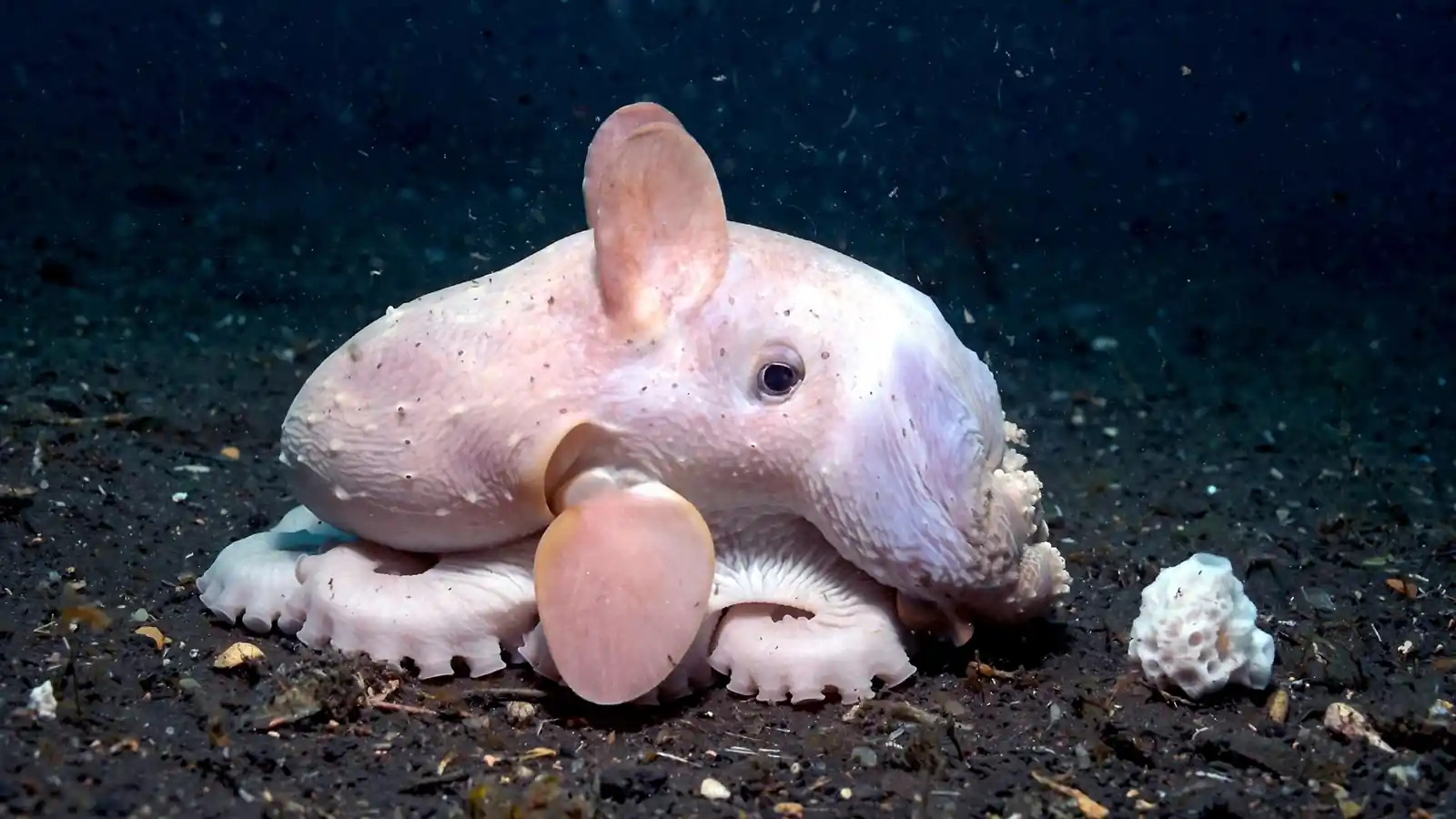
The animal’s shape is what makes it unmistakable. The mantle — the rounded body behind the head — is short and plump, the eight arms are joined by a web of skin that makes them look like an umbrella, and the two fins on top of the head flap gently as the animal swims. You can read the Animal Diversity Web’s Grimpoteuthis account, with the genus’s natural history for the formal description of the group’s anatomy.
Size varies between the 17 recognised species, and the count itself is debated: some lists give 13, others 18, and new deep-sea surveys keep adding to the picture. What does not vary is the animal’s basic design — small, soft, slow and pink, with ears that make it the most recognisable octopus in the ocean.
Those Famous Ears: What the Fins Are For
Its ears are not ears at all. They are fins — two large, flattened paddles on top of the mantle that flap up and down in a slow, gentle rhythm, exactly like the ears of Dumbo the elephant in the 1941 film. The resemblance is so strong that the animal was named for it, and the fins are the first thing anyone notices in footage of the species.

The fins are the animal’s main way of swimming. A dumbo octopus moves by flapping them in a slow wave, steering with its arms and, when it needs a burst of speed, squirting water through its funnel like other octopuses. It is a gentle, unhurried style of swimming that suits a world where there is nowhere to hurry to — and it is part of why the animal looks so calm on camera, drifting above the seafloor like a slow-motion kite.
The fins also help the animal hover. Dumbo octopuses spend much of their time just above the seafloor, holding position with slow fin beats while they scan the sediment for food. Unlike shallow-water octopuses, they have no ink sac — they cannot squirt ink to escape — so the fins, the arms and the animal’s soft, slow drift are its whole defence.
The Deepest Octopus on Earth
The species is the deepest-living octopus known, and the record is a dramatic one. In April 2019, during the Five Deeps Expedition, a camera lander in the Java Trench filmed a one foraging on the seafloor at 6,957 metres — nearly seven kilometres down, in water so deep that the pressure is almost 700 times that at the surface. The sighting was published in May 2020 and remains the deepest octopus ever recorded.

That record is not a fluke of one animal. Dumbo octopuses are routinely found between 3,000 and 7,000 metres deep, on the abyssal plains and in the trenches of every ocean. They are animals of the bottom: they live on or just above the seafloor, where the water is barely above freezing and the only food is what drifts down from the surface or lives in the mud.
The depth record puts the it in rare company. The colossal squid lives at 1,000 to 2,000 metres — deep, but nowhere near the dumbo’s world. Only a handful of animals of any kind live as deep as the it, and it is the only octopus that does.
Swallowed Whole: How It Hunts on the Seafloor
The It eats worms, crustaceans, bivalves and other small animals that live in or on the seafloor sediment. It hunts by hovering just above the bottom, scanning with its large eyes, and then pouncing — wrapping its webbed arms around the prey and swallowing it whole. There is no tearing and no chewing: the animal’s beak is small, and its prey is small enough to go down in one piece.

The hunting style is slow and patient, and it has to be. Food on the abyssal seafloor is scarce, and its metabolism is correspondingly slow. It does not chase prey across the bottom; it drifts, looks, and drops onto whatever it finds. The arms do the work of a net and a mouth at once, and the web of skin between them keeps the catch from escaping.
Because it swallows its prey whole, the animal’s diet can be read from its stomach contents — and the list is a catalogue of deep-sea small life: bristle worms, small crustaceans, the occasional bivalve. It is a humble menu for an animal with a famous name, and it is exactly what the abyss provides.
A Home in Every Deep Ocean
Dumbo octopuses live in the deep oceans of the world — the Atlantic, Pacific and Indian Oceans, and the Southern Ocean around Antarctica. They are found on the abyssal plains and in the trenches, on soft sediment where they can forage, and they occur from the slopes of the continental margins down to the deepest trenches. Different species favour different oceans, but as a group the genus is one of the most widespread of all deep-sea animals.
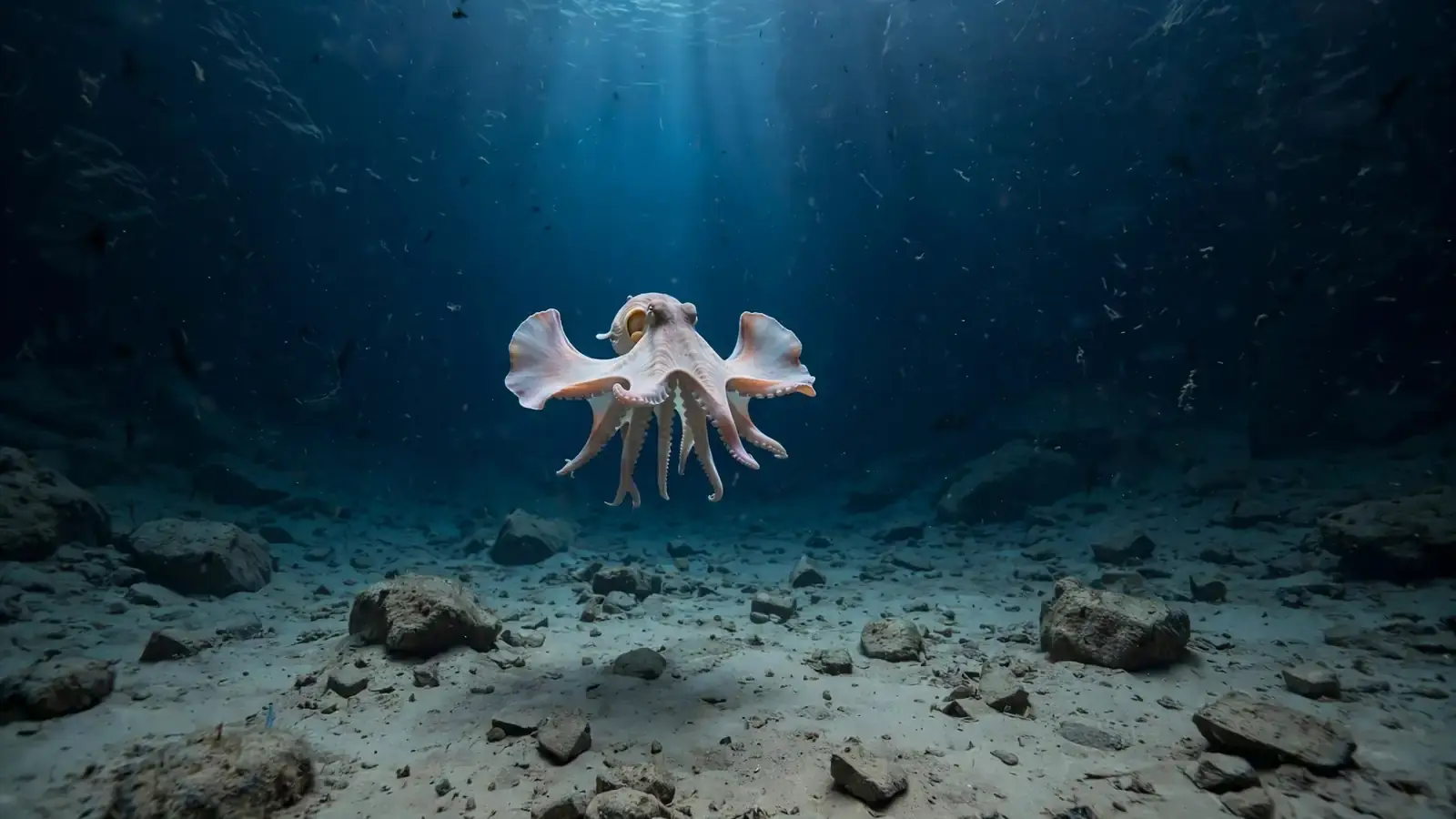
The habitat is the abyss: cold, dark and under enormous pressure. The water at 6,000 metres is about 1 to 2 degrees Celsius, and no sunlight has ever reached it. Its soft, gelatinous body is built for this world — it has no hard shell to crush, and its tissues are mostly water, so the pressure that would destroy a shallow-water animal barely affects it.
That same habitat is now under new pressure from humans. Deep-sea mining, which targets the mineral-rich nodules and crusts of the abyssal seafloor, could damage the soft sediment the it forages on. The animal has not been assessed for the IUCN Red List, so its conservation status is officially unknown — but scientists who study the deep sea are clear that animals this slow-growing and this deep-living recover very slowly from disturbance.
Why Is the Dumbo Octopus Called the Cutest Octopus?
The It is widely called the cutest octopus in the world, and the claim is not really contested. The combination is hard to beat: a small pink body, two big flapping “ears”, large dark eyes and arms that curl into neat spirals. It looks less like a wild animal than like a plush toy, and footage of it drifting above the seafloor has made it one of the most popular deep-sea animals on the internet.

The cuteness is, in a sense, an accident. The fins evolved for swimming, the big eyes for seeing in the dark, and the soft pink colour from the animal’s gelatinous tissue. But the human brain reads big eyes, a small round body and gentle movement as “cute”, and the animal has all three in abundance. The vampire squid is its great rival for the title of the deep sea’s most charming cephalopod — but the vampire squid is dark red and cloak-like, and the it is pink and floppy, and the internet has made its choice.
Behind the charm, though, the animal is a genuine record-holder: the deepest octopus on Earth, a survivor of a world no human could visit without a submersible. The cuteness is what makes people look; the depth is what makes scientists take notice. Both are true, and both are part of why this small pink octopus is one of the best-known animals in the deep sea.
Fun Facts
- It is the deepest-living octopus on Earth, filmed at 6,957 metres in the Java Trench in 2019.
- It was named after Dumbo, the flying elephant from the 1941 Disney film, because of its ear-like fins.
- It has no ink sac, so it cannot squirt ink like shallow-water octopuses.
- It swallows its prey whole — worms, crustaceans and bivalves go down in one piece.
- The largest dumbo octopus ever measured was 1.8 metres long, six times the usual size.
- A female lays her eggs on the seafloor and guards them until they hatch.
Frequently Asked Questions
How Deep Do Dumbo Octopuses Live?
Dumbo octopuses live between about 3,000 and 7,000 metres deep, on the abyssal plains and in the trenches of every ocean. The deepest record is 6,957 metres, filmed in the Java Trench in April 2019 — the deepest octopus ever recorded.
Why Is It Called a Dumbo Octopus?
It is named after Dumbo, the flying elephant from the 1941 Disney film, because the two large fins on top of its head flap like Dumbo’s ears. The fins are its main way of swimming, and the resemblance is the animal’s most famous feature.
How Many Species of Dumbo Octopus Are There?
Seventeen species of dumbo octopus are currently recognised in the genus Grimpoteuthis, though the number is debated: some lists give 13, others 18, and new deep-sea surveys keep adding to the picture. All of them share the same ear-finned design.
How Big Is a Dumbo Octopus?
Most dumbo octopuses are 20 to 30 centimetres long, about the length of a school ruler. The largest ever measured was 1.8 metres long — six times the usual size. The animal’s body is soft and gelatinous, built for drifting and hovering rather than speed.
Are Dumbo Octopuses Endangered?
Dumbo octopuses have not been assessed for the IUCN Red List, so their conservation status is officially unknown. The main concern is deep-sea mining, which could damage the soft abyssal sediment they forage on. Animals this slow-growing and deep-living recover very slowly from disturbance.
What Do Dumbo Octopuses Eat?
Dumbo octopuses eat worms, crustaceans, bivalves and other small animals that live in or on the seafloor sediment. They hover just above the bottom, pounce with their webbed arms and swallow their prey whole — there is no tearing or chewing.
Is the Dumbo Octopus the Cutest Octopus?
It is widely called the cutest octopus in the world, and the claim is not really contested: a small pink body, two big flapping “ears”, large dark eyes and arms that curl into spirals. Behind the charm it is also a record-holder — the deepest-living octopus on Earth.
Do Dumbo Octopuses Have Ink?
No. Unlike shallow-water octopuses, dumbo octopuses have no ink sac, so they cannot squirt ink to escape; their fins, arms and soft, slow drift are their whole defence.
Can You Keep a Dumbo Octopus as a Pet?
No. Dumbo octopuses live in the deep oceans worldwide, 3,000 to 7,000 metres down, in near-freezing darkness under crushing pressure — conditions no home aquarium can recreate — and they are wild deep-sea animals, not pets.
Similar Species Worth Exploring
Keep Exploring
Still charmed by the deep sea’s strangest animals? Meet the vampire squid, the deep sea’s other famous cephalopod, or browse every species in our guide to the types of cephalopods. Few animals in the dark are as delightful as the dumbo octopus.